ASSET IMPAIRMENT
 ANALYSES


Jennifer Goodman, CPA
July 23, 2010
A LITTLE ABOUT ME


               THE
        “TROUBLED COMPANY”
DISCUSSION TOPICS

 Asset impairment analysis: Why, Where, When and How

 Assets held for sale

 Troubled Company example

 US GAAP vs IFRS
WHY: WHY SHOULD YOU TAKE A CLOSER
LOOK AT ASSET IMPAIRMENT ACCOUNTING?
 Economic recession increases potential for impairment
  of assets
 BIG adjustments
 Subjective
 Complex calculations
 Audit committee inquiries
 NOT because of potential tax deductions
GOODWILL IMPAIRMENT TREND
                  300                                                                 18%


                                                                                            Percentage of total population impaired
                                                                                      16%
                  250
                                                                                      14%
Number impaired


                  200                                                                 12%
                                                                                      10%
                  150
                                                                                      8%
                  100                                                                 6%
                                                                                      4%
                   50
                                                                                      2%
                    0                                                                 0%
                        2005         2006         2007       2008        2009
                                                 Years

                               Total Number Impaired     Percentage Impaired    Source : KPMG LLP
                                                                                “Evaluating
                                                                                Impairment Risk”
HOW DO YOU THINK THE ECONOMY WILL
PERFORM OVER THE NEXT 6 MONTHS?
The economy will remain the same – 34%

We’re headed for a double-dip recession – 29%

We’re on our way out of the recession – 19%

Who knows?!? – 16%

We’re headed for a strong recovery next year – 2%

        CPA Letter Daily – July 20, 2010 - AICPA
WHY: WHY SHOULD YOU TAKE A CLOSER
LOOK AT ASSET IMPAIRMENT ACCOUNTING?
 Economic recession increases potential for impairment
  of assets
 BIG adjustments
 Subjective
 Complex calculations
 Audit committee inquiries
 NOT because of potential tax deductions
FAIR VALUE CONSIDERATIONS IN ASSET
IMPAIRMENT
“The price that would be received to sell an asset in an
  orderly transaction between market participants.”
 Level 3 internally developed estimates because markets
  are not observable.
 Need to be based on the assumptions of market
  participants and not the reporting entity.
 Entity-specific intentions should not impact the
  measurement of fair value unless those assumptions are
  consistent with the market.
 Most likely you will have to develop a hypothetical
  market for the asset.
WHY: WHY SHOULD YOU TAKE A CLOSER
LOOK AT ASSET IMPAIRMENT ACCOUNTING?
 Economic recession increases potential for impairment
  of assets
 BIG adjustments
 Subjective
 Complex calculations
 Audit committee inquiries
 NOT because of potential tax deductions
WHERE: WHERE DO WE LOOK FOR ASSET
IMPAIRMENT GUIDANCE?
  Long Lived                          Amortized      Indefinite life
    Assets          Goodwill         Intangibles      Intangibles
ASC Topic 360-10 ASC Topic 350-20 ASC Topic 350-30 ASC Topic 350-30
 SFAS No. 144     SFAS No. 142      SFAS No. 142     SFAS No. 142
WHEN: WHEN TO TEST FOR IMPAIRMENT?

  Long Lived                                 Amortized            Indefinite life
    Assets              Goodwill            Intangibles            Intangibles
ASC Topic 360-10 ASC Topic 350-20 ASC Topic 350-30 ASC Topic 350-30
 SFAS No. 144         SFAS No. 142         SFAS No. 142           SFAS No. 142
 Test if aware of    Test annually for      Amortize over        Test annually for
trigger that could     impairment         useful life; test if     impairment
     impair it                             aware of trigger
                                         that could impair it
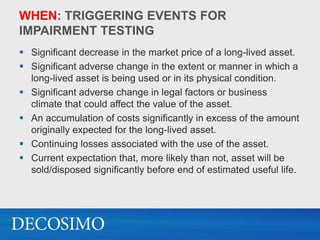
WHEN: TRIGGERING EVENTS FOR
IMPAIRMENT TESTING
 Significant decrease in the market price of a long-lived asset.
 Significant adverse change in the extent or manner in which a
  long-lived asset is being used or in its physical condition.
 Significant adverse change in legal factors or business
  climate that could affect the value of the asset.
 An accumulation of costs significantly in excess of the amount
  originally expected for the long-lived asset.
 Continuing losses associated with the use of the asset.
 Current expectation that, more likely than not, asset will be
  sold/disposed significantly before end of estimated useful life.
TROUBLED COMPANY – SHOULD LONG LIVED
ASSETS BE TESTED FOR IMPAIRMENT?

 Sales $22M 2010             Unsigned Asset Purchase
  Sales $25M 2009              Agreement (APA)
  Sales $32M 2008
 Oper Loss $500k 2010        Signed Loan Modification
  Oper Loss $2M 2009           Agreement conditioned
                               on APA
  Oper Loss $200k 2008
                               Bank accepting $5M in
 Loan covenant violations     PPE for $3M debt
  which haven’t been
  waived. Debt matures w/i
  3 mo. with no current
  financing offers
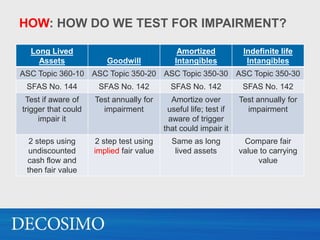
HOW: HOW DO WE TEST FOR IMPAIRMENT?

  Long Lived                                  Amortized            Indefinite life
    Assets              Goodwill             Intangibles            Intangibles
ASC Topic 360-10 ASC Topic 350-20 ASC Topic 350-30 ASC Topic 350-30
 SFAS No. 144         SFAS No. 142          SFAS No. 142           SFAS No. 142
 Test if aware of    Test annually for       Amortize over        Test annually for
trigger that could     impairment          useful life; test if     impairment
     impair it                              aware of trigger
                                          that could impair it
  2 steps using       2 step test using     Same as long           Compare fair
  undiscounted       implied fair value      lived assets         value to carrying
 cash flow and                                                         value
 then fair value
HOW: HOW TO TEST LONG LIVED ASSETS
FOR IMPAIRMENT?
1. Test to determine if there is impairment.
    Measure future undiscounted cash flow including
      disposal cost.
    May have to step up in your grouping of assets to
      identify cash flow.
    If sum of future cash flow LESS than carrying value,
      move on to step 2.
2. Measure impairment.
    Compare fair value to carrying value to measure
      impairment loss i.e. must use fair value guidance
    Can you use discounted cash flows…possibly.
HOW: HOW DO WE TEST GOODWILL FOR
IMPAIRMENT?
1. Allocate goodwill to reporting units.
2. Perform “Step One” of the impairment test by
    comparing the reporting unit’s carrying value to fair
    value.
3. Perform “Step Two” of the impairment test if carrying
    value is greater than fair value.
    i.e. “Rewrite the check that you originally wrote to
       purchase the company.”
HOW: HOW DO WE TEST FINITE LIFE
INTANGIBLES?
Amortization tips:
 Amortize over period asset is expected to contribute to
  cash flows.
 Don’t automatically use straight-line amortization. The
  amortization method should reflect the patter the asset
  economic benefits are consumed.
 Residual value assumed zero unless market for asset.

Evaluate for impairment when events and circumstances
   warrant.

Impairment test – use long lived assets guidance.
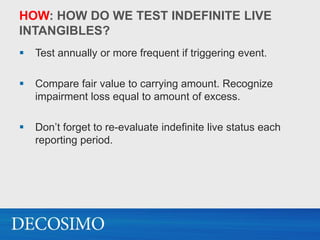
HOW: HOW DO WE TEST INDEFINITE LIVE
INTANGIBLES?
   Test annually or more frequent if triggering event.

   Compare fair value to carrying amount. Recognize
    impairment loss equal to amount of excess.

   Don’t forget to re-evaluate indefinite live status each
    reporting period.
TROUBLED COMPANY – SHOULD AMORTIZED
INTANGIBLE BE TESTED FOR IMPAIRMENT,
AND IF SO, HOW?

 Customer list $750k       Intangible will be sold in
 Sales $100k 2010           the APA
  Sales $3M 2009            Gain expected on the
  Sales $7M 2008             APA sale, however no
                             asset allocation schedule
 Trying to re-establish     exists
  relationship with new
  buyers
ASSETS HELD FOR SALE
 SFAS No. 144

 Do you meet the criteria?

 Stop depreciating or amortizing

 Separately state on your balance sheet

 Report at the lower of carrying amount or fair
  value less cost to sell
ASSETS HELD FOR SALE CRITERIA:

   Management commits to a plan to sell the asset.
   Asset is available for immediate sale in its present
    condition subject only to terms that are usual and customary
    for sales of such assets.
   Active program to locate a buyer and other actions
    required to sell the asset have been initiated.
   The sale of the asset is probable, and transfer of the asset is
    expected to qualify for recognition as a completed sale,
    within one year.
   The asset is being actively marketed for sale at a price that
    is reasonable in relation to its current fair.
   Actions required to complete the plan indicate that it is
    unlikely that significant changes to the plan will be made.
TROUBLED COMPANY – ARE ASSETS HELD
FOR SALE?

 No written plan, in          Unsigned Asset Purchase
  general, to sale assets       Agreement (APA)
 Breakeven on APA and
  Loan Modification            Signed Loan Modification
 Outside looking in = sale     Agreement conditioned
  looks probable                on APA
 Mgmt represents = sale is     Bank accepting $5M in
  uncertain                     PPE for $3M debt
IFRS VS GAAP

 IFRS may lead to need to recognize impairment of long
  lived assets earlier due to differences in testing models.
          GAAP Two Step approach using undiscounted cash flows
          IFRS One Step comparing carrying value to recoverable
           amount

 Reversal of impairments.
          GAAP Reversals are prohibited
          IFRS If certain criteria are met, the reversal of impairments,
           other than goodwill, is permitted
DISCUSSION TOPICS

 Asset impairment analysis: Why, Where, When and How

 Assets held for sale

 Troubled Company example

 US GAAP vs IFRS

Asset Impairment Analyses

  • 1.
    ASSET IMPAIRMENT ANALYSES JenniferGoodman, CPA July 23, 2010
  • 2.
    A LITTLE ABOUTME THE “TROUBLED COMPANY”
  • 3.
    DISCUSSION TOPICS  Assetimpairment analysis: Why, Where, When and How  Assets held for sale  Troubled Company example  US GAAP vs IFRS
  • 4.
    WHY: WHY SHOULDYOU TAKE A CLOSER LOOK AT ASSET IMPAIRMENT ACCOUNTING?  Economic recession increases potential for impairment of assets  BIG adjustments  Subjective  Complex calculations  Audit committee inquiries  NOT because of potential tax deductions
  • 5.
    GOODWILL IMPAIRMENT TREND 300 18% Percentage of total population impaired 16% 250 14% Number impaired 200 12% 10% 150 8% 100 6% 4% 50 2% 0 0% 2005 2006 2007 2008 2009 Years Total Number Impaired Percentage Impaired Source : KPMG LLP “Evaluating Impairment Risk”
  • 6.
    HOW DO YOUTHINK THE ECONOMY WILL PERFORM OVER THE NEXT 6 MONTHS? The economy will remain the same – 34% We’re headed for a double-dip recession – 29% We’re on our way out of the recession – 19% Who knows?!? – 16% We’re headed for a strong recovery next year – 2% CPA Letter Daily – July 20, 2010 - AICPA
  • 7.
    WHY: WHY SHOULDYOU TAKE A CLOSER LOOK AT ASSET IMPAIRMENT ACCOUNTING?  Economic recession increases potential for impairment of assets  BIG adjustments  Subjective  Complex calculations  Audit committee inquiries  NOT because of potential tax deductions
  • 8.
    FAIR VALUE CONSIDERATIONSIN ASSET IMPAIRMENT “The price that would be received to sell an asset in an orderly transaction between market participants.”  Level 3 internally developed estimates because markets are not observable.  Need to be based on the assumptions of market participants and not the reporting entity.  Entity-specific intentions should not impact the measurement of fair value unless those assumptions are consistent with the market.  Most likely you will have to develop a hypothetical market for the asset.
  • 9.
    WHY: WHY SHOULDYOU TAKE A CLOSER LOOK AT ASSET IMPAIRMENT ACCOUNTING?  Economic recession increases potential for impairment of assets  BIG adjustments  Subjective  Complex calculations  Audit committee inquiries  NOT because of potential tax deductions
  • 10.
    WHERE: WHERE DOWE LOOK FOR ASSET IMPAIRMENT GUIDANCE? Long Lived Amortized Indefinite life Assets Goodwill Intangibles Intangibles ASC Topic 360-10 ASC Topic 350-20 ASC Topic 350-30 ASC Topic 350-30 SFAS No. 144 SFAS No. 142 SFAS No. 142 SFAS No. 142
  • 11.
    WHEN: WHEN TOTEST FOR IMPAIRMENT? Long Lived Amortized Indefinite life Assets Goodwill Intangibles Intangibles ASC Topic 360-10 ASC Topic 350-20 ASC Topic 350-30 ASC Topic 350-30 SFAS No. 144 SFAS No. 142 SFAS No. 142 SFAS No. 142 Test if aware of Test annually for Amortize over Test annually for trigger that could impairment useful life; test if impairment impair it aware of trigger that could impair it
  • 12.
    WHEN: TRIGGERING EVENTSFOR IMPAIRMENT TESTING  Significant decrease in the market price of a long-lived asset.  Significant adverse change in the extent or manner in which a long-lived asset is being used or in its physical condition.  Significant adverse change in legal factors or business climate that could affect the value of the asset.  An accumulation of costs significantly in excess of the amount originally expected for the long-lived asset.  Continuing losses associated with the use of the asset.  Current expectation that, more likely than not, asset will be sold/disposed significantly before end of estimated useful life.
  • 13.
    TROUBLED COMPANY –SHOULD LONG LIVED ASSETS BE TESTED FOR IMPAIRMENT?  Sales $22M 2010  Unsigned Asset Purchase Sales $25M 2009 Agreement (APA) Sales $32M 2008  Oper Loss $500k 2010  Signed Loan Modification Oper Loss $2M 2009 Agreement conditioned on APA Oper Loss $200k 2008 Bank accepting $5M in  Loan covenant violations PPE for $3M debt which haven’t been waived. Debt matures w/i 3 mo. with no current financing offers
  • 14.
    HOW: HOW DOWE TEST FOR IMPAIRMENT? Long Lived Amortized Indefinite life Assets Goodwill Intangibles Intangibles ASC Topic 360-10 ASC Topic 350-20 ASC Topic 350-30 ASC Topic 350-30 SFAS No. 144 SFAS No. 142 SFAS No. 142 SFAS No. 142 Test if aware of Test annually for Amortize over Test annually for trigger that could impairment useful life; test if impairment impair it aware of trigger that could impair it 2 steps using 2 step test using Same as long Compare fair undiscounted implied fair value lived assets value to carrying cash flow and value then fair value
  • 15.
    HOW: HOW TOTEST LONG LIVED ASSETS FOR IMPAIRMENT? 1. Test to determine if there is impairment.  Measure future undiscounted cash flow including disposal cost.  May have to step up in your grouping of assets to identify cash flow.  If sum of future cash flow LESS than carrying value, move on to step 2. 2. Measure impairment.  Compare fair value to carrying value to measure impairment loss i.e. must use fair value guidance  Can you use discounted cash flows…possibly.
  • 16.
    HOW: HOW DOWE TEST GOODWILL FOR IMPAIRMENT? 1. Allocate goodwill to reporting units. 2. Perform “Step One” of the impairment test by comparing the reporting unit’s carrying value to fair value. 3. Perform “Step Two” of the impairment test if carrying value is greater than fair value.  i.e. “Rewrite the check that you originally wrote to purchase the company.”
  • 17.
    HOW: HOW DOWE TEST FINITE LIFE INTANGIBLES? Amortization tips:  Amortize over period asset is expected to contribute to cash flows.  Don’t automatically use straight-line amortization. The amortization method should reflect the patter the asset economic benefits are consumed.  Residual value assumed zero unless market for asset. Evaluate for impairment when events and circumstances warrant. Impairment test – use long lived assets guidance.
  • 18.
    HOW: HOW DOWE TEST INDEFINITE LIVE INTANGIBLES?  Test annually or more frequent if triggering event.  Compare fair value to carrying amount. Recognize impairment loss equal to amount of excess.  Don’t forget to re-evaluate indefinite live status each reporting period.
  • 19.
    TROUBLED COMPANY –SHOULD AMORTIZED INTANGIBLE BE TESTED FOR IMPAIRMENT, AND IF SO, HOW?  Customer list $750k  Intangible will be sold in  Sales $100k 2010 the APA Sales $3M 2009  Gain expected on the Sales $7M 2008 APA sale, however no asset allocation schedule  Trying to re-establish exists relationship with new buyers
  • 20.
    ASSETS HELD FORSALE  SFAS No. 144  Do you meet the criteria?  Stop depreciating or amortizing  Separately state on your balance sheet  Report at the lower of carrying amount or fair value less cost to sell
  • 21.
    ASSETS HELD FORSALE CRITERIA:  Management commits to a plan to sell the asset.  Asset is available for immediate sale in its present condition subject only to terms that are usual and customary for sales of such assets.  Active program to locate a buyer and other actions required to sell the asset have been initiated.  The sale of the asset is probable, and transfer of the asset is expected to qualify for recognition as a completed sale, within one year.  The asset is being actively marketed for sale at a price that is reasonable in relation to its current fair.  Actions required to complete the plan indicate that it is unlikely that significant changes to the plan will be made.
  • 22.
    TROUBLED COMPANY –ARE ASSETS HELD FOR SALE?  No written plan, in  Unsigned Asset Purchase general, to sale assets Agreement (APA)  Breakeven on APA and Loan Modification  Signed Loan Modification  Outside looking in = sale Agreement conditioned looks probable on APA  Mgmt represents = sale is Bank accepting $5M in uncertain PPE for $3M debt
  • 23.
    IFRS VS GAAP IFRS may lead to need to recognize impairment of long lived assets earlier due to differences in testing models.  GAAP Two Step approach using undiscounted cash flows  IFRS One Step comparing carrying value to recoverable amount  Reversal of impairments.  GAAP Reversals are prohibited  IFRS If certain criteria are met, the reversal of impairments, other than goodwill, is permitted
  • 24.
    DISCUSSION TOPICS  Assetimpairment analysis: Why, Where, When and How  Assets held for sale  Troubled Company example  US GAAP vs IFRS