Affordable Active Alpha | Built to Beat Behavioral Bias | We Empower Investors Through Education 
As Of Date: 
9/20/2014 
BEWARE OF GEEKS BEARING FORMULAS 
Wesley R. Gray, PhD 
T: +1.215.882.9983 
F: +1.216.245.3686 
ir@alphaarchitect.com 
213 Foxcroft Road 
Broomall, PA 19008
2014 © Alpha Architect. Back to Outline All Rights Reserved. 
2 
Who Can Predict Market Trends?
2014 © Alpha Architect. Back to Outline All Rights Reserved. 
3 
Presentation Outline 
 
Tactical Asset Allocation 
 
Definition 
 
Basic Asset Classes 
 
Common Concepts 
 
Academic Evidence 
 
Out of Sample Performance 
 
Why Complexity Doesn’t Add Value 
 
Performance of Common Concepts 
 
Background 
 
Historical Performance 
 
Appendix 
 
Statistics Descriptions 
 
Disclosures
TACTICAL ASSET ALLOCATION
DEFINITIONS
2014 © Alpha Architect. Back to Outline All Rights Reserved. 
6 
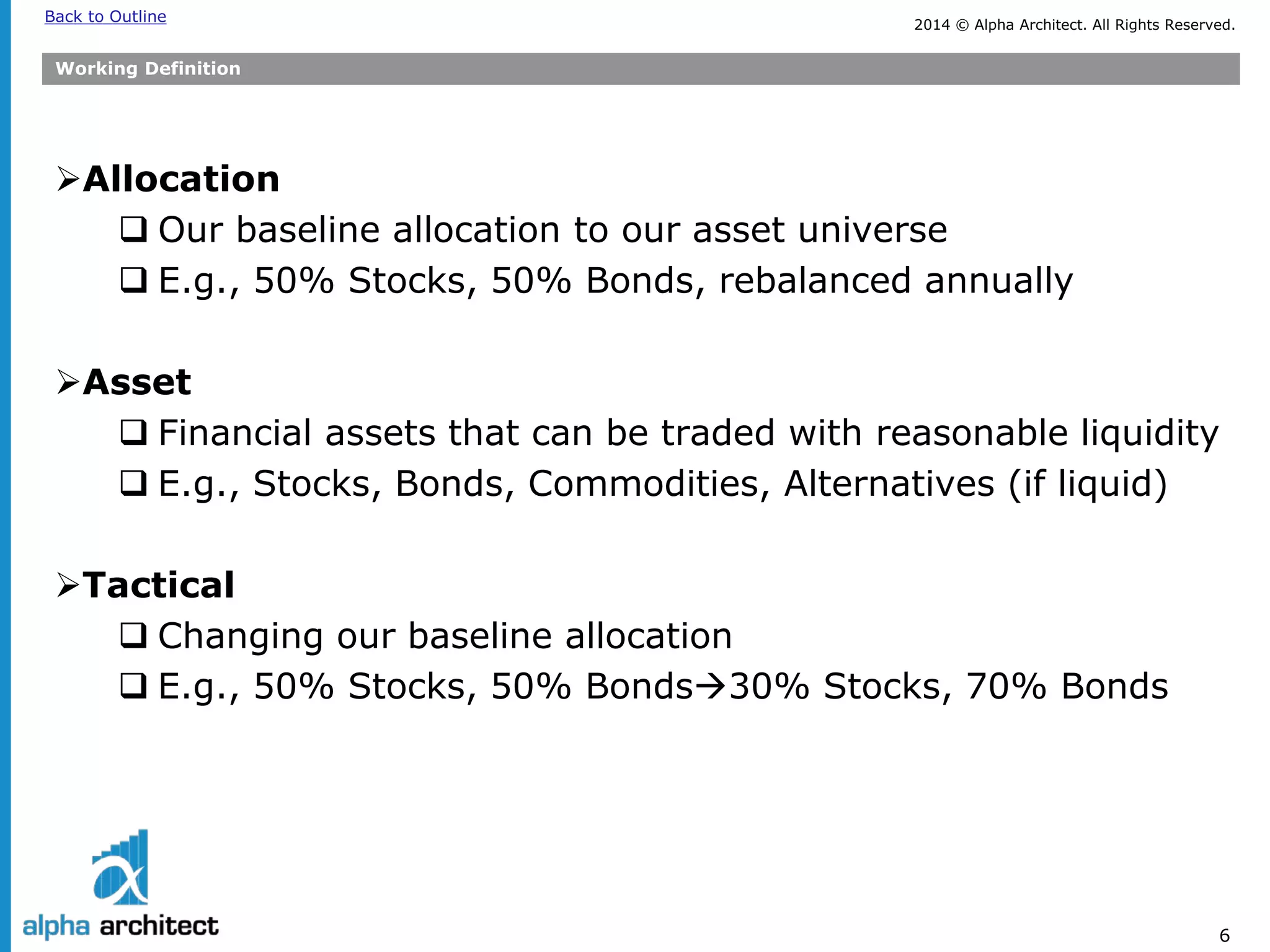
Working Definition 
 
Allocation 
 
Our baseline allocation to our asset universe 
 
E.g., 50% Stocks, 50% Bonds, rebalanced annually 
Asset 
Financial assets that can be traded with reasonable liquidity 
E.g., Stocks, Bonds, Commodities, Alternatives (if liquid) 
Tactical 
Changing our baseline allocation 
E.g., 50% Stocks, 50% Bonds30% Stocks, 70% Bonds
BASIC ASSET CLASSES
2014 © Alpha Architect. Back to Outline All Rights Reserved. 
8 
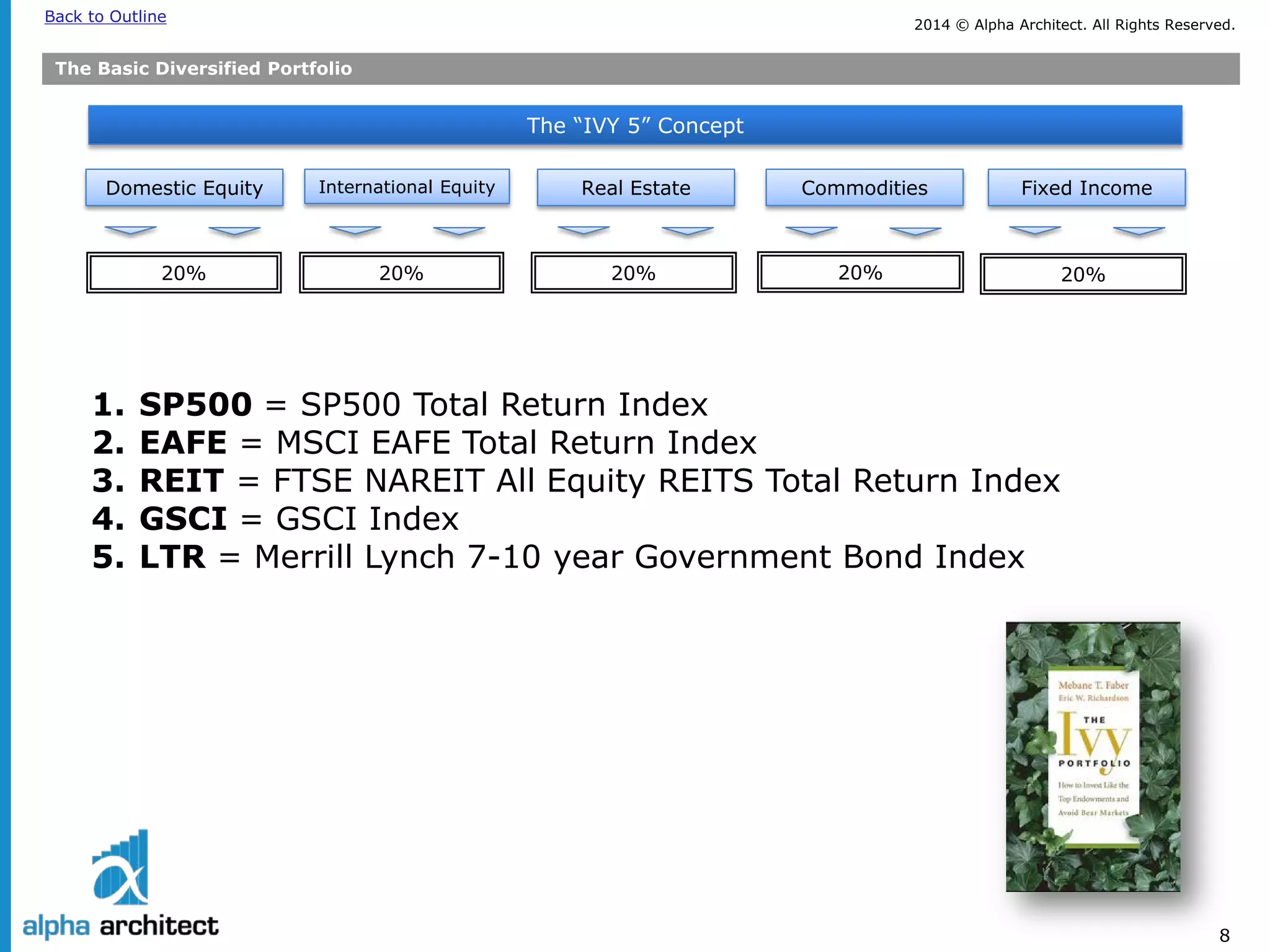
The Basic Diversified Portfolio 
Domestic Equity 
20% 
The “IVY 5” Concept 
20% 
20% 
20% 
International Equity 
Real Estate 
Fixed Income 
Commodities 
20% 
1. 
SP500 = SP500 Total Return Index 
2. 
EAFE = MSCI EAFE Total Return Index 
3. 
REIT = FTSE NAREIT All Equity REITS Total Return Index 
4. 
GSCI = GSCI Index 
5. 
LTR = Merrill Lynch 7-10 year Government Bond Index
COMMON ASSET ALLOCATION TECHNIQUES
2014 © Alpha Architect. Back to Outline All Rights Reserved. 
10 
0 
0.02 
0.04 
0.06 
0.08 
0.1 
0.12 
0.14 
0% 
1% 
2% 
3% 
4% 
5% 
Expected Portfolio Return 
Standard Deviation of the Portfolio 
CAL 
SP500 
LTR 
EAFE 
GSCI 
REIT 
Tangency Portfolio Weights 
MV Frontier 
Minimum Variance 
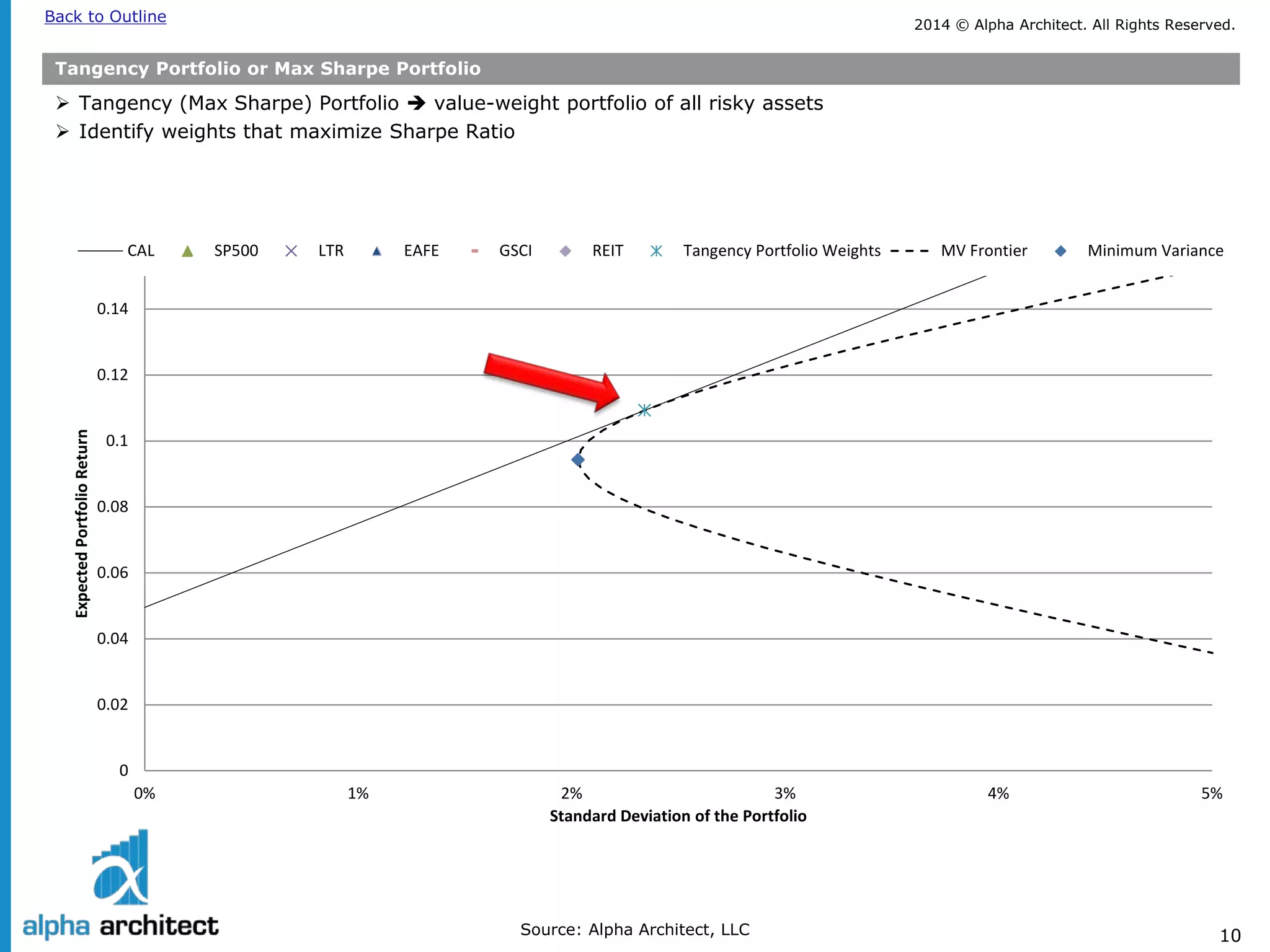
Tangency Portfolio or Max Sharpe Portfolio 
 
Tangency (Max Sharpe) Portfolio  value-weight portfolio of all risky assets 
 
Identify weights that maximize Sharpe Ratio 
Source: Alpha Architect, LLC
2014 © Alpha Architect. Back to Outline All Rights Reserved. 
11 
0 
0.02 
0.04 
0.06 
0.08 
0.1 
0.12 
0.14 
0% 
1% 
2% 
3% 
4% 
5% 
Expected Portfolio Return 
Standard Deviation of the Portfolio 
CAL 
SP500 
LTR 
EAFE 
GSCI 
REIT 
Tangency Portfolio Weights 
MV Frontier 
Minimum Variance 
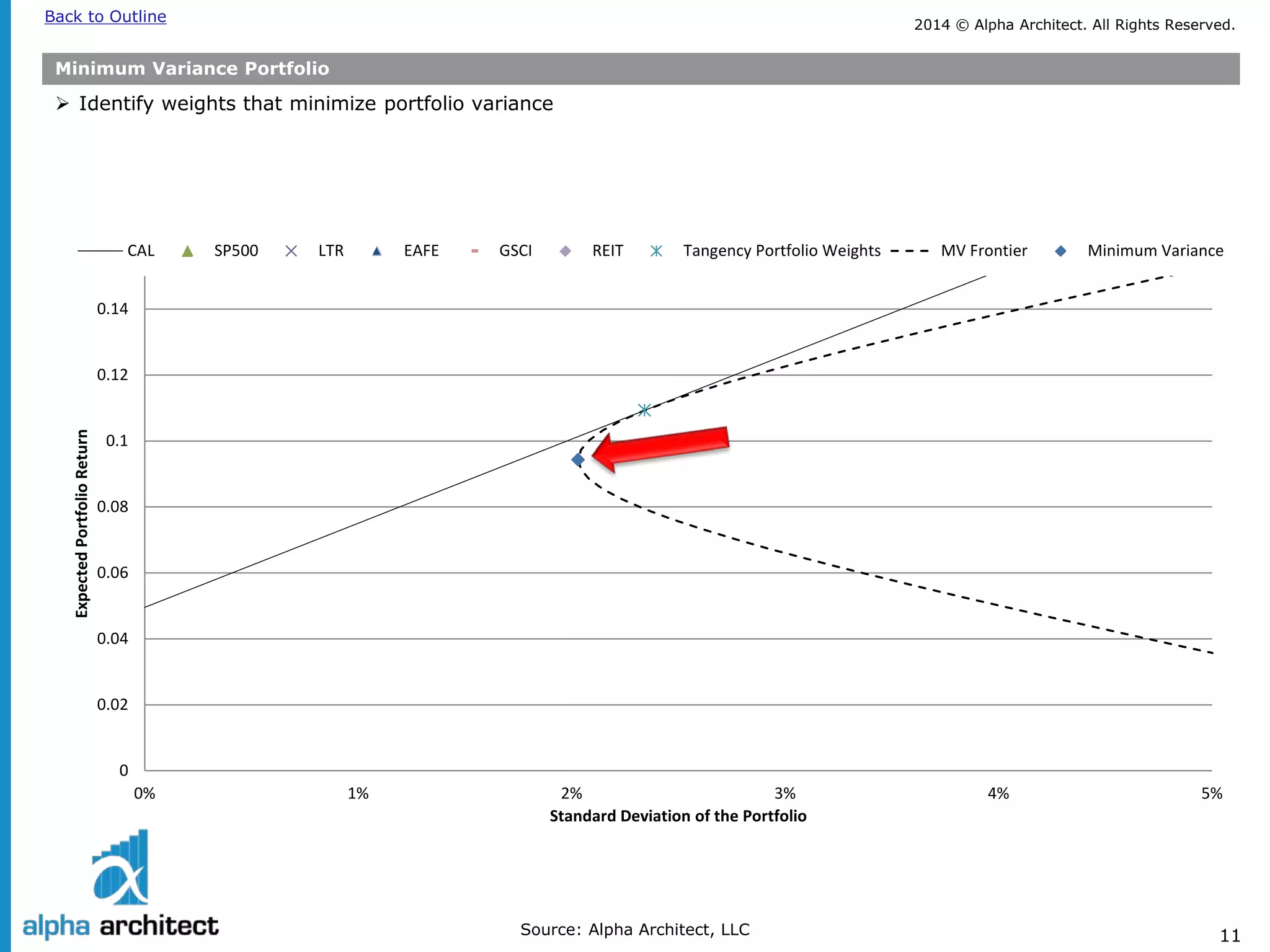
Minimum Variance Portfolio 
 
Identify weights that minimize portfolio variance 
Source: Alpha Architect, LLC
2014 © Alpha Architect. Back to Outline All Rights Reserved. 
12 
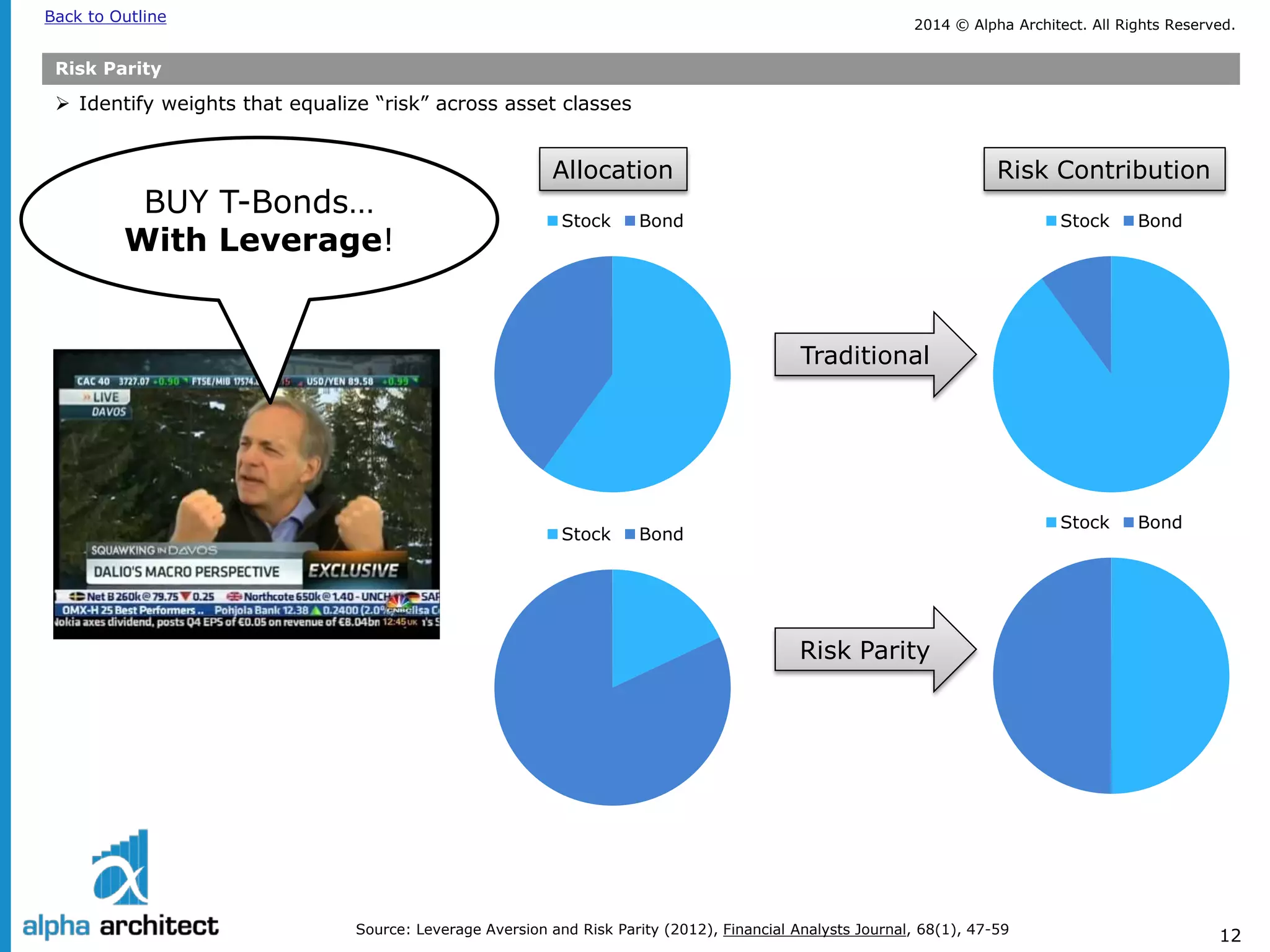
Risk Parity 
 
Identify weights that equalize “risk” across asset classes 
Source: Leverage Aversion and Risk Parity (2012), Financial Analysts Journal, 68(1), 47-59 
BUY T-Bonds… With Leverage! 
Stock 
Bond 
Stock 
Bond 
Traditional 
Stock 
Bond 
Stock 
Bond 
Risk Parity 
Allocation 
Risk Contribution
2014 © Alpha Architect. Back to Outline All Rights Reserved. 
13 
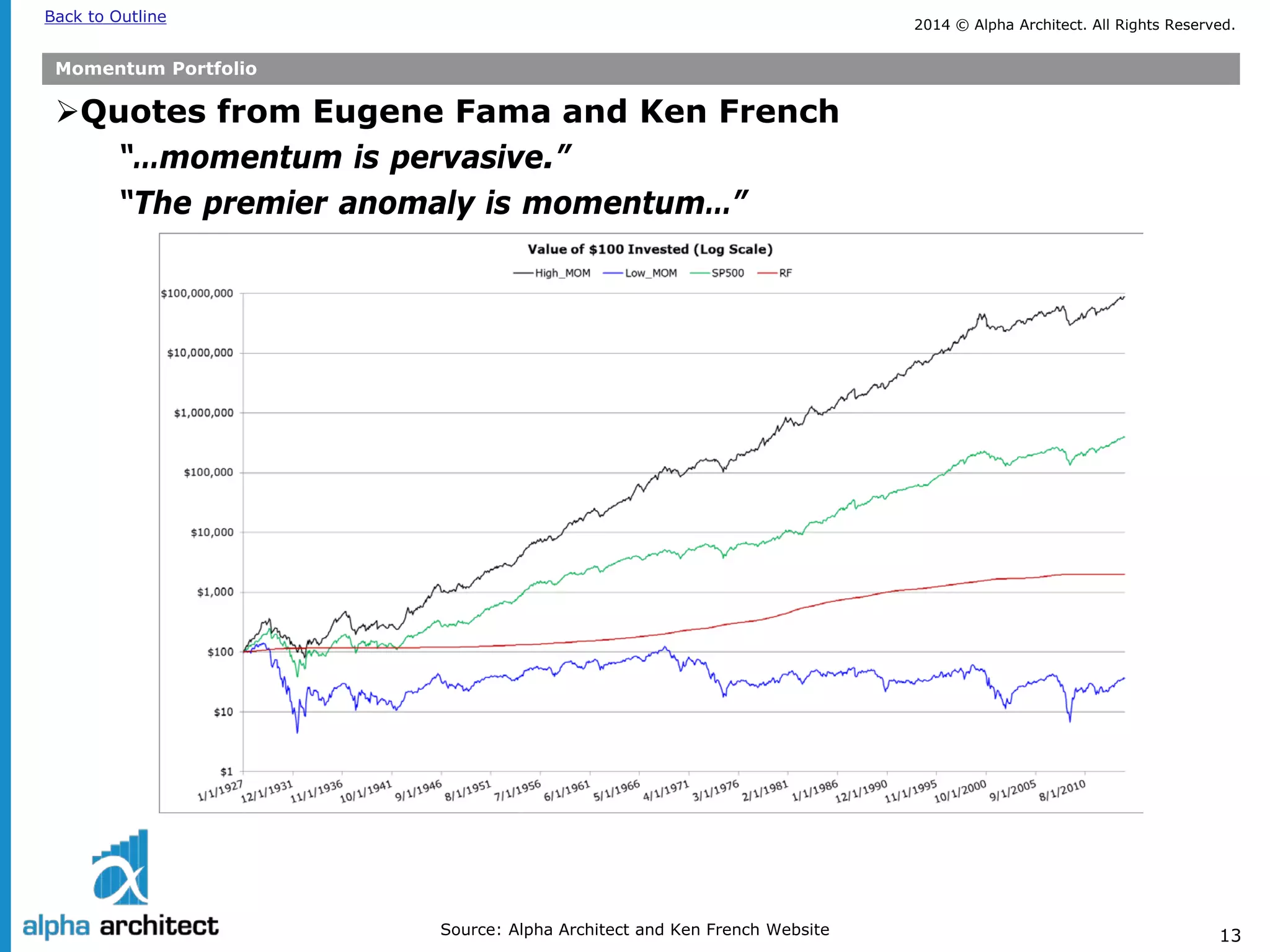
Momentum Portfolio 
 
Quotes from Eugene Fama and Ken French 
“…momentum is pervasive.” 
“The premier anomaly is momentum…” 
Source: Alpha Architect and Ken French Website
2014 © Alpha Architect. Back to Outline All Rights Reserved. 
14 
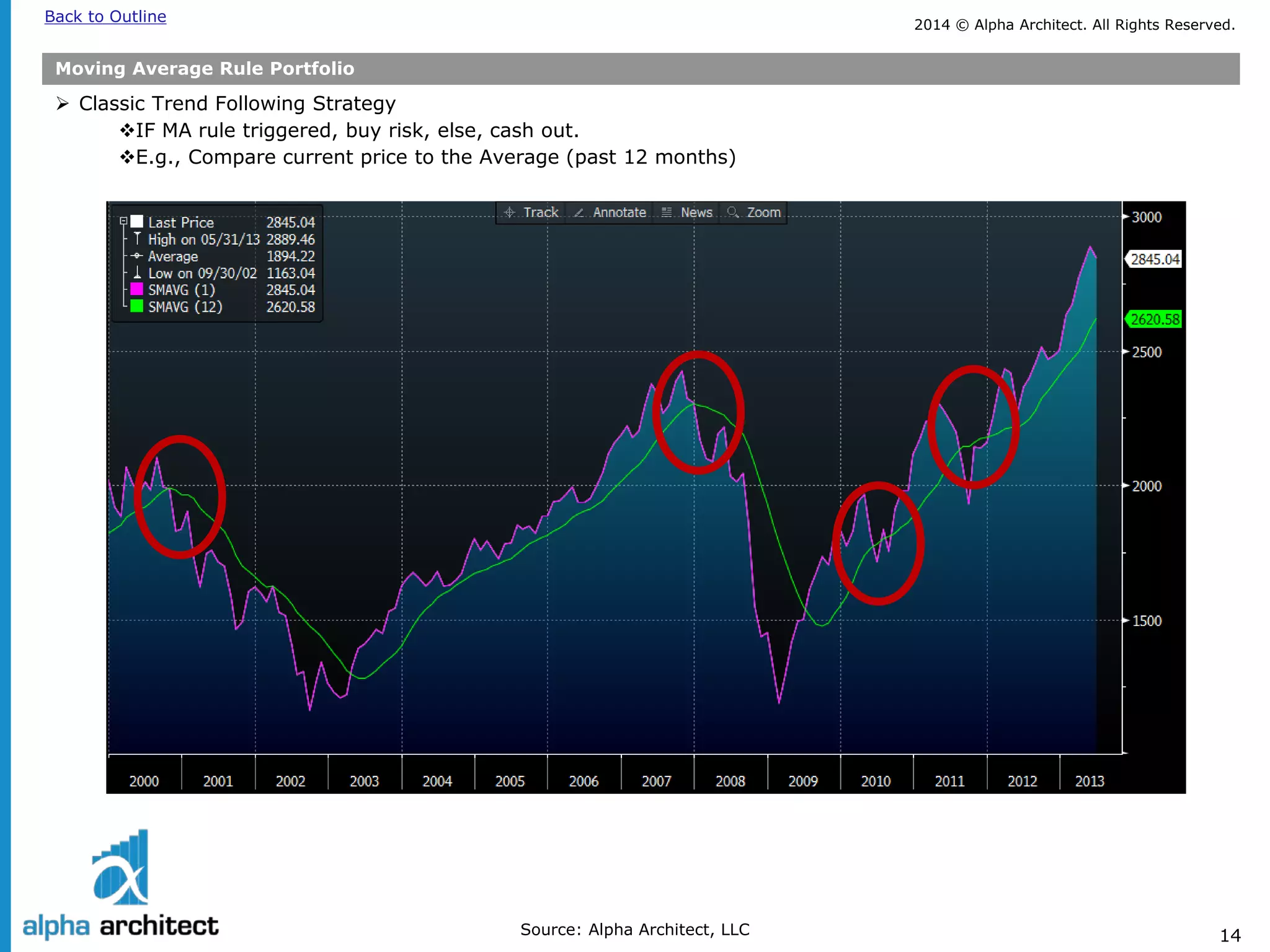
Moving Average Rule Portfolio 
 
Classic Trend Following Strategy 
 
IF MA rule triggered, buy risk, else, cash out. 
 
E.g., Compare current price to the Average (past 12 months) 
Source: Alpha Architect, LLC
ACADEMIC EVIDENCE
2014 © Alpha Architect. Back to Outline All Rights Reserved. 
16 
Source: Data-Driven Investment Management Presentation at the International Conference on Computational Management Science, May 2014, Victor DeMiguel 
Is Mean Variance… 
For Practitioner Use? 
or… 
For Academic Journals? 
“The Motivation behind my dissertation was to apply mathematics to the stock market.” Harry Markowitz, intellectual founder of Mean Variance Analysis “This is not a dissertation in economics, and we cannot give you a PhD in economics for this.” Milton Friedman, Markowitz dissertation advisor
OUT-OF-SAMPLE PERFORMANCE
2014 © Alpha Architect. Back to Outline All Rights Reserved. 
18 
*The results are hypothetical results and are NOT an indicator of future results and do NOT represent returns that any 
investor actually attained. Please see disclosures for additional information. Additional information regarding the 
construction of these results is available upon request. Indexes are unmanaged, do not reflect management or trading 
fees, and one cannot invest directly in an index. 
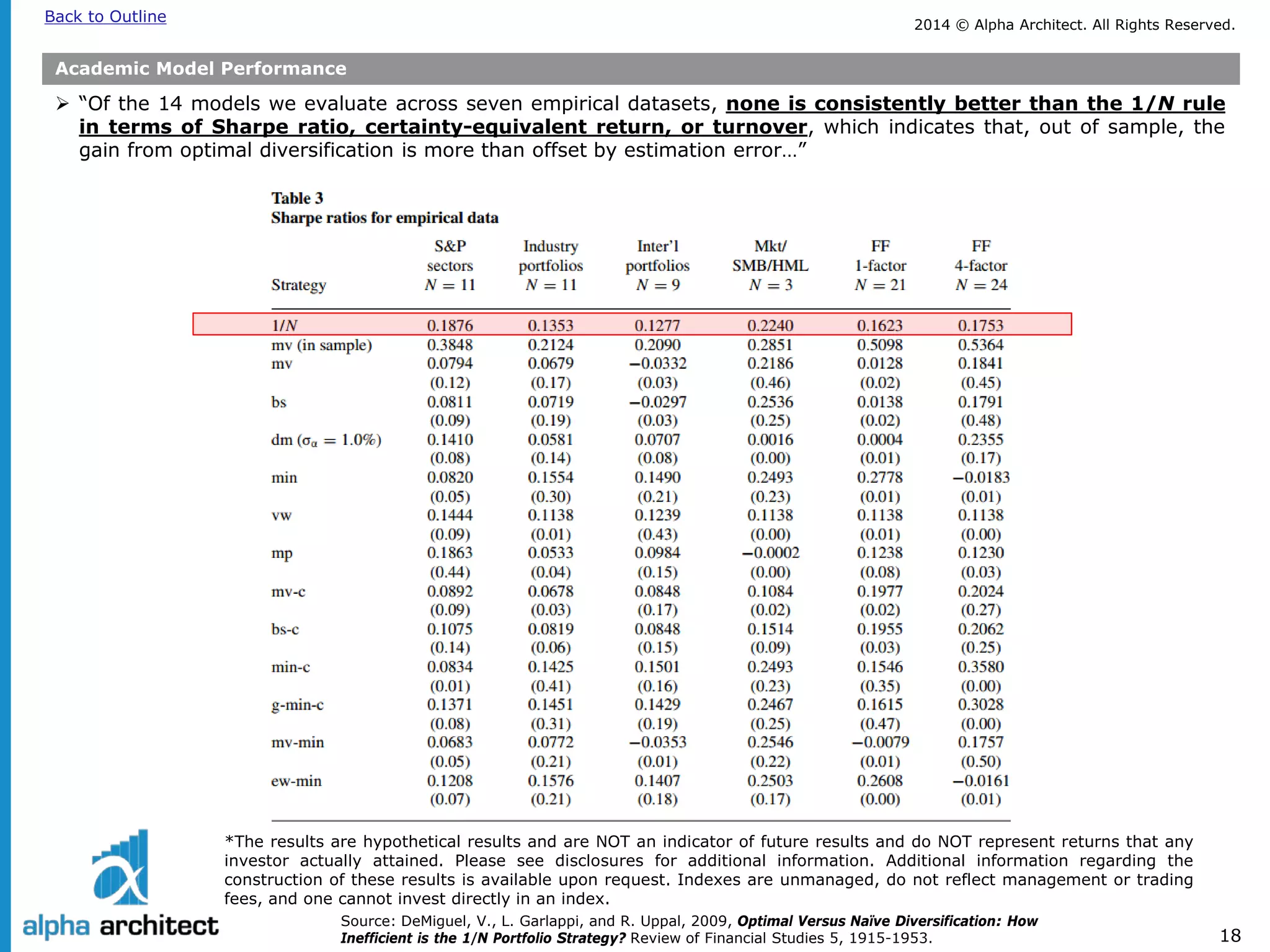
Academic Model Performance 
 
“Of the 14 models we evaluate across seven empirical datasets, none is consistently better than the 1/N rule in terms of Sharpe ratio, certainty-equivalent return, or turnover, which indicates that, out of sample, the gain from optimal diversification is more than offset by estimation error…” 
Source: DeMiguel, V., L. Garlappi, and R. Uppal, 2009, Optimal Versus Naïve Diversification: How Inefficient is the 1/N Portfolio Strategy? Review of Financial Studies 5, 1915-1953.
WHY COMPLEXITY DOESN’T ADD VALUE
2014 © Alpha Architect. Back to Outline All Rights Reserved. 
20
2014 © Alpha Architect. Back to Outline All Rights Reserved. 
21 
*The results are hypothetical results and are NOT an indicator of future results and do NOT represent returns that any 
investor actually attained. Please see disclosures for additional information. Additional information regarding the 
construction of these results is available upon request. Indexes are unmanaged, do not reflect management or trading 
fees, and one cannot invest directly in an index. 
 
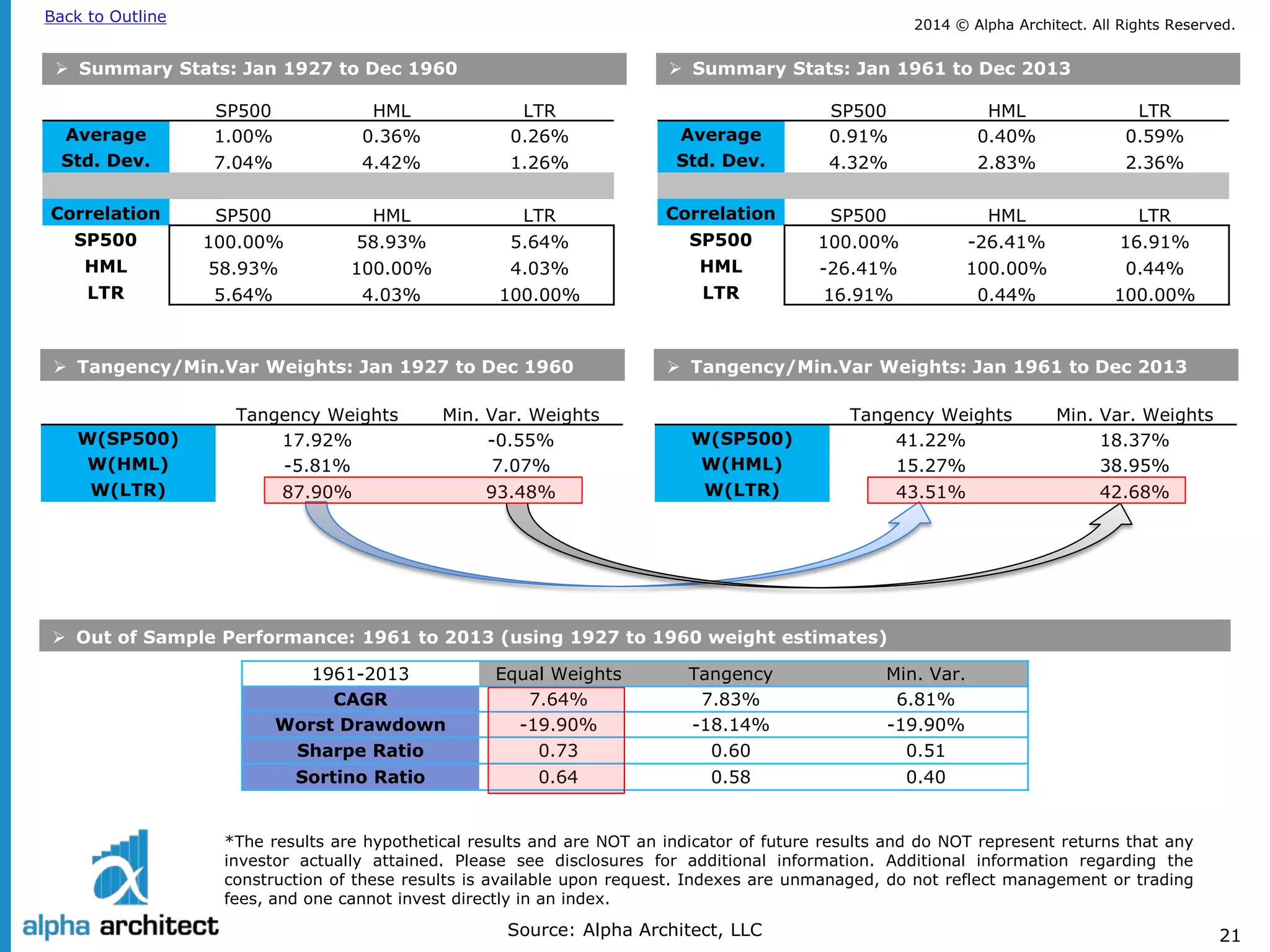
Summary Stats: Jan 1927 to Dec 1960 
 
Tangency/Min.Var Weights: Jan 1927 to Dec 1960 
 
Summary Stats: Jan 1961 to Dec 2013 
 
Tangency/Min.Var Weights: Jan 1961 to Dec 2013 
Source: Alpha Architect, LLC 
SP500 
HML 
LTR 
Average 
1.00% 
0.36% 
0.26% 
Std. Dev. 
7.04% 
4.42% 
1.26% 
Correlation 
SP500 
HML 
LTR 
SP500 
100.00% 
58.93% 
5.64% 
HML 
58.93% 
100.00% 
4.03% 
LTR 
5.64% 
4.03% 
100.00% 
SP500 
HML 
LTR 
Average 
0.91% 
0.40% 
0.59% 
Std. Dev. 
4.32% 
2.83% 
2.36% 
Correlation 
SP500 
HML 
LTR 
SP500 
100.00% 
-26.41% 
16.91% 
HML 
-26.41% 
100.00% 
0.44% 
LTR 
16.91% 
0.44% 
100.00% 
Tangency Weights 
Min. Var. Weights 
W(SP500) 
17.92% 
-0.55% 
W(HML) 
-5.81% 
7.07% 
W(LTR) 
87.90% 
93.48% 
Tangency Weights 
Min. Var. Weights 
W(SP500) 
41.22% 
18.37% 
W(HML) 
15.27% 
38.95% 
W(LTR) 
43.51% 
42.68% 
1961-2013 
Equal Weights 
Tangency 
Min. Var. 
CAGR 
7.64% 
7.83% 
6.81% 
Worst Drawdown 
-19.90% 
-18.14% 
-19.90% 
Sharpe Ratio 
0.73 
0.60 
0.51 
Sortino Ratio 
0.64 
0.58 
0.40 
 
Out of Sample Performance: 1961 to 2013 (using 1927 to 1960 weight estimates)
PERFORMANCE OF COMMON TECHNIQUES
2014 © Alpha Architect. Back to Outline All Rights Reserved. 
23 
Strategy Background 
 
Simulated Historical Performance: 1/1/1979 to 12/31/2013 
 
Results are gross of management fee and transaction costs for illustrative purposes only. 
 
These are simulated performance results and do not reflect the returns an investor would actually achieve. 
 
All returns are total returns and include the reinvestment of distributions (e.g., dividends). 
 
Max Sharpe weights are constrained between -1 and 1 
 
Data is from Bloomberg and publicly available sources. 
 
Legend 
1. 
SP500 = SP500 Total Return Index 
2. 
EAFE = MSCI EAFE Total Return Index 
3. 
REIT = FTSE NAREIT All Equity REITS Total Return Index 
4. 
GSCI = GSCI Index 
5. 
LTR = Merrill Lynch 7-10 year Government Bond Index (prior to 6/1982, Amit Goyal Data) 
6. 
RISK_PARITY = Risk parity on core 5 asset classes, 3-yr rolling windows 
7. 
MOM_TAA = Momentum on core 5 asset classes, 12-month momentum, 
8. 
MAX_SHARPE= Tangency portfolio weights on core 5 asset classes, 3-yr rolling windows (weights constrained [-1,1]) 
9. 
MIN_VAR= Minimum variance portfolio weights on core 5 asset classes, 3-yr rolling windows 
10. 
EW_INDEX = Equal-weight, monthly rebalanced across core 5 asset classes 
11. 
EW_INDEX_MA = Equal-weight, monthly rebalanced across core 5 asset classes, with 12-month moving average rule 
12. 
RANDOM = ¼ random chance of moving to risk-free rate, monthly rebalanced across core 5 asset classes 
Hypothetical performance results have many inherent limitations, some of which, but not all, are described in the disclosures at the end of this document. No representation is being made that any fund or account will or is likely to achieve profits or losses similar to those shown herein. In fact, there are frequently sharp differences between hypothetical performance results and the actual results subsequently realized by any particular trading program. 
Indexes are unmanaged, do not reflect management or trading fees, and one cannot invest directly in an index. 
Please see the disclosures at the end of this document for additional information. 
Source: Alpha Architect, LLC
HISTORICAL PERFORMANCE
2014 © Alpha Architect. Back to Outline All Rights Reserved. 
25 
*The results are hypothetical results and are NOT an indicator of future results and do NOT represent returns that any 
investor actually attained. Please see disclosures for additional information. Additional information regarding the 
construction of these results is available upon request. Indexes are unmanaged, do not reflect management or trading 
fees, and one cannot invest directly in an index. 
 
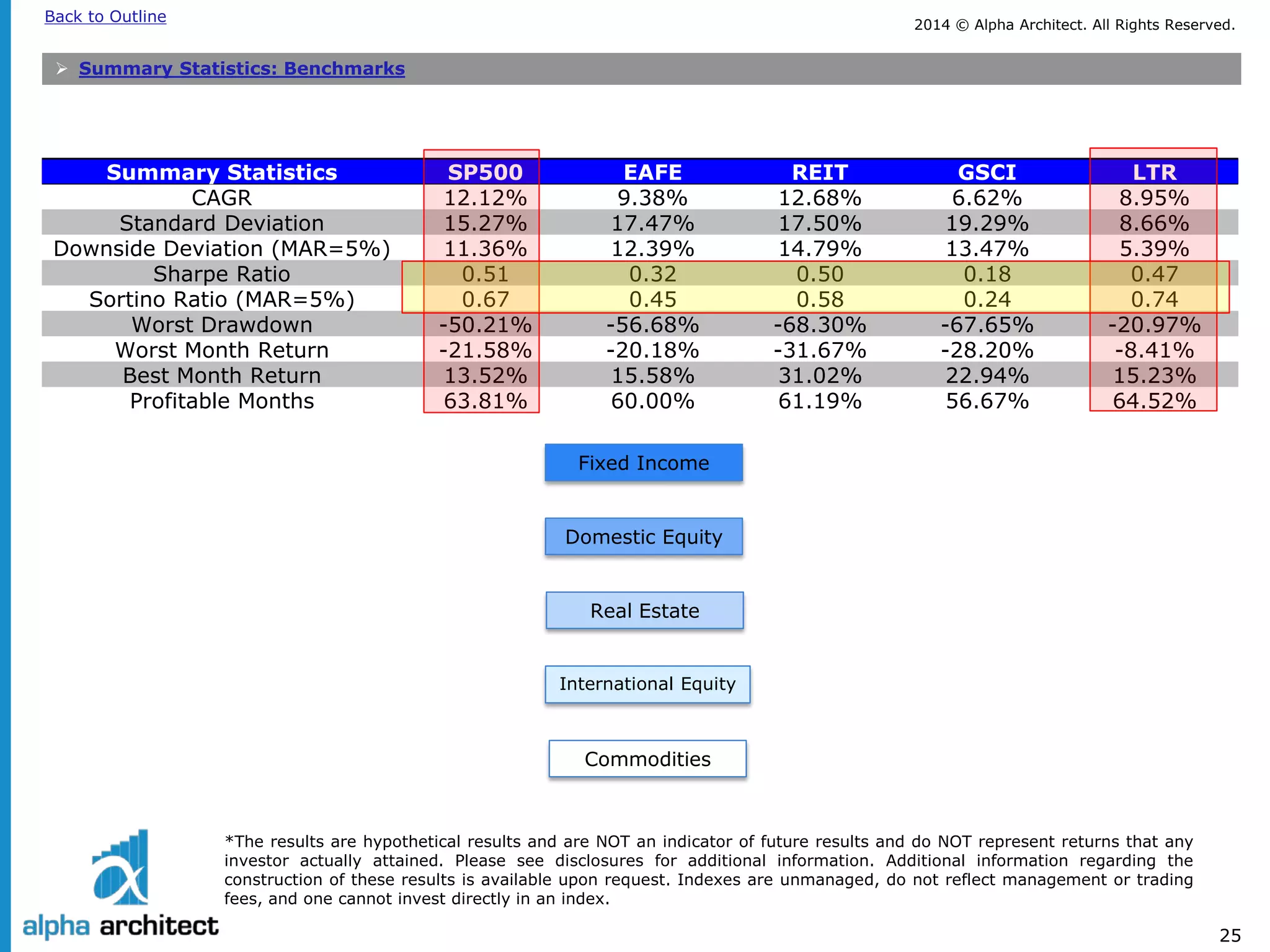
Summary Statistics: Benchmarks 
Summary Statistics 
SP500 
EAFE 
REIT 
GSCI 
LTR 
CAGR 
12.12% 
9.38% 
12.68% 
6.62% 
8.95% 
Standard Deviation 
15.27% 
17.47% 
17.50% 
19.29% 
8.66% 
Downside Deviation (MAR=5%) 
11.36% 
12.39% 
14.79% 
13.47% 
5.39% 
Sharpe Ratio 
0.51 
0.32 
0.50 
0.18 
0.47 
Sortino Ratio (MAR=5%) 
0.67 
0.45 
0.58 
0.24 
0.74 
Worst Drawdown 
-50.21% 
-56.68% 
-68.30% 
-67.65% 
-20.97% 
Worst Month Return 
-21.58% 
-20.18% 
-31.67% 
-28.20% 
-8.41% 
Best Month Return 
13.52% 
15.58% 
31.02% 
22.94% 
15.23% 
Profitable Months 
63.81% 
60.00% 
61.19% 
56.67% 
64.52% 
Domestic Equity 
International Equity 
Real Estate 
Fixed Income 
Commodities
2014 © Alpha Architect. Back to Outline All Rights Reserved. 
26 
*The results are hypothetical results and are NOT an indicator of future results and do NOT represent returns that any 
investor actually attained. Please see disclosures for additional information. Additional information regarding the 
construction of these results is available upon request. Indexes are unmanaged, do not reflect management or trading 
fees, and one cannot invest directly in an index. 
 
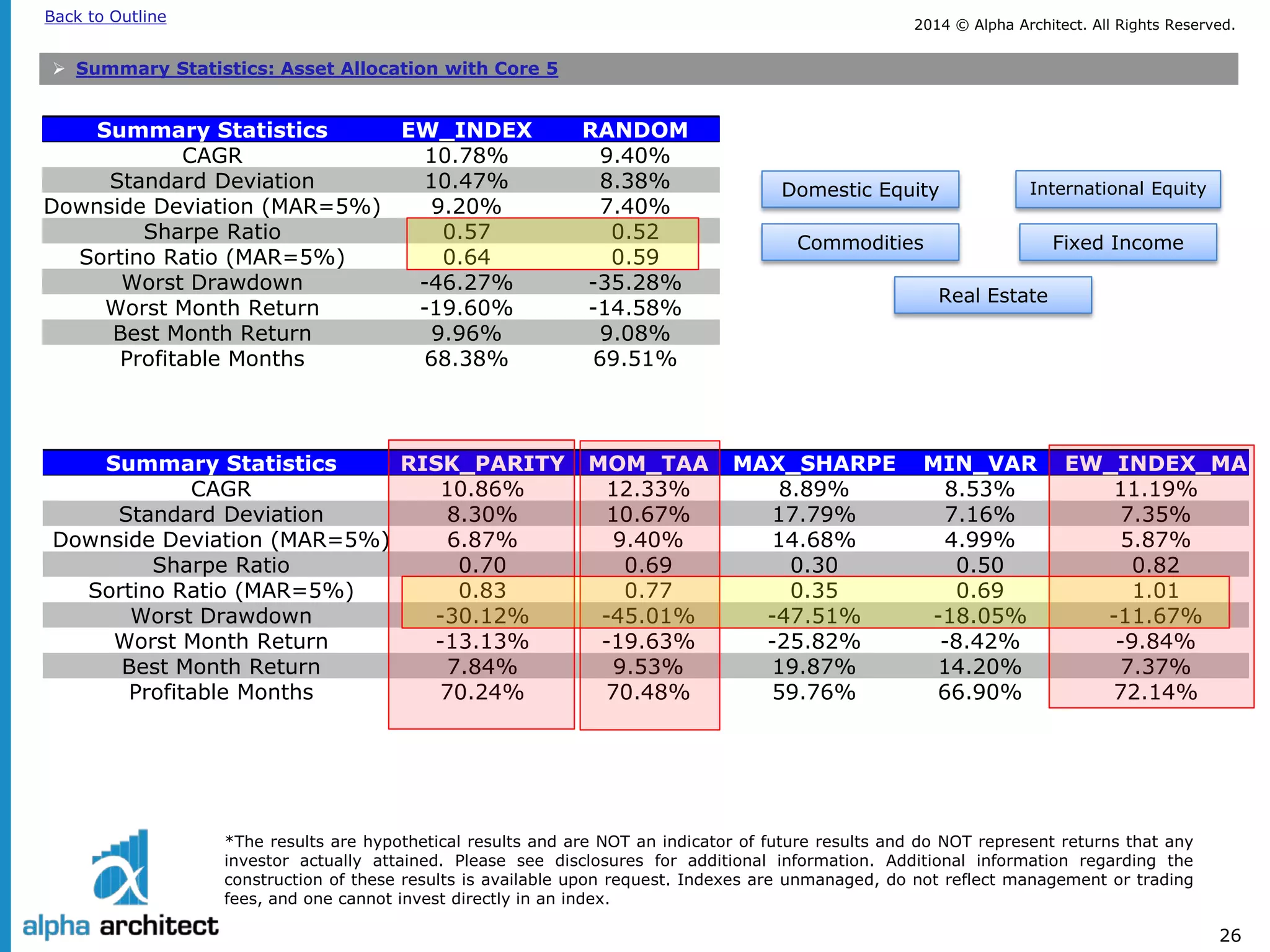
Summary Statistics: Asset Allocation with Core 5 
Summary Statistics 
RISK_PARITY 
MOM_TAA 
MAX_SHARPE 
MIN_VAR 
EW_INDEX_MA 
CAGR 
10.86% 
12.33% 
8.89% 
8.53% 
11.19% 
Standard Deviation 
8.30% 
10.67% 
17.79% 
7.16% 
7.35% 
Downside Deviation (MAR=5%) 
6.87% 
9.40% 
14.68% 
4.99% 
5.87% 
Sharpe Ratio 
0.70 
0.69 
0.30 
0.50 
0.82 
Sortino Ratio (MAR=5%) 
0.83 
0.77 
0.35 
0.69 
1.01 
Worst Drawdown 
-30.12% 
-45.01% 
-47.51% 
-18.05% 
-11.67% 
Worst Month Return 
-13.13% 
-19.63% 
-25.82% 
-8.42% 
-9.84% 
Best Month Return 
7.84% 
9.53% 
19.87% 
14.20% 
7.37% 
Profitable Months 
70.24% 
70.48% 
59.76% 
66.90% 
72.14% 
Domestic Equity 
International Equity 
Real Estate 
Fixed Income 
Commodities 
Summary Statistics 
EW_INDEX 
RANDOM 
CAGR 
10.78% 
9.40% 
Standard Deviation 
10.47% 
8.38% 
Downside Deviation (MAR=5%) 
9.20% 
7.40% 
Sharpe Ratio 
0.57 
0.52 
Sortino Ratio (MAR=5%) 
0.64 
0.59 
Worst Drawdown 
-46.27% 
-35.28% 
Worst Month Return 
-19.60% 
-14.58% 
Best Month Return 
9.96% 
9.08% 
Profitable Months 
68.38% 
69.51%
2014 © Alpha Architect. Back to Outline All Rights Reserved. 
27 
*The results are hypothetical results and are NOT an indicator of future results and do NOT represent returns that any 
investor actually attained. Please see disclosures for additional information. Additional information regarding the 
construction of these results is available upon request. Indexes are unmanaged, do not reflect management or trading 
fees, and one cannot invest directly in an index. 
 
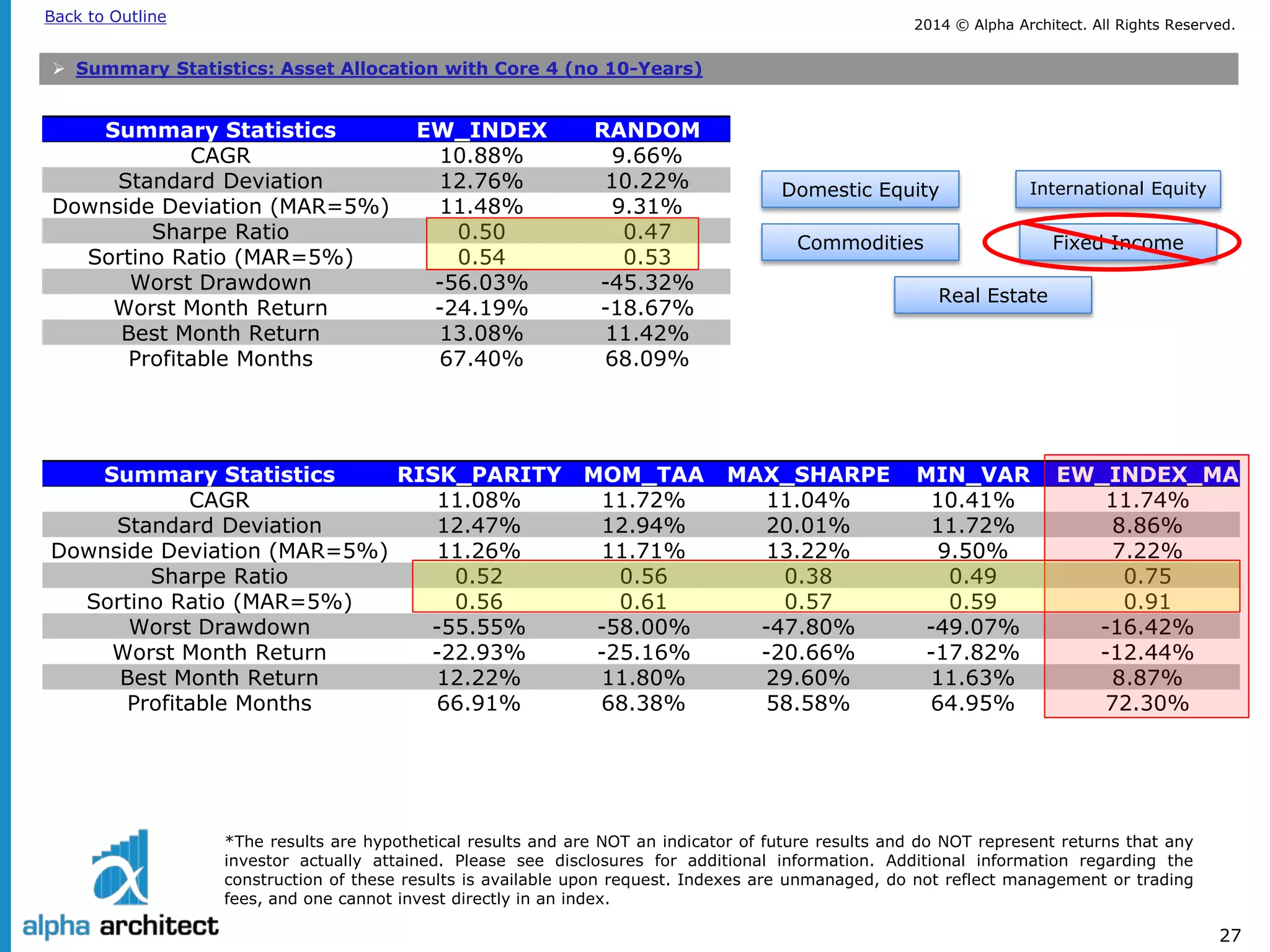
Summary Statistics: Asset Allocation with Core 4 (no 10-Years) 
Summary Statistics 
RISK_PARITY 
MOM_TAA 
MAX_SHARPE 
MIN_VAR 
EW_INDEX_MA 
CAGR 
11.08% 
11.72% 
11.04% 
10.41% 
11.74% 
Standard Deviation 
12.47% 
12.94% 
20.01% 
11.72% 
8.86% 
Downside Deviation (MAR=5%) 
11.26% 
11.71% 
13.22% 
9.50% 
7.22% 
Sharpe Ratio 
0.52 
0.56 
0.38 
0.49 
0.75 
Sortino Ratio (MAR=5%) 
0.56 
0.61 
0.57 
0.59 
0.91 
Worst Drawdown 
-55.55% 
-58.00% 
-47.80% 
-49.07% 
-16.42% 
Worst Month Return 
-22.93% 
-25.16% 
-20.66% 
-17.82% 
-12.44% 
Best Month Return 
12.22% 
11.80% 
29.60% 
11.63% 
8.87% 
Profitable Months 
66.91% 
68.38% 
58.58% 
64.95% 
72.30% 
Domestic Equity 
International Equity 
Real Estate 
Fixed Income 
Commodities 
Summary Statistics 
EW_INDEX 
RANDOM 
CAGR 
10.88% 
9.66% 
Standard Deviation 
12.76% 
10.22% 
Downside Deviation (MAR=5%) 
11.48% 
9.31% 
Sharpe Ratio 
0.50 
0.47 
Sortino Ratio (MAR=5%) 
0.54 
0.53 
Worst Drawdown 
-56.03% 
-45.32% 
Worst Month Return 
-24.19% 
-18.67% 
Best Month Return 
13.08% 
11.42% 
Profitable Months 
67.40% 
68.09%
2014 © Alpha Architect. Back to Outline All Rights Reserved. 
29 
*The results are hypothetical results and are NOT an indicator of future results and do NOT represent returns that any 
investor actually attained. Please see disclosures for additional information. Additional information regarding the 
construction of these results is available upon request. Indexes are unmanaged, do not reflect management or trading 
fees, and one cannot invest directly in an index. 
 
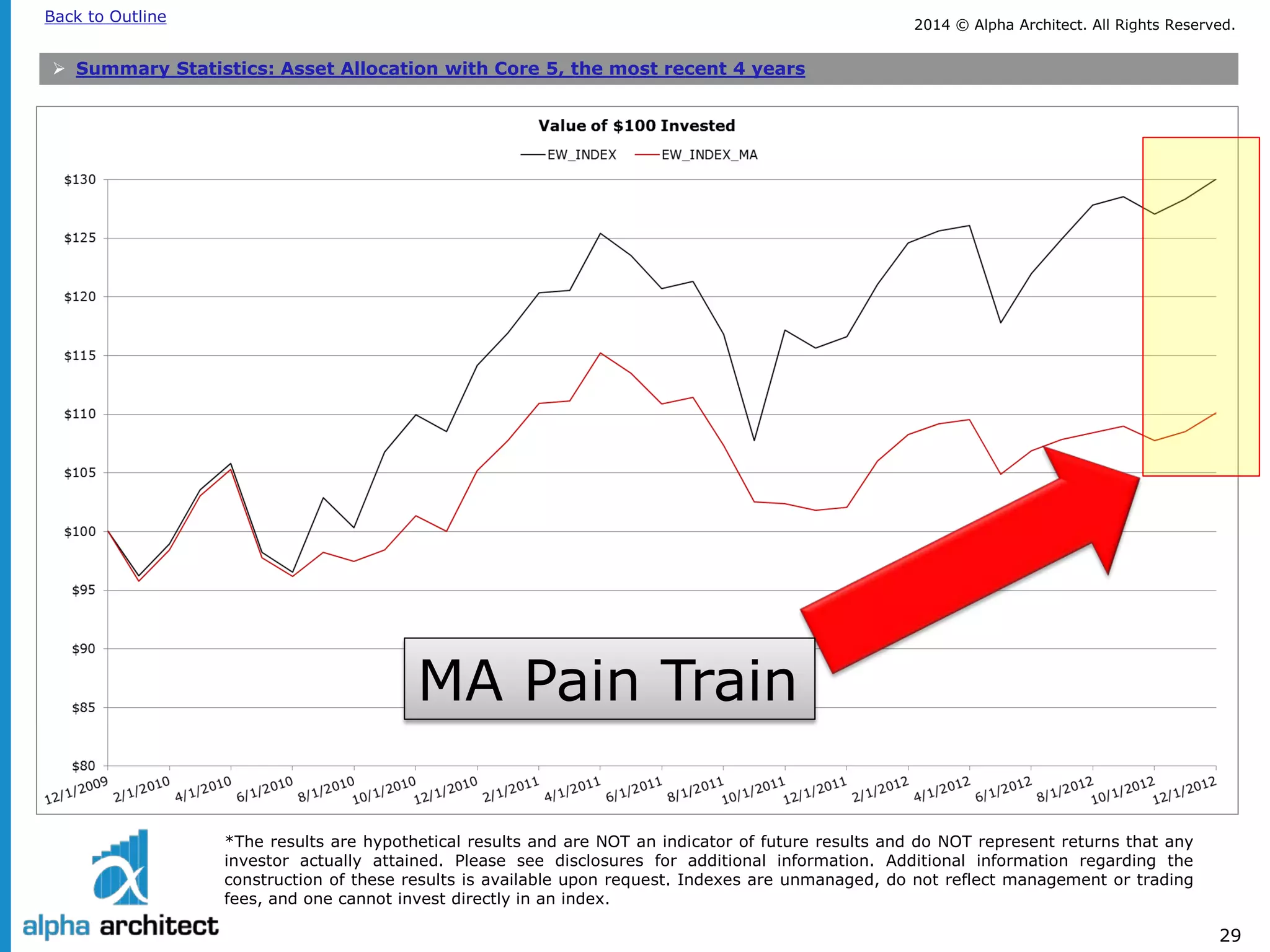
Summary Statistics: Asset Allocation with Core 5, the most recent 4 years 
MA Pain Train
2014 © Alpha Architect. Back to Outline All Rights Reserved. 
30 
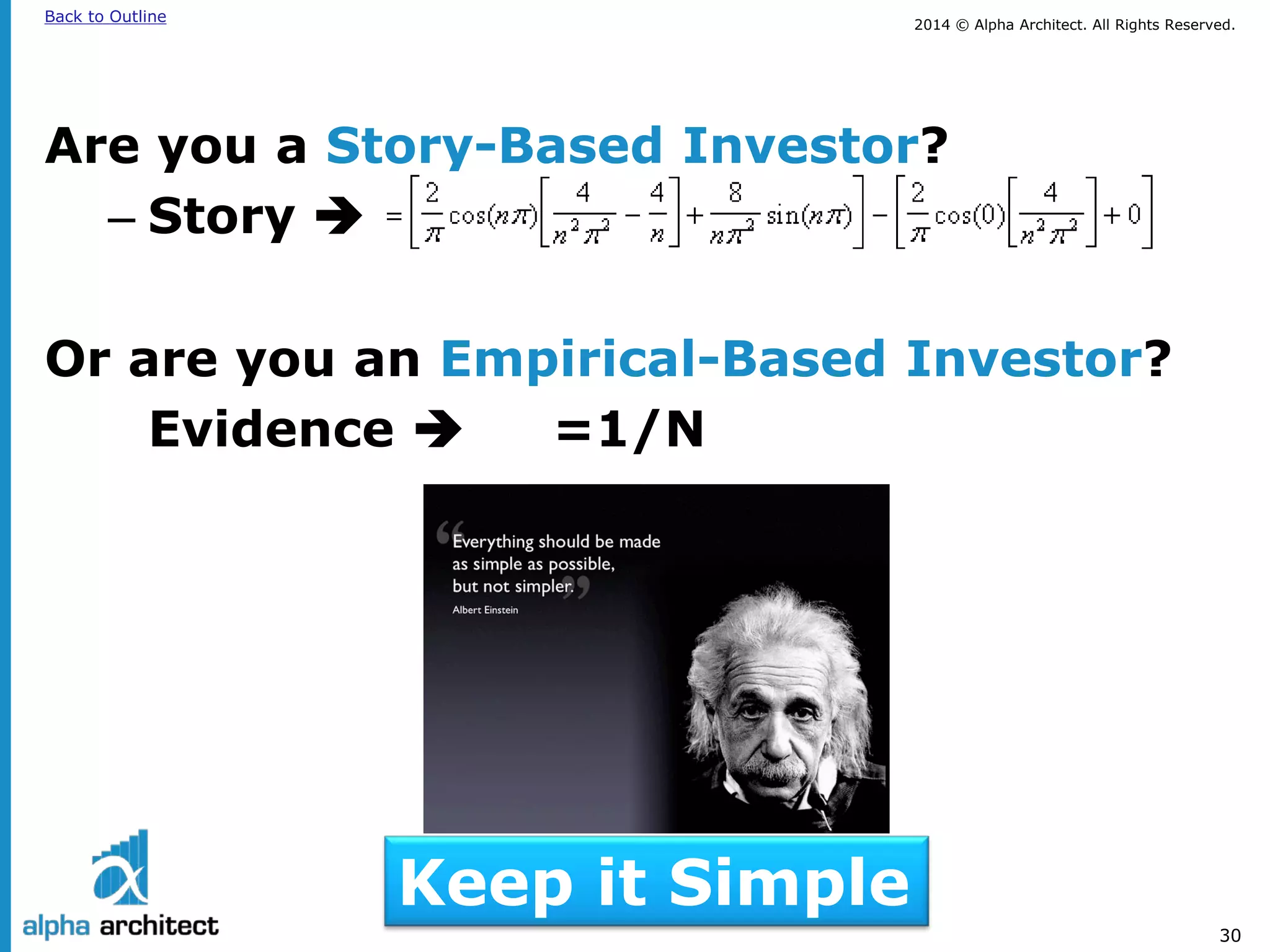
Are you a Story-Based Investor? 
– 
Story  
Or are you an Empirical-Based Investor? 
Evidence  =1/N 
Keep it Simple
2014 © Alpha Architect. Back to Outline All Rights Reserved. 
31
APPENDIX
2014 © Alpha Architect. Back to Outline All Rights Reserved. 
33 
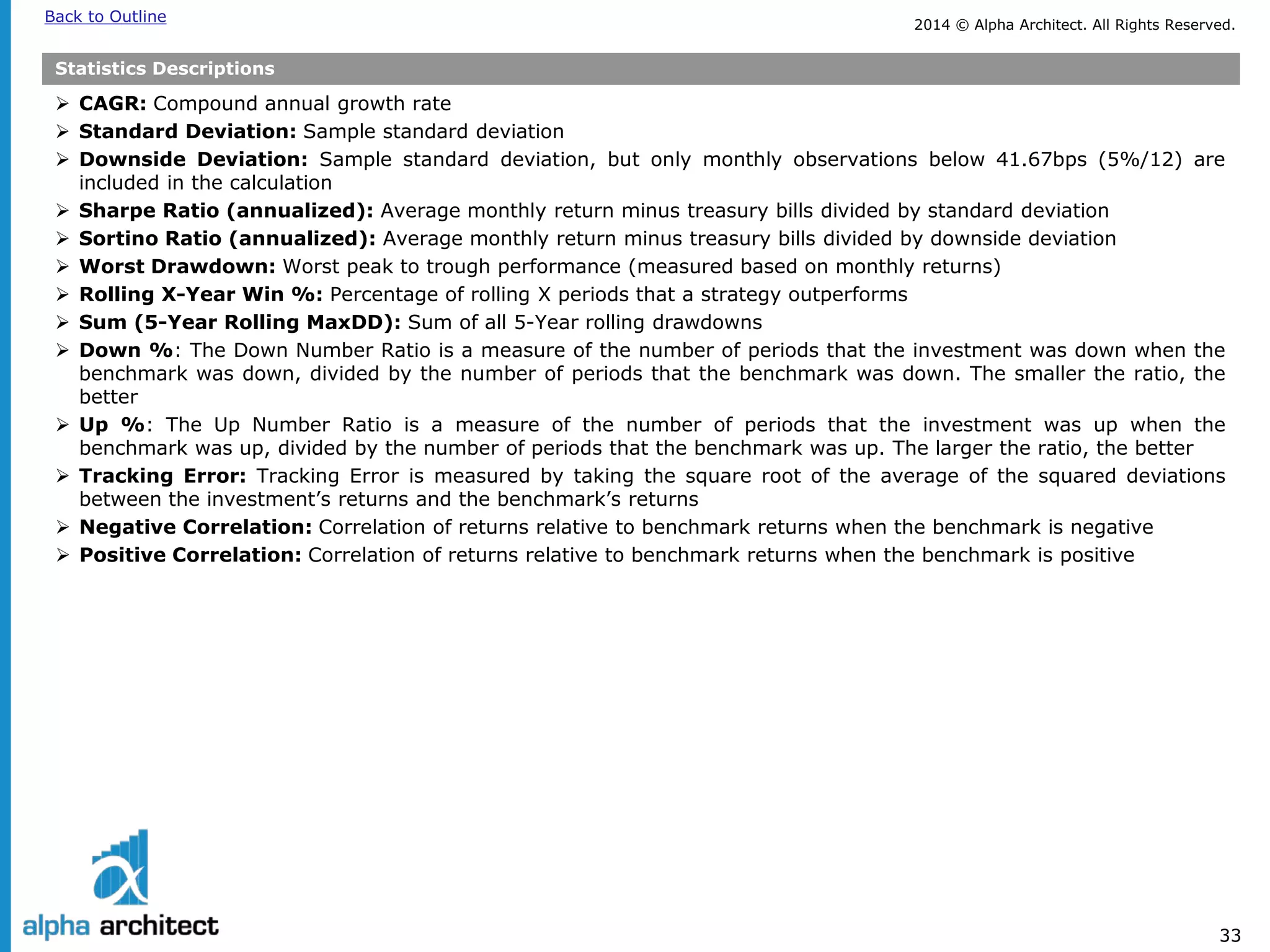
Statistics Descriptions 
 
CAGR: Compound annual growth rate 
 
Standard Deviation: Sample standard deviation 
 
Downside Deviation: Sample standard deviation, but only monthly observations below 41.67bps (5%/12) are included in the calculation 
 
Sharpe Ratio (annualized): Average monthly return minus treasury bills divided by standard deviation 
 
Sortino Ratio (annualized): Average monthly return minus treasury bills divided by downside deviation 
 
Worst Drawdown: Worst peak to trough performance (measured based on monthly returns) 
 
Rolling X-Year Win %: Percentage of rolling X periods that a strategy outperforms 
 
Sum (5-Year Rolling MaxDD): Sum of all 5-Year rolling drawdowns 
 
Down %: The Down Number Ratio is a measure of the number of periods that the investment was down when the benchmark was down, divided by the number of periods that the benchmark was down. The smaller the ratio, the better 
 
Up %: The Up Number Ratio is a measure of the number of periods that the investment was up when the benchmark was up, divided by the number of periods that the benchmark was up. The larger the ratio, the better 
 
Tracking Error: Tracking Error is measured by taking the square root of the average of the squared deviations between the investment’s returns and the benchmark’s returns 
 
Negative Correlation: Correlation of returns relative to benchmark returns when the benchmark is negative 
 
Positive Correlation: Correlation of returns relative to benchmark returns when the benchmark is positive
2014 © Alpha Architect. Back to Outline All Rights Reserved. 
34 
Disclosures 
Performance figures contained herein are hypothetical, unaudited and prepared by Alpha Architect, LLC; hypothetical results are intended for illustrative purposes only. 
Past performance is not indicative of future results, which may vary. 
There is a risk of substantial loss associated with trading commodities, futures, options and other financial instruments. Before trading, investors should carefully consider their financial position and risk tolerance to determine if the proposed trading style is appropriate. Investors should realize that when trading futures, commodities and/or granting/writing options one could lose the full balance of their account. It is also possible to lose more than the initial deposit when trading futures and/or granting/writing options. All funds committed to such a trading strategy should be purely risk capital. 
Hypothetical performance results (e.g., quantitative backtests) have many inherent limitations, some of which, but not all, are described herein. No representation is being made that any fund or account will or is likely to achieve profits or losses similar to those shown herein. In fact, there are frequently sharp differences between hypothetical performance results and the actual results subsequently realized by any particular trading program. One of the limitations of hypothetical performance results is that they are generally prepared with the benefit of hindsight. In addition, hypothetical trading does not involve financial risk, and no hypothetical trading record can completely account for the impact of financial risk in actual trading. For example, the ability to withstand losses or adhere to a particular trading program in spite of trading losses are material points which can adversely affect actual trading results. The hypothetical performance results contained herein represent the application of the quantitative models as currently in effect on the date first written above and there can be no assurance that the models will remain the same in the future or that an application of the current models in the future will produce similar results because the relevant market and economic conditions that prevailed during the hypothetical performance period will not necessarily recur. There are numerous other factors related to the markets in general or to the implementation of any specific trading program which cannot be fully accounted for in the preparation of hypothetical performance results, all of which can adversely affect actual trading results. Hypothetical performance results are presented for illustrative purposes only. 
Indexes are unmanaged, do not reflect management or trading fees, and one cannot invest directly in an index. 
There is no guarantee, express or implied, that long-term return and/or volatility targets will be achieved. Realized returns and/or volatility may come in higher or lower than expected.
Affordable Active Alpha | Built to Beat Behavioral Bias | We Empower Investors Through Education 
As Of Date: 
9/20/2014 
QUESTIONS? 
T: +1.215.882.9983 
F: +1.216.245.3686 
ir@alphaarchitect.com 
213 Foxcroft Road 
Broomall, PA 19008

Asset allocation facts_and_fiction_v03

  • 1.
    Affordable Active Alpha| Built to Beat Behavioral Bias | We Empower Investors Through Education As Of Date: 9/20/2014 BEWARE OF GEEKS BEARING FORMULAS Wesley R. Gray, PhD T: +1.215.882.9983 F: +1.216.245.3686 ir@alphaarchitect.com 213 Foxcroft Road Broomall, PA 19008
  • 2.
    2014 © AlphaArchitect. Back to Outline All Rights Reserved. 2 Who Can Predict Market Trends?
  • 3.
    2014 © AlphaArchitect. Back to Outline All Rights Reserved. 3 Presentation Outline  Tactical Asset Allocation  Definition  Basic Asset Classes  Common Concepts  Academic Evidence  Out of Sample Performance  Why Complexity Doesn’t Add Value  Performance of Common Concepts  Background  Historical Performance  Appendix  Statistics Descriptions  Disclosures
  • 4.
  • 5.
  • 6.
    2014 © AlphaArchitect. Back to Outline All Rights Reserved. 6 Working Definition  Allocation  Our baseline allocation to our asset universe  E.g., 50% Stocks, 50% Bonds, rebalanced annually Asset Financial assets that can be traded with reasonable liquidity E.g., Stocks, Bonds, Commodities, Alternatives (if liquid) Tactical Changing our baseline allocation E.g., 50% Stocks, 50% Bonds30% Stocks, 70% Bonds
  • 7.
  • 8.
    2014 © AlphaArchitect. Back to Outline All Rights Reserved. 8 The Basic Diversified Portfolio Domestic Equity 20% The “IVY 5” Concept 20% 20% 20% International Equity Real Estate Fixed Income Commodities 20% 1. SP500 = SP500 Total Return Index 2. EAFE = MSCI EAFE Total Return Index 3. REIT = FTSE NAREIT All Equity REITS Total Return Index 4. GSCI = GSCI Index 5. LTR = Merrill Lynch 7-10 year Government Bond Index
  • 9.
  • 10.
    2014 © AlphaArchitect. Back to Outline All Rights Reserved. 10 0 0.02 0.04 0.06 0.08 0.1 0.12 0.14 0% 1% 2% 3% 4% 5% Expected Portfolio Return Standard Deviation of the Portfolio CAL SP500 LTR EAFE GSCI REIT Tangency Portfolio Weights MV Frontier Minimum Variance Tangency Portfolio or Max Sharpe Portfolio  Tangency (Max Sharpe) Portfolio  value-weight portfolio of all risky assets  Identify weights that maximize Sharpe Ratio Source: Alpha Architect, LLC
  • 11.
    2014 © AlphaArchitect. Back to Outline All Rights Reserved. 11 0 0.02 0.04 0.06 0.08 0.1 0.12 0.14 0% 1% 2% 3% 4% 5% Expected Portfolio Return Standard Deviation of the Portfolio CAL SP500 LTR EAFE GSCI REIT Tangency Portfolio Weights MV Frontier Minimum Variance Minimum Variance Portfolio  Identify weights that minimize portfolio variance Source: Alpha Architect, LLC
  • 12.
    2014 © AlphaArchitect. Back to Outline All Rights Reserved. 12 Risk Parity  Identify weights that equalize “risk” across asset classes Source: Leverage Aversion and Risk Parity (2012), Financial Analysts Journal, 68(1), 47-59 BUY T-Bonds… With Leverage! Stock Bond Stock Bond Traditional Stock Bond Stock Bond Risk Parity Allocation Risk Contribution
  • 13.
    2014 © AlphaArchitect. Back to Outline All Rights Reserved. 13 Momentum Portfolio  Quotes from Eugene Fama and Ken French “…momentum is pervasive.” “The premier anomaly is momentum…” Source: Alpha Architect and Ken French Website
  • 14.
    2014 © AlphaArchitect. Back to Outline All Rights Reserved. 14 Moving Average Rule Portfolio  Classic Trend Following Strategy  IF MA rule triggered, buy risk, else, cash out.  E.g., Compare current price to the Average (past 12 months) Source: Alpha Architect, LLC
  • 15.
  • 16.
    2014 © AlphaArchitect. Back to Outline All Rights Reserved. 16 Source: Data-Driven Investment Management Presentation at the International Conference on Computational Management Science, May 2014, Victor DeMiguel Is Mean Variance… For Practitioner Use? or… For Academic Journals? “The Motivation behind my dissertation was to apply mathematics to the stock market.” Harry Markowitz, intellectual founder of Mean Variance Analysis “This is not a dissertation in economics, and we cannot give you a PhD in economics for this.” Milton Friedman, Markowitz dissertation advisor
  • 17.
  • 18.
    2014 © AlphaArchitect. Back to Outline All Rights Reserved. 18 *The results are hypothetical results and are NOT an indicator of future results and do NOT represent returns that any investor actually attained. Please see disclosures for additional information. Additional information regarding the construction of these results is available upon request. Indexes are unmanaged, do not reflect management or trading fees, and one cannot invest directly in an index. Academic Model Performance  “Of the 14 models we evaluate across seven empirical datasets, none is consistently better than the 1/N rule in terms of Sharpe ratio, certainty-equivalent return, or turnover, which indicates that, out of sample, the gain from optimal diversification is more than offset by estimation error…” Source: DeMiguel, V., L. Garlappi, and R. Uppal, 2009, Optimal Versus Naïve Diversification: How Inefficient is the 1/N Portfolio Strategy? Review of Financial Studies 5, 1915-1953.
  • 19.
  • 20.
    2014 © AlphaArchitect. Back to Outline All Rights Reserved. 20
  • 21.
    2014 © AlphaArchitect. Back to Outline All Rights Reserved. 21 *The results are hypothetical results and are NOT an indicator of future results and do NOT represent returns that any investor actually attained. Please see disclosures for additional information. Additional information regarding the construction of these results is available upon request. Indexes are unmanaged, do not reflect management or trading fees, and one cannot invest directly in an index.  Summary Stats: Jan 1927 to Dec 1960  Tangency/Min.Var Weights: Jan 1927 to Dec 1960  Summary Stats: Jan 1961 to Dec 2013  Tangency/Min.Var Weights: Jan 1961 to Dec 2013 Source: Alpha Architect, LLC SP500 HML LTR Average 1.00% 0.36% 0.26% Std. Dev. 7.04% 4.42% 1.26% Correlation SP500 HML LTR SP500 100.00% 58.93% 5.64% HML 58.93% 100.00% 4.03% LTR 5.64% 4.03% 100.00% SP500 HML LTR Average 0.91% 0.40% 0.59% Std. Dev. 4.32% 2.83% 2.36% Correlation SP500 HML LTR SP500 100.00% -26.41% 16.91% HML -26.41% 100.00% 0.44% LTR 16.91% 0.44% 100.00% Tangency Weights Min. Var. Weights W(SP500) 17.92% -0.55% W(HML) -5.81% 7.07% W(LTR) 87.90% 93.48% Tangency Weights Min. Var. Weights W(SP500) 41.22% 18.37% W(HML) 15.27% 38.95% W(LTR) 43.51% 42.68% 1961-2013 Equal Weights Tangency Min. Var. CAGR 7.64% 7.83% 6.81% Worst Drawdown -19.90% -18.14% -19.90% Sharpe Ratio 0.73 0.60 0.51 Sortino Ratio 0.64 0.58 0.40  Out of Sample Performance: 1961 to 2013 (using 1927 to 1960 weight estimates)
  • 22.
  • 23.
    2014 © AlphaArchitect. Back to Outline All Rights Reserved. 23 Strategy Background  Simulated Historical Performance: 1/1/1979 to 12/31/2013  Results are gross of management fee and transaction costs for illustrative purposes only.  These are simulated performance results and do not reflect the returns an investor would actually achieve.  All returns are total returns and include the reinvestment of distributions (e.g., dividends).  Max Sharpe weights are constrained between -1 and 1  Data is from Bloomberg and publicly available sources.  Legend 1. SP500 = SP500 Total Return Index 2. EAFE = MSCI EAFE Total Return Index 3. REIT = FTSE NAREIT All Equity REITS Total Return Index 4. GSCI = GSCI Index 5. LTR = Merrill Lynch 7-10 year Government Bond Index (prior to 6/1982, Amit Goyal Data) 6. RISK_PARITY = Risk parity on core 5 asset classes, 3-yr rolling windows 7. MOM_TAA = Momentum on core 5 asset classes, 12-month momentum, 8. MAX_SHARPE= Tangency portfolio weights on core 5 asset classes, 3-yr rolling windows (weights constrained [-1,1]) 9. MIN_VAR= Minimum variance portfolio weights on core 5 asset classes, 3-yr rolling windows 10. EW_INDEX = Equal-weight, monthly rebalanced across core 5 asset classes 11. EW_INDEX_MA = Equal-weight, monthly rebalanced across core 5 asset classes, with 12-month moving average rule 12. RANDOM = ¼ random chance of moving to risk-free rate, monthly rebalanced across core 5 asset classes Hypothetical performance results have many inherent limitations, some of which, but not all, are described in the disclosures at the end of this document. No representation is being made that any fund or account will or is likely to achieve profits or losses similar to those shown herein. In fact, there are frequently sharp differences between hypothetical performance results and the actual results subsequently realized by any particular trading program. Indexes are unmanaged, do not reflect management or trading fees, and one cannot invest directly in an index. Please see the disclosures at the end of this document for additional information. Source: Alpha Architect, LLC
  • 24.
  • 25.
    2014 © AlphaArchitect. Back to Outline All Rights Reserved. 25 *The results are hypothetical results and are NOT an indicator of future results and do NOT represent returns that any investor actually attained. Please see disclosures for additional information. Additional information regarding the construction of these results is available upon request. Indexes are unmanaged, do not reflect management or trading fees, and one cannot invest directly in an index.  Summary Statistics: Benchmarks Summary Statistics SP500 EAFE REIT GSCI LTR CAGR 12.12% 9.38% 12.68% 6.62% 8.95% Standard Deviation 15.27% 17.47% 17.50% 19.29% 8.66% Downside Deviation (MAR=5%) 11.36% 12.39% 14.79% 13.47% 5.39% Sharpe Ratio 0.51 0.32 0.50 0.18 0.47 Sortino Ratio (MAR=5%) 0.67 0.45 0.58 0.24 0.74 Worst Drawdown -50.21% -56.68% -68.30% -67.65% -20.97% Worst Month Return -21.58% -20.18% -31.67% -28.20% -8.41% Best Month Return 13.52% 15.58% 31.02% 22.94% 15.23% Profitable Months 63.81% 60.00% 61.19% 56.67% 64.52% Domestic Equity International Equity Real Estate Fixed Income Commodities
  • 26.
    2014 © AlphaArchitect. Back to Outline All Rights Reserved. 26 *The results are hypothetical results and are NOT an indicator of future results and do NOT represent returns that any investor actually attained. Please see disclosures for additional information. Additional information regarding the construction of these results is available upon request. Indexes are unmanaged, do not reflect management or trading fees, and one cannot invest directly in an index.  Summary Statistics: Asset Allocation with Core 5 Summary Statistics RISK_PARITY MOM_TAA MAX_SHARPE MIN_VAR EW_INDEX_MA CAGR 10.86% 12.33% 8.89% 8.53% 11.19% Standard Deviation 8.30% 10.67% 17.79% 7.16% 7.35% Downside Deviation (MAR=5%) 6.87% 9.40% 14.68% 4.99% 5.87% Sharpe Ratio 0.70 0.69 0.30 0.50 0.82 Sortino Ratio (MAR=5%) 0.83 0.77 0.35 0.69 1.01 Worst Drawdown -30.12% -45.01% -47.51% -18.05% -11.67% Worst Month Return -13.13% -19.63% -25.82% -8.42% -9.84% Best Month Return 7.84% 9.53% 19.87% 14.20% 7.37% Profitable Months 70.24% 70.48% 59.76% 66.90% 72.14% Domestic Equity International Equity Real Estate Fixed Income Commodities Summary Statistics EW_INDEX RANDOM CAGR 10.78% 9.40% Standard Deviation 10.47% 8.38% Downside Deviation (MAR=5%) 9.20% 7.40% Sharpe Ratio 0.57 0.52 Sortino Ratio (MAR=5%) 0.64 0.59 Worst Drawdown -46.27% -35.28% Worst Month Return -19.60% -14.58% Best Month Return 9.96% 9.08% Profitable Months 68.38% 69.51%
  • 27.
    2014 © AlphaArchitect. Back to Outline All Rights Reserved. 27 *The results are hypothetical results and are NOT an indicator of future results and do NOT represent returns that any investor actually attained. Please see disclosures for additional information. Additional information regarding the construction of these results is available upon request. Indexes are unmanaged, do not reflect management or trading fees, and one cannot invest directly in an index.  Summary Statistics: Asset Allocation with Core 4 (no 10-Years) Summary Statistics RISK_PARITY MOM_TAA MAX_SHARPE MIN_VAR EW_INDEX_MA CAGR 11.08% 11.72% 11.04% 10.41% 11.74% Standard Deviation 12.47% 12.94% 20.01% 11.72% 8.86% Downside Deviation (MAR=5%) 11.26% 11.71% 13.22% 9.50% 7.22% Sharpe Ratio 0.52 0.56 0.38 0.49 0.75 Sortino Ratio (MAR=5%) 0.56 0.61 0.57 0.59 0.91 Worst Drawdown -55.55% -58.00% -47.80% -49.07% -16.42% Worst Month Return -22.93% -25.16% -20.66% -17.82% -12.44% Best Month Return 12.22% 11.80% 29.60% 11.63% 8.87% Profitable Months 66.91% 68.38% 58.58% 64.95% 72.30% Domestic Equity International Equity Real Estate Fixed Income Commodities Summary Statistics EW_INDEX RANDOM CAGR 10.88% 9.66% Standard Deviation 12.76% 10.22% Downside Deviation (MAR=5%) 11.48% 9.31% Sharpe Ratio 0.50 0.47 Sortino Ratio (MAR=5%) 0.54 0.53 Worst Drawdown -56.03% -45.32% Worst Month Return -24.19% -18.67% Best Month Return 13.08% 11.42% Profitable Months 67.40% 68.09%
  • 28.
    2014 © AlphaArchitect. Back to Outline All Rights Reserved. 29 *The results are hypothetical results and are NOT an indicator of future results and do NOT represent returns that any investor actually attained. Please see disclosures for additional information. Additional information regarding the construction of these results is available upon request. Indexes are unmanaged, do not reflect management or trading fees, and one cannot invest directly in an index.  Summary Statistics: Asset Allocation with Core 5, the most recent 4 years MA Pain Train
  • 29.
    2014 © AlphaArchitect. Back to Outline All Rights Reserved. 30 Are you a Story-Based Investor? – Story  Or are you an Empirical-Based Investor? Evidence  =1/N Keep it Simple
  • 30.
    2014 © AlphaArchitect. Back to Outline All Rights Reserved. 31
  • 31.
  • 32.
    2014 © AlphaArchitect. Back to Outline All Rights Reserved. 33 Statistics Descriptions  CAGR: Compound annual growth rate  Standard Deviation: Sample standard deviation  Downside Deviation: Sample standard deviation, but only monthly observations below 41.67bps (5%/12) are included in the calculation  Sharpe Ratio (annualized): Average monthly return minus treasury bills divided by standard deviation  Sortino Ratio (annualized): Average monthly return minus treasury bills divided by downside deviation  Worst Drawdown: Worst peak to trough performance (measured based on monthly returns)  Rolling X-Year Win %: Percentage of rolling X periods that a strategy outperforms  Sum (5-Year Rolling MaxDD): Sum of all 5-Year rolling drawdowns  Down %: The Down Number Ratio is a measure of the number of periods that the investment was down when the benchmark was down, divided by the number of periods that the benchmark was down. The smaller the ratio, the better  Up %: The Up Number Ratio is a measure of the number of periods that the investment was up when the benchmark was up, divided by the number of periods that the benchmark was up. The larger the ratio, the better  Tracking Error: Tracking Error is measured by taking the square root of the average of the squared deviations between the investment’s returns and the benchmark’s returns  Negative Correlation: Correlation of returns relative to benchmark returns when the benchmark is negative  Positive Correlation: Correlation of returns relative to benchmark returns when the benchmark is positive
  • 33.
    2014 © AlphaArchitect. Back to Outline All Rights Reserved. 34 Disclosures Performance figures contained herein are hypothetical, unaudited and prepared by Alpha Architect, LLC; hypothetical results are intended for illustrative purposes only. Past performance is not indicative of future results, which may vary. There is a risk of substantial loss associated with trading commodities, futures, options and other financial instruments. Before trading, investors should carefully consider their financial position and risk tolerance to determine if the proposed trading style is appropriate. Investors should realize that when trading futures, commodities and/or granting/writing options one could lose the full balance of their account. It is also possible to lose more than the initial deposit when trading futures and/or granting/writing options. All funds committed to such a trading strategy should be purely risk capital. Hypothetical performance results (e.g., quantitative backtests) have many inherent limitations, some of which, but not all, are described herein. No representation is being made that any fund or account will or is likely to achieve profits or losses similar to those shown herein. In fact, there are frequently sharp differences between hypothetical performance results and the actual results subsequently realized by any particular trading program. One of the limitations of hypothetical performance results is that they are generally prepared with the benefit of hindsight. In addition, hypothetical trading does not involve financial risk, and no hypothetical trading record can completely account for the impact of financial risk in actual trading. For example, the ability to withstand losses or adhere to a particular trading program in spite of trading losses are material points which can adversely affect actual trading results. The hypothetical performance results contained herein represent the application of the quantitative models as currently in effect on the date first written above and there can be no assurance that the models will remain the same in the future or that an application of the current models in the future will produce similar results because the relevant market and economic conditions that prevailed during the hypothetical performance period will not necessarily recur. There are numerous other factors related to the markets in general or to the implementation of any specific trading program which cannot be fully accounted for in the preparation of hypothetical performance results, all of which can adversely affect actual trading results. Hypothetical performance results are presented for illustrative purposes only. Indexes are unmanaged, do not reflect management or trading fees, and one cannot invest directly in an index. There is no guarantee, express or implied, that long-term return and/or volatility targets will be achieved. Realized returns and/or volatility may come in higher or lower than expected.
  • 34.
    Affordable Active Alpha| Built to Beat Behavioral Bias | We Empower Investors Through Education As Of Date: 9/20/2014 QUESTIONS? T: +1.215.882.9983 F: +1.216.245.3686 ir@alphaarchitect.com 213 Foxcroft Road Broomall, PA 19008