Asset Allocation
Murray Priestley
Alpha Holdings Management
General Advice Disclaimer
The information in this presentation is general in nature and does not
take into account your personal circumstances, financial needs or
objectives. Before acting on any information, you should consider the
appropriateness of it and the relevant products having regard to your
objectives, financial situation and needs. In particular, you should seek
independent financial advice and read the relevant Product Disclosure
Statements or other offer documents prior to acquiring any financial
product.
DON’T have a
Financial Plan
85%
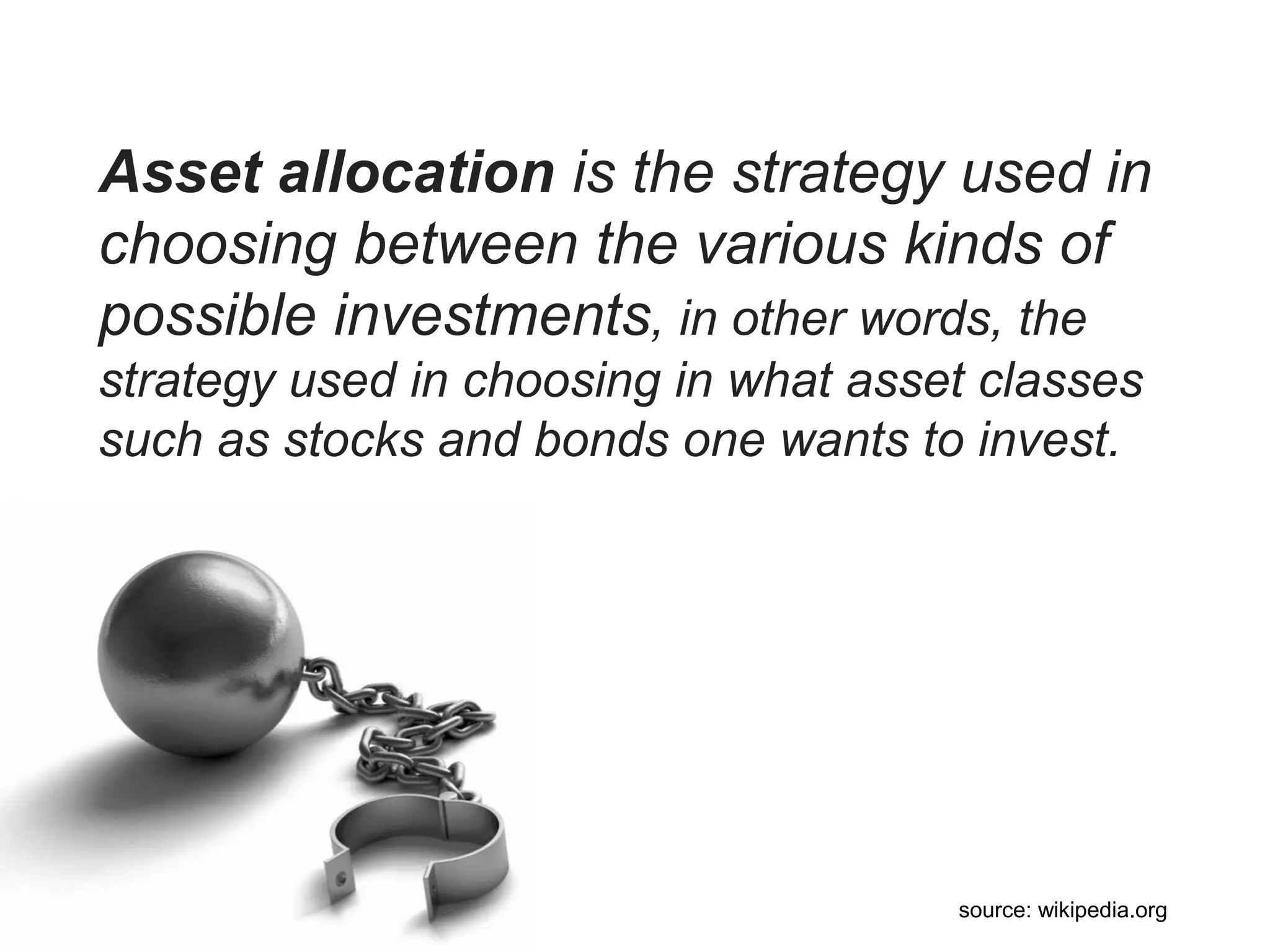
Asset allocation is the strategy used in
choosing between the various kinds of
possible investments, in other words, the
strategy used in choosing in what asset classes
such as stocks and bonds one wants to invest.
source: wikipedia.org
A large part of financial planning consists of
finding an asset allocation that is appropriate
for a given person in terms of their appetite for
and ability to shoulder risk. This can depend
on various factors.
source: wikipedia.org
In most cases it is the key
determinant of your portfolio's
long term rate of return
How important is Asset Allocation?
Bucket Concept
Cash
Money Market Accounts
Government backed bonds (US T-Bills, Treasury
Notes, Municipal bonds, etc.)
Equity in your primary residence (Australia)
Equity in any real estate (US)
Most Fixed Income investments
Most Capital Secured Funds
Security Assets
Shares/Equities
Share Rental
Real Estate
Most Managed/Mutual Funds
Most ETF
Most Hedge Funds
Equity in your business
Real Estate Syndicates
Mezzanine Funds
Growth Assets
Forex
Options (Equity/Futures)
Futures/Commodities
Managed Futures/CTA
Emerging Market ETF
Distressed Asset ETF
Private Equity s
Venture Capital
Angel Investments
IPO/Start-ups
Momentum Assets
Risk Profile
Age Security Growth Momentum
< 40 years 30% 35% 35%
40 to 60 yrs 50% 25% 25%
> 60 years 70% 15% 15%
Questions?
http://murraypriestley.com/

Asset allocation

  • 1.
  • 2.
    General Advice Disclaimer Theinformation in this presentation is general in nature and does not take into account your personal circumstances, financial needs or objectives. Before acting on any information, you should consider the appropriateness of it and the relevant products having regard to your objectives, financial situation and needs. In particular, you should seek independent financial advice and read the relevant Product Disclosure Statements or other offer documents prior to acquiring any financial product.
  • 3.
  • 4.
    Asset allocation isthe strategy used in choosing between the various kinds of possible investments, in other words, the strategy used in choosing in what asset classes such as stocks and bonds one wants to invest. source: wikipedia.org
  • 5.
    A large partof financial planning consists of finding an asset allocation that is appropriate for a given person in terms of their appetite for and ability to shoulder risk. This can depend on various factors. source: wikipedia.org
  • 6.
    In most casesit is the key determinant of your portfolio's long term rate of return How important is Asset Allocation?
  • 8.
  • 9.
    Cash Money Market Accounts Governmentbacked bonds (US T-Bills, Treasury Notes, Municipal bonds, etc.) Equity in your primary residence (Australia) Equity in any real estate (US) Most Fixed Income investments Most Capital Secured Funds Security Assets
  • 10.
    Shares/Equities Share Rental Real Estate MostManaged/Mutual Funds Most ETF Most Hedge Funds Equity in your business Real Estate Syndicates Mezzanine Funds Growth Assets
  • 11.
    Forex Options (Equity/Futures) Futures/Commodities Managed Futures/CTA EmergingMarket ETF Distressed Asset ETF Private Equity s Venture Capital Angel Investments IPO/Start-ups Momentum Assets
  • 12.
    Risk Profile Age SecurityGrowth Momentum < 40 years 30% 35% 35% 40 to 60 yrs 50% 25% 25% > 60 years 70% 15% 15%
  • 14.