Texts 5 and 28

Objectives:
•To examine two linked texts
•Explore the form, structure and
narrative stance of literary writing
• Make a comparative analysis
between two texts.
Context of Production
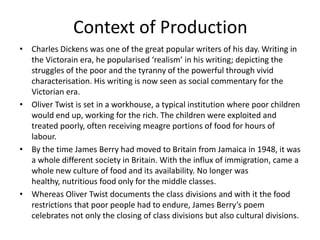
• Charles Dickens was one of the great popular writers of his day. Writing in
  the Victorain era, he popularised ‘realism’ in his writing; depicting the
  struggles of the poor and the tyranny of the powerful through vivid
  characterisation. His writing is now seen as social commentary for the
  Victorian era.
• Oliver Twist is set in a workhouse, a typical institution where poor children
  would end up, working for the rich. The children were exploited and
  treated poorly, often receiving meagre portions of food for hours of
  labour.
• By the time James Berry had moved to Britain from Jamaica in 1948, it was
  a whole different society in Britain. With the influx of immigration, came a
  whole new culture of food and its availability. No longer was
  healthy, nutritious food only for the middle classes.
• Whereas Oliver Twist documents the class divisions and with it the food
  restrictions that poor people had to endure, James Berry’s poem
  celebrates not only the closing of class divisions but also cultural divisions.
Exam Focus
• Typical Exam Question:
  – How do the writers of these two texts convey their
    attitudes towards and ideas about experiences of
    food.
Critical Response Activity
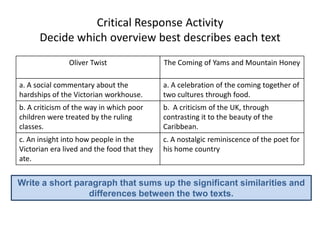
      Decide which overview best describes each text
               Oliver Twist                  The Coming of Yams and Mountain Honey

a. A social commentary about the             a. A celebration of the coming together of
hardships of the Victorian workhouse.        two cultures through food.
b. A criticism of the way in which poor      b. A criticism of the UK, through
children were treated by the ruling          contrasting it to the beauty of the
classes.                                     Caribbean.
c. An insight into how people in the         c. A nostalgic reminiscence of the poet for
Victorian era lived and the food that they   his home country
ate.


Write a short paragraph that sums up the significant similarities and
                 differences between the two texts.
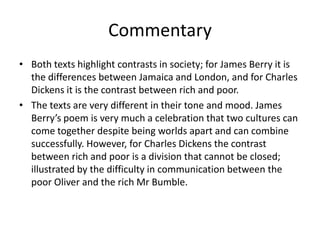
Commentary
• Both texts highlight contrasts in society; for James Berry it is
  the differences between Jamaica and London, and for Charles
  Dickens it is the contrast between rich and poor.
• The texts are very different in their tone and mood. James
  Berry’s poem is very much a celebration that two cultures can
  come together despite being worlds apart and can combine
  successfully. However, for Charles Dickens the contrast
  between rich and poor is a division that cannot be closed;
  illustrated by the difficulty in communication between the
  poor Oliver and the rich Mr Bumble.
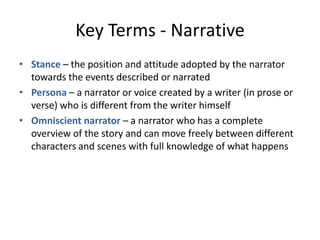
Key Terms - Narrative
• Stance – the position and attitude adopted by the narrator
  towards the events described or narrated
• Persona – a narrator or voice created by a writer (in prose or
  verse) who is different from the writer himself
• Omniscient narrator – a narrator who has a complete
  overview of the story and can move freely between different
  characters and scenes with full knowledge of what happens
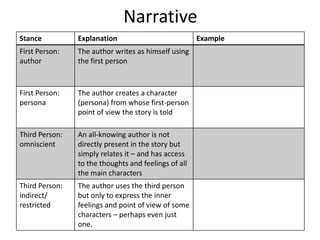
Narrative
Stance          Explanation                           Example
First Person:   The author writes as himself using
author          the first person


First Person:   The author creates a character
persona         (persona) from whose first-person
                point of view the story is told

Third Person:   An all-knowing author is not
omniscient      directly present in the story but
                simply relates it – and has access
                to the thoughts and feelings of all
                the main characters
Third Person:   The author uses the third person
indirect/       but only to express the inner
restricted      feelings and point of view of some
                characters – perhaps even just
                one.
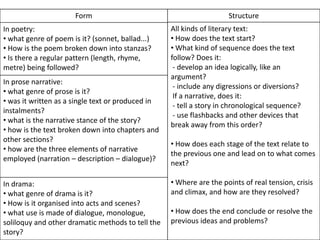
Form                                           Structure
In poetry:                                         All kinds of literary text:
• what genre of poem is it? (sonnet, ballad...)    • How does the text start?
• How is the poem broken down into stanzas?        • What kind of sequence does the text
• Is there a regular pattern (length, rhyme,       follow? Does it:
metre) being followed?                              - develop an idea logically, like an
                                                   argument?
In prose narrative:
                                                    - include any digressions or diversions?
• what genre of prose is it?
                                                    If a narrative, does it:
• was it written as a single text or produced in
                                                    - tell a story in chronological sequence?
instalments?
                                                    - use flashbacks and other devices that
• what is the narrative stance of the story?
                                                   break away from this order?
• how is the text broken down into chapters and
other sections?
                                                   • How does each stage of the text relate to
• how are the three elements of narrative
                                                   the previous one and lead on to what comes
employed (narration – description – dialogue)?
                                                   next?

In drama:                                          • Where are the points of real tension, crisis
• what genre of drama is it?                       and climax, and how are they resolved?
• How is it organised into acts and scenes?
• what use is made of dialogue, monologue,         • How does the end conclude or resolve the
soliloquy and other dramatic methods to tell the   previous ideas and problems?
story?
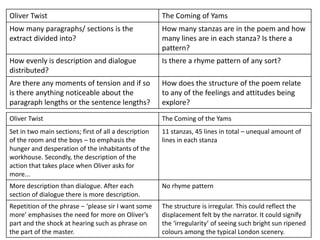
Oliver Twist                                           The Coming of Yams
How many paragraphs/ sections is the                   How many stanzas are in the poem and how
extract divided into?                                  many lines are in each stanza? Is there a
                                                       pattern?
How evenly is description and dialogue                 Is there a rhyme pattern of any sort?
distributed?
Are there any moments of tension and if so             How does the structure of the poem relate
is there anything noticeable about the                 to any of the feelings and attitudes being
paragraph lengths or the sentence lengths?             explore?
Oliver Twist                                           The Coming of the Yams
Set in two main sections; first of all a description   11 stanzas, 45 lines in total – unequal amount of
of the room and the boys – to emphasis the             lines in each stanza
hunger and desperation of the inhabitants of the
workhouse. Secondly, the description of the
action that takes place when Oliver asks for
more...
More description than dialogue. After each             No rhyme pattern
section of dialogue there is more description.
Repetition of the phrase – ‘please sir I want some     The structure is irregular. This could reflect the
more’ emphasises the need for more on Oliver’s         displacement felt by the narrator. It could signify
part and the shock at hearing such as phrase on        the ‘irregularity’ of seeing such bright sun ripened
the part of the master.                                colours among the typical London scenery.
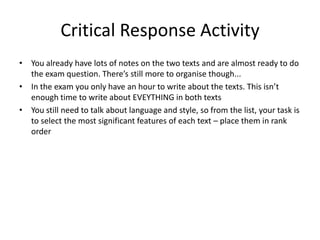
Critical Response Activity
• You already have lots of notes on the two texts and are almost ready to do
  the exam question. There’s still more to organise though...
• In the exam you only have an hour to write about the texts. This isn’t
  enough time to write about EVEYTHING in both texts
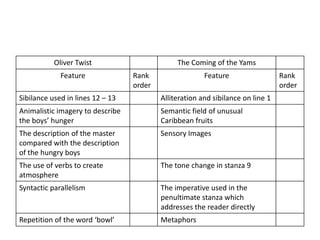
• You still need to talk about language and style, so from the list, your task is
  to select the most significant features of each text – place them in rank
  order
Oliver Twist                        The Coming of the Yams
             Feature              Rank                  Feature                  Rank
                                  order                                          order
Sibilance used in lines 12 – 13           Alliteration and sibilance on line 1
Animalistic imagery to describe           Semantic field of unusual
the boys’ hunger                          Caribbean fruits
The description of the master             Sensory Images
compared with the description
of the hungry boys
The use of verbs to create                The tone change in stanza 9
atmosphere
Syntactic parallelism                     The imperative used in the
                                          penultimate stanza which
                                          addresses the reader directly
Repetition of the word ‘bowl’             Metaphors
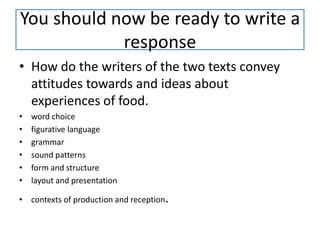
You should now be ready to write a
            response
• How do the writers of the two texts convey
  attitudes towards and ideas about
  experiences of food.
•   word choice
•   figurative language
•   grammar
•   sound patterns
•   form and structure
•   layout and presentation

• contexts of production and reception.

Assessment guidelines

  • 1.
    Texts 5 and28 Objectives: •To examine two linked texts •Explore the form, structure and narrative stance of literary writing • Make a comparative analysis between two texts.
  • 2.
    Context of Production •Charles Dickens was one of the great popular writers of his day. Writing in the Victorain era, he popularised ‘realism’ in his writing; depicting the struggles of the poor and the tyranny of the powerful through vivid characterisation. His writing is now seen as social commentary for the Victorian era. • Oliver Twist is set in a workhouse, a typical institution where poor children would end up, working for the rich. The children were exploited and treated poorly, often receiving meagre portions of food for hours of labour. • By the time James Berry had moved to Britain from Jamaica in 1948, it was a whole different society in Britain. With the influx of immigration, came a whole new culture of food and its availability. No longer was healthy, nutritious food only for the middle classes. • Whereas Oliver Twist documents the class divisions and with it the food restrictions that poor people had to endure, James Berry’s poem celebrates not only the closing of class divisions but also cultural divisions.
  • 3.
    Exam Focus • TypicalExam Question: – How do the writers of these two texts convey their attitudes towards and ideas about experiences of food.
  • 4.
    Critical Response Activity Decide which overview best describes each text Oliver Twist The Coming of Yams and Mountain Honey a. A social commentary about the a. A celebration of the coming together of hardships of the Victorian workhouse. two cultures through food. b. A criticism of the way in which poor b. A criticism of the UK, through children were treated by the ruling contrasting it to the beauty of the classes. Caribbean. c. An insight into how people in the c. A nostalgic reminiscence of the poet for Victorian era lived and the food that they his home country ate. Write a short paragraph that sums up the significant similarities and differences between the two texts.
  • 5.
    Commentary • Both textshighlight contrasts in society; for James Berry it is the differences between Jamaica and London, and for Charles Dickens it is the contrast between rich and poor. • The texts are very different in their tone and mood. James Berry’s poem is very much a celebration that two cultures can come together despite being worlds apart and can combine successfully. However, for Charles Dickens the contrast between rich and poor is a division that cannot be closed; illustrated by the difficulty in communication between the poor Oliver and the rich Mr Bumble.
  • 6.
    Key Terms -Narrative • Stance – the position and attitude adopted by the narrator towards the events described or narrated • Persona – a narrator or voice created by a writer (in prose or verse) who is different from the writer himself • Omniscient narrator – a narrator who has a complete overview of the story and can move freely between different characters and scenes with full knowledge of what happens
  • 7.
    Narrative Stance Explanation Example First Person: The author writes as himself using author the first person First Person: The author creates a character persona (persona) from whose first-person point of view the story is told Third Person: An all-knowing author is not omniscient directly present in the story but simply relates it – and has access to the thoughts and feelings of all the main characters Third Person: The author uses the third person indirect/ but only to express the inner restricted feelings and point of view of some characters – perhaps even just one.
  • 8.
    Form Structure In poetry: All kinds of literary text: • what genre of poem is it? (sonnet, ballad...) • How does the text start? • How is the poem broken down into stanzas? • What kind of sequence does the text • Is there a regular pattern (length, rhyme, follow? Does it: metre) being followed? - develop an idea logically, like an argument? In prose narrative: - include any digressions or diversions? • what genre of prose is it? If a narrative, does it: • was it written as a single text or produced in - tell a story in chronological sequence? instalments? - use flashbacks and other devices that • what is the narrative stance of the story? break away from this order? • how is the text broken down into chapters and other sections? • How does each stage of the text relate to • how are the three elements of narrative the previous one and lead on to what comes employed (narration – description – dialogue)? next? In drama: • Where are the points of real tension, crisis • what genre of drama is it? and climax, and how are they resolved? • How is it organised into acts and scenes? • what use is made of dialogue, monologue, • How does the end conclude or resolve the soliloquy and other dramatic methods to tell the previous ideas and problems? story?
  • 9.
    Oliver Twist The Coming of Yams How many paragraphs/ sections is the How many stanzas are in the poem and how extract divided into? many lines are in each stanza? Is there a pattern? How evenly is description and dialogue Is there a rhyme pattern of any sort? distributed? Are there any moments of tension and if so How does the structure of the poem relate is there anything noticeable about the to any of the feelings and attitudes being paragraph lengths or the sentence lengths? explore? Oliver Twist The Coming of the Yams Set in two main sections; first of all a description 11 stanzas, 45 lines in total – unequal amount of of the room and the boys – to emphasis the lines in each stanza hunger and desperation of the inhabitants of the workhouse. Secondly, the description of the action that takes place when Oliver asks for more... More description than dialogue. After each No rhyme pattern section of dialogue there is more description. Repetition of the phrase – ‘please sir I want some The structure is irregular. This could reflect the more’ emphasises the need for more on Oliver’s displacement felt by the narrator. It could signify part and the shock at hearing such as phrase on the ‘irregularity’ of seeing such bright sun ripened the part of the master. colours among the typical London scenery.
  • 10.
    Critical Response Activity •You already have lots of notes on the two texts and are almost ready to do the exam question. There’s still more to organise though... • In the exam you only have an hour to write about the texts. This isn’t enough time to write about EVEYTHING in both texts • You still need to talk about language and style, so from the list, your task is to select the most significant features of each text – place them in rank order
  • 11.
    Oliver Twist The Coming of the Yams Feature Rank Feature Rank order order Sibilance used in lines 12 – 13 Alliteration and sibilance on line 1 Animalistic imagery to describe Semantic field of unusual the boys’ hunger Caribbean fruits The description of the master Sensory Images compared with the description of the hungry boys The use of verbs to create The tone change in stanza 9 atmosphere Syntactic parallelism The imperative used in the penultimate stanza which addresses the reader directly Repetition of the word ‘bowl’ Metaphors
  • 12.
    You should nowbe ready to write a response • How do the writers of the two texts convey attitudes towards and ideas about experiences of food. • word choice • figurative language • grammar • sound patterns • form and structure • layout and presentation • contexts of production and reception.