
Types of Poetry
Creating a poetry anthology
Christine Wells & Gavin Fitzhenry
Learning Intentions

 Research different types of poetry
 Identify and describe key characteristics of each type of
  poetry
 Identify a theme to write poetry about
Success Criteria
 Demonstrate knowledge of different types of poetry by
  creating a poetry anthology
 Demonstrate understanding of a theme by writing poetry
  based upon the theme
Gathering
                                                                        Processing
                                     Thinking                            Applying
   Random Poetry
                                     Relating to others
                                     Using language, text and symbols
                                     Managing self
                                     Participating and contributing


1.Choose a stimulating resource e.ga photo, ornament, or a skull.
2.Divide class into 3 groups.
3.Ask class to study resource intensely.
4.Ask each person to write down 1 word about the resource.
Group 1 = a noun each Group 2 = a verb each Group 3 = an
adjective each
5. Each word is thought of individually without discussion. It is
written on a piece of paper and put into a box.
6. The words are then mixed up and drawn out randomly.
7. As they are drawn out, they are called out and each student
writes down the words in long lines keeping the order strictly as
drawn.
8. The class is now asked to produce a poem from the words
Gathering
Processing


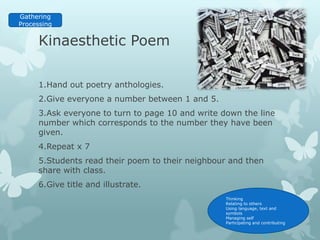
     Kinaesthetic Poem

     1.Hand out poetry anthologies.
     2.Give everyone a number between 1 and 5.
     3.Ask everyone to turn to page 10 and write down the line
     number which corresponds to the number they have been
     given.
     4.Repeat x 7
     5.Students read their poem to their neighbour and then
     share with class.
     6.Give title and illustrate.
                                                  Thinking
                                                  Relating to others
                                                  Using language, text and
                                                  symbols
                                                  Managing self
                                                  Participating and contributing
Haiku
                                                             Gathering

   Haiku poems come from Japan.
   Haiku usually have simple themes and images.
   Haiku are short poems, usually seventeen syllables long:
          the first and third line contain five syllables
          the second line contains seven syllables.


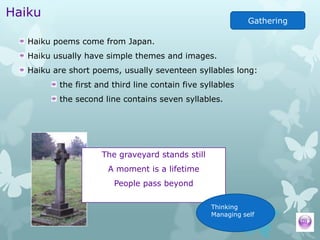
                     The graveyard stands still
                       A moment is a lifetime
                        People pass beyond

                                                  Thinking
                                                  Managing self
Haiku
 Flourishing despite
 Your rough inconstant climate,
 I shake but am still.                                  Processing


 Count the syllables.
 Do these poems conform to the rules of haiku?


                               Your name is on the
                               Internet under those dead -
                               Resting at St Mark’s.

 Haikus often capture a feeling, a perception or a snapshot of
 something. Although brief they can provoke deep thought.

                          Thinking
                          Managing self
                          Participating and
                          contributing
Haiku

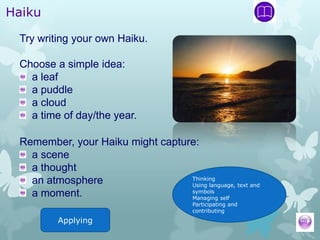
 Try writing your own Haiku.

 Choose a simple idea:
   a leaf
   a puddle
   a cloud
   a time of day/the year.

 Remember, your Haiku might capture:
   a scene
   a thought
                                  Thinking
   an atmosphere                  Using language, text and
                                  symbols
   a moment.                      Managing self
                                          Participating and
                                          contributing
          Applying
Haiku
                                                                 Processing
     Now read this poem

    How does Wendy Cope break the usual conventions of the
    haiku?

                                       Strugnell’s Haiku

   The opening to the poem             November evening;
creates an image of an autumn          The moon is up, rooks settle,
           evening.                    The pubs are open.

                                                      Wendy Cope


              The part about the pub surprises us because this is not what we
      Thinking
                          expect the poet to be thinking about.
      Relating to others
      Using language, text and
      symbols
      Managing self
      Participating and contributing
Limerick
Gathering


 Limerick rules

  The limerick consists of five lines.
  The last line always rhymes with the first two lines.
  The third and fourth lines rhyme with each other.          Thinking
                                                              Managing self
  Rhyme scheme aa bb a                                       Participating
                                                              and
                                                              contributing
  Lines one, two and five may have from eight to eleven
   syllables.
  Lines three and four may have from five to seven syllables.


  The last line of the limerick is special as it contains the joke
   or punch line.
Limerick                                                     Gathering
                                                             Processing

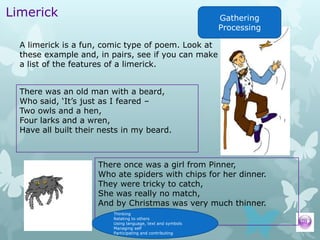
  A limerick is a fun, comic type of poem. Look at
  these example and, in pairs, see if you can make
  a list of the features of a limerick.


  There was an old man with a beard,
  Who said, ‘It’s just as I feared –
  Two owls and a hen,
  Four larks and a wren,
  Have all built their nests in my beard.


                      There once was a girl from Pinner,
                      Who ate spiders with chips for her dinner.
                      They were tricky to catch,
                      She was really no match,
                      And by Christmas was very much thinner.
                          Thinking
                          Relating to others
                          Using language, text and symbols
                          Managing self
                          Participating and contributing
Limerick

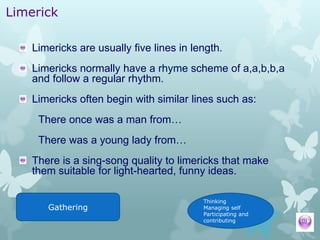
    Limericks are usually five lines in length.
    Limericks normally have a rhyme scheme of a,a,b,b,a
    and follow a regular rhythm.
    Limericks often begin with similar lines such as:
     There once was a man from…
     There was a young lady from…
    There is a sing-song quality to limericks that make
    them suitable for light-hearted, funny ideas.

                                          Thinking
       Gathering                          Managing self
                                          Participating and
                                          contributing
Limerick

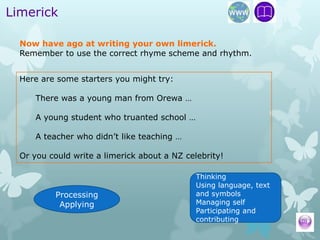
  Now have ago at writing your own limerick.
  Remember to use the correct rhyme scheme and rhythm.


  Here are some starters you might try:

      There was a young man from Orewa …

      A young student who truanted school …

      A teacher who didn’t like teaching …

  Or you could write a limerick about a NZ celebrity!

                                              Thinking
                                              Using language, text
           Processing                         and symbols
            Applying                          Managing self
                                              Participating and
                                              contributing
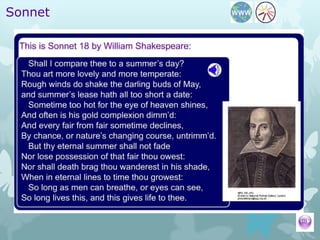
Sonnet
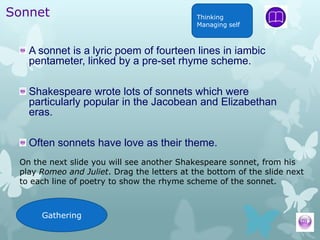
Sonnet                                       Thinking
                                             Managing self


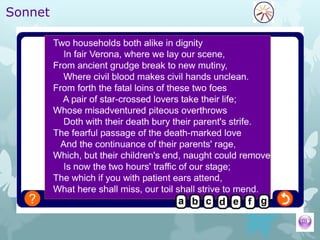
   A sonnet is a lyric poem of fourteen lines in iambic
   pentameter, linked by a pre-set rhyme scheme.

   Shakespeare wrote lots of sonnets which were
   particularly popular in the Jacobean and Elizabethan
   eras.

   Often sonnets have love as their theme.
 On the next slide you will see another Shakespeare sonnet, from his
 play Romeo and Juliet. Drag the letters at the bottom of the slide next
 to each line of poetry to show the rhyme scheme of the sonnet.


      Gathering
Sonnet
Activity
  Some forms of poetry lend themselves to some subjects easier
  than others.

    Can you write a haiku about your school?
                                                            Processing
    Or a limerick about the sky?
                                                             Applying
    Could a sonnet be funny?

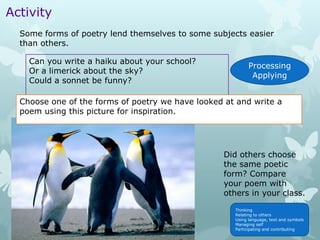
  Choose one of the forms of poetry we have looked at and write a
  poem using this picture for inspiration.


                                                   Did others choose
                                                   the same poetic
                                                   form? Compare
                                                   your poem with
                                                   others in your class.
                                                      Thinking
                                                      Relating to others
                                                      Using language, text and symbols
                                                      Managing self
                                                      Participating and contributing
Gathering
                                                                  Processing
    Task: Poetry Anthology                                         Applying

 This collection of poems/song lyrics will be based on a theme
  called Living in New Zealand. Before you begin your teacher will
  encourage you to brainstorm aspects of your life and your life in
  Aotearoa.


 This assessment may be completed individually or in pairs.
  If choosing to work in pairs you must complete double the
  amount an individual does.


 This anthology will include at least 3 (6) original works
  written by you in chosen poetic forms on the living in New
  Zealand theme. One of these original poems must be at least 10
  lines in length. (Free verse)
 http://edhelper.com/ReadingComprehension_31_14.html

                                              Thinking
 http://thewordshop.tripod.com/forms.html    Relating to others
                                              Using language, text and symbols
                                              Managing self
                                              Participating and contributing
Getting started
 Brainstorm, what aspects of living in New Zealand you wish to focus on.


 Also your anthology will include at least 3 (6) chosen poems/song
  lyrics by a variety of New Zealand writers.
Poetry Links:


 http://aonzpsa.blogspot.co.nz/


 http://newzealandpoetry.org/journal/


 http://www.nzetc.org/iiml/bestnzpoems/index.html This link is great. Just
  open, click on the year then contents. Some poems in this collection are
  audible.


 If you want to include song lyrics you will do the research. The writer(s) must
  be living in, or born in New Zealand.
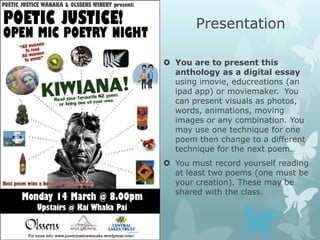
Presentation

 You are to present this
  anthology as a digital essay
  using imovie, educreations (an
  ipad app) or moviemaker. You
  can present visuals as photos,
  words, animations, moving
  images or any combination. You
  may use one technique for one
  poem then change to a different
  technique for the next poem.
 You must record yourself reading
  at least two poems (one must be
  your creation). These may be
  shared with the class.
Helpful links
Check out these links to see what can be done with animated
poetry.
 Here are some of Billy Collins (past Poets Laureate) poetry which
  has been turned into short animated films:
  http://www.bcactionpoet.org/
   You might also like to see/hear him speak in this TED Talk!
   http://www.ted.com/talks/billy_collins_everyday_moments_caug
   ht_in_time.html


 You will have class and homework time to research, write, collect
  and present your anthology.


 Follow the timeline on Ultranet to keep track of when this
  assessment is due.
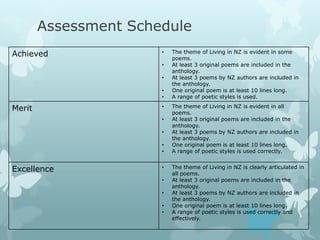
Assessment Schedule
Achieved               •   The theme of Living in NZ is evident in some
                           poems.
                       •   At least 3 original poems are included in the
                           anthology.
                       •   At least 3 poems by NZ authors are included in
                           the anthology.
                       •   One original poem is at least 10 lines long.
                       •   A range of poetic styles is used.

Merit                  •   The theme of Living in NZ is evident in all
                           poems.
                       •   At least 3 original poems are included in the
                           anthology.
                       •   At least 3 poems by NZ authors are included in
                           the anthology.
                       •   One original poem is at least 10 lines long.
                       •   A range of poetic styles is used correctly.


Excellence             •   The theme of Living in NZ is clearly articulated in
                           all poems.
                       •   At least 3 original poems are included in the
                           anthology.
                       •   At least 3 poems by NZ authors are included in
                           the anthology.
                       •   One original poem is at least 10 lines long.
                       •   A range of poetic styles is used correctly and
                           effectively.

Poetry Anthology

  • 1.
    Types of Poetry Creatinga poetry anthology Christine Wells & Gavin Fitzhenry
  • 2.
    Learning Intentions  Researchdifferent types of poetry  Identify and describe key characteristics of each type of poetry  Identify a theme to write poetry about
  • 3.
    Success Criteria  Demonstrateknowledge of different types of poetry by creating a poetry anthology  Demonstrate understanding of a theme by writing poetry based upon the theme
  • 4.
    Gathering Processing Thinking Applying Random Poetry Relating to others Using language, text and symbols Managing self Participating and contributing 1.Choose a stimulating resource e.ga photo, ornament, or a skull. 2.Divide class into 3 groups. 3.Ask class to study resource intensely. 4.Ask each person to write down 1 word about the resource. Group 1 = a noun each Group 2 = a verb each Group 3 = an adjective each 5. Each word is thought of individually without discussion. It is written on a piece of paper and put into a box. 6. The words are then mixed up and drawn out randomly. 7. As they are drawn out, they are called out and each student writes down the words in long lines keeping the order strictly as drawn. 8. The class is now asked to produce a poem from the words
  • 6.
    Gathering Processing Kinaesthetic Poem 1.Hand out poetry anthologies. 2.Give everyone a number between 1 and 5. 3.Ask everyone to turn to page 10 and write down the line number which corresponds to the number they have been given. 4.Repeat x 7 5.Students read their poem to their neighbour and then share with class. 6.Give title and illustrate. Thinking Relating to others Using language, text and symbols Managing self Participating and contributing
  • 7.
    Haiku Gathering Haiku poems come from Japan. Haiku usually have simple themes and images. Haiku are short poems, usually seventeen syllables long: the first and third line contain five syllables the second line contains seven syllables. The graveyard stands still A moment is a lifetime People pass beyond Thinking Managing self
  • 8.
    Haiku Flourishing despite Your rough inconstant climate, I shake but am still. Processing Count the syllables. Do these poems conform to the rules of haiku? Your name is on the Internet under those dead - Resting at St Mark’s. Haikus often capture a feeling, a perception or a snapshot of something. Although brief they can provoke deep thought. Thinking Managing self Participating and contributing
  • 9.
    Haiku Try writingyour own Haiku. Choose a simple idea: a leaf a puddle a cloud a time of day/the year. Remember, your Haiku might capture: a scene a thought Thinking an atmosphere Using language, text and symbols a moment. Managing self Participating and contributing Applying
  • 10.
    Haiku Processing Now read this poem How does Wendy Cope break the usual conventions of the haiku? Strugnell’s Haiku The opening to the poem November evening; creates an image of an autumn The moon is up, rooks settle, evening. The pubs are open. Wendy Cope The part about the pub surprises us because this is not what we Thinking expect the poet to be thinking about. Relating to others Using language, text and symbols Managing self Participating and contributing
  • 11.
  • 12.
    Gathering Limerick rules  The limerick consists of five lines.  The last line always rhymes with the first two lines.  The third and fourth lines rhyme with each other. Thinking Managing self  Rhyme scheme aa bb a Participating and contributing  Lines one, two and five may have from eight to eleven syllables.  Lines three and four may have from five to seven syllables.  The last line of the limerick is special as it contains the joke or punch line.
  • 13.
    Limerick Gathering Processing A limerick is a fun, comic type of poem. Look at these example and, in pairs, see if you can make a list of the features of a limerick. There was an old man with a beard, Who said, ‘It’s just as I feared – Two owls and a hen, Four larks and a wren, Have all built their nests in my beard. There once was a girl from Pinner, Who ate spiders with chips for her dinner. They were tricky to catch, She was really no match, And by Christmas was very much thinner. Thinking Relating to others Using language, text and symbols Managing self Participating and contributing
  • 14.
    Limerick Limericks are usually five lines in length. Limericks normally have a rhyme scheme of a,a,b,b,a and follow a regular rhythm. Limericks often begin with similar lines such as: There once was a man from… There was a young lady from… There is a sing-song quality to limericks that make them suitable for light-hearted, funny ideas. Thinking Gathering Managing self Participating and contributing
  • 15.
    Limerick Nowhave ago at writing your own limerick. Remember to use the correct rhyme scheme and rhythm. Here are some starters you might try: There was a young man from Orewa … A young student who truanted school … A teacher who didn’t like teaching … Or you could write a limerick about a NZ celebrity! Thinking Using language, text Processing and symbols Applying Managing self Participating and contributing
  • 16.
  • 17.
    Sonnet Thinking Managing self A sonnet is a lyric poem of fourteen lines in iambic pentameter, linked by a pre-set rhyme scheme. Shakespeare wrote lots of sonnets which were particularly popular in the Jacobean and Elizabethan eras. Often sonnets have love as their theme. On the next slide you will see another Shakespeare sonnet, from his play Romeo and Juliet. Drag the letters at the bottom of the slide next to each line of poetry to show the rhyme scheme of the sonnet. Gathering
  • 18.
  • 19.
    Activity Someforms of poetry lend themselves to some subjects easier than others. Can you write a haiku about your school? Processing Or a limerick about the sky? Applying Could a sonnet be funny? Choose one of the forms of poetry we have looked at and write a poem using this picture for inspiration. Did others choose the same poetic form? Compare your poem with others in your class. Thinking Relating to others Using language, text and symbols Managing self Participating and contributing
  • 20.
    Gathering Processing Task: Poetry Anthology Applying  This collection of poems/song lyrics will be based on a theme called Living in New Zealand. Before you begin your teacher will encourage you to brainstorm aspects of your life and your life in Aotearoa.  This assessment may be completed individually or in pairs. If choosing to work in pairs you must complete double the amount an individual does.  This anthology will include at least 3 (6) original works written by you in chosen poetic forms on the living in New Zealand theme. One of these original poems must be at least 10 lines in length. (Free verse)  http://edhelper.com/ReadingComprehension_31_14.html Thinking  http://thewordshop.tripod.com/forms.html Relating to others Using language, text and symbols Managing self Participating and contributing
  • 21.
    Getting started  Brainstorm,what aspects of living in New Zealand you wish to focus on.  Also your anthology will include at least 3 (6) chosen poems/song lyrics by a variety of New Zealand writers. Poetry Links:  http://aonzpsa.blogspot.co.nz/  http://newzealandpoetry.org/journal/  http://www.nzetc.org/iiml/bestnzpoems/index.html This link is great. Just open, click on the year then contents. Some poems in this collection are audible.  If you want to include song lyrics you will do the research. The writer(s) must be living in, or born in New Zealand.
  • 22.
    Presentation  You areto present this anthology as a digital essay using imovie, educreations (an ipad app) or moviemaker. You can present visuals as photos, words, animations, moving images or any combination. You may use one technique for one poem then change to a different technique for the next poem.  You must record yourself reading at least two poems (one must be your creation). These may be shared with the class.
  • 23.
    Helpful links Check outthese links to see what can be done with animated poetry.  Here are some of Billy Collins (past Poets Laureate) poetry which has been turned into short animated films: http://www.bcactionpoet.org/ You might also like to see/hear him speak in this TED Talk! http://www.ted.com/talks/billy_collins_everyday_moments_caug ht_in_time.html  You will have class and homework time to research, write, collect and present your anthology.  Follow the timeline on Ultranet to keep track of when this assessment is due.
  • 24.
    Assessment Schedule Achieved • The theme of Living in NZ is evident in some poems. • At least 3 original poems are included in the anthology. • At least 3 poems by NZ authors are included in the anthology. • One original poem is at least 10 lines long. • A range of poetic styles is used. Merit • The theme of Living in NZ is evident in all poems. • At least 3 original poems are included in the anthology. • At least 3 poems by NZ authors are included in the anthology. • One original poem is at least 10 lines long. • A range of poetic styles is used correctly. Excellence • The theme of Living in NZ is clearly articulated in all poems. • At least 3 original poems are included in the anthology. • At least 3 poems by NZ authors are included in the anthology. • One original poem is at least 10 lines long. • A range of poetic styles is used correctly and effectively.