Assessment- Making Thinking Visible
Cormac McGrath
Director Unit for Medical Education (CLK, LIME)
11/24/15Centre for Medical Education, Karolinska Institutet
Agenda: Assessment and MCQs
 Student learning
 Interpolated memory tests
 Formative and summative assessment
 Feedback
 Outcome based education
 Constructive alignment
 Criterion versus norm based assessment
 Sketching a way forward
 Constructing MCQs
 Validating MCQs
 Think aloud protocols
 Digitalising exams
Centre for Medical Education, Karolinska Institutet
From idea to action: a series of four
workshops
 MCQ construction
 Building a database
 Testing your MCQs
 Face validity
 Testing on students
 Talk-aloud protocols
 Scaling up
 digitalising the project
11/24/15Centre for Medical Education, Karolinska Institutet
Discussion
 Positive experiences of assessing students’ work
 What concerns/ queries do you have about assessment?
 Pair and Share
2-3 min
11/24/15Centre for Medical Education, Karolinska Institutet
Do student know what they don’t know?
Dunning-Kreuger effect
 Students may:
 fail to recognize their own
lack of skill
 fail to recognize genuine
skill in others
 fail to recognize the extent
of their inadequacy
 recognize and
acknowledge their own
lack of skill, after they are
exposed to training for
that skill
11/24/15Centre for Medical Education, Karolinska Institutet
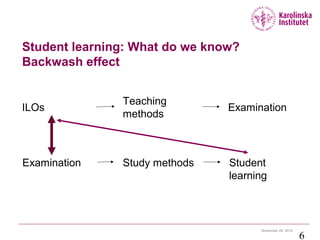
Student learning: What do we know?
Backwash effect
November 24, 2015
6
ILOs
Teaching
methods
Examination
Examination Study methods Student
learning
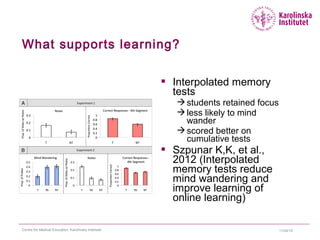
What supports learning?
 Interpolated memory
tests
students retained focus
less likely to mind
wander
scored better on
cumulative tests
 Szpunar K,K, et al.,
2012 (Interpolated
memory tests reduce
mind wandering and
improve learning of
online learning)
11/24/15Centre for Medical Education, Karolinska Institutet
What supports learning?
 Interconnectedness
 Meaningfulness
11/24/15Centre for Medical Education, Karolinska Institutet
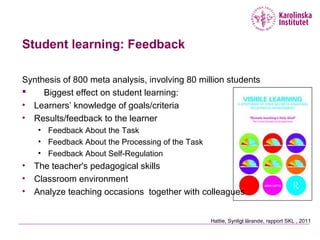
Student learning: Feedback
Synthesis of 800 meta analysis, involving 80 million students
 Biggest effect on student learning:
• Learners’ knowledge of goals/criteria
• Results/feedback to the learner
• Feedback About the Task
• Feedback About the Processing of the Task
• Feedback About Self-Regulation
• The teacher's pedagogical skills
• Classroom environment
• Analyze teaching occasions together with colleagues
Hattie, Synligt lärande, rapport SKL , 2011
How do can we support student
learning?
 Formative assessment
- Continuously runs during the teaching/ learning process
- Diagnostic: gives feedback to students and teachers on
* strengths and weaknesses
* difficulties
* misunderstandings
- Gives an opportunity to modify/ improve
11/24/15Centre for Medical Education, Karolinska Institutet
Discussion
 To which degree do to you provide opportunities for interpolated
“memory” tests in your teaching today?
11/24/15Centre for Medical Education, Karolinska Institutet
Cormac McGrathCormac McGrath, UME 13
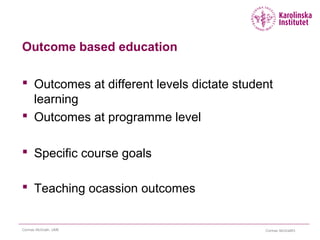
Outcome based education
 Outcomes at different levels dictate student
learning
 Outcomes at programme level
 Specific course goals
 Teaching ocassion outcomes
Cormac McGrathCormac McGrath, UME 14
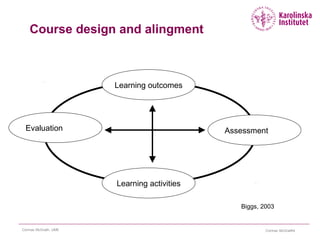
Course design and alingment
Learning outcomes
Assessment
Learning activities
Evaluation
Biggs, 2003
11/24/15Centre for Medical Education, Karolinska Institutet
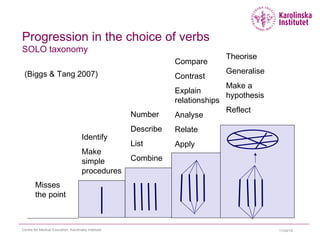
Progression in the choice of verbs
SOLO taxonomy
Identify
Make
simple
procedures
Number
Describe
List
Combine
Compare
Contrast
Explain
relationships
Analyse
Relate
Apply
Misses
the point
Theorise
Generalise
Make a
hypothesis
Reflect
(Biggs & Tang 2007)
Discussion
 Review your intended learning outcomes using the SOLO
taxonomy.
11/24/15Centre for Medical Education, Karolinska Institutet
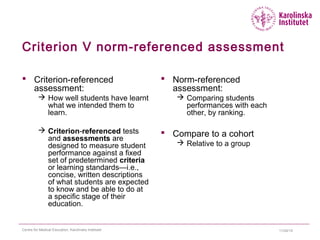
Criterion V norm-referenced assessment
 Criterion-referenced
assessment:
 How well students have learnt
what we intended them to
learn.
 Criterion-referenced tests
and assessments are
designed to measure student
performance against a fixed
set of predetermined criteria
or learning standards—i.e.,
concise, written descriptions
of what students are expected
to know and be able to do at
a specific stage of their
education.
 Norm-referenced
assessment:
 Comparing students
performances with each
other, by ranking.
 Compare to a cohort
 Relative to a group
11/24/15Centre for Medical Education, Karolinska Institutet
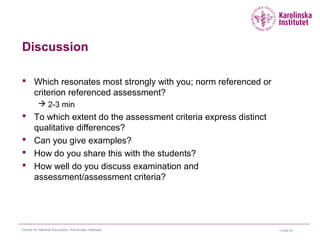
Discussion
 Which resonates most strongly with you; norm referenced or
criterion referenced assessment?
 2-3 min
 To which extent do the assessment criteria express distinct
qualitative differences?
 Can you give examples?
 How do you share this with the students?
 How well do you discuss examination and
assessment/assessment criteria?
11/24/15Centre for Medical Education, Karolinska Institutet
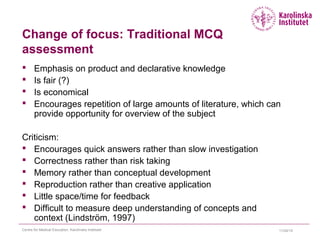
Change of focus: Traditional MCQ
assessment
 Emphasis on product and declarative knowledge
 Is fair (?)
 Is economical
 Encourages repetition of large amounts of literature, which can
provide opportunity for overview of the subject
Criticism:
 Encourages quick answers rather than slow investigation
 Correctness rather than risk taking
 Memory rather than conceptual development
 Reproduction rather than creative application
 Little space/time for feedback
 Difficult to measure deep understanding of concepts and
context (Lindström, 1997)
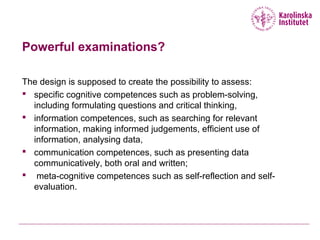
Powerful examinations?
The design is supposed to create the possibility to assess:
 specific cognitive competences such as problem-solving,
including formulating questions and critical thinking,
 information competences, such as searching for relevant
information, making informed judgements, efficient use of
information, analysing data,
 communication competences, such as presenting data
communicatively, both oral and written;
 meta-cognitive competences such as self-reflection and self-
evaluation.
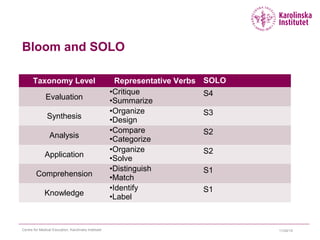
Bloom and SOLO
Taxonomy Level Representative Verbs SOLO
Evaluation
•Critique
•Summarize
S4
Synthesis
•Organize
•Design
S3
Analysis
•Compare
•Categorize
S2
Application
•Organize
•Solve
S2
Comprehension
•Distinguish
•Match
S1
Knowledge
•Identify
•Label
S1
11/24/15Centre for Medical Education, Karolinska Institutet
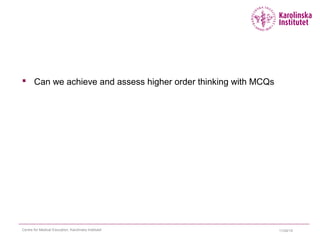
 Can we achieve and assess higher order thinking with MCQs
11/24/15Centre for Medical Education, Karolinska Institutet
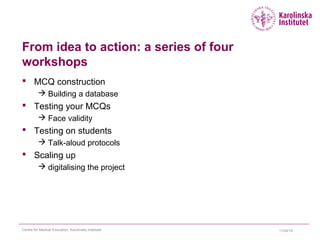
From idea to action: a series of four
workshops
 MCQ construction
 Building a database
 Testing your MCQs
 Face validity
 Testing on students
 Talk-aloud protocols
 Scaling up
 digitalising the project
11/24/15Centre for Medical Education, Karolinska Institutet
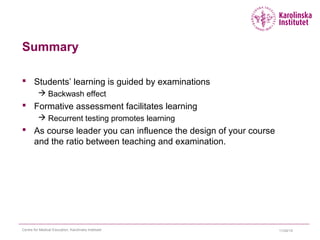
Summary
 Students’ learning is guided by examinations
 Backwash effect
 Formative assessment facilitates learning
 Recurrent testing promotes learning
 As course leader you can influence the design of your course
and the ratio between teaching and examination.
11/24/15Centre for Medical Education, Karolinska Institutet
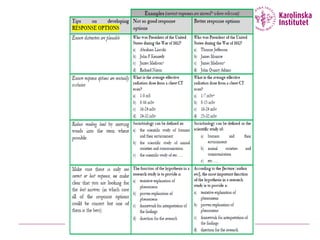
Part two:MCQ
11/24/15Centre for Medical Education, Karolinska Institutet
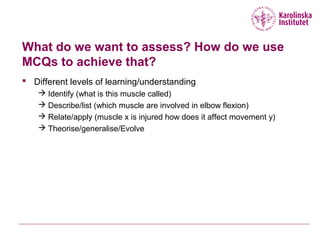
What do we want to assess? How do we use
MCQs to achieve that?
 Different levels of learning/understanding
 Identify (what is this muscle called)
 Describe/list (which muscle are involved in elbow flexion)
 Relate/apply (muscle x is injured how does it affect movement y)
 Theorise/generalise/Evolve
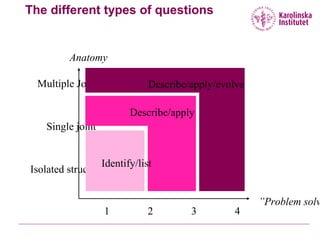
The different types of questions
Anatomy
”Problem solv
Isolated structure
Single joint
Multiple Joints
1 2 3 4
Identify/list
Describe/apply
Describe/apply/evolve
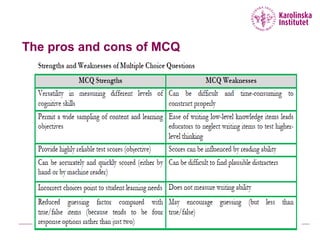
The pros and cons of MCQ
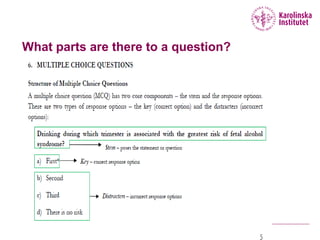
What parts are there to a question?
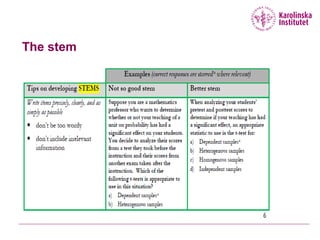
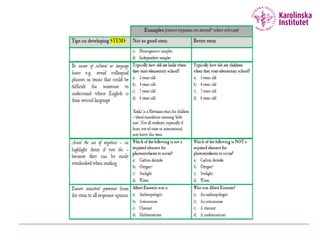
The stem
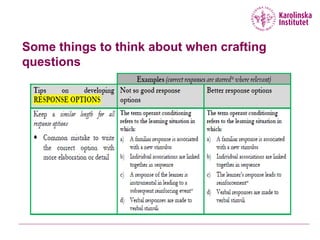
Some things to think about when crafting
questions
Cormac McGrathPedagogik för universitetslärare
35
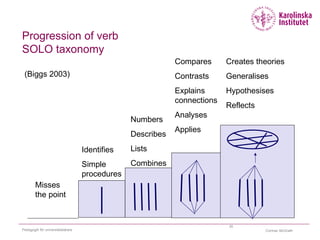
Progression of verb
SOLO taxonomy
Identifies
Simple
procedures
Numbers
Describes
Lists
Combines
Compares
Contrasts
Explains
connections
Analyses
Applies
Misses
the point
Creates theories
Generalises
Hypothesises
Reflects
(Biggs 2003)
11/24/15Centre for Medical Education, Karolinska Institutet
References
 Biggs, J. &C. Tang (2007). Teaching for Quality Learning at
University. SRHE & Open University Press, Buckingham.
 Carroll, J. &C.-M. Zetterling (2009). Guiding students away from
plagiarism. KTH Learning Lab, Stockholm.
 McConnell, DA., Steer, DN., & Owens, KD. (2003) Assessment
and active learning strategies for introductory geology courses.
Journal of Geoscience Education, v. 51 n:o 2, p. 205-216

Assessment fyfa cmg

  • 1.
    Assessment- Making ThinkingVisible Cormac McGrath Director Unit for Medical Education (CLK, LIME) 11/24/15Centre for Medical Education, Karolinska Institutet
  • 2.
    Agenda: Assessment andMCQs  Student learning  Interpolated memory tests  Formative and summative assessment  Feedback  Outcome based education  Constructive alignment  Criterion versus norm based assessment  Sketching a way forward  Constructing MCQs  Validating MCQs  Think aloud protocols  Digitalising exams Centre for Medical Education, Karolinska Institutet
  • 3.
    From idea toaction: a series of four workshops  MCQ construction  Building a database  Testing your MCQs  Face validity  Testing on students  Talk-aloud protocols  Scaling up  digitalising the project 11/24/15Centre for Medical Education, Karolinska Institutet
  • 4.
    Discussion  Positive experiencesof assessing students’ work  What concerns/ queries do you have about assessment?  Pair and Share 2-3 min 11/24/15Centre for Medical Education, Karolinska Institutet
  • 5.
    Do student knowwhat they don’t know? Dunning-Kreuger effect  Students may:  fail to recognize their own lack of skill  fail to recognize genuine skill in others  fail to recognize the extent of their inadequacy  recognize and acknowledge their own lack of skill, after they are exposed to training for that skill 11/24/15Centre for Medical Education, Karolinska Institutet
  • 6.
    Student learning: Whatdo we know? Backwash effect November 24, 2015 6 ILOs Teaching methods Examination Examination Study methods Student learning
  • 7.
    What supports learning? Interpolated memory tests students retained focus less likely to mind wander scored better on cumulative tests  Szpunar K,K, et al., 2012 (Interpolated memory tests reduce mind wandering and improve learning of online learning) 11/24/15Centre for Medical Education, Karolinska Institutet
  • 8.
    What supports learning? Interconnectedness  Meaningfulness 11/24/15Centre for Medical Education, Karolinska Institutet
  • 9.
    Student learning: Feedback Synthesisof 800 meta analysis, involving 80 million students  Biggest effect on student learning: • Learners’ knowledge of goals/criteria • Results/feedback to the learner • Feedback About the Task • Feedback About the Processing of the Task • Feedback About Self-Regulation • The teacher's pedagogical skills • Classroom environment • Analyze teaching occasions together with colleagues Hattie, Synligt lärande, rapport SKL , 2011
  • 10.
    How do canwe support student learning?  Formative assessment - Continuously runs during the teaching/ learning process - Diagnostic: gives feedback to students and teachers on * strengths and weaknesses * difficulties * misunderstandings - Gives an opportunity to modify/ improve 11/24/15Centre for Medical Education, Karolinska Institutet
  • 11.
    Discussion  To whichdegree do to you provide opportunities for interpolated “memory” tests in your teaching today? 11/24/15Centre for Medical Education, Karolinska Institutet
  • 12.
    Cormac McGrathCormac McGrath,UME 13 Outcome based education  Outcomes at different levels dictate student learning  Outcomes at programme level  Specific course goals  Teaching ocassion outcomes
  • 13.
    Cormac McGrathCormac McGrath,UME 14 Course design and alingment Learning outcomes Assessment Learning activities Evaluation Biggs, 2003
  • 14.
    11/24/15Centre for MedicalEducation, Karolinska Institutet Progression in the choice of verbs SOLO taxonomy Identify Make simple procedures Number Describe List Combine Compare Contrast Explain relationships Analyse Relate Apply Misses the point Theorise Generalise Make a hypothesis Reflect (Biggs & Tang 2007)
  • 15.
    Discussion  Review yourintended learning outcomes using the SOLO taxonomy. 11/24/15Centre for Medical Education, Karolinska Institutet
  • 16.
    Criterion V norm-referencedassessment  Criterion-referenced assessment:  How well students have learnt what we intended them to learn.  Criterion-referenced tests and assessments are designed to measure student performance against a fixed set of predetermined criteria or learning standards—i.e., concise, written descriptions of what students are expected to know and be able to do at a specific stage of their education.  Norm-referenced assessment:  Comparing students performances with each other, by ranking.  Compare to a cohort  Relative to a group 11/24/15Centre for Medical Education, Karolinska Institutet
  • 17.
    Discussion  Which resonatesmost strongly with you; norm referenced or criterion referenced assessment?  2-3 min  To which extent do the assessment criteria express distinct qualitative differences?  Can you give examples?  How do you share this with the students?  How well do you discuss examination and assessment/assessment criteria? 11/24/15Centre for Medical Education, Karolinska Institutet
  • 18.
    11/24/15Centre for MedicalEducation, Karolinska Institutet Change of focus: Traditional MCQ assessment  Emphasis on product and declarative knowledge  Is fair (?)  Is economical  Encourages repetition of large amounts of literature, which can provide opportunity for overview of the subject Criticism:  Encourages quick answers rather than slow investigation  Correctness rather than risk taking  Memory rather than conceptual development  Reproduction rather than creative application  Little space/time for feedback  Difficult to measure deep understanding of concepts and context (Lindström, 1997)
  • 19.
    Powerful examinations? The designis supposed to create the possibility to assess:  specific cognitive competences such as problem-solving, including formulating questions and critical thinking,  information competences, such as searching for relevant information, making informed judgements, efficient use of information, analysing data,  communication competences, such as presenting data communicatively, both oral and written;  meta-cognitive competences such as self-reflection and self- evaluation.
  • 20.
    Bloom and SOLO TaxonomyLevel Representative Verbs SOLO Evaluation •Critique •Summarize S4 Synthesis •Organize •Design S3 Analysis •Compare •Categorize S2 Application •Organize •Solve S2 Comprehension •Distinguish •Match S1 Knowledge •Identify •Label S1 11/24/15Centre for Medical Education, Karolinska Institutet
  • 21.
     Can weachieve and assess higher order thinking with MCQs 11/24/15Centre for Medical Education, Karolinska Institutet
  • 22.
    From idea toaction: a series of four workshops  MCQ construction  Building a database  Testing your MCQs  Face validity  Testing on students  Talk-aloud protocols  Scaling up  digitalising the project 11/24/15Centre for Medical Education, Karolinska Institutet
  • 23.
    Summary  Students’ learningis guided by examinations  Backwash effect  Formative assessment facilitates learning  Recurrent testing promotes learning  As course leader you can influence the design of your course and the ratio between teaching and examination. 11/24/15Centre for Medical Education, Karolinska Institutet
  • 24.
    Part two:MCQ 11/24/15Centre forMedical Education, Karolinska Institutet
  • 25.
    What do wewant to assess? How do we use MCQs to achieve that?  Different levels of learning/understanding  Identify (what is this muscle called)  Describe/list (which muscle are involved in elbow flexion)  Relate/apply (muscle x is injured how does it affect movement y)  Theorise/generalise/Evolve
  • 26.
    The different typesof questions Anatomy ”Problem solv Isolated structure Single joint Multiple Joints 1 2 3 4 Identify/list Describe/apply Describe/apply/evolve
  • 27.
    The pros andcons of MCQ
  • 28.
    What parts arethere to a question?
  • 29.
  • 31.
    Some things tothink about when crafting questions
  • 33.
    Cormac McGrathPedagogik föruniversitetslärare 35 Progression of verb SOLO taxonomy Identifies Simple procedures Numbers Describes Lists Combines Compares Contrasts Explains connections Analyses Applies Misses the point Creates theories Generalises Hypothesises Reflects (Biggs 2003)
  • 34.
    11/24/15Centre for MedicalEducation, Karolinska Institutet References  Biggs, J. &C. Tang (2007). Teaching for Quality Learning at University. SRHE & Open University Press, Buckingham.  Carroll, J. &C.-M. Zetterling (2009). Guiding students away from plagiarism. KTH Learning Lab, Stockholm.  McConnell, DA., Steer, DN., & Owens, KD. (2003) Assessment and active learning strategies for introductory geology courses. Journal of Geoscience Education, v. 51 n:o 2, p. 205-216

Editor's Notes

  • #2 Assessment What are the challenges Talk about assessment: formative assessment and summative assessment Constructive alignment Criterion reference assessment-Outcome based curriculum
  • #5 in groups of three
  • #6 The Dunning–Kruger effect is a cognitive bias wherein relatively unskilled individuals suffer from illusory superiority, mistakenly assessing their ability to be much higher than is accurate. Dunning and Kruger attributed this bias to a metacognitive inability of the unskilled to recognize their own ineptitude and evaluate their own ability accurately. Their research also suggests corollaries: he phenomenon was first tested in a series of experiments during 1999 by David Dunning and Justin Kruger of the department of psychology at Cornell University.[1][2] The study was inspired by the case of McArthur Wheeler, a man who robbed two banks after covering his face with lemon juice in the mistaken belief that, because lemon juice is usable as invisible ink, it would prevent his face from being recorded on surveillance cameras.[3] The authors noted that earlier studies suggested that ignorance of standards of performance lies behind a great deal of incorrect self-assessment of competence. This pattern was seen in studies of skills as diverse as reading comprehension, operating a motor vehicle, and playing games such as chess or tennis. Dunning and Kruger proposed that, for a given skill, incompetent people will:[4] fail to recognize their own lack of skill fail to recognize genuine skill in others fail to recognize the extent of their inadequacy recognize and acknowledge their own lack of skill, after they are exposed to training for that skill
  • #7 Backwash-effect could be positive or negative Reflect upon your experiences of assessing students’ work. Discuss in your group some examples of positive and negative backwash effects on assessment. Vi lärare ser målen som det centrala i en kurs. Från studenternas synpunkt är det alltid examinationen som bestämmer målen. Studenter lär vad de tror de ska testas på. = backwash I ett system som inte ligger i linje med vartannat, leder det till ytinlärning Alltså; utforma examinationen så den ligger i linje med målen! Dysthe Assessment is the main factor that influences student learning It is the students’ understanding of the requirements for assessment that makes the ”hidden curriculum” and that has an impact on how students learn. VIKTIG UTGÅNGSPUNKT Viktig utgångspunkt!
  • #10 The effectiveness of marks or written comments has also been investigated. There is considerable evidence that providing written comments (specific FT) is more effective than providing grades (Black & Wiliam, 1998; Crooks, 1988). In one of the early and influential studies, Page (1958) found that feedback in the form of short written comments rather than grades alone significantly improved the test performance of stud The latter can assist in improving task confidence and self- efficacy, which in turn provides resources for more effective and innovative infor- mation and strategy searching (Earley et al., 1990). Seeking help is a learner proficiency, and many types of help-seeking behavior can be considered aspects of self-regulation. A major distinction is made between instrumental help seeking (asking for hints rather than answers) and executive help seeking (asking for answers or direct help that avoids time or work; Nelson-Le Gall, 1981, 1985; Ryan & Pintrich, 1977).
  • #12 Summative assessment- Final. At the end of a course- Descriptive. How well did the students learn the material/ knowledge/ skill - For ranking and selection. Usually no possibility to modify/ improve
  • #15 Olika ordning beroende på om lärare (mål-undervisningsaktivitet-bedömning) student (bedömning-lärandeaktivitet-lärande) men i PLANERING: lärandemål-hur/går att bedöma?-vilken aktivitet förbereder för bedömning/måluppfyllelsen? Alignment istället för CA
  • #16 A way of describing how learners’ performance (level) grow in complexity when mastering academic tasks
  • #17 Review your intended learning outcomes using the SOLO taxonomy.
  • #18 On a criterion-referenced test, every student taking the exam could theoretically fail if they don’t meet the expected standard; alternatively, every student could earn the highest possible score. On criterion-referenced tests, it is not only possible, but desirable, for every student to pass the test or earn a perfect score. Criterion-referenced tests have been compared to driver’s-license exams, which require would-be drivers to achieve a minimum passing score to earn a license.
  • #21 Higher order thinking
  • #26 Assessment is the main factor that influences student learningIt is the students’ understanding of the requirements for assessment that makes the ”hidden curriculum” and that has an impact on how students learn.
  • #36 Svaret, hur värderar vi det? Trowald 70%