05/02/2018 Cormac McGrath 1
05/02/2018 2
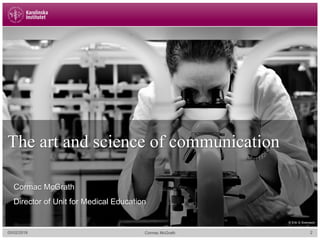
The art and science of communication
Cormac McGrath
Director of Unit for Medical Education
Cormac McGrath
© Erik G Svensson
To communicate science
§ Orally present your research and
adjust to different audiences
§ Reflect on presentation skills and
ability to adjust to different audiences
§ Wakefield scandal (Moore, 2006)
§ The “Werther” effect
(Niederkrotenthaler et al 2006)
§ Reporting on suicide
05/02/2018 Cormac McGrath 3
05/02/2018 Cormac McGrath 4
Milestones during the course
§ Introduction
§ Video recorded 4-5 minute
presentation for general public
§ Literature seminar
§ Media facilitated 4-5 minute
presentation
§ Poster presentation (with poster)
§ Individual reflective statement (with
references).
§ Now organize in groups after the date
that suits you the best.
§ 4-6 groups
§ Introduce yourselves, name,
department, one thing you would like
to share about yourself
§ Each person will introduce someone
else to the whole class. Make sure
you don’t say ehh, or mmmmmm
§ Make sure you know what you want to
say!
05/02/2018 Cormac McGrath 5
05/02/2018 6Cormac McGrath
Do’s and dont’s
In pairs
Think about a lecturer/presentation you have seen in action.
Present one/a few things you thought were good
Present one/a few things you thought were less good
What did s/he do?
Create two lists– do’s and dont’s
What should one do as a presenter?
What should one avoid?
List the three most important points in each
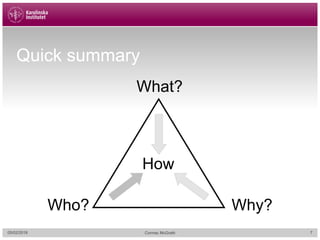
Quick summary
What?
Why?Who?
How
05/02/2018 Cormac McGrath 7
How would you target these
audiences with your project?
Write down a killer opening
statement for each audience:
§ Basic researchers
§ Clinicians
§ Patient organisations
§ Your grandmother
Adapt your message to the audience
(discuss two and two, 5 minutes)
05/02/2018 Cormac McGrath 8
§Part one
§Communication,
perception and
learning
§Part two/three
§Posture, body
language, gestures
and interaction
§To communicate a
message
05/02/2018 Cormac McGrath 9
Common Communication myths
§ Good communication has taken place
§ More communication is better
§ Communication ability is innate
§ The message sent is the message received
§ Communication is unidirectional
05/02/2018 Cormac McGrath 10
Different communicative contexts
• Scientific contexts
– Conferences
– Seminars
– Thesis defence
• Popular scientific contexts
– Media
– Funding organisations
– Society and patient organisations
– Practitioners
§ Focus of this course is the person
on the street.
05/02/2018 Cormac McGrath 11
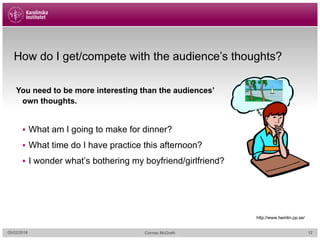
How do I get/compete with the audience’s thoughts?
05/02/2018 Cormac McGrath
You need to be more interesting than the audiences’
own thoughts.
§ What am I going to make for dinner?
§ What time do I have practice this afternoon?
§ I wonder what’s bothering my boyfriend/girlfriend?
http://www.hemlin.pp.se/
12
Lecturing and attention
“Some people talk in their sleep.
Lecturers talk while other people
sleep”
Albert Camus
05/02/2018 Cormac McGrath 13
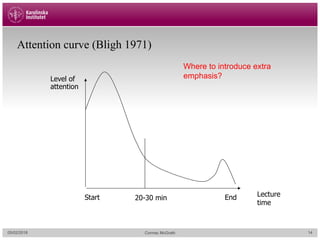
Attention curve (Bligh 1971)
Start End20-30 min
Where to introduce extra
emphasis?Level of
attention
Lecture
time
05/02/2018 Cormac McGrath 14
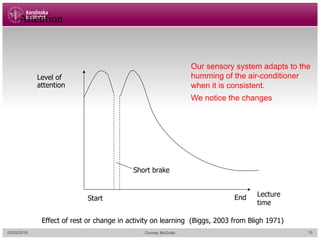
Attention
Level of
attention
Effect of rest or change in activity on learning (Biggs, 2003 from Bligh 1971)
Start End Lecture
time
Short brake
Our sensory system adapts to the
humming of the air-conditioner
when it is consistent.
We notice the changes
05/02/2018 Cormac McGrath 15
Information overload
§Information overload
§Too much information makes understanding
difficult
§Cognitive load (Sweller, Merrienboer 2009)
§ Our working memory is limited, overloading impairs understanding
§ Allow time to process new terminology, new concepts and complexity
§ Reduce extraneous load: make it easy for your audience to get and interpret the
message
05/02/2018 Cormac McGrath 16
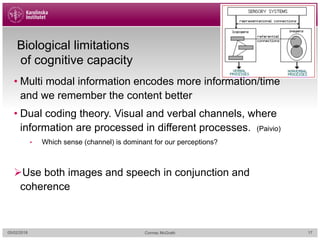
Biological limitations
of cognitive capacity
• Multi modal information encodes more information/time
and we remember the content better
• Dual coding theory. Visual and verbal channels, where
information are processed in different processes. (Paivio)
• Which sense (channel) is dominant for our perceptions?
ØUse both images and speech in conjunction and
coherence
05/02/2018 Cormac McGrath 17
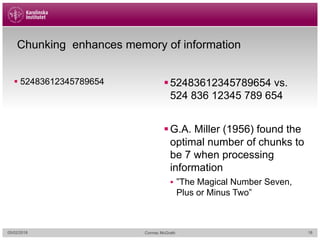
Chunking enhances memory of information
§ 52483612345789654 §52483612345789654 vs.
524 836 12345 789 654
§G.A. Miller (1956) found the
optimal number of chunks to
be 7 when processing
information
§ ”The Magical Number Seven,
Plus or Minus Two”
05/02/2018 Cormac McGrath 18
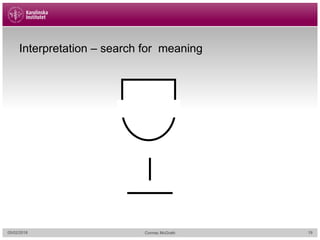
Interpretation – search for meaning
05/02/2018 Cormac McGrath 19
Meaning making
§Biological limitations are nessesary to consider, but
not sufficient to ensure understanding and
remembering
§How do you facilitate meaning making?
§ Relate to previous experience
§ Relate to our needs
§ Who’s your audience?
§ Why should your audience care?
05/02/2018 Cormac McGrath 20
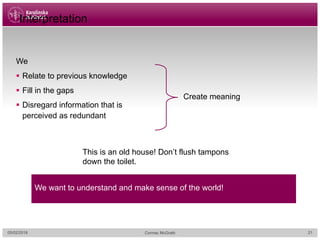
Interpretation
We
§ Relate to previous knowledge
§ Fill in the gaps
§ Disregard information that is
perceived as redundant
We want to understand and make sense of the world!
Create meaning
This is an old house! Don’t flush tampons
down the toilet.
05/02/2018 Cormac McGrath 21
What reaches the consciuos level?
§ We perceive 11 million information bits/second from our senses
§ Only 40 information bits reach the conscious level
§ The conscious experience is delayed with half a second
§ Perceptions reach Cortex after 10-20msek
§ Consciuos experience after 0.5 second
§ Help your audience to sort out impressions to get the core of your message
05/02/2018 Cormac McGrath 22
05/02/2018 Cormac McGrath 23
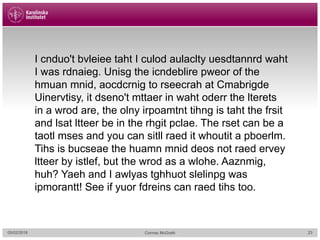
I cnduo't bvleiee taht I culod aulaclty uesdtannrd waht
I was rdnaieg. Unisg the icndeblire pweor of the
hmuan mnid, aocdcrnig to rseecrah at Cmabrigde
Uinervtisy, it dseno't mttaer in waht oderr the lterets
in a wrod are, the olny irpoamtnt tihng is taht the frsit
and lsat ltteer be in the rhgit pclae. The rset can be a
taotl mses and you can sitll raed it whoutit a pboerlm.
Tihs is bucseae the huamn mnid deos not raed ervey
ltteer by istlef, but the wrod as a wlohe. Aaznmig,
huh? Yaeh and I awlyas tghhuot slelinpg was
ipmorantt! See if yuor fdreins can raed tihs too.
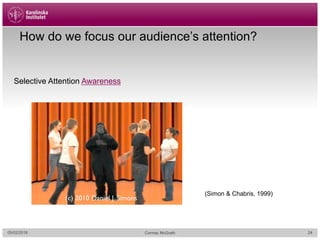
How do we focus our audience’s attention?
Selective Attention Awareness
(Simon & Chabris, 1999)
05/02/2018 Cormac McGrath 24
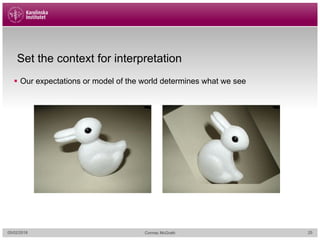
Set the context for interpretation
§ Our expectations or model of the world determines what we see
05/02/2018 Cormac McGrath 25
The curse of knowledge
§ Your everyday knowledge of your topic and scientific field is acquired since many
years. Eventually it becomes transparent to ourselves
§ What does it take for your audience to understand your message?
05/02/2018 Cormac McGrath 26
Summary
§What are the most important things you picked up
so far?
05/02/2018 Cormac McGrath 27
05/02/2018 28Cormac McGrath
So far
• Good communication takes place when the presenter’s intended
message has been internalised by the listener
• Too much information, inhibits learning and understanding
• Too much one-way talking could be taxing for the audience
• Esoteric Jargon complicates things
05/02/2018 29Cormac McGrath05/02/2018 29Cormac McGrath
Your presentation
• What is the basic information you wish to convey?
• What is the right amount of information?
• Be specific, share with your partner!
• Critique each other
05/02/2018 30Cormac McGrath
Elevator Pitch
Key Points
• Identify your goal.
• Explain what you do.
• Communicate your unique selling point.
• Engage with a question.
• Put it all together.
• Practice.
Try to keep a business card or other take-away item with you, which
helps the other person remember you and your message. And cut out
any information that doesn't absolutely need to be there.
Resources
§ http://www.ted.com/talks
§ http://owl.english.purdue.edu/owl/resource/588/04/
§ http://rhetoric.byu.edu/
§ http://www.toastmasters.org/tips.asp
§ http://www.hemlin.pp.se/
05/02/2018 Cormac McGrath 31

2144 st18 intro

  • 1.
  • 2.
    05/02/2018 2 The artand science of communication Cormac McGrath Director of Unit for Medical Education Cormac McGrath © Erik G Svensson
  • 3.
    To communicate science §Orally present your research and adjust to different audiences § Reflect on presentation skills and ability to adjust to different audiences § Wakefield scandal (Moore, 2006) § The “Werther” effect (Niederkrotenthaler et al 2006) § Reporting on suicide 05/02/2018 Cormac McGrath 3
  • 4.
  • 5.
    Milestones during thecourse § Introduction § Video recorded 4-5 minute presentation for general public § Literature seminar § Media facilitated 4-5 minute presentation § Poster presentation (with poster) § Individual reflective statement (with references). § Now organize in groups after the date that suits you the best. § 4-6 groups § Introduce yourselves, name, department, one thing you would like to share about yourself § Each person will introduce someone else to the whole class. Make sure you don’t say ehh, or mmmmmm § Make sure you know what you want to say! 05/02/2018 Cormac McGrath 5
  • 6.
    05/02/2018 6Cormac McGrath Do’sand dont’s In pairs Think about a lecturer/presentation you have seen in action. Present one/a few things you thought were good Present one/a few things you thought were less good What did s/he do? Create two lists– do’s and dont’s What should one do as a presenter? What should one avoid? List the three most important points in each
  • 7.
  • 8.
    How would youtarget these audiences with your project? Write down a killer opening statement for each audience: § Basic researchers § Clinicians § Patient organisations § Your grandmother Adapt your message to the audience (discuss two and two, 5 minutes) 05/02/2018 Cormac McGrath 8
  • 9.
    §Part one §Communication, perception and learning §Parttwo/three §Posture, body language, gestures and interaction §To communicate a message 05/02/2018 Cormac McGrath 9
  • 10.
    Common Communication myths §Good communication has taken place § More communication is better § Communication ability is innate § The message sent is the message received § Communication is unidirectional 05/02/2018 Cormac McGrath 10
  • 11.
    Different communicative contexts •Scientific contexts – Conferences – Seminars – Thesis defence • Popular scientific contexts – Media – Funding organisations – Society and patient organisations – Practitioners § Focus of this course is the person on the street. 05/02/2018 Cormac McGrath 11
  • 12.
    How do Iget/compete with the audience’s thoughts? 05/02/2018 Cormac McGrath You need to be more interesting than the audiences’ own thoughts. § What am I going to make for dinner? § What time do I have practice this afternoon? § I wonder what’s bothering my boyfriend/girlfriend? http://www.hemlin.pp.se/ 12
  • 13.
    Lecturing and attention “Somepeople talk in their sleep. Lecturers talk while other people sleep” Albert Camus 05/02/2018 Cormac McGrath 13
  • 14.
    Attention curve (Bligh1971) Start End20-30 min Where to introduce extra emphasis?Level of attention Lecture time 05/02/2018 Cormac McGrath 14
  • 15.
    Attention Level of attention Effect ofrest or change in activity on learning (Biggs, 2003 from Bligh 1971) Start End Lecture time Short brake Our sensory system adapts to the humming of the air-conditioner when it is consistent. We notice the changes 05/02/2018 Cormac McGrath 15
  • 16.
    Information overload §Information overload §Toomuch information makes understanding difficult §Cognitive load (Sweller, Merrienboer 2009) § Our working memory is limited, overloading impairs understanding § Allow time to process new terminology, new concepts and complexity § Reduce extraneous load: make it easy for your audience to get and interpret the message 05/02/2018 Cormac McGrath 16
  • 17.
    Biological limitations of cognitivecapacity • Multi modal information encodes more information/time and we remember the content better • Dual coding theory. Visual and verbal channels, where information are processed in different processes. (Paivio) • Which sense (channel) is dominant for our perceptions? ØUse both images and speech in conjunction and coherence 05/02/2018 Cormac McGrath 17
  • 18.
    Chunking enhances memoryof information § 52483612345789654 §52483612345789654 vs. 524 836 12345 789 654 §G.A. Miller (1956) found the optimal number of chunks to be 7 when processing information § ”The Magical Number Seven, Plus or Minus Two” 05/02/2018 Cormac McGrath 18
  • 19.
    Interpretation – searchfor meaning 05/02/2018 Cormac McGrath 19
  • 20.
    Meaning making §Biological limitationsare nessesary to consider, but not sufficient to ensure understanding and remembering §How do you facilitate meaning making? § Relate to previous experience § Relate to our needs § Who’s your audience? § Why should your audience care? 05/02/2018 Cormac McGrath 20
  • 21.
    Interpretation We § Relate toprevious knowledge § Fill in the gaps § Disregard information that is perceived as redundant We want to understand and make sense of the world! Create meaning This is an old house! Don’t flush tampons down the toilet. 05/02/2018 Cormac McGrath 21
  • 22.
    What reaches theconsciuos level? § We perceive 11 million information bits/second from our senses § Only 40 information bits reach the conscious level § The conscious experience is delayed with half a second § Perceptions reach Cortex after 10-20msek § Consciuos experience after 0.5 second § Help your audience to sort out impressions to get the core of your message 05/02/2018 Cormac McGrath 22
  • 23.
    05/02/2018 Cormac McGrath23 I cnduo't bvleiee taht I culod aulaclty uesdtannrd waht I was rdnaieg. Unisg the icndeblire pweor of the hmuan mnid, aocdcrnig to rseecrah at Cmabrigde Uinervtisy, it dseno't mttaer in waht oderr the lterets in a wrod are, the olny irpoamtnt tihng is taht the frsit and lsat ltteer be in the rhgit pclae. The rset can be a taotl mses and you can sitll raed it whoutit a pboerlm. Tihs is bucseae the huamn mnid deos not raed ervey ltteer by istlef, but the wrod as a wlohe. Aaznmig, huh? Yaeh and I awlyas tghhuot slelinpg was ipmorantt! See if yuor fdreins can raed tihs too.
  • 24.
    How do wefocus our audience’s attention? Selective Attention Awareness (Simon & Chabris, 1999) 05/02/2018 Cormac McGrath 24
  • 25.
    Set the contextfor interpretation § Our expectations or model of the world determines what we see 05/02/2018 Cormac McGrath 25
  • 26.
    The curse ofknowledge § Your everyday knowledge of your topic and scientific field is acquired since many years. Eventually it becomes transparent to ourselves § What does it take for your audience to understand your message? 05/02/2018 Cormac McGrath 26
  • 27.
    Summary §What are themost important things you picked up so far? 05/02/2018 Cormac McGrath 27
  • 28.
    05/02/2018 28Cormac McGrath Sofar • Good communication takes place when the presenter’s intended message has been internalised by the listener • Too much information, inhibits learning and understanding • Too much one-way talking could be taxing for the audience • Esoteric Jargon complicates things
  • 29.
    05/02/2018 29Cormac McGrath05/02/201829Cormac McGrath Your presentation • What is the basic information you wish to convey? • What is the right amount of information? • Be specific, share with your partner! • Critique each other
  • 30.
    05/02/2018 30Cormac McGrath ElevatorPitch Key Points • Identify your goal. • Explain what you do. • Communicate your unique selling point. • Engage with a question. • Put it all together. • Practice. Try to keep a business card or other take-away item with you, which helps the other person remember you and your message. And cut out any information that doesn't absolutely need to be there.
  • 31.
    Resources § http://www.ted.com/talks § http://owl.english.purdue.edu/owl/resource/588/04/ §http://rhetoric.byu.edu/ § http://www.toastmasters.org/tips.asp § http://www.hemlin.pp.se/ 05/02/2018 Cormac McGrath 31