 Is teaching an art or a science?
 What are your experiences
 Good/bad
 Is motivation a prerequisite of result of teaching?
09/10/2015Cormac McGrath Unit for Medical Education (CME)
Om lärande
 Lärande påverkas av känslor (den affektiva domänen)
 Lärande påverkas av kunskaps-(teoretisk) utveckling
 Lärande begränsas av föreställningar om lärande
 Lärande begränsas av studieteknik
 Lärande är kontextuell
 Studenter lär sig om de har motivation (inre & yttre) och tydliga
och höga prestationsmål
 Studenter lär sig genom att göra, företrädesvis genom att länka
teori och praktik i en cyklisk process
 Studenter kommer sannolikt att föredra olika inlärningsstilar
 Studenter lär sig genom att konstruera mening
 Återkoppling är starkast korrelerat till lärande
09/10/2015Cormac McGrath Unit for Medical Education (CME)
But, first things first…
09/10/2015Cormac McGrath Unit for Medical Education (CME)
 Discuss different types of knowledge ToK
 Identify a Teaching occasion/pedagogical encounter involving
ToK
 Discuss misconceptions in relation to ToK
 Discuss and reflect upon deep/surface approaches to learning
 Reflect on how this can make sense to your practice.
09/10/2015Cormac McGrath Unit for Medical Education (CME)
On Learning, knowledge and
understanding
Cormac McGrath
Unit for Medical Education (UME))
Institutionen LIME
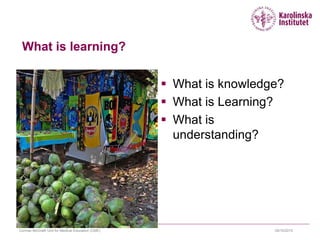
What is learning?
 What is knowledge?
 What is Learning?
 What is
understanding?
09/10/2015Cormac McGrath Unit for Medical Education (CME)
Knowledge & Understanding
 All Boys Should Come
Home Please
 Johnny was a chemist’s son,
but Johnny is no more, for
what he thought was H20
was H2SO4.
 Mums Very Early Morning
Jam Sandwiches Usually
Nauseate People
 Old People From Texas Eat
Spiders
 ”Understanding is the
interconnection of lots of disparate
things – the way it all hangs
together. The feeling that you
understand how the whole thing is
connected up – you can make
sense of it internally… It is as
though one’s mind has
finally ’locked’ in to the pattern… If
you really understand something,
why it works, and what the idea is
behind it, you cannot not
understand it afterwards – you
cannot ’de-understand’ it!”
09/10/2015Cormac McGrath Unit for Medical Education (CME)9 oktober 2015
Learning is complex
 ”Right now, well its not so much about
understanding, more like terms and concepts”
(student)
09/10/2015Cormac McGrath Unit for Medical Education (CME)
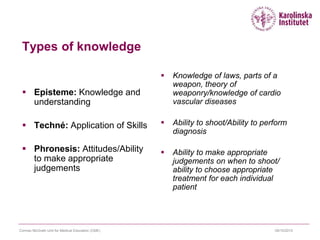
Types of knowledge
 Episteme: Knowledge and
understanding
 Techné: Application of Skills
 Phronesis: Attitudes/Ability
to make appropriate
judgements
 Knowledge of laws, parts of a
weapon, theory of
weaponry/knowledge of cardio
vascular diseases
 Ability to shoot/Ability to perform
diagnosis
 Ability to make appropriate
judgements on when to shoot/
ability to choose appropriate
treatment for each individual
patient
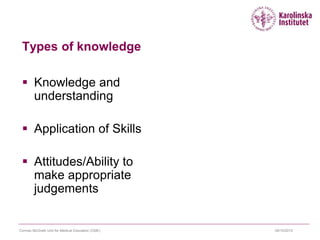
Types of knowledge
 Knowledge and
understanding
 Application of Skills
 Attitudes/Ability to
make appropriate
judgements
09/10/2015Cormac McGrath Unit for Medical Education (CME)
09/10/2015
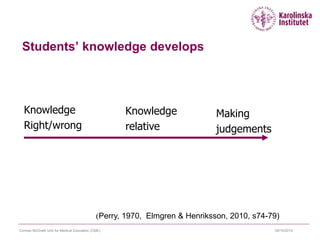
Students’ knowledge develops
(Perry, 1970, Elmgren & Henriksson, 2010, s74-79)
Knowledge
Right/wrong
Knowledge
relative
Making
judgements
Cormac McGrath Unit for Medical Education (CME)
09/10/2015Cormac McGrath Unit for Medical Education (CME)
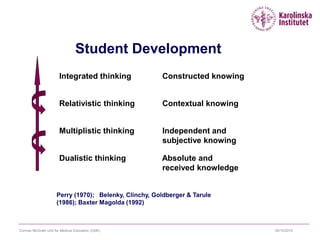
Student Development
Integrated thinking Constructed knowing
Relativistic thinking Contextual knowing
Multiplistic thinking Independent and
subjective knowing
Dualistic thinking Absolute and
received knowledge
Perry (1970); Belenky, Clinchy, Goldberger & Tarule
(1986); Baxter Magolda (1992)
Reflection: Moving away from the grand
theory.
 Why does a bun cost 15 kr?
09/10/2015Cormac McGrath Unit for Medical Education (CME)
Retention research
 15222936435057  15 22 29 36 43 50 57
 Comprehensive theory
of learning
09/10/2015Cormac McGrath Unit for Medical Education (CME)
Research on Student learning
Researchers at Gothenburg University (Ference Marton
et al) 70s
Interested in studying how people act differently in relation
 Written text
 How they approached the task
(Marton mfl, 1977)
09/10/2015Cormac McGrath Unit for Medical Education (CME)
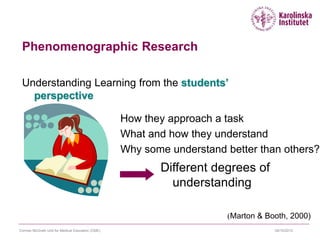
Phenomenographic Research
Understanding Learning from the students’
perspective
How they approach a task
What and how they understand
Why some understand better than others?
(Marton & Booth, 2000)
Different degrees of
understanding
09/10/2015Cormac McGrath Unit for Medical Education (CME)
Understanding – meaningful learning
Integration = to assimilate new knowledge with
existing
It’s about
 Learning in a context
 Looking for synthesis; different areas old and
new
 Develop a sense of wholeness
(interconnectedness) (Ausubel mfl, 1978)
09/10/2015Cormac McGrath Unit for Medical Education (CME)
Understand content in a qualitatively
different way
Students (Economics):
Why does a bun cost 15 kr?
 Price is decided by supply and demand
 Price represents the bun’s actual value
(Marton mfl, 1977)
09/10/2015Cormac McGrath Unit for Medical Education (CME)
Understand content in a qualitatively
different way
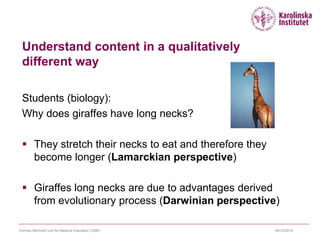
Students (biology):
Why does giraffes have long necks?
 They stretch their necks to eat and therefore they
become longer (Lamarckian perspective)
 Giraffes long necks are due to advantages derived
from evolutionary process (Darwinian perspective)
Approaches to Learning
Deep Approach
 Learning for
understanding, not just
isolated facts;
 Relating new
knowledge to existing
knowledge;
 Questioning of
conclusions;
 Intrinsic motivation.
Surface Approach
 Memorizing facts
without seeking
meaning,
 Following routine;
 Accepting conclusions
without questioning;
 Extrinsic motivation.
09/10/2015Cormac McGrath Unit for Medical Education (CME)
An example:
” To pass an exam it is really
important to use the notes from
the lectures, because that is
probably what the exam is
gonna test, if you have been to
the lecture. So if you can
memorise that, and also the
parts of the book that you have
been directed to, then you are
most likely getting a ’pass’.”
” Well, I usually try to make my own
notes and write summaries on
what I have read. Also, me and
a peer student often study
together, and we try to explain
passages that are difficult to
each other. That usually works
for me, anyway. And for my
friend too, since none of us
have failed so far!”
09/10/2015Cormac McGrath Unit for Medical Education (CME)
Qualitative differences in learning
Approaches to learning are influenced by:
 Intention (remember-understand)
 What will be learned (content)
 Context
09/10/2015Cormac McGrath Unit for Medical Education (CME)
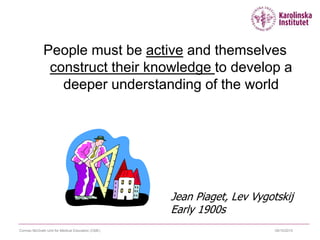
People must be active and themselves
construct their knowledge to develop a
deeper understanding of the world
Jean Piaget, Lev Vygotskij
Early 1900s
Reflection
 What does the surface/deep
distinction mean/suggest to
you?
09/10/2015Cormac McGrath Unit for Medical Education (CME)
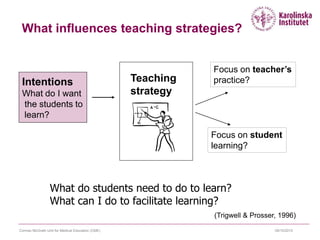
What influences teaching strategies?
Teaching
strategy
Intentions
What do I want
the students to
learn?
Focus on teacher’s
practice?
Focus on student
learning?
What do students need to do to learn?
What can I do to facilitate learning?
(Trigwell & Prosser, 1996)
09/10/2015Cormac McGrath Unit for Medical Education (CME)
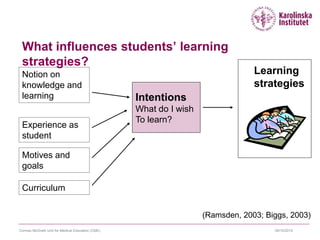
What influences students’ learning
strategies?
Notion on
knowledge and
learning
Learning
strategies
Experience as
student
Motives and
goals
Intentions
What do I wish
To learn?
Curriculum
(Ramsden, 2003; Biggs, 2003)
09/10/2015Cormac McGrath Unit for Medical Education (CME)
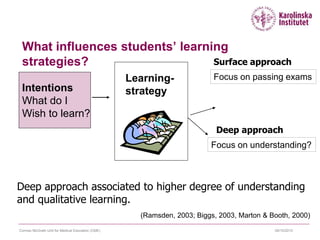
What influences students’ learning
strategies?
Learning-
strategyIntentions
What do I
Wish to learn?
Focus on passing exams
Focus on understanding?
Deep approach associated to higher degree of understanding
and qualitative learning.
Surface approach
Deep approach
(Ramsden, 2003; Biggs, 2003, Marton & Booth, 2000)
09/10/2015Cormac McGrath Unit for Medical Education (CME)
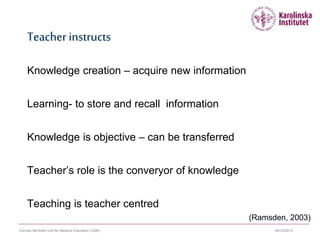
Teacher instructs
Knowledge creation – acquire new information
Learning- to store and recall information
Knowledge is objective – can be transferred
Teacher’s role is the converyor of knowledge
Teaching is teacher centred
(Ramsden, 2003)
09/10/2015Cormac McGrath Unit for Medical Education (CME)
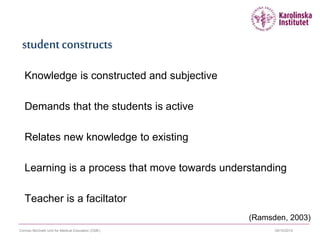
studentconstructs
Knowledge is constructed and subjective
Demands that the students is active
Relates new knowledge to existing
Learning is a process that move towards understanding
Teacher is a faciltator
(Ramsden, 2003)
09/10/2015Cormac McGrath Unit for Medical Education (CME)
Teachers’ approach influences the
students’ approach!
Teachers with an instructive point of
departure/perspective influence students to
surface approaches
Teachers with a constructivist point of
departure/perspective influence students to deep
approaches
(Trigwell et al 1999)
Muddiest point
09/10/2015Cormac McGrath Unit for Medical Education (CME)
Summary
 We can control and influence certain features of the students
learning experience, but only certain. How can you influence
your students learning and facilitate their learning?
09/10/2015Cormac McGrath Unit for Medical Education (CME)
09/10/2015
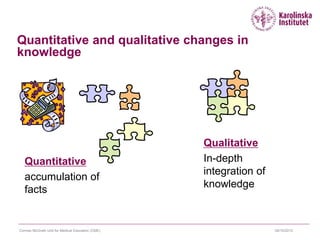
Quantitative and qualitative changes in
knowledge
Quantitative
accumulation of
facts
Qualitative
In-depth
integration of
knowledge
Cormac McGrath Unit for Medical Education (CME)
Reflection…
Return to the TO you described on day one:
What kinds of knowledge are relevant for you?
What do you know about your students’ pre-
knowledge?
What do you know about your students’ perceptions on
what is to be learned?
09/10/2015Cormac McGrath Unit for Medical Education (CME)
Summary
 Discuss different types of knowledge ToK
 Identify a Teaching occasion/pedagogical encounter involving
ToK
 Discuss misconceptions in relation to ToK
 Discuss and reflect upon deep/surface approaches to learning
 Reflect on how this can make sense to your practice.
09/10/2015Cormac McGrath Unit for Medical Education (CME)
Summary
 Looking ahead
 Identify a Teaching occasion/pedagogical encounter involving
ToK
 Discuss and reflect upon deep/surface approaches to learning
and how this may be relevant to your teaching
09/10/2015Cormac McGrath Unit for Medical Education (CME)
09/10/20159 oktober 2015 39
Referenser
Ausubel, D P, Novak, J D & Hanesian, H. (1978) Educational psychology: A
cognitive view. 2nd edition. New York: Holt, Rinehart, and Winston.
Entwistle, N (Ed) (2009) Teaching for Understanding at University,
PalgraveMacMillan,
Entwistle, N & Entwistle, D (2003) Preparing for Examinations: The interplay
of memorising and understanding, and the development of knowledge
objects, Higher Education Research & Development, 22:19-41.
Hedin, A & Svensson, L (1997) Nycklar till kunskap: om motivation, handling
och förståelse i vuxenutbildning. Studentlitteratur, Lund.
Marton, F & Booth, S (2000) Om lärande, Studentlitteratur, Lund.
Marton, F mfl (1977) Inlärning och omvärldsuppfattning, Stockholm, Norstedts
Akademiska Förlag.
Marton, F mfl (1986) Hur vi lär, Stockholm, Rabén & Sjögren.
Marton, F & Pang, M F (2006) On som necessary conditions of learning,
Journal of the Learning Sciences, 15:193-220.
Cormac McGrath Unit for Medical Education (CME)
09/10/20159 oktober 2015 40
Referenser
Meyer,J & Land, R (2006) Treshold concepts and troublesome knowledge: An
introduction, In: Overcoming Barriers to Student Understanding,
Abingdon, Routledge. Pp 3-18.
Nickerson, R (1985) Understanding understanding, American Journal of
Education, 93:201-239.
Perkins, D (1999) The many faces of constructivism, Educational Leadership,
57:6-11.
Pettersen, R (2008) Kvalitetslärande i högre utbildning, Studentlitteratur,
Lund.
Turner, J & Paris, S (1995) How literacy tasks influence children’s motivation
for literacy. The Reading Teacher, 48:662-673.
Weurlander, M, Masiello, I., Söderberg, M. & Wernerson, A. (2009)
Meaningful learning: students’ perceptions of a new form of case seminar
in pathology. Medical Teacher 31 (6):e248-e253.
Weurlander, M., Söderberg, M, Scheja, M., Hult, H. & Wernerson, A. (2011)
Exploring formative assessment as a tool for learning: Students’
experiences of different methods of formative assessment. Assessment
and Evaluation in Higher Education. iFirst
Cormac McGrath Unit for Medical Education (CME)

On learning ghp15 cmg

  • 1.
     Is teachingan art or a science?  What are your experiences  Good/bad  Is motivation a prerequisite of result of teaching? 09/10/2015Cormac McGrath Unit for Medical Education (CME)
  • 2.
    Om lärande  Lärandepåverkas av känslor (den affektiva domänen)  Lärande påverkas av kunskaps-(teoretisk) utveckling  Lärande begränsas av föreställningar om lärande  Lärande begränsas av studieteknik  Lärande är kontextuell  Studenter lär sig om de har motivation (inre & yttre) och tydliga och höga prestationsmål  Studenter lär sig genom att göra, företrädesvis genom att länka teori och praktik i en cyklisk process  Studenter kommer sannolikt att föredra olika inlärningsstilar  Studenter lär sig genom att konstruera mening  Återkoppling är starkast korrelerat till lärande 09/10/2015Cormac McGrath Unit for Medical Education (CME)
  • 3.
    But, first thingsfirst… 09/10/2015Cormac McGrath Unit for Medical Education (CME)
  • 4.
     Discuss differenttypes of knowledge ToK  Identify a Teaching occasion/pedagogical encounter involving ToK  Discuss misconceptions in relation to ToK  Discuss and reflect upon deep/surface approaches to learning  Reflect on how this can make sense to your practice. 09/10/2015Cormac McGrath Unit for Medical Education (CME)
  • 5.
    On Learning, knowledgeand understanding Cormac McGrath Unit for Medical Education (UME)) Institutionen LIME
  • 6.
    What is learning? What is knowledge?  What is Learning?  What is understanding? 09/10/2015Cormac McGrath Unit for Medical Education (CME)
  • 7.
    Knowledge & Understanding All Boys Should Come Home Please  Johnny was a chemist’s son, but Johnny is no more, for what he thought was H20 was H2SO4.  Mums Very Early Morning Jam Sandwiches Usually Nauseate People  Old People From Texas Eat Spiders  ”Understanding is the interconnection of lots of disparate things – the way it all hangs together. The feeling that you understand how the whole thing is connected up – you can make sense of it internally… It is as though one’s mind has finally ’locked’ in to the pattern… If you really understand something, why it works, and what the idea is behind it, you cannot not understand it afterwards – you cannot ’de-understand’ it!” 09/10/2015Cormac McGrath Unit for Medical Education (CME)9 oktober 2015
  • 8.
    Learning is complex ”Right now, well its not so much about understanding, more like terms and concepts” (student) 09/10/2015Cormac McGrath Unit for Medical Education (CME)
  • 9.
    09/10/2015Cormac McGrath Unitfor Medical Education (CME) Types of knowledge  Episteme: Knowledge and understanding  Techné: Application of Skills  Phronesis: Attitudes/Ability to make appropriate judgements  Knowledge of laws, parts of a weapon, theory of weaponry/knowledge of cardio vascular diseases  Ability to shoot/Ability to perform diagnosis  Ability to make appropriate judgements on when to shoot/ ability to choose appropriate treatment for each individual patient
  • 10.
    Types of knowledge Knowledge and understanding  Application of Skills  Attitudes/Ability to make appropriate judgements 09/10/2015Cormac McGrath Unit for Medical Education (CME)
  • 11.
    09/10/2015 Students’ knowledge develops (Perry,1970, Elmgren & Henriksson, 2010, s74-79) Knowledge Right/wrong Knowledge relative Making judgements Cormac McGrath Unit for Medical Education (CME)
  • 12.
    09/10/2015Cormac McGrath Unitfor Medical Education (CME) Student Development Integrated thinking Constructed knowing Relativistic thinking Contextual knowing Multiplistic thinking Independent and subjective knowing Dualistic thinking Absolute and received knowledge Perry (1970); Belenky, Clinchy, Goldberger & Tarule (1986); Baxter Magolda (1992)
  • 13.
    Reflection: Moving awayfrom the grand theory.  Why does a bun cost 15 kr? 09/10/2015Cormac McGrath Unit for Medical Education (CME)
  • 14.
    Retention research  15222936435057 15 22 29 36 43 50 57  Comprehensive theory of learning 09/10/2015Cormac McGrath Unit for Medical Education (CME)
  • 15.
    09/10/2015Cormac McGrath Unitfor Medical Education (CME) Research on Student learning Researchers at Gothenburg University (Ference Marton et al) 70s Interested in studying how people act differently in relation  Written text  How they approached the task (Marton mfl, 1977)
  • 16.
    09/10/2015Cormac McGrath Unitfor Medical Education (CME) Phenomenographic Research Understanding Learning from the students’ perspective How they approach a task What and how they understand Why some understand better than others? (Marton & Booth, 2000) Different degrees of understanding
  • 17.
    09/10/2015Cormac McGrath Unitfor Medical Education (CME) Understanding – meaningful learning Integration = to assimilate new knowledge with existing It’s about  Learning in a context  Looking for synthesis; different areas old and new  Develop a sense of wholeness (interconnectedness) (Ausubel mfl, 1978)
  • 18.
    09/10/2015Cormac McGrath Unitfor Medical Education (CME) Understand content in a qualitatively different way Students (Economics): Why does a bun cost 15 kr?  Price is decided by supply and demand  Price represents the bun’s actual value (Marton mfl, 1977)
  • 19.
    09/10/2015Cormac McGrath Unitfor Medical Education (CME) Understand content in a qualitatively different way Students (biology): Why does giraffes have long necks?  They stretch their necks to eat and therefore they become longer (Lamarckian perspective)  Giraffes long necks are due to advantages derived from evolutionary process (Darwinian perspective)
  • 20.
    Approaches to Learning DeepApproach  Learning for understanding, not just isolated facts;  Relating new knowledge to existing knowledge;  Questioning of conclusions;  Intrinsic motivation. Surface Approach  Memorizing facts without seeking meaning,  Following routine;  Accepting conclusions without questioning;  Extrinsic motivation. 09/10/2015Cormac McGrath Unit for Medical Education (CME)
  • 21.
    09/10/2015Cormac McGrath Unitfor Medical Education (CME) An example: ” To pass an exam it is really important to use the notes from the lectures, because that is probably what the exam is gonna test, if you have been to the lecture. So if you can memorise that, and also the parts of the book that you have been directed to, then you are most likely getting a ’pass’.” ” Well, I usually try to make my own notes and write summaries on what I have read. Also, me and a peer student often study together, and we try to explain passages that are difficult to each other. That usually works for me, anyway. And for my friend too, since none of us have failed so far!”
  • 22.
    09/10/2015Cormac McGrath Unitfor Medical Education (CME) Qualitative differences in learning Approaches to learning are influenced by:  Intention (remember-understand)  What will be learned (content)  Context
  • 23.
    09/10/2015Cormac McGrath Unitfor Medical Education (CME) People must be active and themselves construct their knowledge to develop a deeper understanding of the world Jean Piaget, Lev Vygotskij Early 1900s
  • 24.
    Reflection  What doesthe surface/deep distinction mean/suggest to you? 09/10/2015Cormac McGrath Unit for Medical Education (CME)
  • 25.
    09/10/2015Cormac McGrath Unitfor Medical Education (CME) What influences teaching strategies? Teaching strategy Intentions What do I want the students to learn? Focus on teacher’s practice? Focus on student learning? What do students need to do to learn? What can I do to facilitate learning? (Trigwell & Prosser, 1996)
  • 26.
    09/10/2015Cormac McGrath Unitfor Medical Education (CME) What influences students’ learning strategies? Notion on knowledge and learning Learning strategies Experience as student Motives and goals Intentions What do I wish To learn? Curriculum (Ramsden, 2003; Biggs, 2003)
  • 27.
    09/10/2015Cormac McGrath Unitfor Medical Education (CME) What influences students’ learning strategies? Learning- strategyIntentions What do I Wish to learn? Focus on passing exams Focus on understanding? Deep approach associated to higher degree of understanding and qualitative learning. Surface approach Deep approach (Ramsden, 2003; Biggs, 2003, Marton & Booth, 2000)
  • 28.
    09/10/2015Cormac McGrath Unitfor Medical Education (CME) Teacher instructs Knowledge creation – acquire new information Learning- to store and recall information Knowledge is objective – can be transferred Teacher’s role is the converyor of knowledge Teaching is teacher centred (Ramsden, 2003)
  • 29.
    09/10/2015Cormac McGrath Unitfor Medical Education (CME) studentconstructs Knowledge is constructed and subjective Demands that the students is active Relates new knowledge to existing Learning is a process that move towards understanding Teacher is a faciltator (Ramsden, 2003)
  • 30.
    09/10/2015Cormac McGrath Unitfor Medical Education (CME) Teachers’ approach influences the students’ approach! Teachers with an instructive point of departure/perspective influence students to surface approaches Teachers with a constructivist point of departure/perspective influence students to deep approaches (Trigwell et al 1999)
  • 31.
    Muddiest point 09/10/2015Cormac McGrathUnit for Medical Education (CME)
  • 32.
    Summary  We cancontrol and influence certain features of the students learning experience, but only certain. How can you influence your students learning and facilitate their learning? 09/10/2015Cormac McGrath Unit for Medical Education (CME)
  • 33.
    09/10/2015 Quantitative and qualitativechanges in knowledge Quantitative accumulation of facts Qualitative In-depth integration of knowledge Cormac McGrath Unit for Medical Education (CME)
  • 34.
    Reflection… Return to theTO you described on day one: What kinds of knowledge are relevant for you? What do you know about your students’ pre- knowledge? What do you know about your students’ perceptions on what is to be learned? 09/10/2015Cormac McGrath Unit for Medical Education (CME)
  • 35.
    Summary  Discuss differenttypes of knowledge ToK  Identify a Teaching occasion/pedagogical encounter involving ToK  Discuss misconceptions in relation to ToK  Discuss and reflect upon deep/surface approaches to learning  Reflect on how this can make sense to your practice. 09/10/2015Cormac McGrath Unit for Medical Education (CME)
  • 36.
    Summary  Looking ahead Identify a Teaching occasion/pedagogical encounter involving ToK  Discuss and reflect upon deep/surface approaches to learning and how this may be relevant to your teaching 09/10/2015Cormac McGrath Unit for Medical Education (CME)
  • 37.
    09/10/20159 oktober 201539 Referenser Ausubel, D P, Novak, J D & Hanesian, H. (1978) Educational psychology: A cognitive view. 2nd edition. New York: Holt, Rinehart, and Winston. Entwistle, N (Ed) (2009) Teaching for Understanding at University, PalgraveMacMillan, Entwistle, N & Entwistle, D (2003) Preparing for Examinations: The interplay of memorising and understanding, and the development of knowledge objects, Higher Education Research & Development, 22:19-41. Hedin, A & Svensson, L (1997) Nycklar till kunskap: om motivation, handling och förståelse i vuxenutbildning. Studentlitteratur, Lund. Marton, F & Booth, S (2000) Om lärande, Studentlitteratur, Lund. Marton, F mfl (1977) Inlärning och omvärldsuppfattning, Stockholm, Norstedts Akademiska Förlag. Marton, F mfl (1986) Hur vi lär, Stockholm, Rabén & Sjögren. Marton, F & Pang, M F (2006) On som necessary conditions of learning, Journal of the Learning Sciences, 15:193-220. Cormac McGrath Unit for Medical Education (CME)
  • 38.
    09/10/20159 oktober 201540 Referenser Meyer,J & Land, R (2006) Treshold concepts and troublesome knowledge: An introduction, In: Overcoming Barriers to Student Understanding, Abingdon, Routledge. Pp 3-18. Nickerson, R (1985) Understanding understanding, American Journal of Education, 93:201-239. Perkins, D (1999) The many faces of constructivism, Educational Leadership, 57:6-11. Pettersen, R (2008) Kvalitetslärande i högre utbildning, Studentlitteratur, Lund. Turner, J & Paris, S (1995) How literacy tasks influence children’s motivation for literacy. The Reading Teacher, 48:662-673. Weurlander, M, Masiello, I., Söderberg, M. & Wernerson, A. (2009) Meaningful learning: students’ perceptions of a new form of case seminar in pathology. Medical Teacher 31 (6):e248-e253. Weurlander, M., Söderberg, M, Scheja, M., Hult, H. & Wernerson, A. (2011) Exploring formative assessment as a tool for learning: Students’ experiences of different methods of formative assessment. Assessment and Evaluation in Higher Education. iFirst Cormac McGrath Unit for Medical Education (CME)