To Communicate Science in Different
Contexts, 3 credit points
Course director: Cormac McGrath
Teachers: Cormac McG, Ronny Sejersen,
Anneliese Lilienthal
Administrator: Ingrid Smedberg
Unit for Medical Education, UME
Dept of Learning, Informatics, Management and Ethics (LIME)
The more you share it the better it
becomes!
You + your project – your
treasure
• Status & satisfaction
• Societal impact
• Scientific impact
Dublin descriptors, joint agreement for
doctoral education
[The doctoral student] ”can communicate with their
peers, the larger scholarly community, and with
society in general about their areas of expertise”
(Dublin descriptors 3rd (doctoral) cycle)
The Swedish Higher Education Ordinance
(Högskoleförordningen)
§  For the Degree of Doctor the third-cycle student shall
demonstrate the ability in both national and
international contexts to present and discuss
research and research findings authoritatively in
speech and writing and in dialogue with the
academic community and society in general
(Dublin descriptors 3rd (doctoral) cycle)
”The ability to deliver a polished oral
presentation in front of an audience of
peers is an essential skill for a successful
scientist”
(Anholt, ”Dazzle ’em with style” p XVI)
Intended Learning outcomes
After the course the participants will be able
to:
§  Orally present own
research adapted to
different audiences
§  Reflect on presentation skills
and the ability to adapt to
different audiences
Action Reflection
Experience and feedback from participants and teachers
How can we train to develop our skills to
communicate science?
§  Raise awareness about different ways to present
§  Reflect on important aspects in communication
à Biological constraints in perception and meaning making
à Rhetorical tools for analysing and preparing presentations
à Different character and needs of different audiences
§  Practical experience of presenting one’s project in different
situations
à Practice with feedback
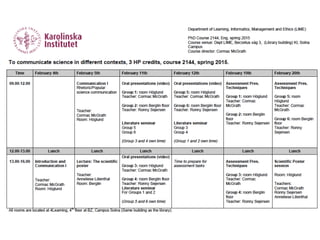
Block1 Block 2 Block 3
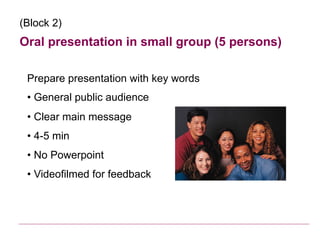
Oral presentation in small group (5 persons)
Prepare presentation with key words
• General public audience
• Clear main message
• 4-5 min
• No Powerpoint
• Videofilmed for feedback
(Block 2)
Literature seminars in groups (peer discussion)
§  Read literature (Anholt book + papers)
§  Process literature by group discussion using questions in
Appendix 2 in course outline
§  Send group summary to Samuel. (paper or email)
(Block 2)
Poster presentation – the scientific
context
§  Prepare a poster, need not be authentic data
§  Print A4 or A3
§  Prepare oral presentation - scientific context,
2minutes
§  Allowed to team up with others
à Indivudually or in groups of 2-3
(Block 3)
Two examination tasks
§  Reflective statement
à Based on own experience, feedback and literature.
§  Oral presentation
à Oral presentation in small group
à With Powerpoint
à 4-5 minutes
(Block 3)
§  Communication
§  Presentation technique
§  Classical Rhetoric
§  Reflection on literature
§  Different media
Summary of course content
Your active
participation!

Introduction cmg

  • 1.
    To Communicate Sciencein Different Contexts, 3 credit points Course director: Cormac McGrath Teachers: Cormac McG, Ronny Sejersen, Anneliese Lilienthal Administrator: Ingrid Smedberg Unit for Medical Education, UME Dept of Learning, Informatics, Management and Ethics (LIME)
  • 2.
    The more youshare it the better it becomes! You + your project – your treasure • Status & satisfaction • Societal impact • Scientific impact
  • 3.
    Dublin descriptors, jointagreement for doctoral education [The doctoral student] ”can communicate with their peers, the larger scholarly community, and with society in general about their areas of expertise” (Dublin descriptors 3rd (doctoral) cycle)
  • 4.
    The Swedish HigherEducation Ordinance (Högskoleförordningen) §  For the Degree of Doctor the third-cycle student shall demonstrate the ability in both national and international contexts to present and discuss research and research findings authoritatively in speech and writing and in dialogue with the academic community and society in general (Dublin descriptors 3rd (doctoral) cycle)
  • 5.
    ”The ability todeliver a polished oral presentation in front of an audience of peers is an essential skill for a successful scientist” (Anholt, ”Dazzle ’em with style” p XVI)
  • 6.
    Intended Learning outcomes Afterthe course the participants will be able to: §  Orally present own research adapted to different audiences §  Reflect on presentation skills and the ability to adapt to different audiences Action Reflection Experience and feedback from participants and teachers
  • 7.
    How can wetrain to develop our skills to communicate science? §  Raise awareness about different ways to present §  Reflect on important aspects in communication à Biological constraints in perception and meaning making à Rhetorical tools for analysing and preparing presentations à Different character and needs of different audiences §  Practical experience of presenting one’s project in different situations à Practice with feedback
  • 8.
  • 9.
    Oral presentation insmall group (5 persons) Prepare presentation with key words • General public audience • Clear main message • 4-5 min • No Powerpoint • Videofilmed for feedback (Block 2)
  • 10.
    Literature seminars ingroups (peer discussion) §  Read literature (Anholt book + papers) §  Process literature by group discussion using questions in Appendix 2 in course outline §  Send group summary to Samuel. (paper or email) (Block 2)
  • 11.
    Poster presentation –the scientific context §  Prepare a poster, need not be authentic data §  Print A4 or A3 §  Prepare oral presentation - scientific context, 2minutes §  Allowed to team up with others à Indivudually or in groups of 2-3 (Block 3)
  • 12.
    Two examination tasks § Reflective statement à Based on own experience, feedback and literature. §  Oral presentation à Oral presentation in small group à With Powerpoint à 4-5 minutes (Block 3)
  • 13.
    §  Communication §  Presentationtechnique §  Classical Rhetoric §  Reflection on literature §  Different media Summary of course content Your active participation!