Art and science of communication
continued…
Cormac McGrath
LIME
This session
§ Voice
§ Body language
§ Interaction
§ Jargon
§ Didactic triangle,
§ If there is time
§ Ethos, Logos & Pathos
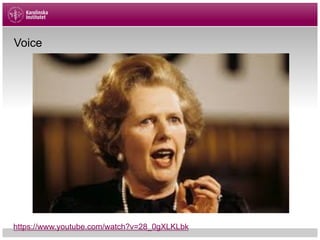
Voice
https://www.youtube.com/watch?v=28_0gXLKLbk
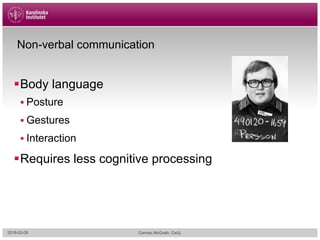
Non-verbal communication
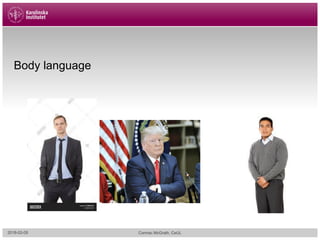
§Body language
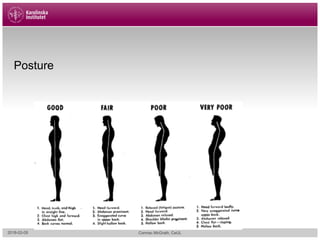
§ Posture
§ Gestures
§ Interaction
§Requires less cognitive processing
2018-02-05 Cormac McGrath, CeUL
Posture
2018-02-05 Cormac McGrath, CeUL
Body language
2018-02-05 Cormac McGrath, CeUL
Gestures
§ Enhance
§ Visa betydelse för dig själv
§ Important areas
§ Coherency
§ Open
2018-02-05 Cormac McGrath, CeUL
Publiken
§ Ögonkontakt
§ Se (observerar) hur de sitter, vad de
gör.
§ Engagera publiken (cold call)
§ Publiken är i fokus (student centrerad
undervisning)
§ Hej, mitt namn är X, jag undervisar
om, det viktigaste med mitt ämne är,
tre saker jag undervisar om är…
2018-02-05 Cormac McGrath, CeUL
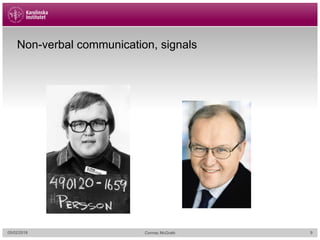
Non-verbal communication, signals
05/02/2018 Cormac McGrath 9
Esoteric jargon
§ Given that we have a limited ability to retain information, and then what is your
stance on esoteric jargon in your subjects.
§ Let’s play jeopardy:
§ This is an unobserved exposure associated with the exposure of interest and is a
potential cause of the outcome of interest. This lead to bias that distorts the magnitude of
the relationship between two factors of interest.
§ Suggested by Thomas Kuhn, this is a scientific revolution and completely changes the
way in which science looks at the world.
§ The theory of knowledge, especially with regard to its methods, validity, and scope, and
the distinction between justified belief and opinion
§ Relating to or denoting the side of the body opposite to that on which a particular
structure or condition occurs.
05/02/2018 Cormac McGrath 10
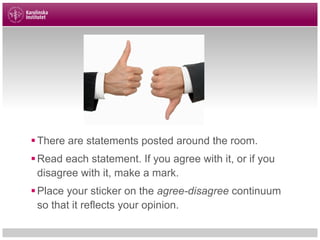
§There are statements posted around the room.
§Read each statement. If you agree with it, or if you
disagree with it, make a mark.
§Place your sticker on the agree-disagree continuum
so that it reflects your opinion.
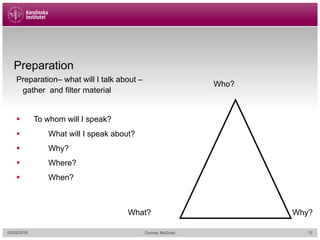
Preparation
Preparation– what will I talk about –
gather and filter material
§ To whom will I speak?
§ What will I speak about?
§ Why?
§ Where?
§ When?
05/02/2018 Cormac McGrath
Who?
What? Why?
12
Modes of persuasion
§Ethos:
§Credibility:
§Logos:
§Logical arguments, reasoning
§Pathos:
§Emotional aspects
05/02/2018 Cormac McGrath 13
Consider your presentation
§ Ethos: who are you? What has
been done in the field previously?
§ Logos: How do you present a
coherent argument from what you
have said? Hard facts.
§ Pathos: What is the human aspect
of your presentation? Why should
I care?
§ Ethos
§ Pathos
§ Logos
05/02/2018 Cormac McGrath 14
§ Ethos: It can be used to gain credibility: "The 1990 consensus reports that fifty
percent of all marriages will end in divorce.”
§ Pathos: Awakens a sense of involvement "Turn and look at the person sitting
next to you. One of the two of you will get a divorce.”
§ Logos: Present the hard facts "Because one out of every two marriages here in
the United States ends in divorce, it is imperative we reform the court system to
have a more fair resolve in settlements for both women and men."
05/02/2018 Cormac McGrath 15
§ And they can be blended together:
§ "The 1990 census report has found that 50% of all marriages end in divorce.
That means that one out of every two marriages are not successful. It could be
yours; it could be the person's sitting next to you. And if you are a woman, your
chances of a fair settlement are far lower than if you are a man. We must reform
our court system."
05/02/2018 Cormac McGrath 16
Classical ways to convince an audience
§Ethos
§Logos
§Pathos
05/02/2018 Cormac McGrath 17
05/02/2018
Cormac McGrath
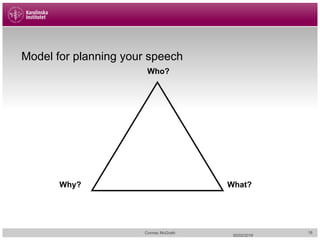
Model for planning your speech
Who?
What?Why?
18
05/02/2018 Cormac McGrath
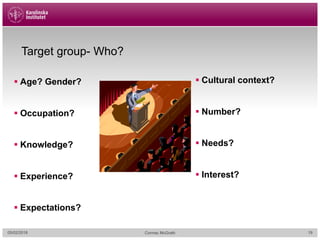
Target group- Who?
§ Age? Gender?
§ Occupation?
§ Knowledge?
§ Experience?
§ Expectations?
§ Cultural context?
§ Number?
§ Needs?
§ Interest?
19
05/02/2018 Cormac McGrath
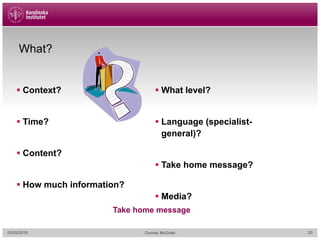
What?
§ Context?
§ Time?
§ Content?
§ How much information?
§ What level?
§ Language (specialist-
general)?
§ Take home message?
§ Media?
Take home message
20
05/02/2018 Cormac McGrath
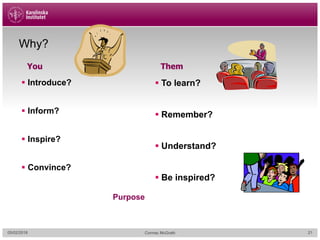
§ Introduce?
§ Inform?
§ Inspire?
§ Convince?
Why?
§ To learn?
§ Remember?
§ Understand?
§ Be inspired?
You Them
Purpose
21
§ In the beginning of your “communications” career, then it is most important to
focus on the facts of your presentation, getting as much said as possible about
your topic, in an accurate and representative way.
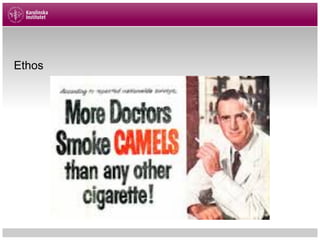
Ethos
Ethos
§ a yr 9 student can never engage the same type (amount) of ethos as a fortune
500 CEO on matters of corporate taxes but can evoke the same or sometimes
stronger feeling of pathos.
_______________________________________________________________
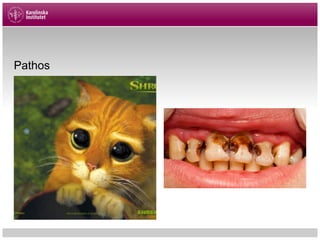
Pathos
Pathos
§ As a speaker you have a responsibility for your listeners well-being and should
never upset them.
______________________________________________________________
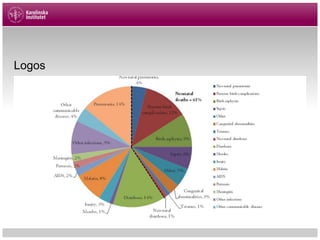
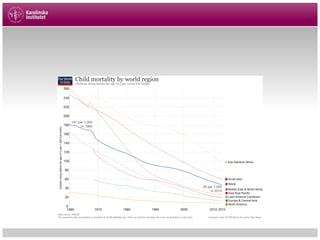
Logos
Logos
§ All men are mortal
§ Cormac is a man
§ Cormac is mortal
The arguments you present have to follow in a discernable and logically sound
sequence.
Let’s analyse this presentation together:
§ To view the video, go to: https://www.youtube.com/watch?v=ATfY8dvbuFg
A few rhetorical devices
§ Cultural references: icons of a generation
§ Repetition
§ Anaphora: Repeating a sentiment in the beginning of each phrase, sentence.
§ Dental hygiene is a concern for …If you care about dental hygiene…. We need to invest
in dental hygience...
§ Anadiplosis: The last word or phrase is repeated to begin the next.
§ “Suffering breeds character; character breeds faith.” – Rev. Jesse Jackson
§ you must make every effort to support your faith with goodness, and goodness with
knowledge, and knowledge with self-control, and self-control with endurance, and
endurance with godliness, and godliness with mutual affection, and mutual
affection with love” ( The Bible, II Peter 1:5 – 7)
§ “Fear leads to anger. Anger leads to hate. Hate leads to suffering.” – Popular culture
figure, short and green.
Your presentation
§ Main points
§ Level of depth
§ Audience, language, what do you need to retain?
§ Do you have a call to action?
§ Ethos: establishing credibility for you and the research area
§ Logos: How do you structure your arguments, how do they lead and follow from
each other
§ Pathos: what are the emotional dimensions to your presentations.
§ Start building a structure, share, compare and get feedback.
Some tips
§ Know your audience
§ Content, content, content
§ KISS (Keep It Short and Simple)
§ Outline your talk (pen & paper, board, post-its)
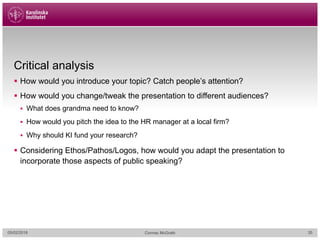
§ Have a clear structure
§ What is your point?
§ Tell a story – “Think conversation, not performance”, Sir Kenneth
Robinson
§ Passion and enthusiasm are contagious
§ First / Last impressions count
§ Make eye contact, use gestures, avoid fillers (ah, urm, well, so, like, etc.)
Remember
§ Practice makes for a good presentation, a good presentation will help your
audience understand your science, understanding your science is important for
everyone, for you as an individual and society at large, and remember society is
funding your science.
Critical analysis
§ How would you introduce your topic? Catch people’s attention?
§ How would you change/tweak the presentation to different audiences?
§ What does grandma need to know?
§ How would you pitch the idea to the HR manager at a local firm?
§ Why should KI fund your research?
§ Considering Ethos/Pathos/Logos, how would you adapt the presentation to
incorporate those aspects of public speaking?
05/02/2018 Cormac McGrath 35
Wrapping things up
§ Make sure what you want to say
§ Plan it carefully!
§ Lighten up on the details!
§ Focus on a clear Take home message
§ Adopt different modes of persuasion
§ Ethos
§ Logos
§ Pathos
05/02/2018 Cormac McGrath 36
Some tips
§ Get organized
§ Practice, practice and practice again
§ (in front of the mirror or peers)
§ Time yourself
§ Plan for the unexpected
§ Remember to breathe and find a breathing pattern that suits you. Exercise in
advance works for some!
§ Powerpoint is your greatest friend and your worse enemy
§ Find a subject that people really care about.
§ Know 100 words about each word on your slide
§ Relax
§ Did I say practice?
05/02/2018 Cormac McGrath 37
Useful links
Garr Reynolds’s website on Presentation Skills
http://www.garrreynolds.com/preso-tips/
Garr Reynolds’s TedEx Talk “Story, Imagery and the Art of 21st
Century Presentations
http://tedxtalks.ted.com/video/Story-Imagery-the-Art-of-21st-
2;search%3Agarr%20reynolds
University of Leicester on Delivering an Effective Presentation
http://www2.le.ac.uk/offices/ld/resources/presentations/delivering-presentation
University of Leicester on Designing a Poster (20-minute tutorial)
https://connect.le.ac.uk/posters

Art & science part ii 2018

  • 1.
    Art and scienceof communication continued… Cormac McGrath LIME
  • 2.
    This session § Voice §Body language § Interaction § Jargon § Didactic triangle, § If there is time § Ethos, Logos & Pathos
  • 3.
  • 4.
    Non-verbal communication §Body language §Posture § Gestures § Interaction §Requires less cognitive processing 2018-02-05 Cormac McGrath, CeUL
  • 5.
  • 6.
  • 7.
    Gestures § Enhance § Visabetydelse för dig själv § Important areas § Coherency § Open 2018-02-05 Cormac McGrath, CeUL
  • 8.
    Publiken § Ögonkontakt § Se(observerar) hur de sitter, vad de gör. § Engagera publiken (cold call) § Publiken är i fokus (student centrerad undervisning) § Hej, mitt namn är X, jag undervisar om, det viktigaste med mitt ämne är, tre saker jag undervisar om är… 2018-02-05 Cormac McGrath, CeUL
  • 9.
  • 10.
    Esoteric jargon § Giventhat we have a limited ability to retain information, and then what is your stance on esoteric jargon in your subjects. § Let’s play jeopardy: § This is an unobserved exposure associated with the exposure of interest and is a potential cause of the outcome of interest. This lead to bias that distorts the magnitude of the relationship between two factors of interest. § Suggested by Thomas Kuhn, this is a scientific revolution and completely changes the way in which science looks at the world. § The theory of knowledge, especially with regard to its methods, validity, and scope, and the distinction between justified belief and opinion § Relating to or denoting the side of the body opposite to that on which a particular structure or condition occurs. 05/02/2018 Cormac McGrath 10
  • 11.
    §There are statementsposted around the room. §Read each statement. If you agree with it, or if you disagree with it, make a mark. §Place your sticker on the agree-disagree continuum so that it reflects your opinion.
  • 12.
    Preparation Preparation– what willI talk about – gather and filter material § To whom will I speak? § What will I speak about? § Why? § Where? § When? 05/02/2018 Cormac McGrath Who? What? Why? 12
  • 13.
    Modes of persuasion §Ethos: §Credibility: §Logos: §Logicalarguments, reasoning §Pathos: §Emotional aspects 05/02/2018 Cormac McGrath 13
  • 14.
    Consider your presentation §Ethos: who are you? What has been done in the field previously? § Logos: How do you present a coherent argument from what you have said? Hard facts. § Pathos: What is the human aspect of your presentation? Why should I care? § Ethos § Pathos § Logos 05/02/2018 Cormac McGrath 14
  • 15.
    § Ethos: Itcan be used to gain credibility: "The 1990 consensus reports that fifty percent of all marriages will end in divorce.” § Pathos: Awakens a sense of involvement "Turn and look at the person sitting next to you. One of the two of you will get a divorce.” § Logos: Present the hard facts "Because one out of every two marriages here in the United States ends in divorce, it is imperative we reform the court system to have a more fair resolve in settlements for both women and men." 05/02/2018 Cormac McGrath 15
  • 16.
    § And theycan be blended together: § "The 1990 census report has found that 50% of all marriages end in divorce. That means that one out of every two marriages are not successful. It could be yours; it could be the person's sitting next to you. And if you are a woman, your chances of a fair settlement are far lower than if you are a man. We must reform our court system." 05/02/2018 Cormac McGrath 16
  • 17.
    Classical ways toconvince an audience §Ethos §Logos §Pathos 05/02/2018 Cormac McGrath 17
  • 18.
    05/02/2018 Cormac McGrath Model forplanning your speech Who? What?Why? 18
  • 19.
    05/02/2018 Cormac McGrath Targetgroup- Who? § Age? Gender? § Occupation? § Knowledge? § Experience? § Expectations? § Cultural context? § Number? § Needs? § Interest? 19
  • 20.
    05/02/2018 Cormac McGrath What? §Context? § Time? § Content? § How much information? § What level? § Language (specialist- general)? § Take home message? § Media? Take home message 20
  • 21.
    05/02/2018 Cormac McGrath §Introduce? § Inform? § Inspire? § Convince? Why? § To learn? § Remember? § Understand? § Be inspired? You Them Purpose 21
  • 22.
    § In thebeginning of your “communications” career, then it is most important to focus on the facts of your presentation, getting as much said as possible about your topic, in an accurate and representative way.
  • 23.
  • 24.
    Ethos § a yr9 student can never engage the same type (amount) of ethos as a fortune 500 CEO on matters of corporate taxes but can evoke the same or sometimes stronger feeling of pathos. _______________________________________________________________
  • 25.
  • 26.
    Pathos § As aspeaker you have a responsibility for your listeners well-being and should never upset them. ______________________________________________________________
  • 27.
  • 29.
    Logos § All menare mortal § Cormac is a man § Cormac is mortal The arguments you present have to follow in a discernable and logically sound sequence.
  • 30.
    Let’s analyse thispresentation together: § To view the video, go to: https://www.youtube.com/watch?v=ATfY8dvbuFg
  • 31.
    A few rhetoricaldevices § Cultural references: icons of a generation § Repetition § Anaphora: Repeating a sentiment in the beginning of each phrase, sentence. § Dental hygiene is a concern for …If you care about dental hygiene…. We need to invest in dental hygience... § Anadiplosis: The last word or phrase is repeated to begin the next. § “Suffering breeds character; character breeds faith.” – Rev. Jesse Jackson § you must make every effort to support your faith with goodness, and goodness with knowledge, and knowledge with self-control, and self-control with endurance, and endurance with godliness, and godliness with mutual affection, and mutual affection with love” ( The Bible, II Peter 1:5 – 7) § “Fear leads to anger. Anger leads to hate. Hate leads to suffering.” – Popular culture figure, short and green.
  • 32.
    Your presentation § Mainpoints § Level of depth § Audience, language, what do you need to retain? § Do you have a call to action? § Ethos: establishing credibility for you and the research area § Logos: How do you structure your arguments, how do they lead and follow from each other § Pathos: what are the emotional dimensions to your presentations. § Start building a structure, share, compare and get feedback.
  • 33.
    Some tips § Knowyour audience § Content, content, content § KISS (Keep It Short and Simple) § Outline your talk (pen & paper, board, post-its) § Have a clear structure § What is your point? § Tell a story – “Think conversation, not performance”, Sir Kenneth Robinson § Passion and enthusiasm are contagious § First / Last impressions count § Make eye contact, use gestures, avoid fillers (ah, urm, well, so, like, etc.)
  • 34.
    Remember § Practice makesfor a good presentation, a good presentation will help your audience understand your science, understanding your science is important for everyone, for you as an individual and society at large, and remember society is funding your science.
  • 35.
    Critical analysis § Howwould you introduce your topic? Catch people’s attention? § How would you change/tweak the presentation to different audiences? § What does grandma need to know? § How would you pitch the idea to the HR manager at a local firm? § Why should KI fund your research? § Considering Ethos/Pathos/Logos, how would you adapt the presentation to incorporate those aspects of public speaking? 05/02/2018 Cormac McGrath 35
  • 36.
    Wrapping things up §Make sure what you want to say § Plan it carefully! § Lighten up on the details! § Focus on a clear Take home message § Adopt different modes of persuasion § Ethos § Logos § Pathos 05/02/2018 Cormac McGrath 36
  • 37.
    Some tips § Getorganized § Practice, practice and practice again § (in front of the mirror or peers) § Time yourself § Plan for the unexpected § Remember to breathe and find a breathing pattern that suits you. Exercise in advance works for some! § Powerpoint is your greatest friend and your worse enemy § Find a subject that people really care about. § Know 100 words about each word on your slide § Relax § Did I say practice? 05/02/2018 Cormac McGrath 37
  • 38.
    Useful links Garr Reynolds’swebsite on Presentation Skills http://www.garrreynolds.com/preso-tips/ Garr Reynolds’s TedEx Talk “Story, Imagery and the Art of 21st Century Presentations http://tedxtalks.ted.com/video/Story-Imagery-the-Art-of-21st- 2;search%3Agarr%20reynolds University of Leicester on Delivering an Effective Presentation http://www2.le.ac.uk/offices/ld/resources/presentations/delivering-presentation University of Leicester on Designing a Poster (20-minute tutorial) https://connect.le.ac.uk/posters