Behavior Theory and
Techniques
--Assertive Training—
By“: Roji Maharjan
So what is Behavior ?
1. Whatpeople do andwhatpeople say
2. Behaviorisovert andcovert
3. Behaviorshaveone ormoredimension thatyoucan measure
3.1. FREQUENCY(Numberoftimea behaviorOccurs)
3.2. DURATION(Behaviorstartsuntilitstops)
3.3. INTENSITY(PhysicalForceinvolve )
4.Canbe Observed,describedandrecorded
5.Behaviorhaveimpacton theenvironment, includingthephysicalor
thesocialenvironment.
2
Behavior Technique ?
NOTE: Behavior modification is not designed to change traits and characteristics. Example: It is not used to
change AUTISM but to, change the behaviors exhibited by children with AUTISM.
1. Askill,ability,aparticular taskorworkthatisusedtomodify the
behavior.
2. Behaviormodificationisconcerned withanalyzing andchangingthe
behavior.
3. Analyzing:Whyapersonshowparticularbehavior?Orwhyisone
behavingincertain way?
4. Modify:implementing proceduretohelppeople to changetheir
behavior.
3
Assertive Training/ Assertiveness
1. Literature meaning: Positive , Self confident
2. Assertiveness is about self confidence, which means having a positive attitude
towards yourself and others.
3. Assertiveness is a social skill that relies heavily on effective communication,
while simultaneously respecting the thoughts and wishes of others.
4. People who are assertive clearly and respectfully communicate their wants, needs,
positions, and boundaries to others.
5. Non assertiveness may be seen as use of inefficient communication skills, where
as assertiveness is considered as balanced response, being neither passive nor
aggressive.
4
What do you mean by assertiveness ?
Assertiveness
5
• Isstandingup for yourselfbut also respectingthe opinionsandneed of
others.
• Isbeingable to expressfeelingat home, work, with employees,customer,
college,teachers , student.
• Characteristics ofassertive person:
Feelfreeto expresstheir thoughts and desires
Able to initiate andmaintainedcomfortable relationship withothers
Theyknowtheir rights, have control over their anger.(But theydo not
represstheir angerbut talk about it ina reasoningmanner)
Assertive People entersfriendshipsfrom an“I countmyneeds.I
countyour needs’ position.
People with lack of Assertive skills…
6
Passive: My feelingsdoes notmatteronlyyoursdo.
• Noeyecontact, soft andmuffledvoice,physicallymakingyourselfseem small.
Aggressive: Expressingthoughts,feelingandbeliefs inawaythatisoften
dishonest andvioletsrightsofothers.
• ThisiswhatIfeel andyourfeelingsdoesnotcount.
• Invasive, glaring,loudvoiceanduseofaggressivegestureslikepinpointing
Never forget what you are. The rest of the world will not. Wear it like armor, and it can
never be used to hurt you
How to develop assertive
skills?1. Listeningthe viewsof others
2. Being able to admit to mistakes andapologies.
3. Behaving asan equal to others nor inferior norsuperior
4. Be honest,anddirect about your feelings,needand beliefs.
5. Bereasonable inyour requests
6. Be honestwhengivingorreceivingfeedback
7. Learnto Say NOto unreasonableexceptions.
7
Techniques
8
1.Use of Istatement
Example: A womanbecomes angrywhenhersister borrowsherfavoritecoatand
returns it with stains anda tear.
Common response: “You ruined myjacket! Areyouever going togrowup?!”
“I” statement response: “I am upset that mycoatwas damaged because I can’t
affordtoreplace it. I reallyappreciate it whenthethings I loanout aretaken care
of.”
Ateenage boyis annoyedwith his parents, whoask him several times each nightif
hehascompleted hishomework.
Common response: “Lay offme!”
“I” statement response: “I feelfrustrated and annoyedwhenI am reminded over
andover to do myhomework.I am oldenoughnow tocomplete myhomework
without reminders.”
Techniques
9
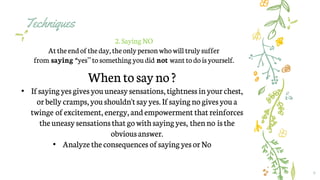
2.Saying NO
At theendof theday,theonlypersonwhowill trulysuffer
from saying “yes”tosomething youdid not want to dois yourself.
Whentosayno?
• Ifsayingyesgivesyouuneasysensations,tightnessinyourchest,
orbelly cramps,youshouldn'tsayyes.Ifsayingno givesyoua
twinge ofexcitement, energy, andempowerment thatreinforces
theuneasysensationsthatgowithsayingyes, thenno isthe
obviousanswer.
• Analyzetheconsequences ofsayingyesorNo
Techniques
10
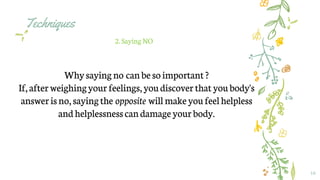
2.Saying NO
Whysayingno canbe soimportant ?
If,after weighingyour feelings,youdiscover that youbody's
answerisno, sayingthe opposite will make youfeel helpless
andhelplessnesscandamage yourbody.
Techniques
11
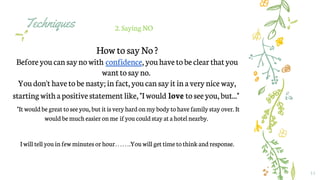
2.Saying NO
How to sayNo?
Beforeyoucan saynowith confidence, youhavetobe clear thatyou
wantto sayno.
Youdon't havetobe nasty;infact,youcan sayitinaverynice way,
startingwithapositivestatement like,"Iwould love toseeyou,but..."
"It would be great toseeyou, but it is very hardonmybody tohavefamily stay over. It
would bemuch easier onme ifyou couldstay at ahotelnearby.
Iwill tell you infew minutes or hour…….You will get time tothink andresponse.
Techniques
12
3. RolePlay
Switch role withclient………
Few Examples
You invite a good friend to your house for a dinner
party, but your friend never arrives and neither
calls to cancel nor to apologize. You would:
a) Ignore it, but manage not to show up the next
time your friend invites you to a party.
b) Never speak to this person again and end the
friendship.
c) Call your friend to find out what happened
13
14
You are in a group discussion at work which includes your boss. A co-worker
asks you a question about your work, but you don't know the answer. You
would:
a) Give your co-worker a false, but plausible answer so your boss will think
you are on top of things.
b) Do not answer, but attack your co-worker by asking a question you know
he/she could not answer.
c) Indicate to your co-worker you are unsure just now, but offer to give
him/her the information later.
Role play
✢ Sayyoujustreceivedanimportant assignment with atight deadline.
Youknowthat youneedassistancefrom Rita,aclassmate,toget it
done.Identifythefollowing communication stylesandpickwhich
youthinkwouldbebest.
15
References
✢ https://www.goodtherapy.org/blog/psychpedia/i-message
✢ https://www.psychologytoday.com/us/blog/cui-bono/201211/are-i-
statements-better-you-statements
✢ https://www.psychologytoday.com/us/blog/how-we-
work/201302/nine-practices-help-you-say-no
✢ https://www.psychologytoday.com/us/blog/how-we-
work/201302/nine-practices-help-you-say-no
16
Thankyou …..
17

Assertive Training

  • 1.
    Behavior Theory and Techniques --AssertiveTraining— By“: Roji Maharjan
  • 2.
    So what isBehavior ? 1. Whatpeople do andwhatpeople say 2. Behaviorisovert andcovert 3. Behaviorshaveone ormoredimension thatyoucan measure 3.1. FREQUENCY(Numberoftimea behaviorOccurs) 3.2. DURATION(Behaviorstartsuntilitstops) 3.3. INTENSITY(PhysicalForceinvolve ) 4.Canbe Observed,describedandrecorded 5.Behaviorhaveimpacton theenvironment, includingthephysicalor thesocialenvironment. 2
  • 3.
    Behavior Technique ? NOTE:Behavior modification is not designed to change traits and characteristics. Example: It is not used to change AUTISM but to, change the behaviors exhibited by children with AUTISM. 1. Askill,ability,aparticular taskorworkthatisusedtomodify the behavior. 2. Behaviormodificationisconcerned withanalyzing andchangingthe behavior. 3. Analyzing:Whyapersonshowparticularbehavior?Orwhyisone behavingincertain way? 4. Modify:implementing proceduretohelppeople to changetheir behavior. 3
  • 4.
    Assertive Training/ Assertiveness 1.Literature meaning: Positive , Self confident 2. Assertiveness is about self confidence, which means having a positive attitude towards yourself and others. 3. Assertiveness is a social skill that relies heavily on effective communication, while simultaneously respecting the thoughts and wishes of others. 4. People who are assertive clearly and respectfully communicate their wants, needs, positions, and boundaries to others. 5. Non assertiveness may be seen as use of inefficient communication skills, where as assertiveness is considered as balanced response, being neither passive nor aggressive. 4 What do you mean by assertiveness ?
  • 5.
    Assertiveness 5 • Isstandingup foryourselfbut also respectingthe opinionsandneed of others. • Isbeingable to expressfeelingat home, work, with employees,customer, college,teachers , student. • Characteristics ofassertive person: Feelfreeto expresstheir thoughts and desires Able to initiate andmaintainedcomfortable relationship withothers Theyknowtheir rights, have control over their anger.(But theydo not represstheir angerbut talk about it ina reasoningmanner) Assertive People entersfriendshipsfrom an“I countmyneeds.I countyour needs’ position.
  • 6.
    People with lackof Assertive skills… 6 Passive: My feelingsdoes notmatteronlyyoursdo. • Noeyecontact, soft andmuffledvoice,physicallymakingyourselfseem small. Aggressive: Expressingthoughts,feelingandbeliefs inawaythatisoften dishonest andvioletsrightsofothers. • ThisiswhatIfeel andyourfeelingsdoesnotcount. • Invasive, glaring,loudvoiceanduseofaggressivegestureslikepinpointing Never forget what you are. The rest of the world will not. Wear it like armor, and it can never be used to hurt you
  • 7.
    How to developassertive skills?1. Listeningthe viewsof others 2. Being able to admit to mistakes andapologies. 3. Behaving asan equal to others nor inferior norsuperior 4. Be honest,anddirect about your feelings,needand beliefs. 5. Bereasonable inyour requests 6. Be honestwhengivingorreceivingfeedback 7. Learnto Say NOto unreasonableexceptions. 7
  • 8.
    Techniques 8 1.Use of Istatement Example:A womanbecomes angrywhenhersister borrowsherfavoritecoatand returns it with stains anda tear. Common response: “You ruined myjacket! Areyouever going togrowup?!” “I” statement response: “I am upset that mycoatwas damaged because I can’t affordtoreplace it. I reallyappreciate it whenthethings I loanout aretaken care of.” Ateenage boyis annoyedwith his parents, whoask him several times each nightif hehascompleted hishomework. Common response: “Lay offme!” “I” statement response: “I feelfrustrated and annoyedwhenI am reminded over andover to do myhomework.I am oldenoughnow tocomplete myhomework without reminders.”
  • 9.
    Techniques 9 2.Saying NO At theendoftheday,theonlypersonwhowill trulysuffer from saying “yes”tosomething youdid not want to dois yourself. Whentosayno? • Ifsayingyesgivesyouuneasysensations,tightnessinyourchest, orbelly cramps,youshouldn'tsayyes.Ifsayingno givesyoua twinge ofexcitement, energy, andempowerment thatreinforces theuneasysensationsthatgowithsayingyes, thenno isthe obviousanswer. • Analyzetheconsequences ofsayingyesorNo
  • 10.
    Techniques 10 2.Saying NO Whysayingno canbesoimportant ? If,after weighingyour feelings,youdiscover that youbody's answerisno, sayingthe opposite will make youfeel helpless andhelplessnesscandamage yourbody.
  • 11.
    Techniques 11 2.Saying NO How tosayNo? Beforeyoucan saynowith confidence, youhavetobe clear thatyou wantto sayno. Youdon't havetobe nasty;infact,youcan sayitinaverynice way, startingwithapositivestatement like,"Iwould love toseeyou,but..." "It would be great toseeyou, but it is very hardonmybody tohavefamily stay over. It would bemuch easier onme ifyou couldstay at ahotelnearby. Iwill tell you infew minutes or hour…….You will get time tothink andresponse.
  • 12.
  • 13.
    Few Examples You invitea good friend to your house for a dinner party, but your friend never arrives and neither calls to cancel nor to apologize. You would: a) Ignore it, but manage not to show up the next time your friend invites you to a party. b) Never speak to this person again and end the friendship. c) Call your friend to find out what happened 13
  • 14.
    14 You are ina group discussion at work which includes your boss. A co-worker asks you a question about your work, but you don't know the answer. You would: a) Give your co-worker a false, but plausible answer so your boss will think you are on top of things. b) Do not answer, but attack your co-worker by asking a question you know he/she could not answer. c) Indicate to your co-worker you are unsure just now, but offer to give him/her the information later.
  • 15.
    Role play ✢ Sayyoujustreceivedanimportantassignment with atight deadline. Youknowthat youneedassistancefrom Rita,aclassmate,toget it done.Identifythefollowing communication stylesandpickwhich youthinkwouldbebest. 15
  • 16.
    References ✢ https://www.goodtherapy.org/blog/psychpedia/i-message ✢ https://www.psychologytoday.com/us/blog/cui-bono/201211/are-i- statements-better-you-statements ✢https://www.psychologytoday.com/us/blog/how-we- work/201302/nine-practices-help-you-say-no ✢ https://www.psychologytoday.com/us/blog/how-we- work/201302/nine-practices-help-you-say-no 16
  • 17.