The document presents ASR-FANET, an adaptive SDN-based routing framework designed to address unique challenges faced by Flying Ad Hoc Networks (FANET), such as high mobility and frequent topology changes. It includes mechanisms for topology discovery, statistics gathering, and route computation, allowing for improved packet delivery and reduced delays compared to traditional routing protocols. Simulation results demonstrate the effectiveness of ASR-FANET in enhancing network performance across various metrics.
![International Journal of Electrical and Computer Engineering (IJECE)
Vol. 11, No. 5, October 2021, pp. 4403~4412
ISSN: 2088-8708, DOI: 10.11591/ijece.v11i5.pp4403-4412 4403
Journal homepage: http://ijece.iaescore.com
ASR-FANET: An adaptive SDN-based routing framework for
FANET
Alaa Taima Albu-Salih1
, Hayder Ayad Khudhair2
1
Ministry of Education, General Directorate for Education in Al-Qadisiyah, Iraq
2
Ministry of Education, General Directorate for Education in Al-Najaf Al-Ashraf, Iraq
Article Info ABSTRACT
Article history:
Received Sep 14, 2020
Revised Mar 20, 2021
Accepted Apr 5, 2021
Flying ad hoc network (FANET) is widely used in many military,
commercial and civilian applications. Compared with mobile adhoc network
(MANET) and vehicular ad hoc network (VANET), FANET holds unique
characteristics such as high mobility, intermittent links and frequent topology
changes, which cause a challenging task in the design of routing protocols. A
novel adaptive software defined networking (SDN)-based routing framework
for FANET called ASR-FANET is proposed in this article to solve the above
challenges. The ASR-FANET framework is mainly composed of three
important parts, which are the topology discovery mechanism, statistics
gathering mechanism and route computation mechanism. In topology
discovery mechanism, the periodic information about network topology is
collected, including nodes and links. In statistics gathering mechanism, the
status of the wireless network connection and flight statistics are collected. In
route computation mechanism, the optimal path is calculated based on link
costs. The performance of ASR-FANET framework is also has been
evaluated by comprehensive simulations. The simulation results show that
proposed framework is much better than other traditional protocols in packet
delivery fraction, average end to end delay, normalized routing load, packet
loss and throughput.
Keywords:
FANET
IoT
OLSR
SDN
UAV
This is an open access article under the CC BY-SA license.
Corresponding Author:
Alaa Taima Albu-Salih
Department of Computer Science
Al Quadisiya University
58002 University Road, Aldiwanyia, Al Quadisiya, Iraq
Email: alaa.taima@qu.edu.iq
1. INTRODUCTION
Unmanned aerial vehicles (UAVs), also known as drones, played a significant role in different civil
and military applications such as reconnaissance, traffic monitoring, battlefield surveillance, border
surveillance, forestry fire monitoring, animal tracking, humanitarian observations [1]. Instead of using one
large UAV, the use of a swarm of small UAVs reveals many advantages in terms of efficiency, adaptability,
flexibility and easy deployment [2]. The use of multiple UAVs, has helped to create the foundation of a new
kind of network called flying ad hoc network (FANET) [3], [4].
FANET can be considered a special sub-class of mobile adhoc network (MANET) in which the
connecting nodes are UAVs [5]. Therefore, a single UAV cannot be regarded as a FANET and is only valid
for multiple UAVs. All multiple UAV networks cannot be regarded as a FANET. The communication
between UAVs should be in ad hoc manner to create FANET [6]. Additionally, FANET can also be
classified as a subgroup of vehicular ad hoc network (VANET), which is also a sub-class of MANET.
Figure 1 shows the relationship between FANET, VANET, and MANET [3], [7].](https://image.slidesharecdn.com/7723871em5apr2120mar2114sep20ry-210728065550/85/ASR-FANET-An-adaptive-SDN-based-routing-framework-for-FANET-1-320.jpg)
![International Journal of Electrical and Computer Engineering (IJECE)
Vol. 11, No. 5, October 2021, pp. 4403~4412
ISSN: 2088-8708, DOI: 10.11591/ijece.v11i5.pp4403-4412 4403
Journal homepage: http://ijece.iaescore.com
ASR-FANET: An adaptive SDN-based routing framework for
FANET
Alaa Taima Albu-Salih1
, Hayder Ayad Khudhair2
1
Ministry of Education, General Directorate for Education in Al-Qadisiyah, Iraq
2
Ministry of Education, General Directorate for Education in Al-Najaf Al-Ashraf, Iraq
Article Info ABSTRACT
Article history:
Received Sep 14, 2020
Revised Mar 20, 2021
Accepted Apr 5, 2021
Flying ad hoc network (FANET) is widely used in many military,
commercial and civilian applications. Compared with mobile adhoc network
(MANET) and vehicular ad hoc network (VANET), FANET holds unique
characteristics such as high mobility, intermittent links and frequent topology
changes, which cause a challenging task in the design of routing protocols. A
novel adaptive software defined networking (SDN)-based routing framework
for FANET called ASR-FANET is proposed in this article to solve the above
challenges. The ASR-FANET framework is mainly composed of three
important parts, which are the topology discovery mechanism, statistics
gathering mechanism and route computation mechanism. In topology
discovery mechanism, the periodic information about network topology is
collected, including nodes and links. In statistics gathering mechanism, the
status of the wireless network connection and flight statistics are collected. In
route computation mechanism, the optimal path is calculated based on link
costs. The performance of ASR-FANET framework is also has been
evaluated by comprehensive simulations. The simulation results show that
proposed framework is much better than other traditional protocols in packet
delivery fraction, average end to end delay, normalized routing load, packet
loss and throughput.
Keywords:
FANET
IoT
OLSR
SDN
UAV
This is an open access article under the CC BY-SA license.
Corresponding Author:
Alaa Taima Albu-Salih
Department of Computer Science
Al Quadisiya University
58002 University Road, Aldiwanyia, Al Quadisiya, Iraq
Email: alaa.taima@qu.edu.iq
1. INTRODUCTION
Unmanned aerial vehicles (UAVs), also known as drones, played a significant role in different civil
and military applications such as reconnaissance, traffic monitoring, battlefield surveillance, border
surveillance, forestry fire monitoring, animal tracking, humanitarian observations [1]. Instead of using one
large UAV, the use of a swarm of small UAVs reveals many advantages in terms of efficiency, adaptability,
flexibility and easy deployment [2]. The use of multiple UAVs, has helped to create the foundation of a new
kind of network called flying ad hoc network (FANET) [3], [4].
FANET can be considered a special sub-class of mobile adhoc network (MANET) in which the
connecting nodes are UAVs [5]. Therefore, a single UAV cannot be regarded as a FANET and is only valid
for multiple UAVs. All multiple UAV networks cannot be regarded as a FANET. The communication
between UAVs should be in ad hoc manner to create FANET [6]. Additionally, FANET can also be
classified as a subgroup of vehicular ad hoc network (VANET), which is also a sub-class of MANET.
Figure 1 shows the relationship between FANET, VANET, and MANET [3], [7].](https://image.slidesharecdn.com/7723871em5apr2120mar2114sep20ry-210728065550/75/ASR-FANET-An-adaptive-SDN-based-routing-framework-for-FANET-1-2048.jpg)
![ ISSN: 2088-8708
Int J Elec & Comp Eng, Vol. 11, No. 5, October 2021: 4403 - 4412
4404
Figure 1. MANET, VANET and FANET networks
The most certain differences between the FANETs and other adhoc networks (MANET and
VANET), is the dynamic topology of network, the speed of nodes and the mobility of the nodes.
Additionally, FANET differs from MANET and VANET in connection, QoS, node movement features, and
data delivery. The comparison between MANET, VANET and FANET with different criteria are given in
Table 1 [8], [9].
FANET nodes (UAV) are used to collect data from the internet of things (IoT) as mobile collectors
[10]. Indeed, each single UAV in FANET can play a major role on the IoTs, which consists of devices with a
small battery capacity sensor [11]. These devices can not usually be distributed over long distances, due to
the energy limitation of IoT devices. Thus, UAV will travel dynamically towards IoT devices, gather data
and transfer it to other UAVs in FANET network that are outside the communication ranges of IoT devices
[12], as seen in Figure 2.
Table 1. Differences between FANET, VANET and MANET [3]
Criteria MANET VANET FANET
Node mobility Low High Very High
Mobility model Arbitrary Steady Usually predetermined, but special mobility
models for independent multi-UAV systems
Node density Low Medium Very Low
Topology change Slow Average Fast
Radio propagation
model
Very close to ground, LoS is
not accessible for all cases
Close to ground, LoS is not
accessible for all cases
High above the ground level, Line of Sight
is accessible for most of the cases
Power consumption
and network lifetime
Need of energy Efficient
protocols
Not needed Needed for mini UAVs, but now needed for
smaal UAVs
Computational power Limited Average Very BIG
Localization GPS GPS, AGPS, DGPS GPS, AGPS, DGPS, IMU
Figure 2. UAV-IoT network](https://image.slidesharecdn.com/7723871em5apr2120mar2114sep20ry-210728065550/85/ASR-FANET-An-adaptive-SDN-based-routing-framework-for-FANET-2-320.jpg)
![Int J Elec & Comp Eng ISSN: 2088-8708
ASR-FANET: An adaptive SDN-based routing framework for FANET (Alaa Taima Albu-Salih)
4405
Routing is one of the most challenging issues for FANET because of the specific features of FANET
such as fast network topology variance, high mobility and intermittent links between UAV nodes [13].
Current MANET and VANET routing protocols cannot meet all of the FANET requirements network
because FANET topology will change more often than standard MANET and VANET topology [14]. As a
result, those protocols fail to follow the evolution of the topology of the FANET network. So, there is a big
challenge in front of researchers to provide an efficient and reliable routing strategy. Therefore, there is a
need of developing new routing strategy for to providing a reliable communication between FANET nodes.
A promising alternative to conventional internet protocol (IP) networks is the software-defined
networks (SDN). SDN implements network programmability by separating network control and data plane
[15]. The control plane a logically centralized network controller dictates overall network activities, while in
the data plane is responsible for transmitting data flows. The SDN architecture enhances the routing strategy
's efficiency based on the information gathered by the SDN controller [16].
The FANET network is characterized for its quick changing network topology, high mobility,
intermittent links, energy constraints, and link quality changes. Traditional routing strategies are not able to
meet the above FANET requirements. So, we propose a novel adaptive SDN routing framework for FANET
(namely, ASR-FANET) considering the dynamic topology of FANET. To optimize the routing and quality of
service (QoS) requirements, FANET topology can be dynamically modified using an ASR-FANET
framework. The goal of this framework is to enhance the performance of its network while taking into
account all the routing constraints, such as fast changing network topology, high mobility, intermittent links
and link quality changes. The article provides the contributions: By defining key routing problems in the
FANET, we perform an extensive FANET routing investigation which is the main features of this article. The
contributions of this paper can be defined is being as:
a. By defining the key challenges of the routing problem in the FANET, we perform an accurate
investigation of SDN-based routing in FANET.
b. An Adaptive SDN-based routing framework is proposed for dynamic routing using multiple UAVs in the
IoT network. We refer to this framework as (ASR-FANET). This framework includes an ASR-FANET
controller that collects the global information of FANET nodes (e.g., speed, location information and
residual energy). This controller makes routing decisions and decides how the UAV nodes should move.
c. The performance of this ASR-FANET is compared with two common traditional routing protocols in
terms of packet delivery fraction, end2end delay, normalized routing load, packet loss and throughput.
d. Simulation results show that the proposed framework can achieve lower end2end delay, normalizing
routing load, and higher throughput and packet delivery fraction.
The rest of this paper is structured is being as. The routing methods in FANET networks are
discussed in section 2. Section 3 introduces the suggested framework steps. In section 4, the steps of the
suggested framework are presented. Finally, section 5 provides conclusions and recommendations for future study.
2. RELATED WORKS
In spite of practical applications of FANET in IoT networks, many technical issues such as routing
should be studied. Although traditional routing protocols are designed MANET, they are not necessarily
suited to FANET because FANET topology will change more often than standard MANET. A number of
routing protocols with different techniques are proposed for FANET trying to increase the packet delivery
ratio, reduce the end to end delay, to decrease packet drop, and to be adapted in different situations.
Therefore, we first review the relevant SDN-based routing protocols in FANET according to the previous
issue, and then examine each of these works and describe the advantages and drawbacks of each work.
The authors Ramaprasath in [17] proposed a novel UAVs communication scheme based SDN. An
SDN controller is used to calculate the routes and to monitor information with regards to the network. The
main goal of this scheme is to decrease the latency, and increase the throughput Silva et al. [18] exploited the
SDN to maintain the topology of FANET. The primary purpose of this protocol is to define and modify the
topology so as to maintain the connection between the independent nodes via the relay nodes.
Secinti et al. [19] proposed resilient multi-path routing framework by SDN for dynamic UAV
networks. The SDN controller is composed of 4 separate modules: Data acquisition module, transmission
time calculation module, end2end resilient multipath routing module, and multi-layer graph modeling
module. A multi-layer graph modeling module with SDN controller is used to create separate paths to
prevent jammed routes.
Iqbal [20], an SDN-based mechanism for FANET with highly dynamic is proposed. The mechanism
is used to predict network disruptions (such as link outages) and maximize availability and performance of
network. An SDN is used to make the necessary routing changes for minimizing the effect of the predicted
link changes. Z. Yuan [21], novel architecture for mobile sensor networking is proposed for a micro UAV](https://image.slidesharecdn.com/7723871em5apr2120mar2114sep20ry-210728065550/85/ASR-FANET-An-adaptive-SDN-based-routing-framework-for-FANET-3-320.jpg)
![ ISSN: 2088-8708
Int J Elec & Comp Eng, Vol. 11, No. 5, October 2021: 4403 - 4412
4406
using SDN. The goal of this architecture is to enhance network performance and increase the use of
conventional mobile networks for wireless channel resources.
Qi et al. [22] developed a TDR algorithm with a coordinator and a controller for the SDN cluster.
The controller is used to collect the whole abstract cluster network views, schedule the network resources and
also guide the data forwarding. TDR aims to ensure the reliability and delay-sensitive capabilities of various
applications with the respective QoS.
Chen et al. [23] developed an ATN architecture based on the SDN for airborne tactical network.
(SD-ATN's) software defined-arsitektur network goal is to ensure that the SDN control plane collects the data
plane monitoring information in real time. MCF-SD-ATN is a communication protocol is designed to collect
monitoring information in efficient manner and ensure a QoS of monitoring information.
Alharthi et al. [24] utilizes the SDN in SDN-based UAV architecture to incorporate a wide variety
of deployment scenarios for UAVs. The architecture is useful for use in cases such as network coverage,
scanning, and sensing, and is capable of working where network connectivity is not available. Small-and
large-scale scenarios have been employed to explain this architecture.
Kirichek et al. [25] designed an FUSN architecture based on the SDN for flying sensor network in
which UAVs are used as controllers and sensors. FANET nodes are deployed to create connectivity between
ground and a flying data collector as switches. Another node will be configured as the SDN controller for
updating the routing tables for the other nodes. This architecture aims to establish efficient routing from
mobile sensors located on the ground with the help of UAVs. In Table 2, the previously reviewed works for
SDN-based routing solutions are compared in terms of some parameters such as deadline time, optimal
deployment of UAVs, the energy consumption of FANET nodes, the optimal number of FANET nodes, and
the minimum amount of time to collect data from IoT nodes.
Table 1. Comparison of the reviewed works
Deadline
Minimum
travelled
time of UAV
Energy
Efficiency
Optimal
positioning
of UAV
Centralized/
Distributed
Fixed/
mobile
nodes
Single-
Hop/
multi-hop
Reference
No
No
Yes
No
Centralized
Fixed
Multiple
Ramaprasath et al. [17]
No
No
No
Yes
Centralized
Mobile
Multiple
Silva et al. [18]
No
No
No
No
Distributed
Fixed
Multiple
Secinti et al. [19]
No
No
No
No
Centralized
Fixed
Single
Iqbal et al. [20]
No
No
No
No
Centralized
Mobile
Single
Yuan et al. [21]
No
No
Yes
No
Distributed
Mobile
Single
Qi et al. [22]
No
No
No
No
Centralized
Fixed
Single
Chen et al. [23]
No
No
Yes
No
Centralized
Mobile
Single
Alharthi et al. [24]
No
No
No
Yes
Centralized
Fixed
Single
Kirichek et al. [25]
3. THE PROPOSED FRAMEWORK
To address the issue of traditional routing in FANET network, a novel adaptive SDN routing
framework for FANET was proposed (namely, ASR-FANET). An adaptive-SDN controller is used in ASR-
FANET, in which network control is divided between SDN control and UAV (data plane). In this case, the
FANET nodes have the decisions to carry data with the distributing routing protocols, without the SDN
controller involving them. In the presence of network failures and instability, non-SDN (traditional) routing
protocols such as optimized link state routing (OLSR) can be used to provide a stable network architecture
for exploring network topology and routing.
Part of the nodes in the SDN network in ASR-FANET framework will dynamically move from SDN
to a conventional distributed routing protocol (e.g. OLSR) and bypass SDN forwarding rules. In distributed
manner, FANET nodes can be selected in a specific area where frequent network changes occur. Naturally,
the distributed routing protocol will be compatible with these changes faster than the SDN controller. When
the connection to the SDN controller becomes more stable, FANET nodes can be reconfigured by the SDN
controller and migrated to the SDN again. By transferring the control to the FANET nodes, the SDN
architecture more becomes suitable for the FANET environment and more compatible with network
modifications.
SDN network is formed by mounting the Open Flow switches on the UAVs and the control facility
on a centralized controller. We considered a centralized network in which the locations of UAVs and IoT
devices are known to an SDN controller. The controller is aware of the global network topology. We used a
single central controller which monitors the overall traffic network.
Since many of the IoT network applications have been spread equally on the network, we also
presume that the distribution of IoT nodes in the network would be uniform. Nodes are of two types: Cluster](https://image.slidesharecdn.com/7723871em5apr2120mar2114sep20ry-210728065550/85/ASR-FANET-An-adaptive-SDN-based-routing-framework-for-FANET-4-320.jpg)
![Int J Elec & Comp Eng ISSN: 2088-8708
ASR-FANET: An adaptive SDN-based routing framework for FANET (Alaa Taima Albu-Salih)
4407
head (CH) and cluster member (CM). The CHs and CMs are randomly deployed in the network field. Each
device would usually has a line of sight view with a given probability towards a particular UAV. This line of
sight possibility depends on the environment, the position of the IoT device, the UAV and the elevation angle
between UAV and IoT device. In this article, each of the IoT nodes is supposed to be the ability to set their
own rates as well as the radius of transmission. All nodes of IoT network are aware of their geographical
place based on global positioning system (GPS), and their locations are known to FANET and are used to
find optimal route for FANET nodes.
We assume that the of UAV nodes in the FANET will be distributed in adhoc formation. In this
article, every UAV has the ability to move at fixed speed and fixed height. UAV with high processing power
and memory will be assumed. In this article, every UAV has the ability to move with no obstacles. Every
UAV has the ability to move without risk of collision. Based on the above assumptions of FANET and IoT
networks, the ASR-FANET framework for designing a novel dynamic routing framework for FANET using
the Adaptive SDN can be consisted of three main mechanisms: topology discovery mechanism, statistics
gathering mechanism and, and route computation mechanism. As shown in Figure 3, all of these three
mechanisms are located in the SDN controller. Below we will explain each of them in detail:
− Topology discovery mechanism
In this mechanism, the periodic information about network topology (nodes and links) is collected.
The connectivity information about network is constantly available to other mechanisms in the SDN
controller.
− Statistics gathering mechanism
This mechanism collects the status of the FANET flight statistics (speed, GPS data, IMU data) and
network connection (delay, RSSI, bit error rate). The information for this mechanism is sent as a reference to
create a new flow path.
− Route computation mechanism
This mechanism is used to determine the optimal paths based on data obtained from other
mechanisms.
Any UAV in FANET has both LTE and Wi-Fi connectivity. The control connection between UAV
and SDN is enabled through LTE connectivity, while the Wi-Fi connectivity provides data communication
between the UAVs and IoT devices. The OLSR routing protocol is used for data traffic for the lack of access
to the SDN controller. The OLSR routing protocol provides an appropriate response to change the topology
events, such as adding/removing UAV nodes and wireless links among them.
Figure 3. Illustration of ASR-FANET architecture
4. PERFORMANCE EVALUATION
To demonstrate the performance of the ASR-FANET framework presented above, we chose one
reactive routing protocol (AODV) [26] and one proactive routing protocols (OLSR) [27]. These protocols
can be used to evaluate the performance evaluation of the suggested framework for dynamic routing for
FANET network. The following metrics are used to evaluate the effectiveness of ASR-FANET framework:
− Throughput](https://image.slidesharecdn.com/7723871em5apr2120mar2114sep20ry-210728065550/85/ASR-FANET-An-adaptive-SDN-based-routing-framework-for-FANET-5-320.jpg)
![ ISSN: 2088-8708
Int J Elec & Comp Eng, Vol. 11, No. 5, October 2021: 4403 - 4412
4408
− Package delivery ratio (PDF)
− Packet loss (PL)
− Normalized routing load (NRL)
− End to end delay (E2E Delay)
4.1. Simulation setup
In our simulation, the size of the 800×800m2 network is assumed. The simulation was performed
using python software as a platform for implementation on a system with a processor 2.3 GHz Quad-Core
Intel Core i5 and 8 gigabytes of main memory. The rest of simulation parameters are enlightened in Table 2.
To implement the research, we developed the previous proposed ASR-FANET approach with POX controller
and we used OpenFlow protocol as the southbound to collect network statistical information from our
network. A routing mechanism which got the statistical information to make a decision for data plane.
Table 2. Simulation parameters
Value
Parameter
POX
SDN Controller
802.11
MAC Type
TwoRayGround
Radio Wave Propagation
Omni Antenna
Antenna
200 seconds
Simulation Time
Random Walk
Mobility Model
800×800m2
Area size
200
No. of IoT Nodes
5 10 15 20
No. of UAV
10 20 30 40 m/s
UAV’s Speed
70 m
UAV’s Heights
40 m
Transmission Range
45 deg
UAV Elevation Angles
200 kbps
Transmission Bit Rate
2000 bit
Packet Size
4.2. Results and analysis
In this section, some comparisons are made between ASR-FANET and several algorithms, which
include AODV algorithm and OLSR algorithm in terms of PDR, E2E delay, packet loss, throughput, and
NRL. ASR-FANET's performance is tested using two scenarios.
a. Scenario 1: Different number of UAV nodes
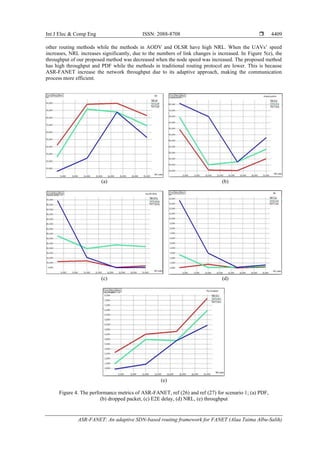
In this scenario, the effect of the number of UAV nodes on the effectiveness of ASR-FANET of is
investigated. Figure 4. shows the performance metrics of proposed ASR-FANET and two adhoc routing
protocols for scenario 1. According to Figure 4(a), the PDF of ASR-FANET is the best due to the proposed
ASR-FANET calculates paths based on the link utilizations. PDF in AODV and OLSR performed the worst.
Figure 4(b) displays that ASR-FANET also outperformed AODV and OLSR when evaluated using the
packet losses metric. The packet losses are decreased when the number of nodes increased. Figure 4(c) shows
the AED is decreased when the number of nodes increased. AED in our proposed method is least and in [14]
and [15] is highest. In in Figure 4(d), the throughput of ASR-FANET method shows a lower NRL over
number of UAVs. This is because the SDN controller can adjust routing paths dynamically to avoid
overloaded links. The NRL of these methods is decreased when the number of UAVs increased. In
Figure 4(e), the throughput is more significant with ASR-FANET and the throughput is less significant with
routing methods in AODV and OLSR because the ASR-FANET finds the optimal paths adaptively regarding
the condition of network.
b. Scenario 2: Various Speed of UAV
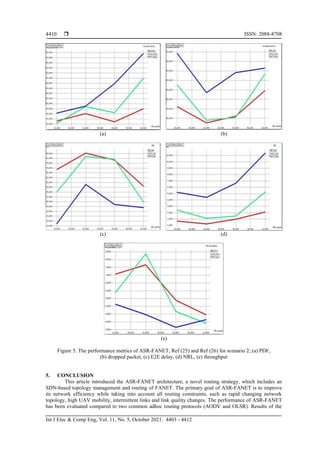
This scenario considers the various speed of UAV to demonstrate the efficiency of ASR-FANET.
Figure 5 shows the performance metrics of proposed framework and two routing method (AODV and OLSR)
for scenario 2. According to Figure 5(a) the PDF were decreased when the UAV speed was increased due to
the proposed ASR-FANET calculates paths based on the link utilizations. The proposed method has high
PDF while AODV and OLSR are lower. Figure 5(b) shows the number of packets lost in [14] and [15] is
highest, while in our proposed method is lowest. ASR-FANET considers adaptive method to reduce the
number of dropped packets. The lost packet is increased when the node speed increased. According to
Figure 5(c), adaptive routing strategy of the ASR-FANET leads to significant reduction in average E2E. This
Figure shows the average E2E increases when the UAVs speed increased. In Figure 5(d),the NRL of these
protocols is increases with high speed for all methods. The method-based Adaptive SDN has low NRL than](https://image.slidesharecdn.com/7723871em5apr2120mar2114sep20ry-210728065550/85/ASR-FANET-An-adaptive-SDN-based-routing-framework-for-FANET-6-320.jpg)
![Int J Elec & Comp Eng ISSN: 2088-8708
ASR-FANET: An adaptive SDN-based routing framework for FANET (Alaa Taima Albu-Salih)
4411
simulation indicate that the proposed framework can reduce the average E2E delay, normalizing routing load
and dropped packets, and increase the throughput and packet delivery fraction. In the future work, we plan to
extend our framework into optimal FANET topology with SDN strategy in deadline based IoT application.
REFERENCES
[1] L. Gupta, R. Jain and G. Vaszkun, “Survey of Important Issues in UAV Communication Networks,” in IEEE
Communications Surveys and Tutorials, vol. 18, no. 2, pp. 1123-1152, Secondquarter 2016,
doi: 10.1109/COMST.2015.2495297.
[2] H. Shakhatreh et al., “Unmanned Aerial Vehicles (UAVs): A Survey on Civil Applications and Key Research
Challenges,” in IEEE Access, vol. 7, pp. 48572-48634, 2019, doi: 10.1109/ACCESS.2019.2909530.
[3] I. Bekmezci, O. K. Sahingoz, and S. Temel, “Flying ad-hoc networks (FANETs): A survey. Ad Hoc Networks,”
vol. 11, no. 3, pp. 1254-1270, doi: doi.org/10.1016/j.adhoc.2012.12.004.
[4] O. K. Sahingoz, “Networking models in flying ad-hoc networks (FANETs): Concepts and challenges,” Journal of
Intelligent and Robotic Systems, vol. 74, no. 1-2, pp. 513-527, 2014, doi: 10.1007/s10846-013-9959-7.
[5] M. A. Khan, S. M. Riaz, R. M. Asif, and A. Shah, “Review of communication protocols for FANETs:(Flying ad-
hoc networks),” In International Conference on Engineering and Emerging Technologies, 2015.
[6] M. B. Yassein and N. Alhuda, “Flying ad-hoc networks: Routing protocols, mobility models,” International
Journal of Advanced Computer Science and Applications (IJACSA), no. 7, no. 6, 2016,
doi: 10.14569/IJACSA.2016.070621.
[7] O. K. Sahingoz, "Mobile networking with UAVs: Opportunities and challenges," 2013 International Conference on
Unmanned Aircraft Systems (ICUAS), Atlanta, GA, USA, 2013, pp. 933-941, doi: 10.1109/ICUAS.2013.6564779.
[8] M. H. Tareque, M. S. Hossain, and M. Atiquzzaman, “On the routing in Flying Ad Hoc Networks,” 2015
Federated Conference on Computer Science and Information Systems (FedCSIS), Lodz, Poland, 2015, pp. 1-9,
doi: 10.15439/2015F002.
[9] O. S. Oubbati, M. Atiquzzaman, P. Lorenz, M. H. Tareque and M. S. Hossain, “Routing in Flying Ad Hoc
Networks: Survey, Constraints, and Future Challenge Perspectives,” in IEEE Access, vol. 7, pp. 81057-81105,
2019, doi: 10.1109/ACCESS.2019.2923840.
[10] Y. Liu, H. N. Dai, Q. Wang, M. K. Shukla, and M. Imran, “Unmanned aerial vehicle for internet of everything:
Opportunities and challenges,” Computer Communications, vol. 155, pp. 66-83, 2020,
doi: 10.1016/j.comcom.2020.03.017.
[11] A. D. Boursianis et al., “Internet of Things (IoT) and Agricultural Unmanned Aerial Vehicles (UAVs) in Smart
Farming: A Comprehensive Review,” Internet of Things, p. 100187, 2020, doi: 10.1016/j.iot.2020.100187.
[12] M. Mozaffari, W. Saad, M. Bennis, and M. Debbah, “Mobile Unmanned Aerial Vehicles (UAVs) for Energy-
Efficient Internet of Things Communications,” in IEEE Transactions on Wireless Communications, vol. 16, no. 11,
pp. 7574-7589, Nov. 2017, doi: 10.1109/TWC.2017.2751045.
[13] M. F. Khan, K. L. A. Yau, R. M. Noor, and M. A. Imran, “Routing schemes in FANETs: A survey,” Sensors,
vol. 20, no. 1, pp. 38, doi: 10.3390/s20010038.
[14] M. A. Khan, I. U. Khan, A. Safi, and I. M. Quershi, “Dynamic routing in flying ad-hoc networks using topology-
based routing protocols,” Drones, vol. 2, no. 3, pp. 27, 2018, doi: 10.3390/drones2030027.
[15] S. Bera, S. Misra and A. V. Vasilakos, “Software-Defined Networking for Internet of Things: A Survey,” in IEEE
Internet of Things Journal, vol. 4, no. 6, pp. 1994-2008, Dec. 2017, doi: 10.1109/JIOT.2017.2746186.
[16] O. Sami Oubbati, M. Atiquzzaman, T. A. Ahanger, and A. Ibrahim, “Softwarization of UAV Networks: A Survey
of Applications and Future Trends,” in IEEE Access, vol. 8, pp. 98073-98125, 2020,
doi: 10.1109/ACCESS.2020.2994494.
[17] A. Ramaprasath, A. Srinivasan, C. H. Lung, and M. St-Hilaire, “Intelligent wireless ad hoc routing protocol and
controller for UAV networks,” In Ad Hoc Networks, Springer, Cham, doi: 10.1007/978-3-319-51204-4_8
[18] T. Dapper e Silva, C. F. Emygdio de Melo, P. Cumino, D. Rosário, E. Cerqueira, and E. Pignaton de Freitas,
“STFANET: SDN-Based Topology Management for Flying Ad Hoc Network,” in IEEE Access, vol. 7,
pp. 173499-173514, 2019, doi: 10.1109/ACCESS.2019.2956724.
[19] G. Secinti, P. B. Darian, B. Canberk, and K. R. Chowdhury, “Resilient end-to-end connectivity for software defined
unmanned aerial vehicular networks,” 2017 IEEE 28th Annual International Symposium on Personal, Indoor, and
Mobile Radio Communications (PIMRC), Montreal, QC, Canada, 2017, pp. 1-5,
doi: 10.1109/PIMRC.2017.8292772.
[20] H. Iqbal, J. Ma, K. Stranc, K. Palmer, and P. Benbenek, “A software-defined networking architecture for aerial
network optimization,” 2016 IEEE NetSoft Conference and Workshops (NetSoft), Seoul, Korea (South), 2016,
pp. 151-155, doi: 10.1109/NETSOFT.2016.7502462.
[21] Z. Yuan, X. Huang, L. Sun, and J. Jin, “Software defined mobile sensor network for micro UAV swarm,” 2016
IEEE International Conference on Control and Robotics Engineering (ICCRE), Singapore, 2016, pp. 1-4,
doi: 10.1109/ICCRE.2016.7476140.
[22] W. Qi, Q. Song, X. Kong, and L. Guo, “A traffic-differentiated routing algorithm in Flying Ad Hoc Sensor
Networks with SDN cluster controllers,” Journal of the Franklin Institute, vol. 356, no. 2, pp. 766-790, 2019,
doi: 10.1016/j.jfranklin.2017.11.012
[23] K. Chen, S. Zhao, and N. Lv, “Network monitoring information collection in the SDN-enabled airborne tactical
network,” International Journal of Aerospace Engineering, 2018, doi: 10.1155/2018/1940842.](https://image.slidesharecdn.com/7723871em5apr2120mar2114sep20ry-210728065550/85/ASR-FANET-An-adaptive-SDN-based-routing-framework-for-FANET-9-320.jpg)
![ ISSN: 2088-8708
Int J Elec & Comp Eng, Vol. 11, No. 5, October 2021: 4403 - 4412
4412
[24] M. Alharthi, A. M. Taha, and H. S. Hassanein, “An Architecture for Software Defined Drone Networks,” ICC
2019-2019 IEEE International Conference on Communications (ICC), Shanghai, China, 2019, pp. 1-5,
doi: 10.1109/ICC.2019.8761968.
[25] R. Kirichek, A. Vladyko, A. Paramonov, and A. Koucheryavy, “Software-defined architecture for flying ubiquitous
sensor networking,” 2017 19th International Conference on Advanced Communication Technology (ICACT),
PyeongChang, Korea (South), 2017, pp. 158-162, doi: 10.23919/ICACT.2017.7890076.
[26] K. Singh and A. K. Verma, “Experimental analysis of AODV, DSDV and OLSR routing protocol for flying adhoc
networks (FANETs),” 2015 IEEE International Conference on Electrical, Computer and Communication
Technologies (ICECCT), Coimbatore, India, 2015, pp. 1-4, doi: 10.1109/ICECCT.2015.7226085.
[27] S. Rosati, K. Krużelecki, G. Heitz, D. Floreano, and B. Rimoldi, “Dynamic Routing for Flying Ad Hoc Networks,”
in IEEE Transactions on Vehicular Technology, vol. 65, no. 3, pp. 1690-1700, March 2016,
doi: 10.1109/TVT.2015.2414819.
BIOGRAPHIES OF AUTHORS
Alaa Taima Albu-salih received the B.Sc. degree in Computer Engineering from University of
Al-Qadisiyah, Iraq in 2005, the M. Sc degree in Information Technology from Babylon
University, Iraq in 2013 and the Ph.D. degree in Computer Engineering at Ferdowsi university
of Mashhad, Mashhad, Iran in 2018. His research interests include wireless sensor networks,
mobility models, routing, software-defined networking, internet of things, mathematical
modeling, optimization, Unmanned Aerial Vehicle and he have several publications in these
fields.
Hayder Ayad Khudhair is completed B.Sc. in Computer Sciences at Babylon University,
Babil, Iraq. Receive his M. Sc (master) in Computer Sciences in the year of 2014 from the
college of computer sciences at Babylon University as well his Phd. degree from Babylon
University, college of information technology in 2019. He is currently working as a lecturer in
Al-Najaf Education Directorate. His research in master degree interests Ad-Hoc networks
latency time and his research in Phd. degree interests Wireless Sensor Network coverage and
connectivity, data mining, machine learning as regression analysis and he have several
publications in these fields.](https://image.slidesharecdn.com/7723871em5apr2120mar2114sep20ry-210728065550/85/ASR-FANET-An-adaptive-SDN-based-routing-framework-for-FANET-10-320.jpg)


