Presented by
MD ISHTIAQUE
MUSTAFA KHAN
KESHNATH SINGH
ABDUL MALIK
MD SHAHID
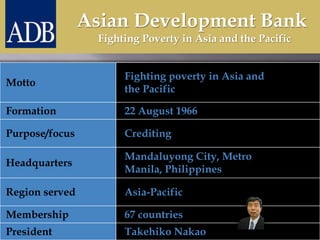
Asian Development Bank
Fighting Poverty in Asia and the Pacific
Motto
Fighting poverty in Asia and
the Pacific
Formation 22 August 1966
Purpose/focus Crediting
Headquarters
Mandaluyong City, Metro
Manila, Philippines
Region served Asia-Pacific
Membership 67 countries
President Takehiko Nakao
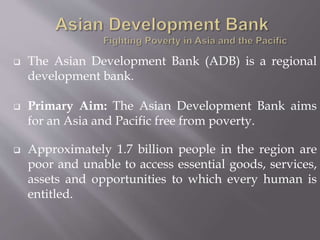
 The Asian Development Bank (ADB) is a regional
development bank.
 Primary Aim: The Asian Development Bank aims
for an Asia and Pacific free from poverty.
 Approximately 1.7 billion people in the region are
poor and unable to access essential goods, services,
assets and opportunities to which every human is
entitled.
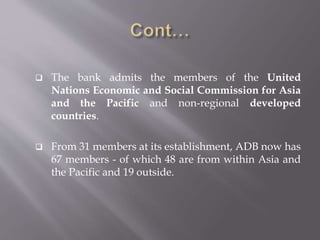
 The bank admits the members of the United
Nations Economic and Social Commission for Asia
and the Pacific and non-regional developed
countries.
 From 31 members at its establishment, ADB now has
67 members - of which 48 are from within Asia and
the Pacific and 19 outside.
Non regional members Regional members
Asian Development Bank
Fighting Poverty in Asia and the Pacific
4819
Asian Development Bank
Fighting Poverty in Asia and the Pacific
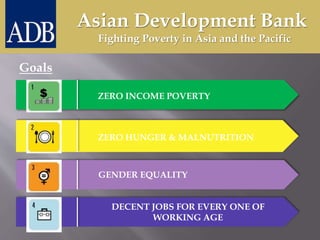
ZERO INCOME POVERTY
ZERO HUNGER & MALNUTRITION
GENDER EQUALITY
DECENT JOBS FOR EVERY ONE OF
WORKING AGE
Goals
Asian Development Bank
Fighting Poverty in Asia and the Pacific
HEALTH FOR ALL
IMPROVED LIVING CONDITION
FOR ALL
QUALITY EDUCATION FOR ALL
LIVE ABLE CITIES
Asian Development Bank
Fighting Poverty in Asia and the Pacific
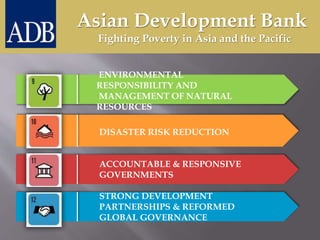
ENVIRONMENTAL
RESPONSIBILITY AND
MANAGEMENT OF NATURAL
RESOURCES
DISASTER RISK REDUCTION
ACCOUNTABLE & RESPONSIVE
GOVERNMENTS
STRONG DEVELOPMENT
PARTNERSHIPS & REFORMED
GLOBAL GOVERNANCE
1. Promote investment in the region of public and
private capital for development purposes.
2. Provide loans for the economic and social
development of the member countries of the
region.
3. Help member countries in coordinating their
development policies and plans.
4. Provide technical assistance for the preparation,
financing and execution of development
projects and programmes.
5. Undertake such other activities and provide
such other services as may advance its
objectives.
6. Provide financial and technical assistance to
member countries for environmental
protection.
7. Act as financial intermediary by transferring
resources from global capital markets to
developing countries.
8. Support public resource mobilization and
management to member countries.
The Bank's operations cover a wide spectrum of
activities
and have been classified according to the following
sectors:
 Agriculture
 Education
 Energy
 Finance
 Health
Areas of Work
 Industry and Trade
 Information and Communication
Technology
 Public Sector Management
 Social Protection
 Transport
 Water
CHALLENGES
 India became a member of the Asian Development
Bank (ADB) as a founding member in 1966.
 India is holding 6.33% of shares, totaling 672,030
shares, in ADB as on 31st December, 2012.
 India has 5.36% voting rights.
 ADB holds Annual meetings in a member country
in late April or early May every year. 46th Annual
Meeting of the ADB is being hosted by India
during 2-5 May, 2013 in New Delhi.
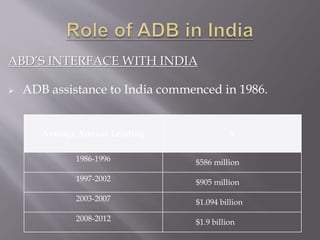
ABD’S INTERFACE WITH INDIA
 ADB assistance to India commenced in 1986.
Average Annual Lending $
1986-1996 $586 million
1997-2002 $905 million
2003-2007 $1.094 billion
2008-2012 $1.9 billion
 1) ADB supports push for more private sector
investment in affordable homes.
 2) $300 million loan signed to support India's
national urban health program.
 3)ADB $200 Million loan to help India's Axis
bank finance small holders farmers.
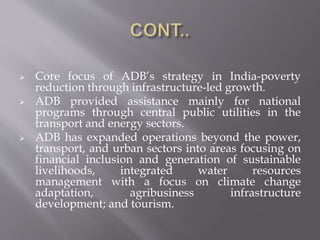
 Core focus of ADB’s strategy in India-poverty
reduction through infrastructure-led growth.
 ADB provided assistance mainly for national
programs through central public utilities in the
transport and energy sectors.
 ADB has expanded operations beyond the power,
transport, and urban sectors into areas focusing on
financial inclusion and generation of sustainable
livelihoods, integrated water resources
management with a focus on climate change
adaptation, agribusiness infrastructure
development; and tourism.
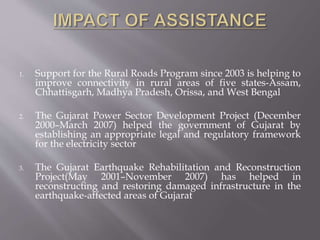
1. Support for the Rural Roads Program since 2003 is helping to
improve connectivity in rural areas of five states-Assam,
Chhattisgarh, Madhya Pradesh, Orissa, and West Bengal
2. The Gujarat Power Sector Development Project (December
2000–March 2007) helped the government of Gujarat by
establishing an appropriate legal and regulatory framework
for the electricity sector
3. The Gujarat Earthquake Rehabilitation and Reconstruction
Project(May 2001–November 2007) has helped in
reconstructing and restoring damaged infrastructure in the
earthquake-affected areas of Gujarat
4. The Tsunami Emergency Assistance (Sector)
Project has helped to rebuild houses, roads,
bridges, ports facilities, and other public
infrastructure incorporating better safety
standards
5. The Housing Finance II project, consisting of
loans(March 2002–June 2007), provided loans
to low-income households for home purchases
or improvements through financial
intermediaries
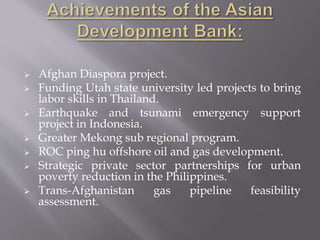
 Afghan Diaspora project.
 Funding Utah state university led projects to bring
labor skills in Thailand.
 Earthquake and tsunami emergency support
project in Indonesia.
 Greater Mekong sub regional program.
 ROC ping hu offshore oil and gas development.
 Strategic private sector partnerships for urban
poverty reduction in the Philippines.
 Trans-Afghanistan gas pipeline feasibility
assessment.
 Loan of $1.2 billion to bail it out of an impending
economic crisis in Pakistan and ongoing funding for
the countries growing energy needs, specifically
Hydro-power projects.
 Micro finance support for private enterprises, in
conjunction with governments,
including Pakistan and India.
 The Yichang-Wanzhou Railway project in the
mountainous area of western Hubei Province and
north-eastern Chongqing Municipality, China.
 Colombo Harbor Expansion Project.
 To promote investment in ESCAP region of
public & private capital for development
 To utilize the resources for financing
development, giving priority to the projects
Asian  development bank

Asian development bank

  • 1.
    Presented by MD ISHTIAQUE MUSTAFAKHAN KESHNATH SINGH ABDUL MALIK MD SHAHID
  • 2.
    Asian Development Bank FightingPoverty in Asia and the Pacific Motto Fighting poverty in Asia and the Pacific Formation 22 August 1966 Purpose/focus Crediting Headquarters Mandaluyong City, Metro Manila, Philippines Region served Asia-Pacific Membership 67 countries President Takehiko Nakao
  • 3.
     The AsianDevelopment Bank (ADB) is a regional development bank.  Primary Aim: The Asian Development Bank aims for an Asia and Pacific free from poverty.  Approximately 1.7 billion people in the region are poor and unable to access essential goods, services, assets and opportunities to which every human is entitled.
  • 4.
     The bankadmits the members of the United Nations Economic and Social Commission for Asia and the Pacific and non-regional developed countries.  From 31 members at its establishment, ADB now has 67 members - of which 48 are from within Asia and the Pacific and 19 outside.
  • 5.
    Non regional membersRegional members Asian Development Bank Fighting Poverty in Asia and the Pacific 4819
  • 6.
    Asian Development Bank FightingPoverty in Asia and the Pacific ZERO INCOME POVERTY ZERO HUNGER & MALNUTRITION GENDER EQUALITY DECENT JOBS FOR EVERY ONE OF WORKING AGE Goals
  • 7.
    Asian Development Bank FightingPoverty in Asia and the Pacific HEALTH FOR ALL IMPROVED LIVING CONDITION FOR ALL QUALITY EDUCATION FOR ALL LIVE ABLE CITIES
  • 8.
    Asian Development Bank FightingPoverty in Asia and the Pacific ENVIRONMENTAL RESPONSIBILITY AND MANAGEMENT OF NATURAL RESOURCES DISASTER RISK REDUCTION ACCOUNTABLE & RESPONSIVE GOVERNMENTS STRONG DEVELOPMENT PARTNERSHIPS & REFORMED GLOBAL GOVERNANCE
  • 9.
    1. Promote investmentin the region of public and private capital for development purposes. 2. Provide loans for the economic and social development of the member countries of the region. 3. Help member countries in coordinating their development policies and plans.
  • 10.
    4. Provide technicalassistance for the preparation, financing and execution of development projects and programmes. 5. Undertake such other activities and provide such other services as may advance its objectives. 6. Provide financial and technical assistance to member countries for environmental protection.
  • 11.
    7. Act asfinancial intermediary by transferring resources from global capital markets to developing countries. 8. Support public resource mobilization and management to member countries.
  • 12.
    The Bank's operationscover a wide spectrum of activities and have been classified according to the following sectors:  Agriculture  Education  Energy  Finance  Health Areas of Work  Industry and Trade  Information and Communication Technology  Public Sector Management  Social Protection  Transport  Water
  • 14.
  • 15.
     India becamea member of the Asian Development Bank (ADB) as a founding member in 1966.  India is holding 6.33% of shares, totaling 672,030 shares, in ADB as on 31st December, 2012.  India has 5.36% voting rights.  ADB holds Annual meetings in a member country in late April or early May every year. 46th Annual Meeting of the ADB is being hosted by India during 2-5 May, 2013 in New Delhi.
  • 16.
    ABD’S INTERFACE WITHINDIA  ADB assistance to India commenced in 1986. Average Annual Lending $ 1986-1996 $586 million 1997-2002 $905 million 2003-2007 $1.094 billion 2008-2012 $1.9 billion
  • 17.
     1) ADBsupports push for more private sector investment in affordable homes.  2) $300 million loan signed to support India's national urban health program.  3)ADB $200 Million loan to help India's Axis bank finance small holders farmers.
  • 18.
     Core focusof ADB’s strategy in India-poverty reduction through infrastructure-led growth.  ADB provided assistance mainly for national programs through central public utilities in the transport and energy sectors.  ADB has expanded operations beyond the power, transport, and urban sectors into areas focusing on financial inclusion and generation of sustainable livelihoods, integrated water resources management with a focus on climate change adaptation, agribusiness infrastructure development; and tourism.
  • 19.
    1. Support forthe Rural Roads Program since 2003 is helping to improve connectivity in rural areas of five states-Assam, Chhattisgarh, Madhya Pradesh, Orissa, and West Bengal 2. The Gujarat Power Sector Development Project (December 2000–March 2007) helped the government of Gujarat by establishing an appropriate legal and regulatory framework for the electricity sector 3. The Gujarat Earthquake Rehabilitation and Reconstruction Project(May 2001–November 2007) has helped in reconstructing and restoring damaged infrastructure in the earthquake-affected areas of Gujarat
  • 20.
    4. The TsunamiEmergency Assistance (Sector) Project has helped to rebuild houses, roads, bridges, ports facilities, and other public infrastructure incorporating better safety standards 5. The Housing Finance II project, consisting of loans(March 2002–June 2007), provided loans to low-income households for home purchases or improvements through financial intermediaries
  • 21.
     Afghan Diasporaproject.  Funding Utah state university led projects to bring labor skills in Thailand.  Earthquake and tsunami emergency support project in Indonesia.  Greater Mekong sub regional program.  ROC ping hu offshore oil and gas development.  Strategic private sector partnerships for urban poverty reduction in the Philippines.  Trans-Afghanistan gas pipeline feasibility assessment.
  • 22.
     Loan of$1.2 billion to bail it out of an impending economic crisis in Pakistan and ongoing funding for the countries growing energy needs, specifically Hydro-power projects.  Micro finance support for private enterprises, in conjunction with governments, including Pakistan and India.  The Yichang-Wanzhou Railway project in the mountainous area of western Hubei Province and north-eastern Chongqing Municipality, China.  Colombo Harbor Expansion Project.
  • 23.
     To promoteinvestment in ESCAP region of public & private capital for development  To utilize the resources for financing development, giving priority to the projects