ASIAN DEVELOPMENT BANK 
By 
Mounika 
Rayapati
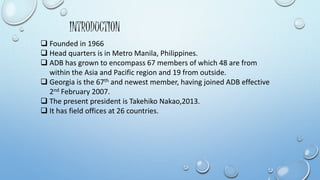
INTRODUCTION 
 Founded in 1966 
 Head quarters is in Metro Manila, Philippines. 
 ADB has grown to encompass 67 members of which 48 are from 
within the Asia and Pacific region and 19 from outside. 
 Georgia is the 67th and newest member, having joined ADB effective 
2nd February 2007. 
 The present president is Takehiko Nakao,2013. 
 It has field offices at 26 countries.
VISION 
 An Asia and Pacific free of poverty. 
MISSION 
 Mission is to help its developing member countries 
reduce poverty and improve the quality of life of their 
people. 
 Under strategy 2020, ADB will follow 3 complementary 
strategic agendas: Inclusive growth, environment 
sustainable growth and regional integration.
STATES GOALS 
Promoting economic growth 
Reducing poverty 
Developing human resources 
Improving the status of women 
Protecting the environment
WHAT DOES ADB DO ? 
ADB’s overarching goal is to reduce poverty in Asia and in Pacific. 
It helps to improve the quality of peoples lives by providing loans 
at a low interest rates and technical assistance for a broad range 
of development activities.
SOURCES OF FUNDS 
Issuing of funds 
Retained earnings from lending's 
Members contribution 
Borrowings from world capital market 
PROJECTS AND PROGRAMS 
 Supports projects in agriculture and natural resources, education, 
energy, transport and communication, finance, industry and non-fuel 
minerals. 
 Countries with limited debt repayment capacity in the region receive 
additional help through the ADF.
ADB & INDIA 
India joined at its founding in 1966 and since lending 
operations began in 1986. it is the 4th largest shareholder. 
Ashok K Lahiri is the executive director and Tadashi Kondo 
is the ADB country director for India. 
ROLE OF ADB IN INDIA 
 ADB has approved 130 loans (sovereign and non-sovereign) 
amounting to $20,586.5 million since 1986. 
 Core focus on ADB’s strategy in India is poverty reduction through 
infrastructure-led growth. 
 The growth to be maintain environment sustainable, admist 
increasing preserve on natural resources.
IMPACT OF ASSISTANCE 
 Support for rural roads program since 2003 is helping to improve 
connectivity in rural areas of five states- Assam, Chhattisgarh, Madhya 
Pradesh, Orissa and west Bengal. 
 The Gujarat earthquake rehabilitation and reconstruction project(may 2001- 
November 2007) has helped in reconstructing and restoring damaged infra 
in the earthquake affected areas of Gujarat. 
 The tsunami emergency assistance project has helped to rebuild houses, 
roads, bridges, ports facilities and other public infra incorporating better 
safety standards. 
 The housing finance II project, consisting of loans(march2002- june2007), 
provided loans to low income households for home purchases or 
improvements through financial intermediaries.
PROJECTS UNDERTAKEN IN INDIA 
 Integrating Poverty Reduction in Programs and Projects in India. 
 Capacity Building for the Clean Development Mechanism in India. 
 Capacity Building for the Contract supervision and Management in NHAI. 
 Capacity Development for Strengthening Implementation of social and 
Environmental Safeguard requirements in Projects in India. 
 Securities Companies in India. 
 SBI Gilts Ltd , etc….
ACHIVEMENTS OF ASIAN DEVELOPMENT BANK 
 Funding projects led by the Utah State University to bring labor 
skills to Thailand. 
 Technical assistance grant of US$2 million to Bangladesh to 
overcome the challenges linked to climate change. 
 Loan of $1.2 billion to bail Pakistan out of an impending economic 
crisis. 
 Contributions towards the development of solar energy in India. 
 Earthquake and Tsunami Emergency Support Project in Indonesia.
CHALLENGES OF ADB 
 Poverty is still one of the main challenges faced by ADB. 
 Safe water is still not available to 60% of the people in the member 
countries. 
 Improved sanitation facilities not reached 
70% of the people. 
 Out of every 100 children, 40 die before they 
reach the age of 15. Infant mortality rate is very high. 
 Half of the undernourished population of the world lives in Asia. 
 Rising inflation has adversely impacted growth rates in Asia
 Report on Asian Development Bank

Report on Asian Development Bank

  • 1.
    ASIAN DEVELOPMENT BANK By Mounika Rayapati
  • 2.
    INTRODUCTION  Foundedin 1966  Head quarters is in Metro Manila, Philippines.  ADB has grown to encompass 67 members of which 48 are from within the Asia and Pacific region and 19 from outside.  Georgia is the 67th and newest member, having joined ADB effective 2nd February 2007.  The present president is Takehiko Nakao,2013.  It has field offices at 26 countries.
  • 3.
    VISION  AnAsia and Pacific free of poverty. MISSION  Mission is to help its developing member countries reduce poverty and improve the quality of life of their people.  Under strategy 2020, ADB will follow 3 complementary strategic agendas: Inclusive growth, environment sustainable growth and regional integration.
  • 4.
    STATES GOALS Promotingeconomic growth Reducing poverty Developing human resources Improving the status of women Protecting the environment
  • 5.
    WHAT DOES ADBDO ? ADB’s overarching goal is to reduce poverty in Asia and in Pacific. It helps to improve the quality of peoples lives by providing loans at a low interest rates and technical assistance for a broad range of development activities.
  • 6.
    SOURCES OF FUNDS Issuing of funds Retained earnings from lending's Members contribution Borrowings from world capital market PROJECTS AND PROGRAMS  Supports projects in agriculture and natural resources, education, energy, transport and communication, finance, industry and non-fuel minerals.  Countries with limited debt repayment capacity in the region receive additional help through the ADF.
  • 7.
    ADB & INDIA India joined at its founding in 1966 and since lending operations began in 1986. it is the 4th largest shareholder. Ashok K Lahiri is the executive director and Tadashi Kondo is the ADB country director for India. ROLE OF ADB IN INDIA  ADB has approved 130 loans (sovereign and non-sovereign) amounting to $20,586.5 million since 1986.  Core focus on ADB’s strategy in India is poverty reduction through infrastructure-led growth.  The growth to be maintain environment sustainable, admist increasing preserve on natural resources.
  • 8.
    IMPACT OF ASSISTANCE  Support for rural roads program since 2003 is helping to improve connectivity in rural areas of five states- Assam, Chhattisgarh, Madhya Pradesh, Orissa and west Bengal.  The Gujarat earthquake rehabilitation and reconstruction project(may 2001- November 2007) has helped in reconstructing and restoring damaged infra in the earthquake affected areas of Gujarat.  The tsunami emergency assistance project has helped to rebuild houses, roads, bridges, ports facilities and other public infra incorporating better safety standards.  The housing finance II project, consisting of loans(march2002- june2007), provided loans to low income households for home purchases or improvements through financial intermediaries.
  • 9.
    PROJECTS UNDERTAKEN ININDIA  Integrating Poverty Reduction in Programs and Projects in India.  Capacity Building for the Clean Development Mechanism in India.  Capacity Building for the Contract supervision and Management in NHAI.  Capacity Development for Strengthening Implementation of social and Environmental Safeguard requirements in Projects in India.  Securities Companies in India.  SBI Gilts Ltd , etc….
  • 10.
    ACHIVEMENTS OF ASIANDEVELOPMENT BANK  Funding projects led by the Utah State University to bring labor skills to Thailand.  Technical assistance grant of US$2 million to Bangladesh to overcome the challenges linked to climate change.  Loan of $1.2 billion to bail Pakistan out of an impending economic crisis.  Contributions towards the development of solar energy in India.  Earthquake and Tsunami Emergency Support Project in Indonesia.
  • 11.
    CHALLENGES OF ADB  Poverty is still one of the main challenges faced by ADB.  Safe water is still not available to 60% of the people in the member countries.  Improved sanitation facilities not reached 70% of the people.  Out of every 100 children, 40 die before they reach the age of 15. Infant mortality rate is very high.  Half of the undernourished population of the world lives in Asia.  Rising inflation has adversely impacted growth rates in Asia