Asexual
Propagation
(GRAFTING)
Presented by:
EUNICE Z. ESTABILLO
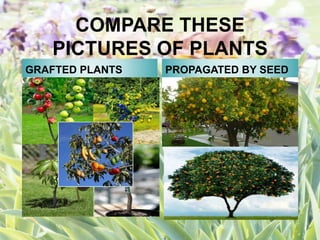
COMPARE THESE
PICTURES OF PLANTS
GRAFTED PLANTS PROPAGATED BY SEED
The Cambium
The cambium is a
protective barrier.
Cambium – a
cylindrical layer of cells
in plant roots and stem
that produces the new
tissue responsible for
increased girth,
particularly sap
conducting tissues,
xylem and phloem and
bark.
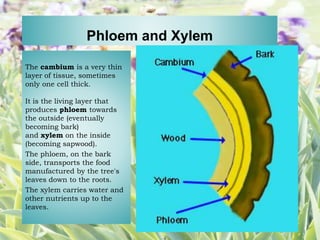
Phloem and Xylem
The cambium is a very thin
layer of tissue, sometimes
only one cell thick.
It is the living layer that
produces phloem towards
the outside (eventually
becoming bark)
and xylem on the inside
(becoming sapwood).
The phloem, on the bark
side, transports the food
manufactured by the tree's
leaves down to the roots.
The xylem carries water and
other nutrients up to the
leaves.
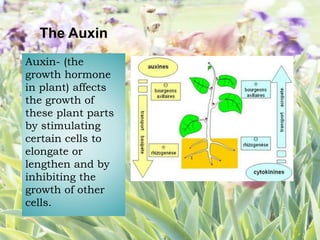
The Auxin
Auxin- (the
growth hormone
in plant) affects
the growth of
these plant parts
by stimulating
certain cells to
elongate or
lengthen and by
inhibiting the
growth of other
cells.
What is Grafting
Grafting is an asexual propagation
whereby two plant parts are joined in
such a manner that they will unite
and continue their growth as one
plant. The upper part of the
combination is called scion and the
lower part is the rootstock.
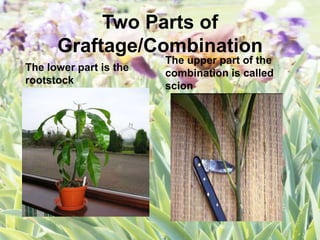
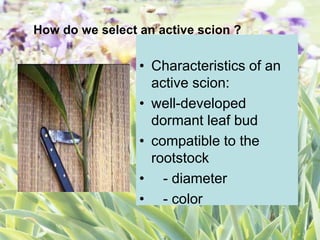
Two Parts of
Graftage/Combination
The lower part is the
rootstock
The upper part of the
combination is called
scion
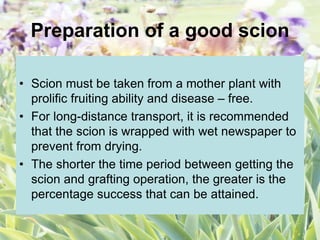
How do we select an active scion ?
• Characteristics of an
active scion:
• well-developed
dormant leaf bud
• compatible to the
rootstock
• - diameter
• - color
Preparation of a good scion
• Scion must be taken from a mother plant with
prolific fruiting ability and disease – free.
• For long-distance transport, it is recommended
that the scion is wrapped with wet newspaper to
prevent from drying.
• The shorter the time period between getting the
scion and grafting operation, the greater is the
percentage success that can be attained.
What are the tools and materials needed in
grafting ?
Tools
> Grafting knife
> Pruning shear
Materials
> Grafting tape > Old newspaper
Ice wrapper
PPE > gloves
Advantages of Grafting
• Used in propagating some seedless
varieties and hybrid plants.
• Used rootstocks resistant to viral diseases
and drought.
• In the case of ornamental plants, having
different varieties in one plant looks
attractive
Methods of
Grafting
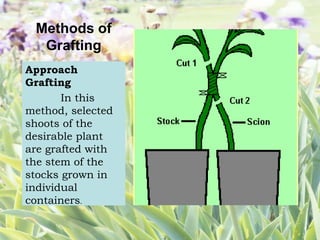
Approach
Grafting
In this
method, selected
shoots of the
desirable plant
are grafted with
the stem of the
stocks grown in
individual
containers.
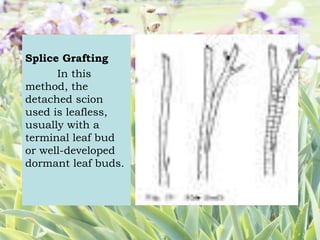
Splice Grafting
In this
method, the
detached scion
used is leafless,
usually with a
terminal leaf bud
or well-developed
dormant leaf buds.
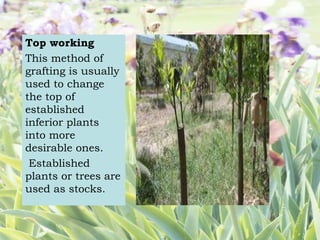
Top working
This method of
grafting is usually
used to change
the top of
established
inferior plants
into more
desirable ones.
Established
plants or trees are
used as stocks.
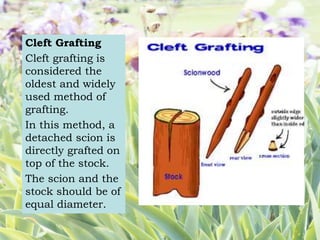
Cleft Grafting
Cleft grafting is
considered the
oldest and widely
used method of
grafting.
In this method, a
detached scion is
directly grafted on
top of the stock.
The scion and the
stock should be of
equal diameter.
What are the steps in performing cleft
grafting?
• Select an active scion measuring 6”.
• Cut the basal end of the scion into a long (1”) and
gradually tapering perfect wedge.
• Cut gradually the above part of the scion where union is
to occur.
• Make a vertical split at the center of the stock deep
enough to hold the wedge.
• Fit together cut surfaces of the two stems with their
cambium in contact.
• Tightly bind the joined parts with a grafting tape to cover
the exposed cut surfaces.
• Cover the graftage with an ice candy plastic to prevent
entry of water in cut surfaces.
Asexual-Propagation-GRAFTING.pptx

Asexual-Propagation-GRAFTING.pptx

  • 1.
  • 2.
    COMPARE THESE PICTURES OFPLANTS GRAFTED PLANTS PROPAGATED BY SEED
  • 3.
    The Cambium The cambiumis a protective barrier. Cambium – a cylindrical layer of cells in plant roots and stem that produces the new tissue responsible for increased girth, particularly sap conducting tissues, xylem and phloem and bark.
  • 4.
    Phloem and Xylem Thecambium is a very thin layer of tissue, sometimes only one cell thick. It is the living layer that produces phloem towards the outside (eventually becoming bark) and xylem on the inside (becoming sapwood). The phloem, on the bark side, transports the food manufactured by the tree's leaves down to the roots. The xylem carries water and other nutrients up to the leaves.
  • 5.
    The Auxin Auxin- (the growthhormone in plant) affects the growth of these plant parts by stimulating certain cells to elongate or lengthen and by inhibiting the growth of other cells.
  • 6.
    What is Grafting Graftingis an asexual propagation whereby two plant parts are joined in such a manner that they will unite and continue their growth as one plant. The upper part of the combination is called scion and the lower part is the rootstock.
  • 7.
    Two Parts of Graftage/Combination Thelower part is the rootstock The upper part of the combination is called scion
  • 8.
    How do weselect an active scion ? • Characteristics of an active scion: • well-developed dormant leaf bud • compatible to the rootstock • - diameter • - color
  • 9.
    Preparation of agood scion • Scion must be taken from a mother plant with prolific fruiting ability and disease – free. • For long-distance transport, it is recommended that the scion is wrapped with wet newspaper to prevent from drying. • The shorter the time period between getting the scion and grafting operation, the greater is the percentage success that can be attained.
  • 10.
    What are thetools and materials needed in grafting ? Tools > Grafting knife > Pruning shear Materials > Grafting tape > Old newspaper Ice wrapper PPE > gloves
  • 11.
    Advantages of Grafting •Used in propagating some seedless varieties and hybrid plants. • Used rootstocks resistant to viral diseases and drought. • In the case of ornamental plants, having different varieties in one plant looks attractive
  • 12.
    Methods of Grafting Approach Grafting In this method,selected shoots of the desirable plant are grafted with the stem of the stocks grown in individual containers.
  • 13.
    Splice Grafting In this method,the detached scion used is leafless, usually with a terminal leaf bud or well-developed dormant leaf buds.
  • 14.
    Top working This methodof grafting is usually used to change the top of established inferior plants into more desirable ones. Established plants or trees are used as stocks.
  • 15.
    Cleft Grafting Cleft graftingis considered the oldest and widely used method of grafting. In this method, a detached scion is directly grafted on top of the stock. The scion and the stock should be of equal diameter.
  • 16.
    What are thesteps in performing cleft grafting? • Select an active scion measuring 6”. • Cut the basal end of the scion into a long (1”) and gradually tapering perfect wedge. • Cut gradually the above part of the scion where union is to occur. • Make a vertical split at the center of the stock deep enough to hold the wedge. • Fit together cut surfaces of the two stems with their cambium in contact. • Tightly bind the joined parts with a grafting tape to cover the exposed cut surfaces. • Cover the graftage with an ice candy plastic to prevent entry of water in cut surfaces.