ASEAN: An Emerging
Management Model
Challenging How HR Professionals Work
Presentation by Michael A. Netzley, Ph.D.
October 7, 2016
We Wanted to Know….
§ What makes a good and
successful company in
ASEAN?
§ What does the ASEAN model
look like?
§ How should leaders today
and in the future be
developed and educated?
Stephen Wyatt
Editor
Michael Netzley
Scientific Supervisor
Bob Aubrey
Researcher, Writer
3
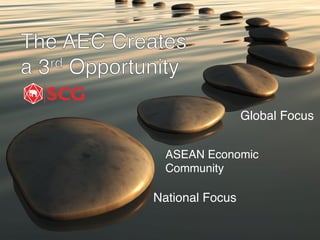
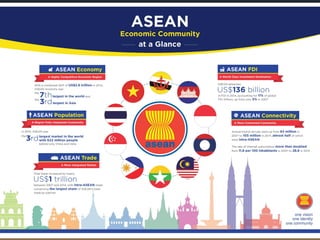
ASEAN
National Focus
Global Focus
ASEAN Economic
Community
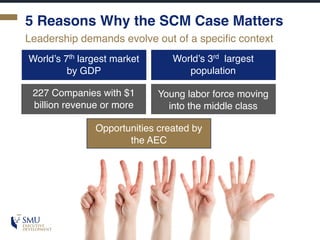
5 Reasons Why the SCM Case Matters
Leadership demands evolve out of a specific context
Opportunities created by
the AEC
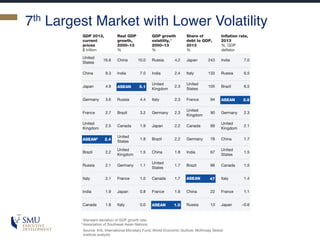
World’s 7th largest market
by GDP
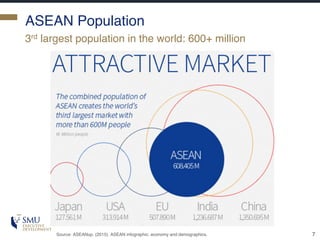
World’s 3rd largest
population
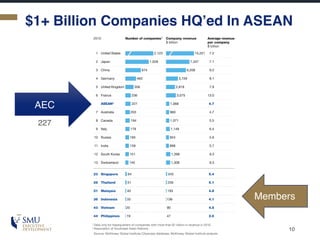
227 Companies with $1
billion revenue or more
Young labor force moving
into the middle class
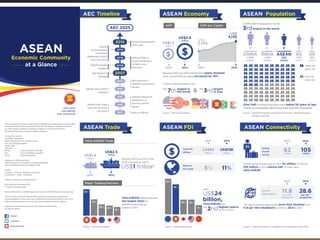
7th Largest Market with Lower Volatility
ASEAN Population
3rd largest population in the world: 600+ million
7Source: ASEANup. (2015). ASEAN infographic: economy and demographics.
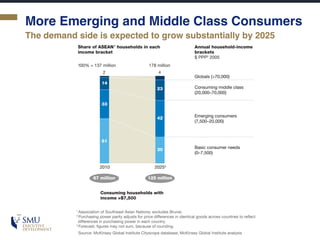
More Emerging and Middle Class Consumers
The demand side is expected to grow substantially by 2025
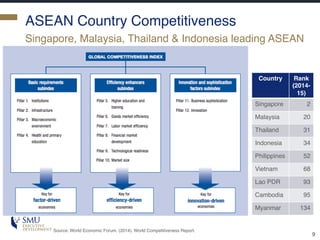
ASEAN Country Competitiveness
Singapore, Malaysia, Thailand & Indonesia leading ASEAN
9
Country Rank
(2014-
15)
Singapore 2
Malaysia 20
Thailand 31
Indonesia 34
Philippines 52
Vietnam 68
Lao PDR 93
Cambodia 95
Myanmar 134
Source: World Economic Forum. (2014). World Competitiveness Report.
$1+ Billion Companies HQ’ed In ASEAN
10
AEC
Members
227
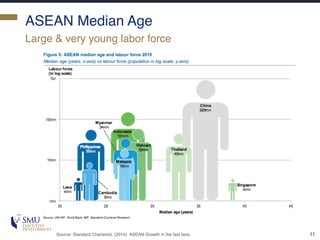
ASEAN Median Age
Large & very young labor force
11Source: Standard Chartered. (2014). ASEAN Growth in the fast lane.
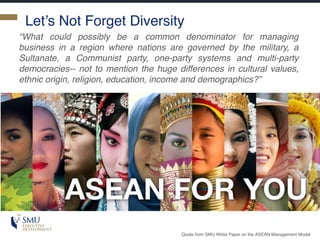
Let’s Not Forget Diversity
“What could possibly be a common denominator for managing
business in a region where nations are governed by the military, a
Sultanate, a Communist party, one-party systems and multi-party
democracies-- not to mention the huge differences in cultural values,
ethnic origin, religion, education, income and demographics?”
Quote from SMU White Paper on the ASEAN Management Model
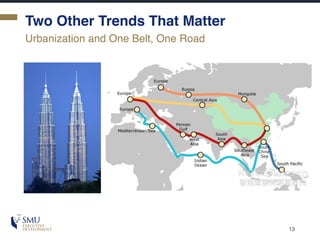
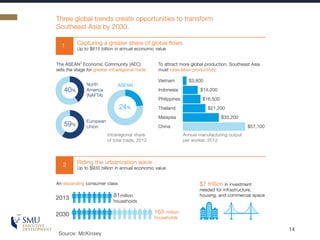
Two Other Trends That Matter
13
Urbanization and One Belt, One Road
14
Source: McKinsey
Leading in ASEAN
What Leadership Model Evolves Out of This Context?
What is a Regional Management Model?
§ A management model answers the question: what
constitutes a good and successful company for the
region?
§ A region model is not just an economic model, it is
also social and cultural. It impacts governance and
business leadership.
§ The only other regional model is the EU. ASEAN
can draw lessons from Europe. European integration
triggered management development from national to
regional (most already did international)
§ Some European regional innovations such as top
business schools, internships and Erasmus exchanges
can help the ASEAN human development challenge.
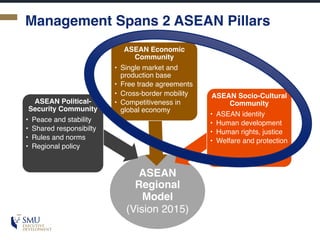
Management Spans 2 ASEAN Pillars
ASEAN
Regional
Model
(Vision 2015)
ASEAN Political-
Security Community
• Peace and stability
• Shared responsibilty
• Rules and norms
• Regional policy
ASEAN Economic
Community
• Single market and
production base
• Free trade agreements
• Cross-border mobility
• Competitiveness in
global economy
ASEAN Socio-Cultural
Community
• ASEAN identity
• Human development
• Human rights, justice
• Welfare and protection
Objectives
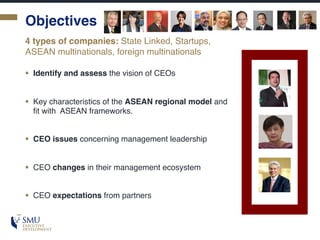
§ Identify and assess the vision of CEOs
§ Key characteristics of the ASEAN regional model and
fit with ASEAN frameworks.
§ CEO issues concerning management leadership
§ CEO changes in their management ecosystem
§ CEO expectations from partners
4 types of companies: State Linked, Startups,
ASEAN multinationals, foreign multinationals
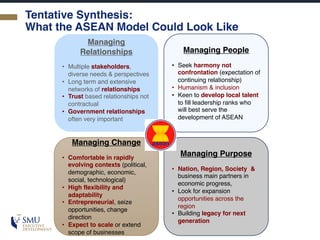
Tentative Synthesis:
What the ASEAN Model Could Look Like
Managing
Relationships
• Multiple stakeholders,
diverse needs & perspectives
• Long term and extensive
networks of relationships
• Trust based relationships not
contractual
• Government relationships
often very important
Managing Change
• Comfortable in rapidly
evolving contexts (political,
demographic, economic,
social, technological)
• High flexibility and
adaptability
• Entrepreneurial, seize
opportunities, change
direction
• Expect to scale or extend
scope of businesses
Managing Purpose
• Nation, Region, Society &
business main partners in
economic progress,
• Look for expansion
opportunities across the
region
• Building legacy for next
generation
Managing People
• Seek harmony not
confrontation (expectation of
continuing relationship)
• Humanism & inclusion
• Keen to develop local talent
to fill leadership ranks who
will best serve the
development of ASEAN
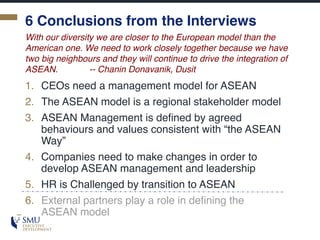
6 Conclusions from the Interviews
1. CEOs need a management model for ASEAN
2. The ASEAN model is a regional stakeholder model
3. ASEAN Management is defined by agreed
behaviours and values consistent with “the ASEAN
Way”
4. Companies need to make changes in order to
develop ASEAN management and leadership
5. HR is Challenged by transition to ASEAN
6. External partners play a role in defining the
ASEAN model
With our diversity we are closer to the European model than the
American one. We need to work closely together because we have
two big neighbours and they will continue to drive the integration of
ASEAN. -- Chanin Donavanik, Dusit
1. CEOs talked about an “ASEAN Way”
§ For CEOs the ASEAN model is built on relationships
of trust and operates with informal agreements
across a very diverse group of countries.
§ It represents is new stage of management
development that goes beyond the family-based and
nationalistic models.
§ CEOs called it the “ASEAN Way” which aligns
management with the way political and economic
relations are conducted amongst the ten ASEAN
countries.
ASEAN management is more like a network of partnerships than the highly
legislated European model. You will have strong nations within ASEAN but you
won’t have one central power. So businesses will partner across the region
rather than building a big ASEAN office. -- J.P. Orbeta, Ayala
2. CEOs talked about Stakeholders
§ ASEAN management serves shareholders but takes into
account other stakeholders.
§ Stakeholders represent diverse political systems with their
national interests, NGOs and worker associations
representing very different levels of economic development.
§ ASEAN has itself become a major stakeholder with the
AEC and the ASCC.
First is the ability to manage multiple stakeholders. Second, at the country
level things are very diverse, so you need to manage diversity. Third is
demographics: as a region we are very young – so we need a management
model for young people. Fourth, our soft infrastructures are underdeveloped,
so you have to deal with ambiguity and uncertainty. Fifth, entrepreneurs grow
their businesses largely by private capital and family ownership rather than
public capital. --Piyush Gupta, DBS
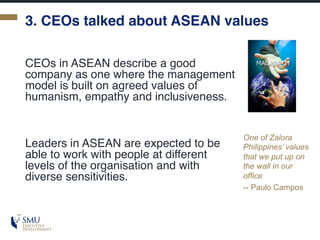
3. CEOs talked about ASEAN values
CEOs in ASEAN describe a good
company as one where the management
model is built on agreed values of
humanism, empathy and inclusiveness.
Leaders in ASEAN are expected to be
able to work with people at different
levels of the organisation and with
diverse sensitivities.
One of Zalora
Philippines’ values
that we put up on
the wall in our
office
-- Paulo Campos
Malakasit: an authentic ASEAN management concept?
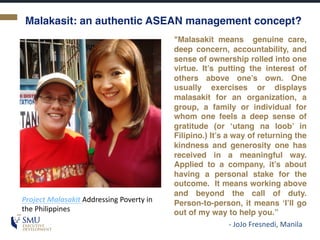
Project	Malasakit Addressing	Poverty	in	
the	Philippines
"Malasakit means genuine care,
deep concern, accountability, and
sense of ownership rolled into one
virtue. It’s putting the interest of
others above one’s own. One
usually exercises or displays
malasakit for an organization, a
group, a family or individual for
whom one feels a deep sense of
gratitude (or ‘utang na loob’ in
Filipino.) It’s a way of returning the
kindness and generosity one has
received in a meaningful way.
Applied to a company, it’s about
having a personal stake for the
outcome. It means working above
and beyond the call of duty.
Person-to-person, it means ‘I’ll go
out of my way to help you.”
- JoJo Fresnedi,	Manila
Musyawarah and mufakat
ASEAN contributed to [the region’s] unexpected outbreak of
peace in at least three important ways. First, it cultivated a
culture of “musyawarah and mufakat” (“consultation and
consensus” in Indonesian).
- Kishore Mahbubani and Rhoda Severino
Values captured in Bahasa and revealing the ASEAN Way
Source: McKinsey,ASEAN The way Forward
4. The Actions Companies can Take for ASEAN
1. Build a regional model for your company
2. Re-identify your stakeholders
3. Assess you strengths and weaknesses to
manage across ASEAN
4. Build an effective ecosystem (HR,
Professional Service Providers, Education
Partners, Management Associations)
Managers lack knowledge and experience of other countries in
ASEAN -- the school system has to prepare people for ASEAN.
-- Eric Durand, Lamberet
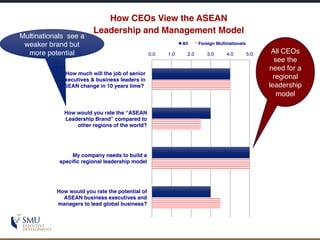
0.0 1.0 2.0 3.0 4.0 5.0
How much will the job of senior
executives & business leaders in
ASEAN change in 10 years time?
How would you rate the “ASEAN
Leadership Brand” compared to
other regions of the world?
My company needs to build a
specific regional leadership model
How would you rate the potential of
ASEAN business executives and
managers to lead global business?
How CEOs View the ASEAN
Leadership and Management Model
All Foreign Multinationals
Multinationals see a
weaker brand but
more potential All CEOs
see the
need for a
regional
leadership
model
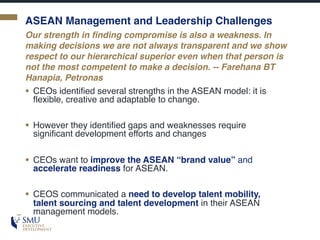
ASEAN Management and Leadership Challenges
§ CEOs identified several strengths in the ASEAN model: it is
flexible, creative and adaptable to change.
§ However they identified gaps and weaknesses require
significant development efforts and changes
§ CEOs want to improve the ASEAN “brand value” and
accelerate readiness for ASEAN.
§ CEOS communicated a need to develop talent mobility,
talent sourcing and talent development in their ASEAN
management models.
Our strength in finding compromise is also a weakness. In
making decisions we are not always transparent and we show
respect to our hierarchical superior even when that person is
not the most competent to make a decision. -- Farehana BT
Hanapia, Petronas
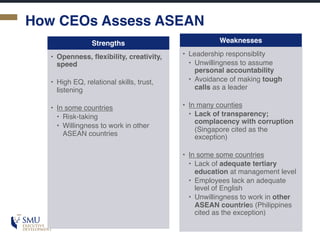
How CEOs Assess ASEAN
Strengths
• Openness, flexibility, creativity,
speed
• High EQ, relational skills, trust,
listening
• In some countries
• Risk-taking
• Willingness to work in other
ASEAN countries
Weaknesses
• Leadership responsiblity
• Unwillingness to assume
personal accountability
• Avoidance of making tough
calls as a leader
• In many counties
• Lack of transparency;
complacency with corruption
(Singapore cited as the
exception)
• In some some countries
• Lack of adequate tertiary
education at management level
• Employees lack an adequate
level of English
• Unwillingness to work in other
ASEAN countries (Philippines
cited as the exception)
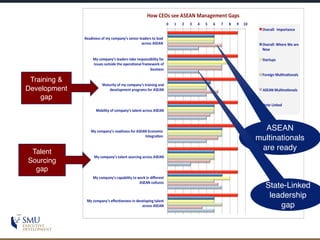
Talent
Sourcing
gap
Training &
Development
gap
ASEAN
multinationals
are ready
State-Linked
leadership
gap
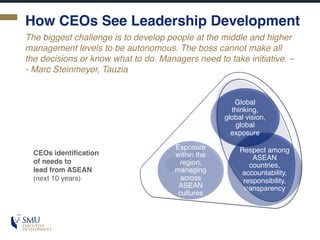
How CEOs See Leadership Development
The biggest challenge is to develop people at the middle and higher
management levels to be autonomous. The boss cannot make all
the decisions or know what to do. Managers need to take initiative. –
- Marc Steinmeyer, Tauzia
CEOs identification
of needs to
lead from ASEAN
(next 10 years)
Exposure
within the
region,
managing
across
ASEAN
cultures
Respect among
ASEAN
countries,
accountability,
responsibility,
transparency
Global
thinking,
global vision,
global
exposure
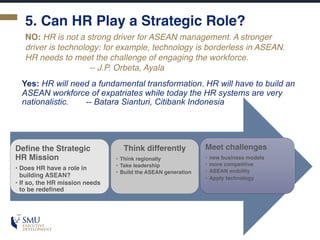
5. Can HR Play a Strategic Role?
NO: HR is not a strong driver for ASEAN management. A stronger
driver is technology: for example, technology is borderless in ASEAN.
HR needs to meet the challenge of engaging the workforce.
-- J.P. Orbeta, Ayala
Yes: HR will need a fundamental transformation. HR will have to build an
ASEAN workforce of expatriates while today the HR systems are very
nationalistic. -- Batara Sianturi, Citibank Indonesia
Define the Strategic
HR Mission
• Does HR have a role in
building ASEAN?
• If so, the HR mission needs
to be redefined
Think differently
• Think regionally
• Take leadership
• Build the ASEAN generation
Meet challenges
• new business models
• more competitive
• ASEAN mobility
• Apply technology
Appendices
35
ASEAN Leadership Model (research funded by SMU Executive Development)

ASEAN Leadership Model (research funded by SMU Executive Development)

  • 1.
    ASEAN: An Emerging ManagementModel Challenging How HR Professionals Work Presentation by Michael A. Netzley, Ph.D. October 7, 2016
  • 2.
    We Wanted toKnow…. § What makes a good and successful company in ASEAN? § What does the ASEAN model look like? § How should leaders today and in the future be developed and educated? Stephen Wyatt Editor Michael Netzley Scientific Supervisor Bob Aubrey Researcher, Writer
  • 3.
  • 4.
  • 5.
    5 Reasons Whythe SCM Case Matters Leadership demands evolve out of a specific context Opportunities created by the AEC World’s 7th largest market by GDP World’s 3rd largest population 227 Companies with $1 billion revenue or more Young labor force moving into the middle class
  • 6.
    7th Largest Marketwith Lower Volatility
  • 7.
    ASEAN Population 3rd largestpopulation in the world: 600+ million 7Source: ASEANup. (2015). ASEAN infographic: economy and demographics.
  • 8.
    More Emerging andMiddle Class Consumers The demand side is expected to grow substantially by 2025
  • 9.
    ASEAN Country Competitiveness Singapore,Malaysia, Thailand & Indonesia leading ASEAN 9 Country Rank (2014- 15) Singapore 2 Malaysia 20 Thailand 31 Indonesia 34 Philippines 52 Vietnam 68 Lao PDR 93 Cambodia 95 Myanmar 134 Source: World Economic Forum. (2014). World Competitiveness Report.
  • 10.
    $1+ Billion CompaniesHQ’ed In ASEAN 10 AEC Members 227
  • 11.
    ASEAN Median Age Large& very young labor force 11Source: Standard Chartered. (2014). ASEAN Growth in the fast lane.
  • 12.
    Let’s Not ForgetDiversity “What could possibly be a common denominator for managing business in a region where nations are governed by the military, a Sultanate, a Communist party, one-party systems and multi-party democracies-- not to mention the huge differences in cultural values, ethnic origin, religion, education, income and demographics?” Quote from SMU White Paper on the ASEAN Management Model
  • 13.
    Two Other TrendsThat Matter 13 Urbanization and One Belt, One Road
  • 14.
  • 15.
    Leading in ASEAN WhatLeadership Model Evolves Out of This Context?
  • 16.
    What is aRegional Management Model? § A management model answers the question: what constitutes a good and successful company for the region? § A region model is not just an economic model, it is also social and cultural. It impacts governance and business leadership. § The only other regional model is the EU. ASEAN can draw lessons from Europe. European integration triggered management development from national to regional (most already did international) § Some European regional innovations such as top business schools, internships and Erasmus exchanges can help the ASEAN human development challenge.
  • 17.
    Management Spans 2ASEAN Pillars ASEAN Regional Model (Vision 2015) ASEAN Political- Security Community • Peace and stability • Shared responsibilty • Rules and norms • Regional policy ASEAN Economic Community • Single market and production base • Free trade agreements • Cross-border mobility • Competitiveness in global economy ASEAN Socio-Cultural Community • ASEAN identity • Human development • Human rights, justice • Welfare and protection
  • 18.
    Objectives § Identify andassess the vision of CEOs § Key characteristics of the ASEAN regional model and fit with ASEAN frameworks. § CEO issues concerning management leadership § CEO changes in their management ecosystem § CEO expectations from partners 4 types of companies: State Linked, Startups, ASEAN multinationals, foreign multinationals
  • 19.
    Tentative Synthesis: What theASEAN Model Could Look Like Managing Relationships • Multiple stakeholders, diverse needs & perspectives • Long term and extensive networks of relationships • Trust based relationships not contractual • Government relationships often very important Managing Change • Comfortable in rapidly evolving contexts (political, demographic, economic, social, technological) • High flexibility and adaptability • Entrepreneurial, seize opportunities, change direction • Expect to scale or extend scope of businesses Managing Purpose • Nation, Region, Society & business main partners in economic progress, • Look for expansion opportunities across the region • Building legacy for next generation Managing People • Seek harmony not confrontation (expectation of continuing relationship) • Humanism & inclusion • Keen to develop local talent to fill leadership ranks who will best serve the development of ASEAN
  • 20.
    6 Conclusions fromthe Interviews 1. CEOs need a management model for ASEAN 2. The ASEAN model is a regional stakeholder model 3. ASEAN Management is defined by agreed behaviours and values consistent with “the ASEAN Way” 4. Companies need to make changes in order to develop ASEAN management and leadership 5. HR is Challenged by transition to ASEAN 6. External partners play a role in defining the ASEAN model With our diversity we are closer to the European model than the American one. We need to work closely together because we have two big neighbours and they will continue to drive the integration of ASEAN. -- Chanin Donavanik, Dusit
  • 21.
    1. CEOs talkedabout an “ASEAN Way” § For CEOs the ASEAN model is built on relationships of trust and operates with informal agreements across a very diverse group of countries. § It represents is new stage of management development that goes beyond the family-based and nationalistic models. § CEOs called it the “ASEAN Way” which aligns management with the way political and economic relations are conducted amongst the ten ASEAN countries. ASEAN management is more like a network of partnerships than the highly legislated European model. You will have strong nations within ASEAN but you won’t have one central power. So businesses will partner across the region rather than building a big ASEAN office. -- J.P. Orbeta, Ayala
  • 22.
    2. CEOs talkedabout Stakeholders § ASEAN management serves shareholders but takes into account other stakeholders. § Stakeholders represent diverse political systems with their national interests, NGOs and worker associations representing very different levels of economic development. § ASEAN has itself become a major stakeholder with the AEC and the ASCC. First is the ability to manage multiple stakeholders. Second, at the country level things are very diverse, so you need to manage diversity. Third is demographics: as a region we are very young – so we need a management model for young people. Fourth, our soft infrastructures are underdeveloped, so you have to deal with ambiguity and uncertainty. Fifth, entrepreneurs grow their businesses largely by private capital and family ownership rather than public capital. --Piyush Gupta, DBS
  • 23.
    3. CEOs talkedabout ASEAN values CEOs in ASEAN describe a good company as one where the management model is built on agreed values of humanism, empathy and inclusiveness. Leaders in ASEAN are expected to be able to work with people at different levels of the organisation and with diverse sensitivities. One of Zalora Philippines’ values that we put up on the wall in our office -- Paulo Campos
  • 24.
    Malakasit: an authenticASEAN management concept? Project Malasakit Addressing Poverty in the Philippines "Malasakit means genuine care, deep concern, accountability, and sense of ownership rolled into one virtue. It’s putting the interest of others above one’s own. One usually exercises or displays malasakit for an organization, a group, a family or individual for whom one feels a deep sense of gratitude (or ‘utang na loob’ in Filipino.) It’s a way of returning the kindness and generosity one has received in a meaningful way. Applied to a company, it’s about having a personal stake for the outcome. It means working above and beyond the call of duty. Person-to-person, it means ‘I’ll go out of my way to help you.” - JoJo Fresnedi, Manila
  • 25.
    Musyawarah and mufakat ASEANcontributed to [the region’s] unexpected outbreak of peace in at least three important ways. First, it cultivated a culture of “musyawarah and mufakat” (“consultation and consensus” in Indonesian). - Kishore Mahbubani and Rhoda Severino Values captured in Bahasa and revealing the ASEAN Way Source: McKinsey,ASEAN The way Forward
  • 26.
    4. The ActionsCompanies can Take for ASEAN 1. Build a regional model for your company 2. Re-identify your stakeholders 3. Assess you strengths and weaknesses to manage across ASEAN 4. Build an effective ecosystem (HR, Professional Service Providers, Education Partners, Management Associations) Managers lack knowledge and experience of other countries in ASEAN -- the school system has to prepare people for ASEAN. -- Eric Durand, Lamberet
  • 27.
    0.0 1.0 2.03.0 4.0 5.0 How much will the job of senior executives & business leaders in ASEAN change in 10 years time? How would you rate the “ASEAN Leadership Brand” compared to other regions of the world? My company needs to build a specific regional leadership model How would you rate the potential of ASEAN business executives and managers to lead global business? How CEOs View the ASEAN Leadership and Management Model All Foreign Multinationals Multinationals see a weaker brand but more potential All CEOs see the need for a regional leadership model
  • 28.
    ASEAN Management andLeadership Challenges § CEOs identified several strengths in the ASEAN model: it is flexible, creative and adaptable to change. § However they identified gaps and weaknesses require significant development efforts and changes § CEOs want to improve the ASEAN “brand value” and accelerate readiness for ASEAN. § CEOS communicated a need to develop talent mobility, talent sourcing and talent development in their ASEAN management models. Our strength in finding compromise is also a weakness. In making decisions we are not always transparent and we show respect to our hierarchical superior even when that person is not the most competent to make a decision. -- Farehana BT Hanapia, Petronas
  • 29.
    How CEOs AssessASEAN Strengths • Openness, flexibility, creativity, speed • High EQ, relational skills, trust, listening • In some countries • Risk-taking • Willingness to work in other ASEAN countries Weaknesses • Leadership responsiblity • Unwillingness to assume personal accountability • Avoidance of making tough calls as a leader • In many counties • Lack of transparency; complacency with corruption (Singapore cited as the exception) • In some some countries • Lack of adequate tertiary education at management level • Employees lack an adequate level of English • Unwillingness to work in other ASEAN countries (Philippines cited as the exception)
  • 30.
  • 31.
    How CEOs SeeLeadership Development The biggest challenge is to develop people at the middle and higher management levels to be autonomous. The boss cannot make all the decisions or know what to do. Managers need to take initiative. – - Marc Steinmeyer, Tauzia CEOs identification of needs to lead from ASEAN (next 10 years) Exposure within the region, managing across ASEAN cultures Respect among ASEAN countries, accountability, responsibility, transparency Global thinking, global vision, global exposure
  • 32.
    5. Can HRPlay a Strategic Role? NO: HR is not a strong driver for ASEAN management. A stronger driver is technology: for example, technology is borderless in ASEAN. HR needs to meet the challenge of engaging the workforce. -- J.P. Orbeta, Ayala Yes: HR will need a fundamental transformation. HR will have to build an ASEAN workforce of expatriates while today the HR systems are very nationalistic. -- Batara Sianturi, Citibank Indonesia Define the Strategic HR Mission • Does HR have a role in building ASEAN? • If so, the HR mission needs to be redefined Think differently • Think regionally • Take leadership • Build the ASEAN generation Meet challenges • new business models • more competitive • ASEAN mobility • Apply technology
  • 34.
  • 35.