REGIONAL INTEGRATION
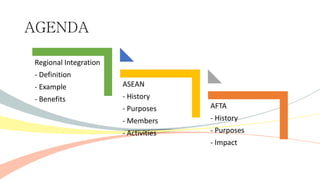
AGENDA
AFTA
- History
- Purposes
- Impact
ASEAN
- History
- Purposes
- Members
- Activities
Regional Integration
- Definition
- Example
- Benefits
Definition
Two or more nation-states agree to co-operate and work closely
together to achieve peace, stability and wealth.
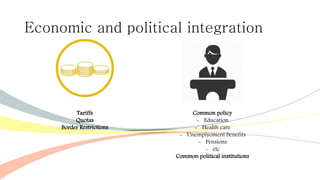
Economic and political integration
Tariffs
Quotas
Border Restrictions
Common policy
- Education
- Health care
- Unemplyoment benefits
- Pensions
- etc
Common political institutions
Benefits
• Increase trade and enhance consumer choice
• Increased market size
• Serve as a first step towards the expansion of exports
worldwide
• Can build cross-border production chains
• Strengthen their economic and political institutions
• Encourage the liberalisation of services markets
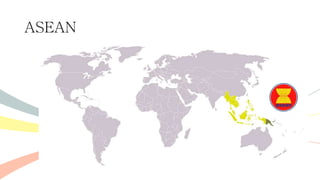
ASEAN
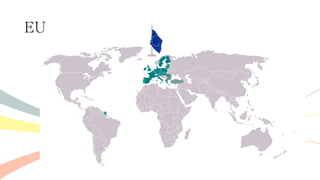
EU
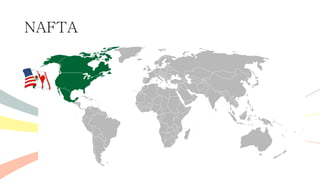
NAFTA
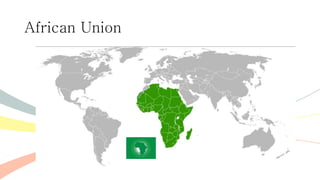
African Union
https://www.youtube.com/watch?v=Rswa_M1xKuo
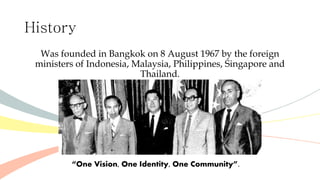
History
Was founded in Bangkok on 8 August 1967 by the foreign
ministers of Indonesia, Malaysia, Philippines, Singapore and
Thailand.
“One Vision, One Identity, One Community”.
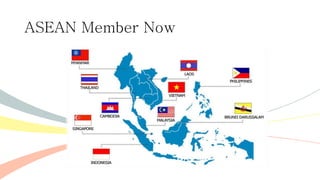
ASEAN Member Now
Aims and Purposes of ASEAN
• To accelerate the economic growth, social progress and cultural
development.
• To promote regional peace and stability.
• To promote active collaboration and mutual assistance in
economic, social, cultural, technical, scientific, and
administrative fields.
• To provide assistance to each other in the educational,
professional, technical and administrative spheres.
Aims and Purposes of ASEAN
• To collaborate in agriculture and industries, expansion of trade,
study of the problems of international commodity trade,
improvement of their transportation, communications facilities,
and the raising of the living standards of the peoples.
• To promote Southeast Asian Studies
• Maintain close and beneficial cooperation with existing
international and regional organizations with similar aims and
purposes.
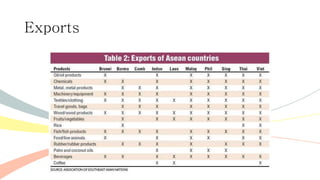
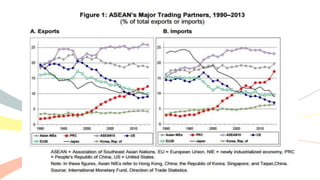
Exports
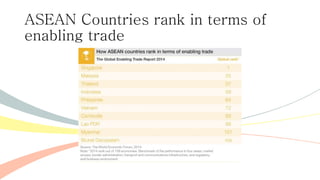
ASEAN Countries rank in terms of
enabling trade
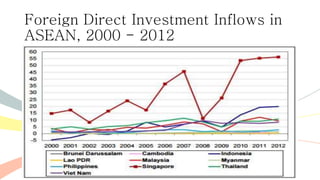
Foreign Direct Investment Inflows in
ASEAN, 2000 - 2012
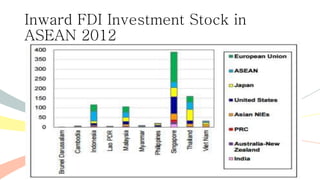
Inward FDI Investment Stock in
ASEAN 2012
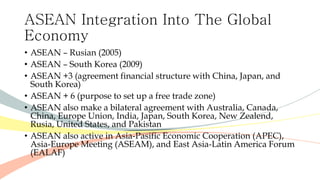
ASEAN Integration Into The Global
Economy
• ASEAN – Rusian (2005)
• ASEAN – South Korea (2009)
• ASEAN +3 (agreement financial structure with China, Japan, and
South Korea)
• ASEAN + 6 (purpose to set up a free trade zone)
• ASEAN also make a bilateral agreement with Australia, Canada,
China, Europe Union, India, Japan, South Korea, New Zealend,
Rusia, United States, and Pakistan
• ASEAN also active in Asia-Pasific Economic Cooperation (APEC),
Asia-Europe Meeting (ASEAM), and East Asia-Latin America Forum
(EALAF)
ASEAN Internal Agreement
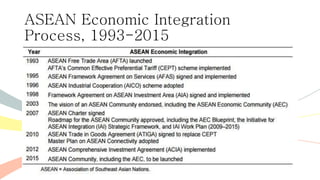
ASEAN Economic Integration
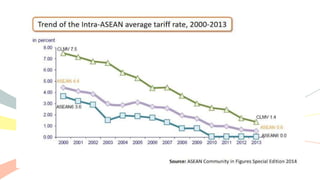
Process, 1993-2015
AFTA
History of AFTA
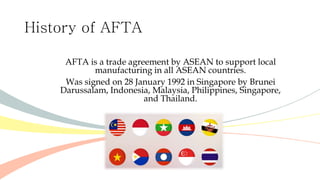
AFTA is a trade agreement by ASEAN to support local
manufacturing in all ASEAN countries.
Was signed on 28 January 1992 in Singapore by Brunei
Darussalam, Indonesia, Malaysia, Philippines, Singapore,
and Thailand.
Primary Goals of AFTA
• Elimination of tariffs and non-tariff barriers (open border)
• Attract more FDI
• Increase efficiency and profitability
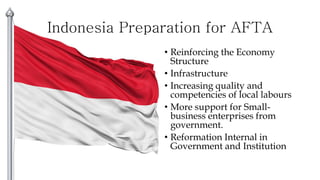
Indonesia Preparation for AFTA
• Reinforcing the Economy
Structure
• Infrastructure
• Increasing quality and
competencies of local labours
• More support for Small-
business enterprises from
government.
• Reformation Internal in
Government and Institution
THANK YOU

Asean

  • 1.
  • 2.
    AGENDA AFTA - History - Purposes -Impact ASEAN - History - Purposes - Members - Activities Regional Integration - Definition - Example - Benefits
  • 3.
    Definition Two or morenation-states agree to co-operate and work closely together to achieve peace, stability and wealth.
  • 4.
    Economic and politicalintegration Tariffs Quotas Border Restrictions Common policy - Education - Health care - Unemplyoment benefits - Pensions - etc Common political institutions
  • 5.
    Benefits • Increase tradeand enhance consumer choice • Increased market size • Serve as a first step towards the expansion of exports worldwide • Can build cross-border production chains • Strengthen their economic and political institutions • Encourage the liberalisation of services markets
  • 6.
  • 7.
  • 8.
  • 9.
  • 10.
  • 11.
    History Was founded inBangkok on 8 August 1967 by the foreign ministers of Indonesia, Malaysia, Philippines, Singapore and Thailand. “One Vision, One Identity, One Community”.
  • 12.
  • 13.
    Aims and Purposesof ASEAN • To accelerate the economic growth, social progress and cultural development. • To promote regional peace and stability. • To promote active collaboration and mutual assistance in economic, social, cultural, technical, scientific, and administrative fields. • To provide assistance to each other in the educational, professional, technical and administrative spheres.
  • 14.
    Aims and Purposesof ASEAN • To collaborate in agriculture and industries, expansion of trade, study of the problems of international commodity trade, improvement of their transportation, communications facilities, and the raising of the living standards of the peoples. • To promote Southeast Asian Studies • Maintain close and beneficial cooperation with existing international and regional organizations with similar aims and purposes.
  • 15.
  • 16.
    ASEAN Countries rankin terms of enabling trade
  • 18.
    Foreign Direct InvestmentInflows in ASEAN, 2000 - 2012
  • 19.
    Inward FDI InvestmentStock in ASEAN 2012
  • 20.
    ASEAN Integration IntoThe Global Economy • ASEAN – Rusian (2005) • ASEAN – South Korea (2009) • ASEAN +3 (agreement financial structure with China, Japan, and South Korea) • ASEAN + 6 (purpose to set up a free trade zone) • ASEAN also make a bilateral agreement with Australia, Canada, China, Europe Union, India, Japan, South Korea, New Zealend, Rusia, United States, and Pakistan • ASEAN also active in Asia-Pasific Economic Cooperation (APEC), Asia-Europe Meeting (ASEAM), and East Asia-Latin America Forum (EALAF)
  • 21.
  • 22.
  • 23.
  • 24.
    History of AFTA AFTAis a trade agreement by ASEAN to support local manufacturing in all ASEAN countries. Was signed on 28 January 1992 in Singapore by Brunei Darussalam, Indonesia, Malaysia, Philippines, Singapore, and Thailand.
  • 25.
    Primary Goals ofAFTA • Elimination of tariffs and non-tariff barriers (open border) • Attract more FDI • Increase efficiency and profitability
  • 28.
    Indonesia Preparation forAFTA • Reinforcing the Economy Structure • Infrastructure • Increasing quality and competencies of local labours • More support for Small- business enterprises from government. • Reformation Internal in Government and Institution
  • 29.