Augusto B. Agosto,
REB, REA
ASEAN 2015:
Challenges to Real Estate
Practitioners
President, Cebu South Real Estate Board (PAREB-
CESOREB)
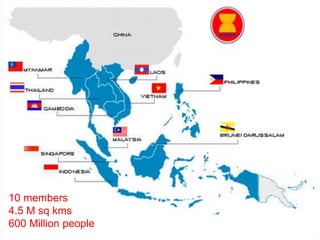
10 members
4.5 M sq kms
600 Million people
2015: ASEAN ECONOMIC
COMMUNITY
 States to adopt the AEC Blueprint for
implementation by 2015;
 The AEC will establish ASEAN as a single market
and production base making ASEAN more
dynamic and competitive with new mechanisms
and measures to strengthen the implementation
of its existing economic initiatives;
 Accelerating regional integration in the priority
sectors;
 Facilitating movement of business persons,
skilled labour and talents; and strengthening the
institutional mechanisms of ASEAN.
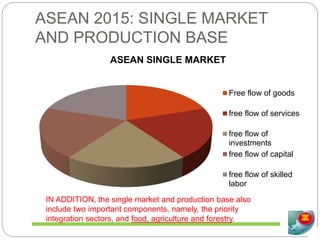
ASEAN 2015: SINGLE MARKET
AND PRODUCTION BASE
ASEAN SINGLE MARKET
Free flow of goods
free flow of services
free flow of
investments
free flow of capital
free flow of skilled
labor
IN ADDITION, the single market and production base also
include two important components, namely, the priority
integration sectors, and food, agriculture and forestry.
ASEAN 2015: FREE FLOW OF
GOODS AND SERVICES
 Free flow of goods is one of the principal means
by which the aims of a single market and
production base can be achieved. A single market
for goods (and services) will also facilitate the
development of production networks in the region
and enhance ASEAN’s capacity to serve as a
global production centre or as a part of the global
supply chain.
ASEAN 2015: ZERO TARIFFS
 Through ASEAN Free Trade Area (AFTA),
ASEAN has achieved significant progress in the
removal of tariffs. However, free flow of goods
would require not only zero tariffs but the removal
of non-tariff barriers as well. In addition, another
major component that would facilitate free flow of
goods is trade facilitation measures such as
integrating customs procedures, establishing the
ASEAN Single Window, continuously enhancing
the Common Effective Preferential Tariffs (CEPT)
Rules of Origin including its Operational
Certification Procedures, and harmonising
standards and conformance procedures.
ASEAN 2015: ZERO TARIFFS
ACTIONS BEFORE AND BEYOND
2015
 Eliminate import duties on all products, except for
those phased in from the Sensitive and Highly
Sensitive Lists by 2010 for ASEAN-6 and by
2015, with flexibilities for some sensitive products
by 2018, for CLMV in accordance with the
provisions of the Protocol to Amend the CEPT
Agreement for the Elimination of Import Duties;
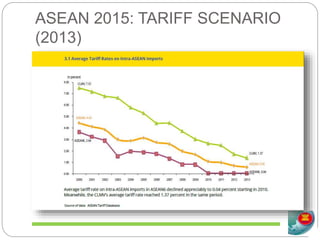
ASEAN 2015: TARIFF SCENARIO
(2013)
ASEAN 2015: FREE FLOW OF
SERVICES
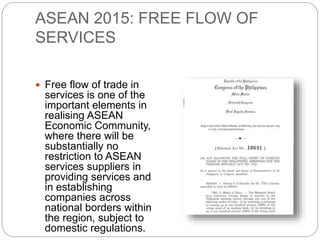
 Free flow of trade in
services is one of the
important elements in
realising ASEAN
Economic Community,
where there will be
substantially no
restriction to ASEAN
services suppliers in
providing services and
in establishing
companies across
national borders within
the region, subject to
domestic regulations.
ASEAN 2015: FREE FLOW OF
SERVICES
 In facilitating the free flow of services by 2015,
ASEAN is also working towards recognition of
professional qualifications with a view to facilitate
their movement within the region.
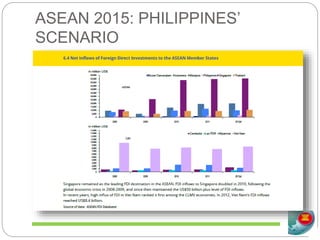
ASEAN 2015: PHILIPPINES’
SCENARIO
ASEAN 2015: FREE FLOW OF
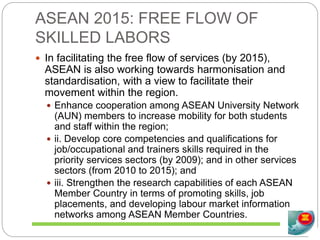
SKILLED LABORS
 In facilitating the free flow of services (by 2015),
ASEAN is also working towards harmonisation and
standardisation, with a view to facilitate their
movement within the region.
 Enhance cooperation among ASEAN University Network
(AUN) members to increase mobility for both students
and staff within the region;
 ii. Develop core competencies and qualifications for
job/occupational and trainers skills required in the
priority services sectors (by 2009); and in other services
sectors (from 2010 to 2015); and
 iii. Strengthen the research capabilities of each ASEAN
Member Country in terms of promoting skills, job
placements, and developing labour market information
networks among ASEAN Member Countries.
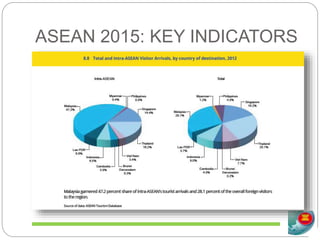
ASEAN 2015: KEY INDICATORS
What to expect in 2015?
 Start of a more freer and open ASEAN, geared
towards integration and regional cooperation in
almost all sectors in national and regional life
 A more closely-link ASEAN
 An integrated ASEAN
What to expect in 2015?
 More players in Real Estate -foreign developers
come in, recruit local sales force, and tap the
market
 Market itself as a premier regional destination for
global investments
 marketing to help drive greater appreciation
toward developments, and eventually help
developers avoid getting caught in a competition
based on price
Our Challenges
 Education
 Many ASEAN
countries have
achieved remarkable
gains in ensuring that,
by 2015, children,
boys and girls alike,
will be able to
complete a full course
of primary schooling.
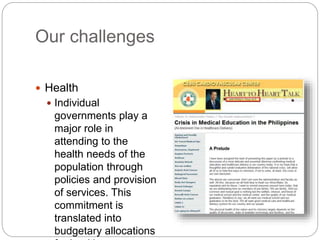
Our challenges
 Health
 Individual
governments play a
major role in
attending to the
health needs of the
population through
policies and provision
of services. This
commitment is
translated into
budgetary allocations
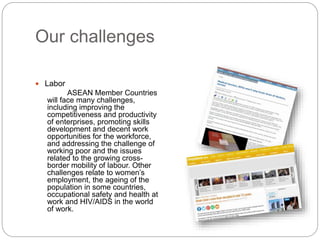
Our challenges
 Labor
ASEAN Member Countries
will face many challenges,
including improving the
competitiveness and productivity
of enterprises, promoting skills
development and decent work
opportunities for the workforce,
and addressing the challenge of
working poor and the issues
related to the growing cross-
border mobility of labour. Other
challenges relate to women’s
employment, the ageing of the
population in some countries,
occupational safety and health at
work and HIV/AIDS in the world
of work.
Thank you

Challenge of ASEAN

  • 1.
    Augusto B. Agosto, REB,REA ASEAN 2015: Challenges to Real Estate Practitioners President, Cebu South Real Estate Board (PAREB- CESOREB)
  • 2.
    10 members 4.5 Msq kms 600 Million people
  • 3.
    2015: ASEAN ECONOMIC COMMUNITY States to adopt the AEC Blueprint for implementation by 2015;  The AEC will establish ASEAN as a single market and production base making ASEAN more dynamic and competitive with new mechanisms and measures to strengthen the implementation of its existing economic initiatives;  Accelerating regional integration in the priority sectors;  Facilitating movement of business persons, skilled labour and talents; and strengthening the institutional mechanisms of ASEAN.
  • 4.
    ASEAN 2015: SINGLEMARKET AND PRODUCTION BASE ASEAN SINGLE MARKET Free flow of goods free flow of services free flow of investments free flow of capital free flow of skilled labor IN ADDITION, the single market and production base also include two important components, namely, the priority integration sectors, and food, agriculture and forestry.
  • 5.
    ASEAN 2015: FREEFLOW OF GOODS AND SERVICES  Free flow of goods is one of the principal means by which the aims of a single market and production base can be achieved. A single market for goods (and services) will also facilitate the development of production networks in the region and enhance ASEAN’s capacity to serve as a global production centre or as a part of the global supply chain.
  • 6.
    ASEAN 2015: ZEROTARIFFS  Through ASEAN Free Trade Area (AFTA), ASEAN has achieved significant progress in the removal of tariffs. However, free flow of goods would require not only zero tariffs but the removal of non-tariff barriers as well. In addition, another major component that would facilitate free flow of goods is trade facilitation measures such as integrating customs procedures, establishing the ASEAN Single Window, continuously enhancing the Common Effective Preferential Tariffs (CEPT) Rules of Origin including its Operational Certification Procedures, and harmonising standards and conformance procedures.
  • 7.
    ASEAN 2015: ZEROTARIFFS ACTIONS BEFORE AND BEYOND 2015  Eliminate import duties on all products, except for those phased in from the Sensitive and Highly Sensitive Lists by 2010 for ASEAN-6 and by 2015, with flexibilities for some sensitive products by 2018, for CLMV in accordance with the provisions of the Protocol to Amend the CEPT Agreement for the Elimination of Import Duties;
  • 8.
    ASEAN 2015: TARIFFSCENARIO (2013)
  • 9.
    ASEAN 2015: FREEFLOW OF SERVICES  Free flow of trade in services is one of the important elements in realising ASEAN Economic Community, where there will be substantially no restriction to ASEAN services suppliers in providing services and in establishing companies across national borders within the region, subject to domestic regulations.
  • 10.
    ASEAN 2015: FREEFLOW OF SERVICES  In facilitating the free flow of services by 2015, ASEAN is also working towards recognition of professional qualifications with a view to facilitate their movement within the region.
  • 11.
  • 12.
    ASEAN 2015: FREEFLOW OF SKILLED LABORS  In facilitating the free flow of services (by 2015), ASEAN is also working towards harmonisation and standardisation, with a view to facilitate their movement within the region.  Enhance cooperation among ASEAN University Network (AUN) members to increase mobility for both students and staff within the region;  ii. Develop core competencies and qualifications for job/occupational and trainers skills required in the priority services sectors (by 2009); and in other services sectors (from 2010 to 2015); and  iii. Strengthen the research capabilities of each ASEAN Member Country in terms of promoting skills, job placements, and developing labour market information networks among ASEAN Member Countries.
  • 13.
    ASEAN 2015: KEYINDICATORS
  • 14.
    What to expectin 2015?  Start of a more freer and open ASEAN, geared towards integration and regional cooperation in almost all sectors in national and regional life  A more closely-link ASEAN  An integrated ASEAN
  • 15.
    What to expectin 2015?  More players in Real Estate -foreign developers come in, recruit local sales force, and tap the market  Market itself as a premier regional destination for global investments  marketing to help drive greater appreciation toward developments, and eventually help developers avoid getting caught in a competition based on price
  • 16.
    Our Challenges  Education Many ASEAN countries have achieved remarkable gains in ensuring that, by 2015, children, boys and girls alike, will be able to complete a full course of primary schooling.
  • 17.
    Our challenges  Health Individual governments play a major role in attending to the health needs of the population through policies and provision of services. This commitment is translated into budgetary allocations
  • 18.
    Our challenges  Labor ASEANMember Countries will face many challenges, including improving the competitiveness and productivity of enterprises, promoting skills development and decent work opportunities for the workforce, and addressing the challenge of working poor and the issues related to the growing cross- border mobility of labour. Other challenges relate to women’s employment, the ageing of the population in some countries, occupational safety and health at work and HIV/AIDS in the world of work.
  • 19.

Editor's Notes

  • #4 Insert a picture of an animal and/or plant found in your country.
  • #5 Add key points in the history of your country to the timeline.
  • #6 Insert a picture illustrating a custom or tradition.
  • #17 Challenges: Branding & Networking, Quality of service, knowhow