Pictorialism, Photo-Secession
& Straight Photography
1870-1930
“Art is not so much a matter of methods and
processes as it is an affair of temperament,
of taste and of sentiment... In the hands of
the artist, the photograph becomes a work
of art... In a word, photography is what the
photographer makes it - an art or a trade.”
(William Howe Downes, 1900. A World History of Photography, Naomi Rosenblum, 1997)
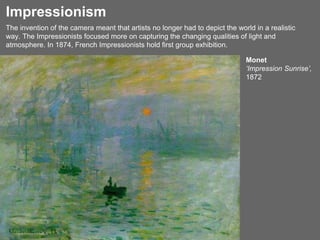
The invention of the camera meant that artists no longer had to depict the world in a realistic
way. The Impressionists focused more on capturing the changing qualities of light and
atmosphere. In 1874, French Impressionists hold first group exhibition.
Monet
‘Impression Sunrise’,
1872
Impressionism
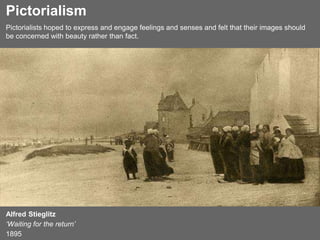
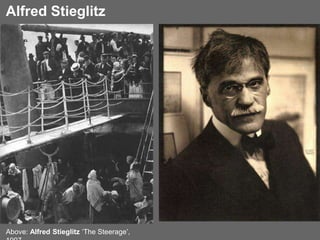
Alfred Stieglitz
‘Waiting for the return’
1895
Pictorialism
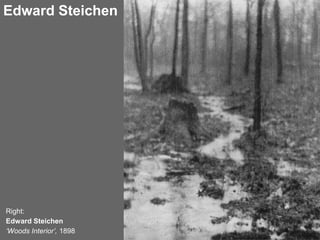
Pictorialists hoped to express and engage feelings and senses and felt that their images should
be concerned with beauty rather than fact.
Edward Steichen
Right:
Edward Steichen
‘Woods Interior’, 1898
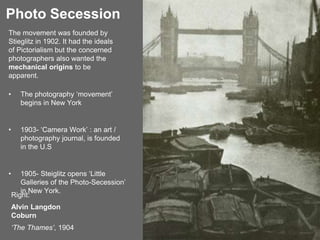
Photo Secession
• The photography ‘movement’
begins in New York
• 1903- ‘Camera Work’ : an art /
photography journal, is founded
in the U.S
• 1905- Steiglitz opens ‘Little
Galleries of the Photo-Secession’
in New York.
Right:
Alvin Langdon
Coburn
‘The Thames’, 1904
The movement was founded by
Stieglitz in 1902. It had the ideals
of Pictorialism but the concerned
photographers also wanted the
mechanical origins to be
apparent.
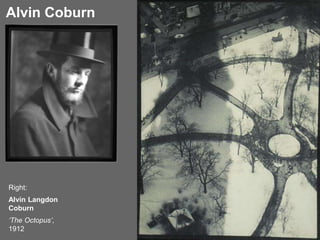
Alvin Coburn
Right:
Alvin Langdon
Coburn
‘The Octopus’,
1912
Alfred Stieglitz
Above: Alfred Stieglitz ‘The Steerage’,
The End of
Secessionism
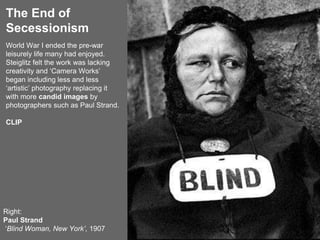
Right:
Paul Strand
‘Blind Woman, New York’, 1907
World War I ended the pre-war
leisurely life many had enjoyed.
Steiglitz felt the work was lacking
creativity and ‘Camera Works’
began including less and less
‘artistic’ photography replacing it
with more candid images by
photographers such as Paul Strand.
CLIP
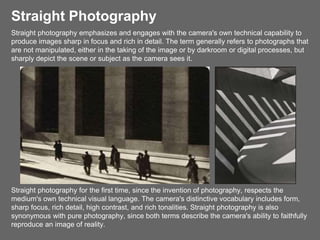
Straight Photography
Straight photography emphasizes and engages with the camera's own technical capability to
produce images sharp in focus and rich in detail. The term generally refers to photographs that
are not manipulated, either in the taking of the image or by darkroom or digital processes, but
sharply depict the scene or subject as the camera sees it.
Straight photography for the first time, since the invention of photography, respects the
medium's own technical visual language. The camera's distinctive vocabulary includes form,
sharp focus, rich detail, high contrast, and rich tonalities. Straight photography is also
synonymous with pure photography, since both terms describe the camera's ability to faithfully
reproduce an image of reality.
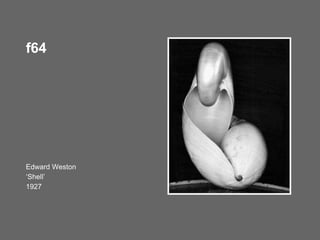
Edward Weston
‘Shell’
1927
f64
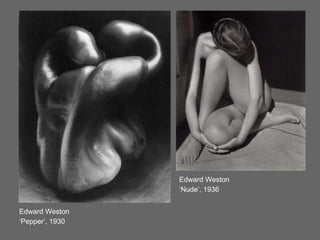
Edward Weston
‘Pepper’, 1930
Edward Weston
‘Nude’, 1936
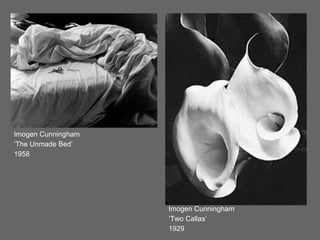
Imogen Cunningham
‘Two Callas’
1929
Imogen Cunningham
‘The Unmade Bed’
1958
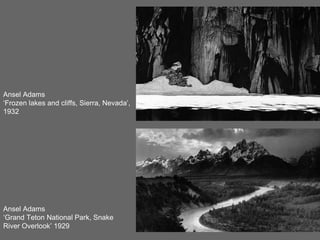
Ansel Adams
‘Frozen lakes and cliffs, Sierra, Nevada’,
1932
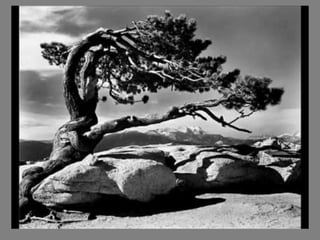
Ansel Adams
‘Grand Teton National Park, Snake
River Overlook’ 1929
Homework Task
Explain the intentions, key players and context of the four
Photographic Movements:
Pictorialism
Photo Secession
Straight Photography
F64
Please make sure that you illustrate your description with
images by the photographers as well as images of the
photographers.

Pictorialism- f64.pptx

  • 1.
  • 2.
    “Art is notso much a matter of methods and processes as it is an affair of temperament, of taste and of sentiment... In the hands of the artist, the photograph becomes a work of art... In a word, photography is what the photographer makes it - an art or a trade.” (William Howe Downes, 1900. A World History of Photography, Naomi Rosenblum, 1997)
  • 3.
    The invention ofthe camera meant that artists no longer had to depict the world in a realistic way. The Impressionists focused more on capturing the changing qualities of light and atmosphere. In 1874, French Impressionists hold first group exhibition. Monet ‘Impression Sunrise’, 1872 Impressionism
  • 4.
    Alfred Stieglitz ‘Waiting forthe return’ 1895 Pictorialism Pictorialists hoped to express and engage feelings and senses and felt that their images should be concerned with beauty rather than fact.
  • 5.
  • 7.
    Photo Secession • Thephotography ‘movement’ begins in New York • 1903- ‘Camera Work’ : an art / photography journal, is founded in the U.S • 1905- Steiglitz opens ‘Little Galleries of the Photo-Secession’ in New York. Right: Alvin Langdon Coburn ‘The Thames’, 1904 The movement was founded by Stieglitz in 1902. It had the ideals of Pictorialism but the concerned photographers also wanted the mechanical origins to be apparent.
  • 8.
  • 9.
    Alfred Stieglitz Above: AlfredStieglitz ‘The Steerage’,
  • 10.
    The End of Secessionism Right: PaulStrand ‘Blind Woman, New York’, 1907 World War I ended the pre-war leisurely life many had enjoyed. Steiglitz felt the work was lacking creativity and ‘Camera Works’ began including less and less ‘artistic’ photography replacing it with more candid images by photographers such as Paul Strand. CLIP
  • 11.
    Straight Photography Straight photographyemphasizes and engages with the camera's own technical capability to produce images sharp in focus and rich in detail. The term generally refers to photographs that are not manipulated, either in the taking of the image or by darkroom or digital processes, but sharply depict the scene or subject as the camera sees it. Straight photography for the first time, since the invention of photography, respects the medium's own technical visual language. The camera's distinctive vocabulary includes form, sharp focus, rich detail, high contrast, and rich tonalities. Straight photography is also synonymous with pure photography, since both terms describe the camera's ability to faithfully reproduce an image of reality.
  • 13.
  • 15.
  • 16.
    Imogen Cunningham ‘Two Callas’ 1929 ImogenCunningham ‘The Unmade Bed’ 1958
  • 17.
    Ansel Adams ‘Frozen lakesand cliffs, Sierra, Nevada’, 1932 Ansel Adams ‘Grand Teton National Park, Snake River Overlook’ 1929
  • 18.
    Homework Task Explain theintentions, key players and context of the four Photographic Movements: Pictorialism Photo Secession Straight Photography F64 Please make sure that you illustrate your description with images by the photographers as well as images of the photographers.