Year 13 Exam Project
Growth and Evolution
Assessment Objectives
• The Assessment Objectives require you to:
• Develop your ideas through sustained and focused
investigations informed by contextual and other sources,
demonstrating analytical and critical understanding.
• Experiment with and select appropriate resources,
media, materials, techniques and processes, reviewing
and refining your ideas as your work develops.
• Record in visual and/or other forms ideas, observations
and insights relevant to your intentions, demonstrating
your ability to reflect on your work and progress.
• Present a personal, informed and meaningful response
demonstrating critical understanding, realising intentions
and, where appropriate, making connections between
visual elements.
Workshop One

Michael Landy

Uproot weeds and bring back to class without soil.
Beware of nettles.
Make continuous line drawings, and detailed observational
studies in your book.
Materials
2B, 3B, 4B pencils
Homework

Complete two drawings of trees or plants from direct observation.
One line drawing and one as a tonal drawing.
Workshop Two

Create a series of prints in different colours of Broccoli after Martin Creed’s
Work No 1000: 1,000 prints made with broccoli.
Key words: Minimalism, conceptual art.
Extension
Make observational studies of shells, skulls and natural objects.
Use fine liner pen and wash.

Gemma Anderson
Homework

Create a double page spread on Martin Creed.
Analyse and evaluate one of his artworks.
Create your own response to one of his conceptual sculptures.
Use ordinary objects but consider how you could convey a sense of
growth and/or evolution in your work.
Photograph your outcomes and present in your sketchbook.
Assess what went well? Even better if…?
Extension: Visit the Martin Creed exhibition at the Hayward and document this.
Workshop Three
Look at and discuss the work of the Boyle Family.
Create clay slabs and make impressions to record
erosion of the urban environment.
Create plaster casts of these.
Fire and then glaze original clay impression.

http://www.boylefamily.co.uk/
The Boyle family “aims to make art that does not exclude anything as a potential subject”
Workshop Four
Use found imagery relevant to the
theme growth and evolution.
Use a geometric pattern as a
background.
Accurately trace and transfer
shapes from the geometric pattern
onto the found images.
Cut out these shapes and
incorporate them within the pattern
as in this example by Jelle Martens.

Jelle Martens
Homework
Ensure you have documented all four workshops in your sketchbook.
Workshops include:
1.
2.
3.
4.

Drawings of weeds after Michael Landy
Colour prints of Broccoli after Martin Creed
Clay tile impressions and plaster casts after the Boyle Family
Geometric collage after Jelle Martens

In each workshop you must make annotated connections to the artists above.
Assess your own responses:
What went well?
Even better if…?
Dada and anti-art

Hannah Höch

•
•

Anarchistic and rebellious art movements emerge from
reactions to the fashions and politics of their time.
Dada and Photomontage
Tesselation

M C Escher

Damien Hirst
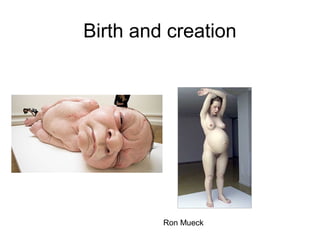
Birth and creation

Ron Mueck
Patricia Piccinini
Leonardo da Vinci
Thomas Grunfeld

Shen Shaomin
Portraiture
• Many artists such as Gwen John, Rembrandt,
Stanley Spencer, Avigdor Arikha, Frida Kahlo
and Jenny Saville have used portraiture to
document their own families and their personal
transformation through time. Lucian Freud,
Mary Cassatt and Augustus John frequently
used their own relatives as models, allowing us
glimpses of the effects of time on their own
intimate personal lives.
Rembrandt
Self-portrait
c.1628

Rembrandt
Self-portrait
c.1669
Self-Portraits

Lucian Freud
Stanley Spencer

Avigdor Arikha
Landscape

Stephen Magsig

http://www.smagsig.com/
George Shaw
Yehudit Sasportas
Agnes Denes
Wheatfield, a Confrontation 1982
Created during a six-month period in the spring, summer, and fall of 1982
when Denes, planted a field of golden wheat on two acres of rubble-strewn
landfill near Wall Street and the World Trade Center in lower Manhattan.
Anya Gallaccio
Karl Blossfeldt
Urban Development

Mark Bradford
Diana Al-Hadid
http://www.dianaalhadid.com/
Sculptor Diana Al-Hadid constructs baroque architectural forms such as towers, labyrinths,
and pipe organs that appear to be in a state of ruin.
Using materials such as cardboard, plywood, plaster, and resin,

http://hammer.ucla.edu/exhibitions/detail/exhibition_id/180
constructions with copper
sulphate chemical growth;
mounted on glass and wood
trestle table with Perspex cover
underlit by two strip lights.
Roger Hiorns
Mark Dion
Mobile Wilderness Unit - Wolf
2006
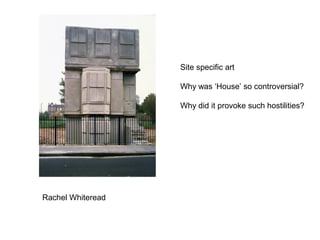
Site specific art
Why was ‘House’ so controversial?
Why did it provoke such hostilities?

Rachel Whiteread
Ghost Parking Lot
Hamden, Connecticut, 1978
artist/architect James Wines. A Pompeian tide of dark stuff has poured itself
over a row of cars. The idea, said Wines, was “to make a public space out of
something that’s already inherently there”.
Technological development

Technological development give contemporary artists and sculptors
extraordinary scope to create the products of their fertile imaginations.
These range from the highly polished metallic surfaces of Anish Kapoor’s
site-specific sculptures, to the enormous resin cast pieces by Damien Hirst.
It is interesting to explore whether the material itself or the idea is driving the work.
Often characteristics of a material can suggest ideas, such as the impressive
adhesive qualities of acrylic paint, which allows objects as diverse as
stainless steel kitchen utensils, leather suitcases and plastic boxes to be
used as canvases.

Robert Rauschenberg
Combinations of three-dimensional sculptural forms and two- dimensional
painting techniques can result in spectacular outcomes such as Grayson
Perry’s Barbaric Splendour, and the motorcycle shrine he created for his
teddy bear, The Tomb of the Unknown Craftsman.
Mechanical evolution inspired an art
movement in the early 20th century
called Futurism.

Umberto Boccioni
Unique Forms of Continuity in Space, 1913
Mariko Mori
http://www.royalacademy.org.uk/exhibitions/mariko-mori/
Dieter Roth
Gartenskulptur
Dieter Roth
In 1970 Roth began work on Gartenskulptur (Garden sculpture), a project that
would continue even beyond his death. Continuously augmented and developed
over a period of almost thirty years, Gartenskulptur is a meditation on collection,
decay, and metamorphosis. The installation's first manifestation was a bust Roth
formed from birdseed and chocolate that was placed on an outdoor platform for
birds to pick apart. Over time Roth added to the sculpture, placing various small
art pieces and pre-installation sketches and drawings of the work itself on and
around the platform. Every incarnation of the piece incorporates materials found
on site, and the waste that results from Gartenskulptur's exposure to the
elements is recycled back into the work through a system of tunnels and
preserving jars, allowing the work to grow with every installation. Installed with
the assistance of Björn Roth, the artist's son and collaborator, Gartenskulptur
shares its exhibition space with the workshop where its progress is monitored
and developed.
http://momaps1.org/exhibitions/view/80
Inventions

The origins of many inventions like the tank and the helicopter can
be traced back to the engineering ideas of Leonardo da Vinci,
which were conceived far ahead of his time and documented in his
drawings.
Darwin’s work was promoted in Germany by the biologist Ernst Haeckel
who discovered, described and named a great many new species.
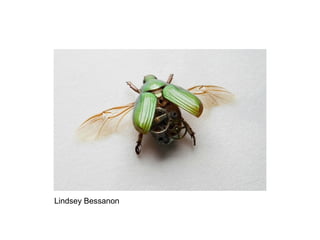
Lindsey Bessanon
Decay

Sam Taylor-Wood
Critical and Contextual Studies
• The history of art has been defined by some as a linear
evolution of preoccupations and styles. Writing in the
16th century, Giorgio Vasari traced a nascence of art
from Giotto and Cimabue through a developmental
period to an age of perfection that culminated in the work
of artists like Michelangelo. In the 20th century, Alfred
H. Barr defined Modernism as a progressive sequence
of ‘isms’, which he mapped out on a now famous chart in
1936. These approaches focus attention on a particular
selection of artists who conform to the paradigms of the
chain reaction proposed. In contrast to this approach,
some art historians like TJ Clark, Griselda Pollock and
Robert Hughes have preferred to scrutinise the wider
social and political conditions that have influenced the
evolution of artworks.
Critical and Contextual Studies
• One of the greatest challenges for artists of all cultures is
the depiction of creation and the evolution of man. It is
fascinating to consider how spiritual ideology has been
shaped over the centuries by imagery as diverse as
Michelangelo’s Sistine Chapel ceiling, Aboriginal
depictions of Dreamtime, Hindu representations of
Brahma and Daoist Yin- Yang symbolism. Recent works
by Cantonese light artist Chi-Yung Wong and American
artist and scientist Professor Donna J Cox are based
around visualisations of the Big Bang Theory of creation.
Critical and Contextual Studies
• When looking at the works of many artists it is
sometimes easy to identify transitional pieces that signal
dramatic change. Picasso’s Les Demoiselles
d’Avignon and Mondrian’s studies of trees are good
examples. However, occasionally an artist will set off on
a creative course that is unexpected; Victor Pasmore’s
abstract work from 1947 onwards is very different from
the lyrical figurative style he employed when helping to
shape the Euston Road School in the previous decade.
David Hockney has always been an artist willing to
embrace creative opportunities and alternative
approaches as they arise. His 2012 retrospective
included an exhibition of fifty-one iPad drawings. When
Hockney agreed to the exhibition in 2007 the iPad did
not exist.
Image Analysis: Writing Frame
Process

Mise en Scene

What has the artist used to make the art work? Consider the materials
and media. Has it been presented in a special way?

(“Setting in Scene”) Look carefully at the picture and write
a paragraph explaining what is going on in the scene from
an objective/impartial viewpoint.

Content

Keywords

What do you think are the intentions of the artist? what kind of mood
is created? What wider issues do you think the artist is exploring?
What ideas could you take from the artist and explore in your work?

Write down a list of 5-10 keywords in response to this picture:

TITLE: Les Demoiselles D’Avignon
DATE: 1905
ARTIST: Picasso

Title:
How does the title of the work contribute to your understanding of the work?

Yr13 growth and evolution

  • 1.
    Year 13 ExamProject Growth and Evolution
  • 2.
    Assessment Objectives • TheAssessment Objectives require you to: • Develop your ideas through sustained and focused investigations informed by contextual and other sources, demonstrating analytical and critical understanding. • Experiment with and select appropriate resources, media, materials, techniques and processes, reviewing and refining your ideas as your work develops. • Record in visual and/or other forms ideas, observations and insights relevant to your intentions, demonstrating your ability to reflect on your work and progress. • Present a personal, informed and meaningful response demonstrating critical understanding, realising intentions and, where appropriate, making connections between visual elements.
  • 3.
    Workshop One Michael Landy Uprootweeds and bring back to class without soil. Beware of nettles. Make continuous line drawings, and detailed observational studies in your book. Materials 2B, 3B, 4B pencils
  • 4.
    Homework Complete two drawingsof trees or plants from direct observation. One line drawing and one as a tonal drawing.
  • 5.
    Workshop Two Create aseries of prints in different colours of Broccoli after Martin Creed’s Work No 1000: 1,000 prints made with broccoli. Key words: Minimalism, conceptual art.
  • 6.
    Extension Make observational studiesof shells, skulls and natural objects. Use fine liner pen and wash. Gemma Anderson
  • 7.
    Homework Create a doublepage spread on Martin Creed. Analyse and evaluate one of his artworks. Create your own response to one of his conceptual sculptures. Use ordinary objects but consider how you could convey a sense of growth and/or evolution in your work. Photograph your outcomes and present in your sketchbook. Assess what went well? Even better if…? Extension: Visit the Martin Creed exhibition at the Hayward and document this.
  • 8.
    Workshop Three Look atand discuss the work of the Boyle Family. Create clay slabs and make impressions to record erosion of the urban environment. Create plaster casts of these. Fire and then glaze original clay impression. http://www.boylefamily.co.uk/ The Boyle family “aims to make art that does not exclude anything as a potential subject”
  • 9.
    Workshop Four Use foundimagery relevant to the theme growth and evolution. Use a geometric pattern as a background. Accurately trace and transfer shapes from the geometric pattern onto the found images. Cut out these shapes and incorporate them within the pattern as in this example by Jelle Martens. Jelle Martens
  • 10.
    Homework Ensure you havedocumented all four workshops in your sketchbook. Workshops include: 1. 2. 3. 4. Drawings of weeds after Michael Landy Colour prints of Broccoli after Martin Creed Clay tile impressions and plaster casts after the Boyle Family Geometric collage after Jelle Martens In each workshop you must make annotated connections to the artists above. Assess your own responses: What went well? Even better if…?
  • 11.
    Dada and anti-art HannahHöch • • Anarchistic and rebellious art movements emerge from reactions to the fashions and politics of their time. Dada and Photomontage
  • 12.
  • 13.
  • 14.
  • 15.
  • 16.
  • 17.
    Portraiture • Many artistssuch as Gwen John, Rembrandt, Stanley Spencer, Avigdor Arikha, Frida Kahlo and Jenny Saville have used portraiture to document their own families and their personal transformation through time. Lucian Freud, Mary Cassatt and Augustus John frequently used their own relatives as models, allowing us glimpses of the effects of time on their own intimate personal lives.
  • 18.
  • 19.
  • 20.
  • 21.
  • 22.
  • 23.
  • 24.
    Agnes Denes Wheatfield, aConfrontation 1982 Created during a six-month period in the spring, summer, and fall of 1982 when Denes, planted a field of golden wheat on two acres of rubble-strewn landfill near Wall Street and the World Trade Center in lower Manhattan.
  • 25.
  • 26.
  • 27.
  • 28.
    Sculptor Diana Al-Hadidconstructs baroque architectural forms such as towers, labyrinths, and pipe organs that appear to be in a state of ruin. Using materials such as cardboard, plywood, plaster, and resin, http://hammer.ucla.edu/exhibitions/detail/exhibition_id/180
  • 29.
    constructions with copper sulphatechemical growth; mounted on glass and wood trestle table with Perspex cover underlit by two strip lights. Roger Hiorns
  • 30.
  • 31.
    Site specific art Whywas ‘House’ so controversial? Why did it provoke such hostilities? Rachel Whiteread
  • 33.
    Ghost Parking Lot Hamden,Connecticut, 1978 artist/architect James Wines. A Pompeian tide of dark stuff has poured itself over a row of cars. The idea, said Wines, was “to make a public space out of something that’s already inherently there”.
  • 34.
    Technological development Technological developmentgive contemporary artists and sculptors extraordinary scope to create the products of their fertile imaginations. These range from the highly polished metallic surfaces of Anish Kapoor’s site-specific sculptures, to the enormous resin cast pieces by Damien Hirst. It is interesting to explore whether the material itself or the idea is driving the work.
  • 35.
    Often characteristics ofa material can suggest ideas, such as the impressive adhesive qualities of acrylic paint, which allows objects as diverse as stainless steel kitchen utensils, leather suitcases and plastic boxes to be used as canvases. Robert Rauschenberg
  • 36.
    Combinations of three-dimensionalsculptural forms and two- dimensional painting techniques can result in spectacular outcomes such as Grayson Perry’s Barbaric Splendour, and the motorcycle shrine he created for his teddy bear, The Tomb of the Unknown Craftsman.
  • 37.
    Mechanical evolution inspiredan art movement in the early 20th century called Futurism. Umberto Boccioni Unique Forms of Continuity in Space, 1913
  • 38.
  • 39.
  • 40.
    Dieter Roth In 1970Roth began work on Gartenskulptur (Garden sculpture), a project that would continue even beyond his death. Continuously augmented and developed over a period of almost thirty years, Gartenskulptur is a meditation on collection, decay, and metamorphosis. The installation's first manifestation was a bust Roth formed from birdseed and chocolate that was placed on an outdoor platform for birds to pick apart. Over time Roth added to the sculpture, placing various small art pieces and pre-installation sketches and drawings of the work itself on and around the platform. Every incarnation of the piece incorporates materials found on site, and the waste that results from Gartenskulptur's exposure to the elements is recycled back into the work through a system of tunnels and preserving jars, allowing the work to grow with every installation. Installed with the assistance of Björn Roth, the artist's son and collaborator, Gartenskulptur shares its exhibition space with the workshop where its progress is monitored and developed. http://momaps1.org/exhibitions/view/80
  • 41.
    Inventions The origins ofmany inventions like the tank and the helicopter can be traced back to the engineering ideas of Leonardo da Vinci, which were conceived far ahead of his time and documented in his drawings.
  • 42.
    Darwin’s work waspromoted in Germany by the biologist Ernst Haeckel who discovered, described and named a great many new species.
  • 43.
  • 44.
  • 45.
    Critical and ContextualStudies • The history of art has been defined by some as a linear evolution of preoccupations and styles. Writing in the 16th century, Giorgio Vasari traced a nascence of art from Giotto and Cimabue through a developmental period to an age of perfection that culminated in the work of artists like Michelangelo. In the 20th century, Alfred H. Barr defined Modernism as a progressive sequence of ‘isms’, which he mapped out on a now famous chart in 1936. These approaches focus attention on a particular selection of artists who conform to the paradigms of the chain reaction proposed. In contrast to this approach, some art historians like TJ Clark, Griselda Pollock and Robert Hughes have preferred to scrutinise the wider social and political conditions that have influenced the evolution of artworks.
  • 47.
    Critical and ContextualStudies • One of the greatest challenges for artists of all cultures is the depiction of creation and the evolution of man. It is fascinating to consider how spiritual ideology has been shaped over the centuries by imagery as diverse as Michelangelo’s Sistine Chapel ceiling, Aboriginal depictions of Dreamtime, Hindu representations of Brahma and Daoist Yin- Yang symbolism. Recent works by Cantonese light artist Chi-Yung Wong and American artist and scientist Professor Donna J Cox are based around visualisations of the Big Bang Theory of creation.
  • 49.
    Critical and ContextualStudies • When looking at the works of many artists it is sometimes easy to identify transitional pieces that signal dramatic change. Picasso’s Les Demoiselles d’Avignon and Mondrian’s studies of trees are good examples. However, occasionally an artist will set off on a creative course that is unexpected; Victor Pasmore’s abstract work from 1947 onwards is very different from the lyrical figurative style he employed when helping to shape the Euston Road School in the previous decade. David Hockney has always been an artist willing to embrace creative opportunities and alternative approaches as they arise. His 2012 retrospective included an exhibition of fifty-one iPad drawings. When Hockney agreed to the exhibition in 2007 the iPad did not exist.
  • 50.
    Image Analysis: WritingFrame Process Mise en Scene What has the artist used to make the art work? Consider the materials and media. Has it been presented in a special way? (“Setting in Scene”) Look carefully at the picture and write a paragraph explaining what is going on in the scene from an objective/impartial viewpoint. Content Keywords What do you think are the intentions of the artist? what kind of mood is created? What wider issues do you think the artist is exploring? What ideas could you take from the artist and explore in your work? Write down a list of 5-10 keywords in response to this picture: TITLE: Les Demoiselles D’Avignon DATE: 1905 ARTIST: Picasso Title: How does the title of the work contribute to your understanding of the work?