Ordinary…
Extraordinary…
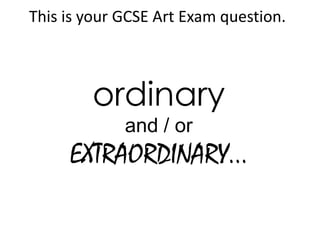
This is your GCSE Art Exam question.


        ordinary
             and / or
     EXTRAORDINARY...
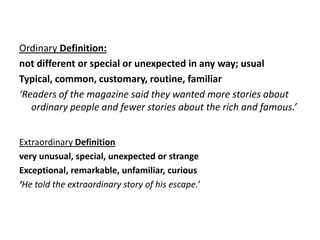
Ordinary Definition:
not different or special or unexpected in any way; usual
Typical, common, customary, routine, familiar
‘Readers of the magazine said they wanted more stories about
   ordinary people and fewer stories about the rich and famous.’


Extraordinary Definition
very unusual, special, unexpected or strange
Exceptional, remarkable, unfamiliar, curious
‘He told the extraordinary story of his escape.’
Today we will:

THINK about what these words ACTUALLY mean
 LOOK at many starting points for this question
   DISCOVER artists and designers who could
            inspire us on this topic
         SHARE ideas with each other
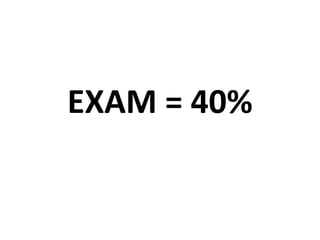
EXAM = 40%
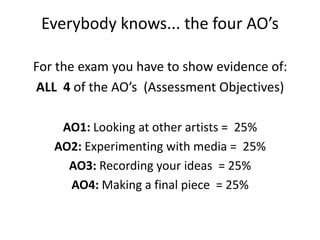
Everybody knows... the four AO’s

For the exam you have to show evidence of:
ALL 4 of the AO’s (Assessment Objectives)

    AO1: Looking at other artists = 25%
   AO2: Experimenting with media = 25%
     AO3: Recording your ideas = 25%
     AO4: Making a final piece = 25%
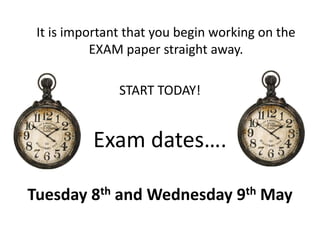
It is important that you begin working on the
           EXAM paper straight away.

               START TODAY!


          Exam dates….

Tuesday 8th and Wednesday 9th May
Where to begin?
There are 6 main starting points.

PEOPLE, PLACES, IMAGINATION, O
 BJECTS, ACTIVITIES and NATURAL
             WORLD.
Contextual references

The artists on the next few pages are
  suggestions to help you think about possible
  ideas.
  You may already have ideas of your own.

        Keep an open mind at this point...
PEOPLE
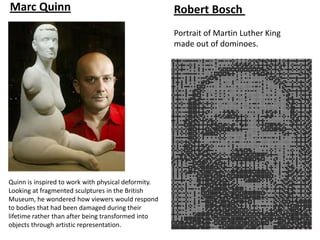
Marc Quinn                                           Robert Bosch
                                                     Portrait of Martin Luther King
                                                     made out of dominoes.


Quinn is inspired to work with physical deformity.
Looking at fragmented sculptures in the British
Museum, he wondered how viewers would respond
to bodies that had been damaged during their
lifetime rather than after being transformed into
objects through artistic representation.
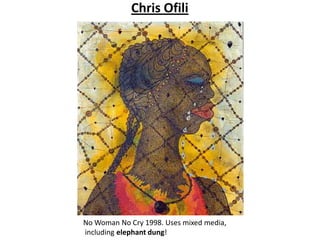
Chris Ofili


No Woman No Cry 1998. Uses mixed media,
including elephant dung!
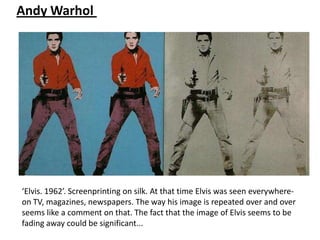
Andy Warhol


‘Elvis. 1962’. Screenprinting on silk. At that time Elvis was seen everywhere-
on TV, magazines, newspapers. The way his image is repeated over and over
seems like a comment on that. The fact that the image of Elvis seems to be
fading away could be significant...
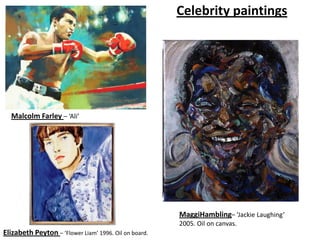
Celebrity paintings


  Malcolm Farley – ‘Ali’


                                                       MaggiHambling– ‘Jackie Laughing’
                                                       2005. Oil on canvas.
Elizabeth Peyton – ‘Flower Liam’ 1996. Oil on board.
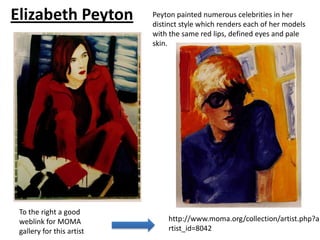
Elizabeth Peyton           Peyton painted numerous celebrities in her
                           distinct style which renders each of her models
                           with the same red lips, defined eyes and pale
                           skin.


 To the right a good
 weblink for MOMA              http://www.moma.org/collection/artist.php?a
 gallery for this artist       rtist_id=8042
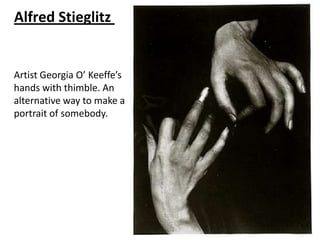
Alfred Stieglitz


Artist Georgia O’ Keeffe’s
hands with thimble. An
alternative way to make a
portrait of somebody.
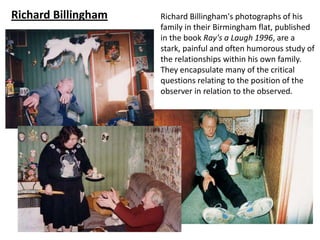
Richard Billingham   Richard Billingham's photographs of his
                     family in their Birmingham flat, published
                     in the book Ray's a Laugh 1996, are a
                     stark, painful and often humorous study of
                     the relationships within his own family.
                     They encapsulate many of the critical
                     questions relating to the position of the
                     observer in relation to the observed.
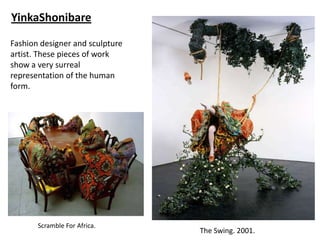
YinkaShonibare

Fashion designer and sculpture
artist. These pieces of work
show a very surreal
representation of the human
form.


       Scramble For Africa.
                                 The Swing. 2001.
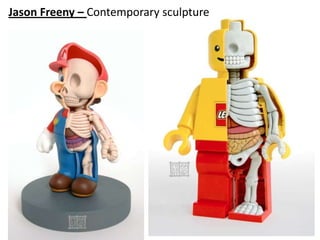
Jason Freeny – Contemporary sculpture
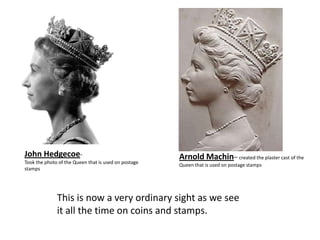
John Hedgecoe-                                        Arnold Machin– created the plaster cast of the
Took the photo of the Queen that is used on postage   Queen that is used on postage stamps
stamps


              This is now a very ordinary sight as we see
              it all the time on coins and stamps.
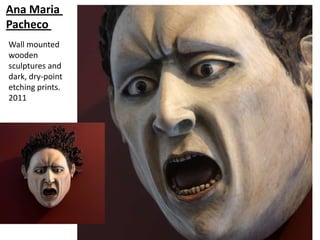
Ana Maria
Pacheco
Wall mounted
wooden
sculptures and
dark, dry-point
etching prints.
2011
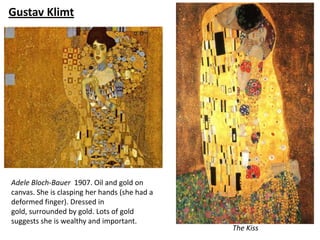
Gustav Klimt


Adele Bloch-Bauer 1907. Oil and gold on
canvas. She is clasping her hands (she had a
deformed finger). Dressed in
gold, surrounded by gold. Lots of gold
suggests she is wealthy and important.
                                               The Kiss
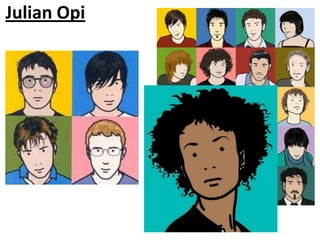
Julian Opi
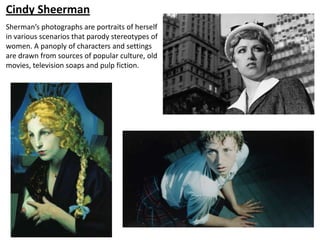
Cindy Sheerman
Sherman’s photographs are portraits of herself
in various scenarios that parody stereotypes of
women. A panoply of characters and settings
are drawn from sources of popular culture, old
movies, television soaps and pulp fiction.
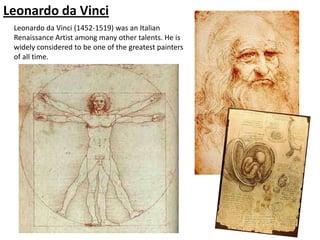
Leonardo da Vinci
 Leonardo da Vinci (1452-1519) was an Italian
 Renaissance Artist among many other talents. He is
 widely considered to be one of the greatest painters
 of all time.
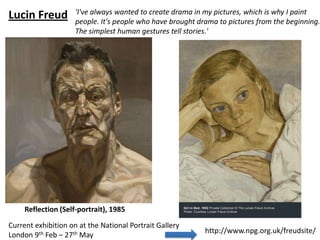
'I've always wanted to create drama in my pictures, which is why I paint
Lucin Freud          people. It's people who have brought drama to pictures from the beginning.
                     The simplest human gestures tell stories.'


     Reflection (Self-portrait), 1985

Current exhibition on at the National Portrait Gallery
                                                            http://www.npg.org.uk/freudsite/
London 9th Feb – 27th May
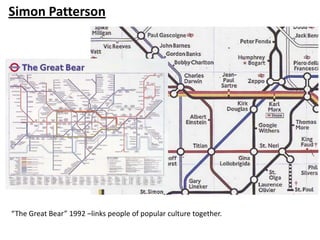
Simon Patterson


“The Great Bear” 1992 –links people of popular culture together.
OBJECTS
Shelly Goldsmith


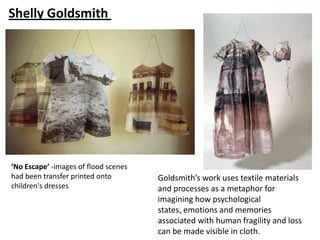
‘No Escape’ -images of flood scenes
had been transfer printed onto        Goldsmith’s work uses textile materials
children's dresses.                   and processes as a metaphor for
                                      imagining how psychological
                                      states, emotions and memories
                                      associated with human fragility and loss
                                      can be made visible in cloth.
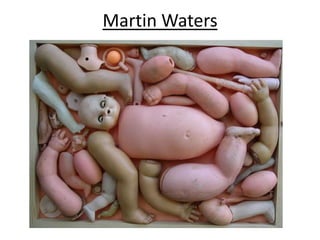
Martin Waters
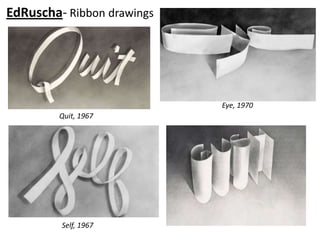
EdRuscha- Ribbon drawings


                            Eye, 1970
        Quit, 1967


         Self, 1967
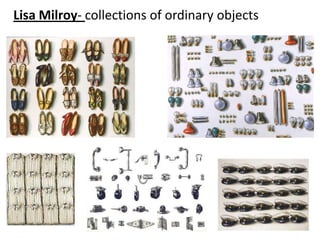
Lisa Milroy- collections of ordinary objects
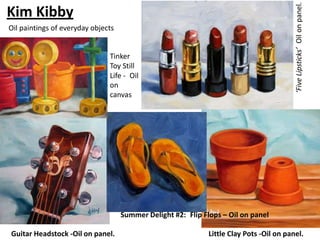
‘Five Lipsticks’
Oil on panel.
Kim Kibby
Oil paintings of everyday objects


                               Tinker
                               Toy Still
                               Life -
Oil
                               on
                               canvas


                                    Summer Delight #2:
Flip Flops – Oil on panel

Guitar Headstock -Oil on panel.                               Little Clay Pots -Oil on panel.
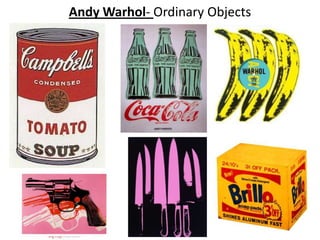
Andy Warhol- Ordinary Objects
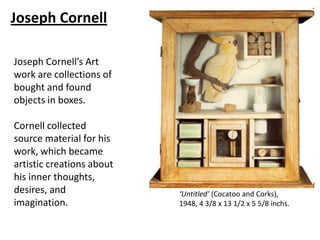
Joseph Cornell

Joseph Cornell’s Art
work are collections of
bought and found
objects in boxes.

Cornell collected
source material for his
work, which became
artistic creations about
his inner thoughts,
desires, and               ‘Untitled’ (Cocatoo and Corks),
imagination.               1948, 4 3/8 x 13 1/2 x 5 5/8 inchs.
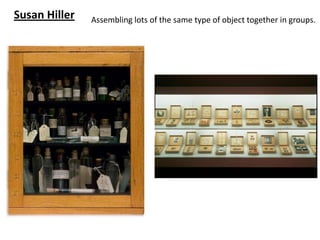
Susan Hiller   Assembling lots of the same type of object together in groups.
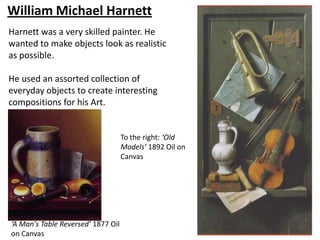
William Michael Harnett
Harnett was a very skilled painter. He
wanted to make objects look as realistic
as possible.

He used an assorted collection of
everyday objects to create interesting
compositions for his Art.


                                    To the right: ‘Old
                                    Models’ 1892 Oil on
                                    Canvas


‘A Man's Table Reversed’ 1877 Oil
on Canvas
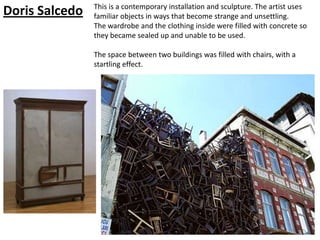
This is a contemporary installation and sculpture. The artist uses
Doris Salcedo   familiar objects in ways that become strange and unsettling.
                The wardrobe and the clothing inside were filled with concrete so
                they became sealed up and unable to be used.

                The space between two buildings was filled with chairs, with a
                startling effect.
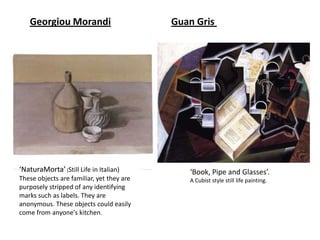
Georgiou Morandi                        Guan Gris


‘NaturaMorta’ (Still Life in Italian)         ‘Book, Pipe and Glasses’.
These objects are familiar, yet they are      A Cubist style still life painting.
purposely stripped of any identifying
marks such as labels. They are
anonymous. These objects could easily
come from anyone's kitchen.
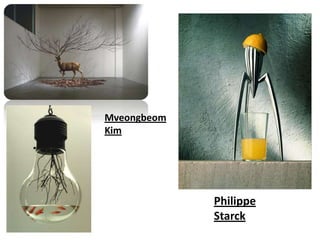
Mveongbeom
Kim


             Philippe
             Starck
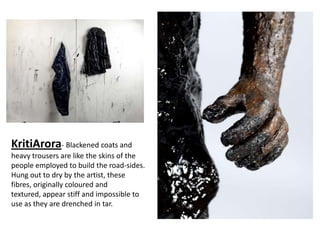
KritiArora- Blackened coats and
heavy trousers are like the skins of the
people employed to build the road-sides.
Hung out to dry by the artist, these
fibres, originally coloured and
textured, appear stiff and impossible to
use as they are drenched in tar.
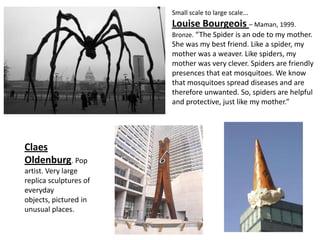
Small scale to large scale...
                        Louise Bourgeois – Maman, 1999.
                        Bronze. “The Spider is an ode to my mother.
                        She was my best friend. Like a spider, my
                        mother was a weaver. Like spiders, my
                        mother was very clever. Spiders are friendly
                        presences that eat mosquitoes. We know
                        that mosquitoes spread diseases and are
                        therefore unwanted. So, spiders are helpful
                        and protective, just like my mother.”


Claes
Oldenburg. Pop
artist. Very large
replica sculptures of
everyday
objects, pictured in
unusual places.
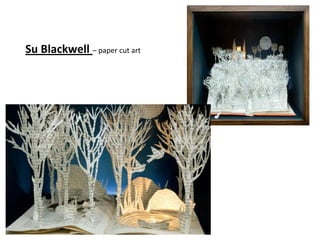
Su Blackwell – paper cut art
PLACES
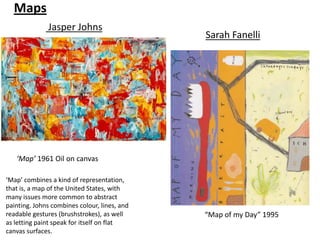
Maps
              Jasper Johns
                                              Sarah Fanelli


   ‘Map’ 1961 Oil on canvas

‘Map’ combines a kind of representation,
that is, a map of the United States, with
many issues more common to abstract
painting. Johns combines colour, lines, and
readable gestures (brushstrokes), as well     “Map of my Day” 1995
as letting paint speak for itself on flat
canvas surfaces.
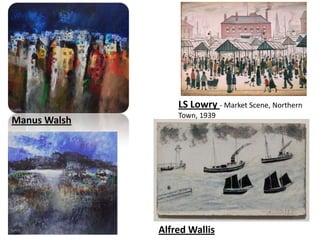
LS Lowry - Market Scene, Northern
                  Town, 1939
Manus Walsh


              Alfred Wallis
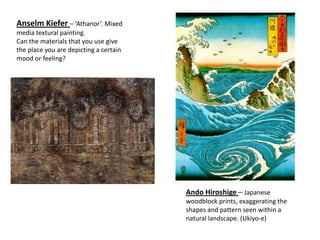
Anselm Kiefer – ‘Athanor’. Mixed
media textural painting.
Can the materials that you use give
the place you are depicting a certain
mood or feeling?


                                        Ando Hiroshige – Japanese
                                        woodblock prints, exaggerating the
                                        shapes and pattern seen within a
                                        natural landscape. (Ukiyo-e)
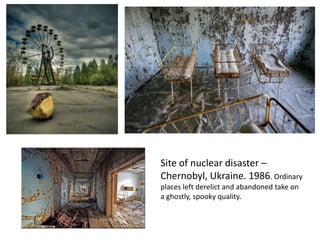
Site of nuclear disaster –
Chernobyl, Ukraine. 1986. Ordinary
places left derelict and abandoned take on
a ghostly, spooky quality.
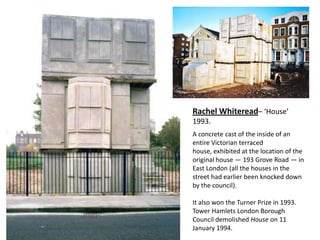
Rachel Whiteread– ‘House’
1993.
A concrete cast of the inside of an
entire Victorian terraced
house, exhibited at the location of the
original house — 193 Grove Road — in
East London (all the houses in the
street had earlier been knocked down
by the council).

It also won the Turner Prize in 1993.
Tower Hamlets London Borough
Council demolished House on 11
January 1994.
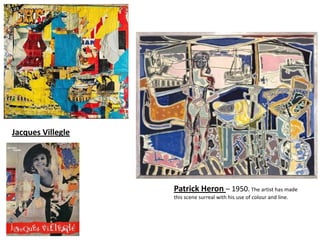
Jacques Villegle


                   Patrick Heron – 1950. The artist has made
                   this scene surreal with his use of colour and line.
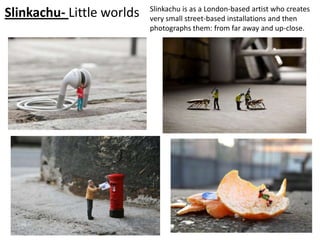
Slinkachu is as a London-based artist who creates
Slinkachu- Little worlds   very small street-based installations and then
                           photographs them: from far away and up-close.
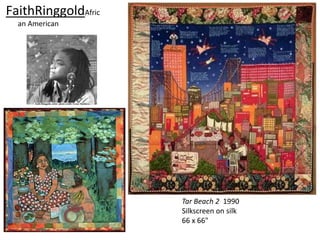
FaithRinggoldAfric
  an American


                     Tar Beach 2 1990
                     Silkscreen on silk
                     66 x 66"
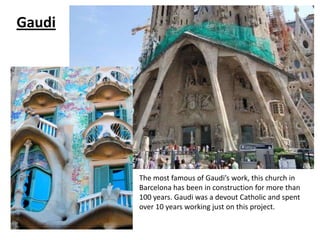
Gaudi


        The most famous of Gaudi’s work, this church in
        Barcelona has been in construction for more than
        100 years. Gaudi was a devout Catholic and spent
        over 10 years working just on this project.

Exam part 1

  • 1.
  • 2.
  • 3.
    This is yourGCSE Art Exam question. ordinary and / or EXTRAORDINARY...
  • 4.
    Ordinary Definition: not differentor special or unexpected in any way; usual Typical, common, customary, routine, familiar ‘Readers of the magazine said they wanted more stories about ordinary people and fewer stories about the rich and famous.’ Extraordinary Definition very unusual, special, unexpected or strange Exceptional, remarkable, unfamiliar, curious ‘He told the extraordinary story of his escape.’
  • 5.
    Today we will: THINKabout what these words ACTUALLY mean LOOK at many starting points for this question DISCOVER artists and designers who could inspire us on this topic SHARE ideas with each other
  • 6.
  • 7.
    Everybody knows... thefour AO’s For the exam you have to show evidence of: ALL 4 of the AO’s (Assessment Objectives) AO1: Looking at other artists = 25% AO2: Experimenting with media = 25% AO3: Recording your ideas = 25% AO4: Making a final piece = 25%
  • 8.
    It is importantthat you begin working on the EXAM paper straight away. START TODAY! Exam dates…. Tuesday 8th and Wednesday 9th May
  • 9.
  • 10.
    There are 6main starting points. PEOPLE, PLACES, IMAGINATION, O BJECTS, ACTIVITIES and NATURAL WORLD.
  • 11.
    Contextual references The artistson the next few pages are suggestions to help you think about possible ideas. You may already have ideas of your own. Keep an open mind at this point...
  • 12.
  • 13.
    Marc Quinn Robert Bosch Portrait of Martin Luther King made out of dominoes. Quinn is inspired to work with physical deformity. Looking at fragmented sculptures in the British Museum, he wondered how viewers would respond to bodies that had been damaged during their lifetime rather than after being transformed into objects through artistic representation.
  • 14.
    Chris Ofili No WomanNo Cry 1998. Uses mixed media, including elephant dung!
  • 15.
    Andy Warhol ‘Elvis. 1962’.Screenprinting on silk. At that time Elvis was seen everywhere- on TV, magazines, newspapers. The way his image is repeated over and over seems like a comment on that. The fact that the image of Elvis seems to be fading away could be significant...
  • 16.
    Celebrity paintings Malcolm Farley – ‘Ali’ MaggiHambling– ‘Jackie Laughing’ 2005. Oil on canvas. Elizabeth Peyton – ‘Flower Liam’ 1996. Oil on board.
  • 17.
    Elizabeth Peyton Peyton painted numerous celebrities in her distinct style which renders each of her models with the same red lips, defined eyes and pale skin. To the right a good weblink for MOMA http://www.moma.org/collection/artist.php?a gallery for this artist rtist_id=8042
  • 18.
    Alfred Stieglitz Artist GeorgiaO’ Keeffe’s hands with thimble. An alternative way to make a portrait of somebody.
  • 19.
    Richard Billingham Richard Billingham's photographs of his family in their Birmingham flat, published in the book Ray's a Laugh 1996, are a stark, painful and often humorous study of the relationships within his own family. They encapsulate many of the critical questions relating to the position of the observer in relation to the observed.
  • 20.
    YinkaShonibare Fashion designer andsculpture artist. These pieces of work show a very surreal representation of the human form. Scramble For Africa. The Swing. 2001.
  • 21.
    Jason Freeny –Contemporary sculpture
  • 22.
    John Hedgecoe- Arnold Machin– created the plaster cast of the Took the photo of the Queen that is used on postage Queen that is used on postage stamps stamps This is now a very ordinary sight as we see it all the time on coins and stamps.
  • 23.
    Ana Maria Pacheco Wall mounted wooden sculpturesand dark, dry-point etching prints. 2011
  • 24.
    Gustav Klimt Adele Bloch-Bauer1907. Oil and gold on canvas. She is clasping her hands (she had a deformed finger). Dressed in gold, surrounded by gold. Lots of gold suggests she is wealthy and important. The Kiss
  • 25.
  • 26.
    Cindy Sheerman Sherman’s photographsare portraits of herself in various scenarios that parody stereotypes of women. A panoply of characters and settings are drawn from sources of popular culture, old movies, television soaps and pulp fiction.
  • 27.
    Leonardo da Vinci Leonardo da Vinci (1452-1519) was an Italian Renaissance Artist among many other talents. He is widely considered to be one of the greatest painters of all time.
  • 28.
    'I've always wantedto create drama in my pictures, which is why I paint Lucin Freud people. It's people who have brought drama to pictures from the beginning. The simplest human gestures tell stories.' Reflection (Self-portrait), 1985 Current exhibition on at the National Portrait Gallery http://www.npg.org.uk/freudsite/ London 9th Feb – 27th May
  • 29.
    Simon Patterson “The GreatBear” 1992 –links people of popular culture together.
  • 30.
  • 31.
    Shelly Goldsmith ‘No Escape’-images of flood scenes had been transfer printed onto Goldsmith’s work uses textile materials children's dresses. and processes as a metaphor for imagining how psychological states, emotions and memories associated with human fragility and loss can be made visible in cloth.
  • 32.
  • 33.
    EdRuscha- Ribbon drawings Eye, 1970 Quit, 1967 Self, 1967
  • 34.
    Lisa Milroy- collectionsof ordinary objects
  • 35.
    ‘Five Lipsticks’
Oil onpanel. Kim Kibby Oil paintings of everyday objects Tinker Toy Still Life -
Oil on canvas Summer Delight #2:
Flip Flops – Oil on panel Guitar Headstock -Oil on panel. Little Clay Pots -Oil on panel.
  • 36.
  • 37.
    Joseph Cornell Joseph Cornell’sArt work are collections of bought and found objects in boxes. Cornell collected source material for his work, which became artistic creations about his inner thoughts, desires, and ‘Untitled’ (Cocatoo and Corks), imagination. 1948, 4 3/8 x 13 1/2 x 5 5/8 inchs.
  • 38.
    Susan Hiller Assembling lots of the same type of object together in groups.
  • 39.
    William Michael Harnett Harnettwas a very skilled painter. He wanted to make objects look as realistic as possible. He used an assorted collection of everyday objects to create interesting compositions for his Art. To the right: ‘Old Models’ 1892 Oil on Canvas ‘A Man's Table Reversed’ 1877 Oil on Canvas
  • 40.
    This is acontemporary installation and sculpture. The artist uses Doris Salcedo familiar objects in ways that become strange and unsettling. The wardrobe and the clothing inside were filled with concrete so they became sealed up and unable to be used. The space between two buildings was filled with chairs, with a startling effect.
  • 41.
    Georgiou Morandi Guan Gris ‘NaturaMorta’ (Still Life in Italian) ‘Book, Pipe and Glasses’. These objects are familiar, yet they are A Cubist style still life painting. purposely stripped of any identifying marks such as labels. They are anonymous. These objects could easily come from anyone's kitchen.
  • 42.
    Mveongbeom Kim Philippe Starck
  • 43.
    KritiArora- Blackened coatsand heavy trousers are like the skins of the people employed to build the road-sides. Hung out to dry by the artist, these fibres, originally coloured and textured, appear stiff and impossible to use as they are drenched in tar.
  • 44.
    Small scale tolarge scale... Louise Bourgeois – Maman, 1999. Bronze. “The Spider is an ode to my mother. She was my best friend. Like a spider, my mother was a weaver. Like spiders, my mother was very clever. Spiders are friendly presences that eat mosquitoes. We know that mosquitoes spread diseases and are therefore unwanted. So, spiders are helpful and protective, just like my mother.” Claes Oldenburg. Pop artist. Very large replica sculptures of everyday objects, pictured in unusual places.
  • 45.
    Su Blackwell –paper cut art
  • 46.
  • 47.
    Maps Jasper Johns Sarah Fanelli ‘Map’ 1961 Oil on canvas ‘Map’ combines a kind of representation, that is, a map of the United States, with many issues more common to abstract painting. Johns combines colour, lines, and readable gestures (brushstrokes), as well “Map of my Day” 1995 as letting paint speak for itself on flat canvas surfaces.
  • 48.
    LS Lowry -Market Scene, Northern Town, 1939 Manus Walsh Alfred Wallis
  • 49.
    Anselm Kiefer –‘Athanor’. Mixed media textural painting. Can the materials that you use give the place you are depicting a certain mood or feeling? Ando Hiroshige – Japanese woodblock prints, exaggerating the shapes and pattern seen within a natural landscape. (Ukiyo-e)
  • 50.
    Site of nucleardisaster – Chernobyl, Ukraine. 1986. Ordinary places left derelict and abandoned take on a ghostly, spooky quality.
  • 51.
    Rachel Whiteread– ‘House’ 1993. Aconcrete cast of the inside of an entire Victorian terraced house, exhibited at the location of the original house — 193 Grove Road — in East London (all the houses in the street had earlier been knocked down by the council). It also won the Turner Prize in 1993. Tower Hamlets London Borough Council demolished House on 11 January 1994.
  • 52.
    Jacques Villegle Patrick Heron – 1950. The artist has made this scene surreal with his use of colour and line.
  • 53.
    Slinkachu is asa London-based artist who creates Slinkachu- Little worlds very small street-based installations and then photographs them: from far away and up-close.
  • 54.
    FaithRinggoldAfric anAmerican Tar Beach 2 1990 Silkscreen on silk 66 x 66"
  • 55.
    Gaudi The most famous of Gaudi’s work, this church in Barcelona has been in construction for more than 100 years. Gaudi was a devout Catholic and spent over 10 years working just on this project.