
The History of Photography
The Early Years
The photograph was the ultimate response
to a social and cultural appetite for a more
accurate and real- looking representation
of reality, a need that had its origins in the
Renaissance.
- Naomi Rosenblum, A World History of Photography
During the Renaissance (16th Century), artists became
increasingly interested in exploring and representing the
reality of nature.
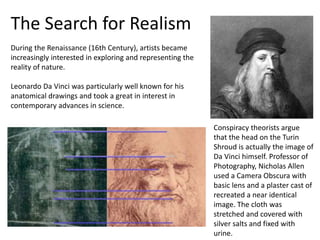
Leonardo Da Vinci was particularly well known for his
anatomical drawings and took a great in interest in
contemporary advances in science.
The Search for Realism
Conspiracy theorists argue
that the head on the Turin
Shroud is actually the image of
Da Vinci himself. Professor of
Photography, Nicholas Allen
used a Camera Obscura with
basic lens and a plaster cast of
recreated a near identical
image. The cloth was
stretched and covered with
silver salts and fixed with
urine.
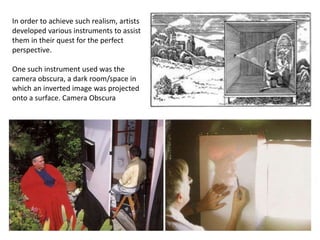
In order to achieve such realism, artists
developed various instruments to assist
them in their quest for the perfect
perspective.
One such instrument used was the
camera obscura, a dark room/space in
which an inverted image was projected
onto a surface. Camera Obscura
Capturing Shadows
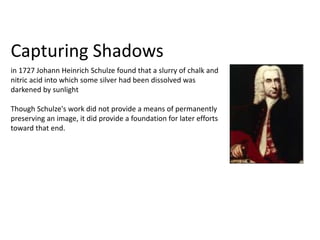
in 1727 Johann Heinrich Schulze found that a slurry of chalk and
nitric acid into which some silver had been dissolved was
darkened by sunlight
Though Schulze's work did not provide a means of permanently
preserving an image, it did provide a foundation for later efforts
toward that end.
As the industrial revolution
transformed society in the 1800s
with mass-production leading the
way forward, scientists endeavored
to reproduce reality in a fixed
format.
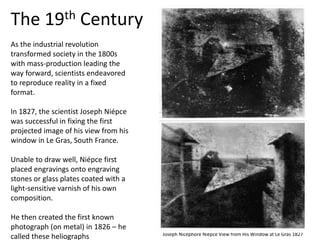
In 1827, the scientist Joseph Niépce
was successful in fixing the first
projected image of his view from his
window in Le Gras, South France.
Unable to draw well, Niépce first
placed engravings onto engraving
stones or glass plates coated with a
light-sensitive varnish of his own
composition.
He then created the first known
photograph (on metal) in 1826 – he
called these heliographs
The 19th Century
Joseph Nicéphore Niépce View from His Window at Le Gras 1827
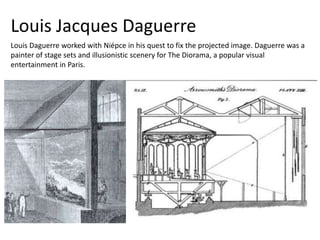
Louis Daguerre worked with Niépce in his quest to fix the projected image. Daguerre was a
painter of stage sets and illusionistic scenery for The Diorama, a popular visual
entertainment in Paris.
Louis Jacques Daguerre
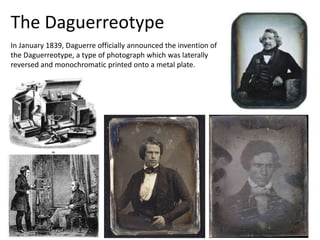
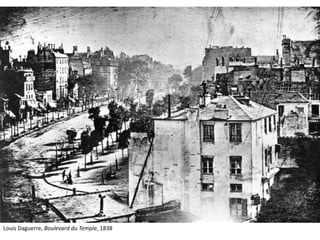
In January 1839, Daguerre officially announced the invention of
the Daguerreotype, a type of photograph which was laterally
reversed and monochromatic printed onto a metal plate.
The Daguerreotype
Louis Daguerre, Boulevard du Temple, 1838
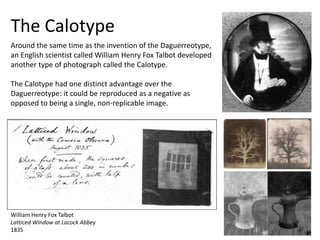
Around the same time as the invention of the Daguerreotype,
an English scientist called William Henry Fox Talbot developed
another type of photograph called the Calotype.
The Calotype had one distinct advantage over the
Daguerreotype: it could be reproduced as a negative as
opposed to being a single, non-replicable image.
The Calotype
William Henry Fox Talbot
Latticed Window at Lacock Abbey
1835
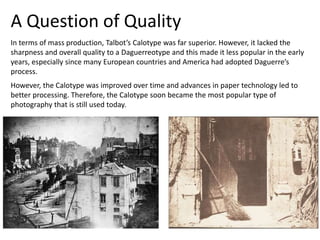
A Question of Quality
In terms of mass production, Talbot’s Calotype was far superior. However, it lacked the
sharpness and overall quality to a Daguerreotype and this made it less popular in the early
years, especially since many European countries and America had adopted Daguerre’s
process.
However, the Calotype was improved over time and advances in paper technology led to
better processing. Therefore, the Calotype soon became the most popular type of
photography that is still used today.
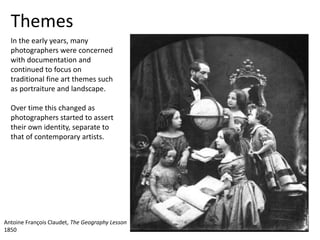
Themes
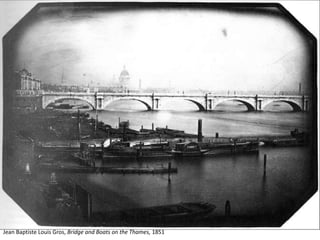
In the early years, many
photographers were concerned
with documentation and
continued to focus on
traditional fine art themes such
as portraiture and landscape.
Over time this changed as
photographers started to assert
their own identity, separate to
that of contemporary artists.
Antoine François Claudet, The Geography Lesson
1850
Jean Baptiste Louis Gros, Bridge and Boats on the Thames, 1851
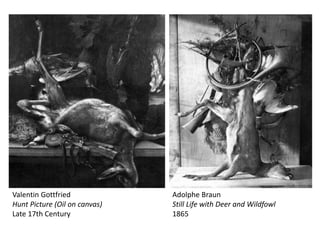
Valentin Gottfried
Hunt Picture (Oil on canvas)
Late 17th Century
Adolphe Braun
Still Life with Deer and Wildfowl
1865

Early Photography

  • 1.
    The History ofPhotography The Early Years
  • 2.
    The photograph wasthe ultimate response to a social and cultural appetite for a more accurate and real- looking representation of reality, a need that had its origins in the Renaissance. - Naomi Rosenblum, A World History of Photography
  • 3.
    During the Renaissance(16th Century), artists became increasingly interested in exploring and representing the reality of nature. Leonardo Da Vinci was particularly well known for his anatomical drawings and took a great in interest in contemporary advances in science. The Search for Realism Conspiracy theorists argue that the head on the Turin Shroud is actually the image of Da Vinci himself. Professor of Photography, Nicholas Allen used a Camera Obscura with basic lens and a plaster cast of recreated a near identical image. The cloth was stretched and covered with silver salts and fixed with urine.
  • 4.
    In order toachieve such realism, artists developed various instruments to assist them in their quest for the perfect perspective. One such instrument used was the camera obscura, a dark room/space in which an inverted image was projected onto a surface. Camera Obscura
  • 5.
    Capturing Shadows in 1727Johann Heinrich Schulze found that a slurry of chalk and nitric acid into which some silver had been dissolved was darkened by sunlight Though Schulze's work did not provide a means of permanently preserving an image, it did provide a foundation for later efforts toward that end.
  • 6.
    As the industrialrevolution transformed society in the 1800s with mass-production leading the way forward, scientists endeavored to reproduce reality in a fixed format. In 1827, the scientist Joseph Niépce was successful in fixing the first projected image of his view from his window in Le Gras, South France. Unable to draw well, Niépce first placed engravings onto engraving stones or glass plates coated with a light-sensitive varnish of his own composition. He then created the first known photograph (on metal) in 1826 – he called these heliographs The 19th Century Joseph Nicéphore Niépce View from His Window at Le Gras 1827
  • 7.
    Louis Daguerre workedwith Niépce in his quest to fix the projected image. Daguerre was a painter of stage sets and illusionistic scenery for The Diorama, a popular visual entertainment in Paris. Louis Jacques Daguerre
  • 8.
    In January 1839,Daguerre officially announced the invention of the Daguerreotype, a type of photograph which was laterally reversed and monochromatic printed onto a metal plate. The Daguerreotype
  • 9.
  • 10.
    Around the sametime as the invention of the Daguerreotype, an English scientist called William Henry Fox Talbot developed another type of photograph called the Calotype. The Calotype had one distinct advantage over the Daguerreotype: it could be reproduced as a negative as opposed to being a single, non-replicable image. The Calotype William Henry Fox Talbot Latticed Window at Lacock Abbey 1835
  • 11.
    A Question ofQuality In terms of mass production, Talbot’s Calotype was far superior. However, it lacked the sharpness and overall quality to a Daguerreotype and this made it less popular in the early years, especially since many European countries and America had adopted Daguerre’s process. However, the Calotype was improved over time and advances in paper technology led to better processing. Therefore, the Calotype soon became the most popular type of photography that is still used today.
  • 12.
    Themes In the earlyyears, many photographers were concerned with documentation and continued to focus on traditional fine art themes such as portraiture and landscape. Over time this changed as photographers started to assert their own identity, separate to that of contemporary artists. Antoine François Claudet, The Geography Lesson 1850
  • 13.
    Jean Baptiste LouisGros, Bridge and Boats on the Thames, 1851
  • 14.
    Valentin Gottfried Hunt Picture(Oil on canvas) Late 17th Century Adolphe Braun Still Life with Deer and Wildfowl 1865

Editor's Notes

  • #10 However there were problems with the daguerreotype. It required long exposures and this meant that any movement resulted in blur It was also a one off image that was extremely delicate the mirror surface could be easily scratched and this led to them becoming an object of attention just as much as it was an image of information