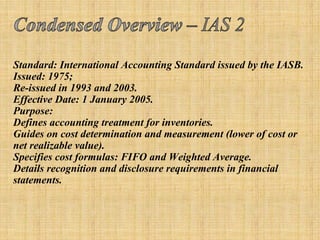
Standard: International AccountingStandard issued by the IASB.
Issued: 1975;
Re-issued in 1993 and 2003.
Effective Date: 1 January 2005.
Purpose:
Defines accounting treatment for inventories.
Guides on cost determination and measurement (lower of cost or
net realizable value).
Specifies cost formulas: FIFO and Weighted Average.
Details recognition and disclosure requirements in financial
statements.
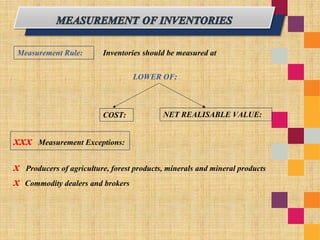
Measurement Rule: Inventoriesshould be measured at
LOWER OF:
COST: NET REALISABLE VALUE:
xxx Measurement Exceptions:
x Producers of agriculture, forest products, minerals and mineral products
x Commodity dealers and brokers
7.
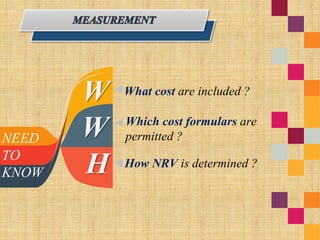
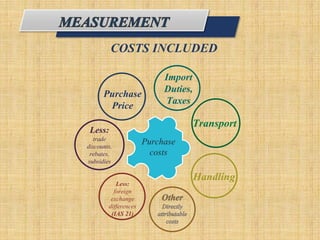
What cost areincluded ?
Which cost formulars are
permitted ?
How NRV is determined ?
NEED
TO
KNOW
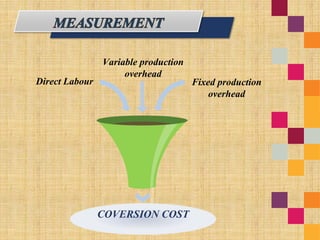
Direct Labour Fixedproduction
overhead
Variable production
overhead
COVERSION COST
11.
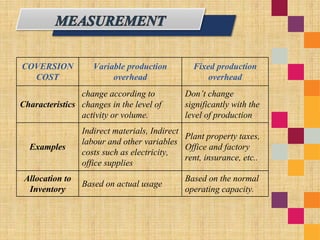
COVERSION
COST
Variable production
overhead
Fixed production
overhead
Characteristics
changeaccording to
changes in the level of
activity or volume.
Don’t change
significantly with the
level of production
Examples
Indirect materials, Indirect
labour and other variables
costs such as electricity,
office supplies
Plant property taxes,
Office and factory
rent, insurance, etc..
Allocation to
Inventory
Based on actual usage
Based on the normal
operating capacity.
12.
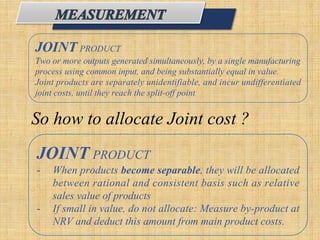
JOINT PRODUCT
Two ormore outputs generated simultaneously, by a single manufacturing
process using common input, and being substantially equal in value.
Joint products are separately unidentifiable, and incur undifferentiated
joint costs, until they reach the split-off point.
So how to allocate Joint cost ?
JOINT PRODUCT
- When products become separable, they will be allocated
between rational and consistent basis such as relative
sales value of products
- If small in value, do not allocate: Measure by-product at
NRV and deduct this amount from main product costs.
13.
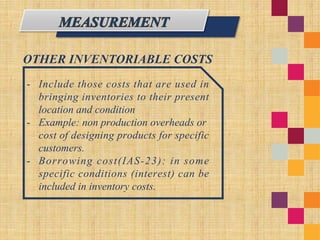
OTHER INVENTORIABLE COSTS
-Include those costs that are used in
bringing inventories to their present
location and condition
- Example: non production overheads or
cost of designing products for specific
customers.
- Borrowing cost(IAS-23): in some
specific conditions (interest) can be
included in inventory costs.
14.
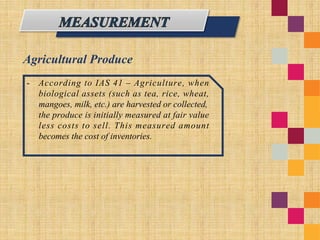
Agricultural Produce
- Accordingto IAS 41 – Agriculture, when
biological assets (such as tea, rice, wheat,
mangoes, milk, etc.) are harvested or collected,
the produce is initially measured at fair value
less costs to sell. This measured amount
becomes the cost of inventories.
15.
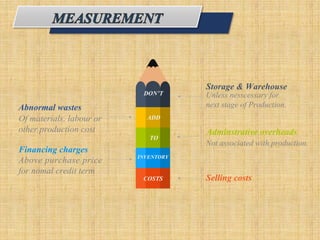
Abnormal wastes
Financing charges
Abovepurchase price
for nomal credit term
Storage & Warehouse
Unless nesscessary for
next stage of Production.
Adminstrative overheads
Not associated with production.
Selling costs
DON’T
ADD
TO
INVENTORY
COSTS
Of materials, labour or
other production cost
16.
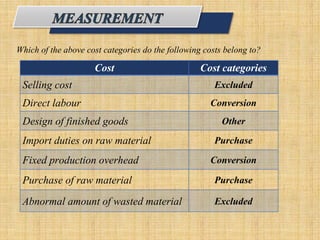
Which of theabove cost categories do the following costs belong to?
Cost Cost categories
Selling cost Excluded
Direct labour Conversion
Design of finished goods Other
Import duties on raw material Purchase
Fixed production overhead Conversion
Purchase of raw material Purchase
Abnormal amount of wasted material Excluded
17.
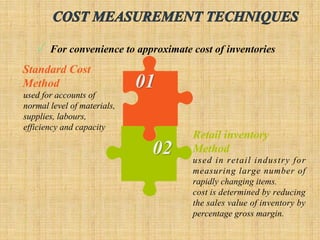
Standard Cost
Method
used foraccounts of
normal level of materials,
supplies, labours,
efficiency and capacity
Retail inventory
Method
used in retail industry for
measuring large number of
rapidly changing items.
cost is determined by reducing
the sales value of inventory by
percentage gross margin.
For convenience to approximate cost of inventories
18.
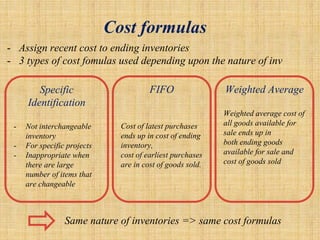
Specific
Identification
- Not interchangeable
inventory
-For specific projects
- Inappropriate when
there are large
number of items that
are changeable
FIFO
Cost of latest purchases
ends up in cost of ending
inventory,
cost of earliest purchases
are in cost of goods sold.
Weighted Average
Weighted average cost of
all goods available for
sale ends up in
both ending goods
available for sale and
cost of goods sold
- Assign recent cost to ending inventories
- 3 types of cost fomulas used depending upon the nature of inv
Same nature of inventories => same cost formulas
Cost formulas
19.
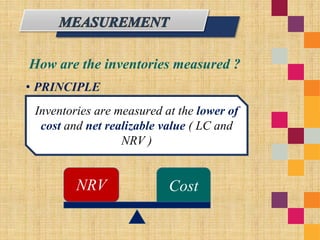
• PRINCIPLE
Inventories aremeasured at the lower of
cost and net realizable value ( LC and
NRV )
How are the inventories measured ?
NRV Cost
21.
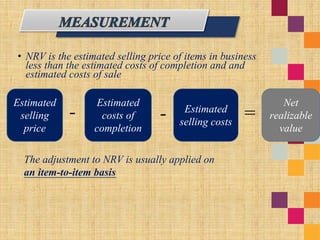
• NRV isthe estimated selling price of items in business
less than the estimated costs of completion and and
estimated costs of sale
Estimated
selling
price
Estimated
costs of
completion
Estimated
selling costs
Net
realizable
value
- - =
The adjustment to NRV is usually applied on
an item-to-item basis
22.
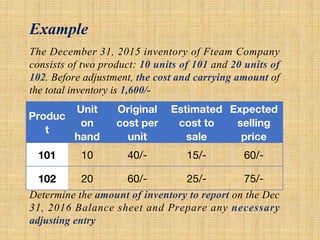
Produc
t
Unit
on
hand
Original
cost per
unit
Estimated
cost to
sale
Expected
selling
price
10110 40/- 15/- 60/-
102 20 60/- 25/- 75/-
The December 31, 2015 inventory of Fteam Company
consists of two product: 10 units of 101 and 20 units of
102. Before adjustment, the cost and carrying amount of
the total inventory is 1,600/-
Determine the amount of inventory to report on the Dec
31, 2016 Balance sheet and Prepare any necessary
adjusting entry
Example
23.
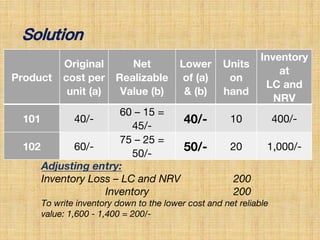
Product
Original
cost per
unit (a)
Net
Realizable
Value(b)
Lower
of (a)
& (b)
Units
on
hand
Inventory
at
LC and
NRV
101 40/-
60 – 15 =
45/-
40/- 10 400/-
102 60/-
75 – 25 =
50/-
50/- 20 1,000/-
Adjusting entry:
Inventory Loss – LC and NRV 200
Inventory 200
To write inventory down to the lower cost and net reliable
value: 1,600 - 1,400 = 200/-
Solution
24.
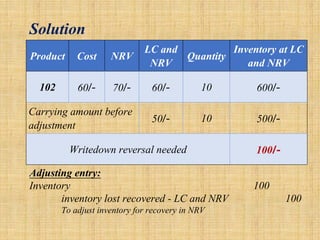
Example
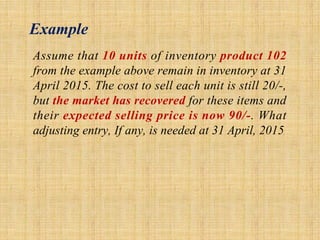
Assume that 10units of inventory product 102
from the example above remain in inventory at 31
April 2015. The cost to sell each unit is still 20/-,
but the market has recovered for these items and
their expected selling price is now 90/-. What
adjusting entry, If any, is needed at 31 April, 2015
25.
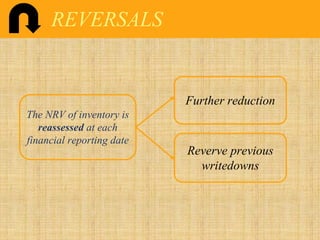
REVERSALS
The NRV ofinventory is
reassessed at each
financial reporting date
Further reduction
Reverve previous
writedowns
26.
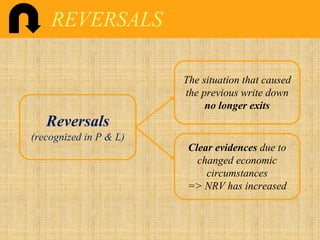
REVERSALS
Reversals
(recognized in P& L)
The situation that caused
the previous write down
no longer exits
Clear evidences due to
changed economic
circumstances
=> NRV has increased
27.
Solution
Product Cost NRV
LCand
NRV
Quantity
Inventory at LC
and NRV
102 60/- 70/- 60/- 10 600/-
Carrying amount before
adjustment
50/- 10 500/-
Writedown reversal needed 100/-
Adjusting entry:
Inventory 100
inventory lost recovered - LC and NRV 100
To adjust inventory for recovery in NRV
28.
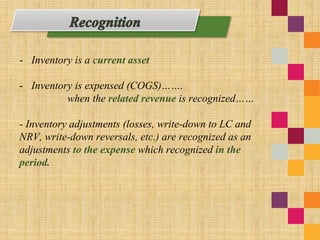
- Inventory isa current asset
- Inventory is expensed (COGS)…….
when the related revenue is recognized……
- Inventory adjustments (losses, write-down to LC and
NRV, write-down reversals, etc.) are recognized as an
adjustments to the expense which recognized in the
period.
29.
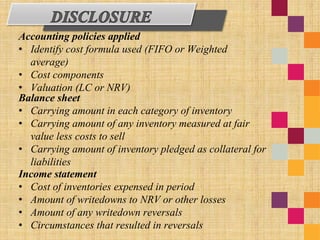
Accounting policies applied
•Identify cost formula used (FIFO or Weighted
average)
• Cost components
• Valuation (LC or NRV)
Balance sheet
• Carrying amount in each category of inventory
• Carrying amount of any inventory measured at fair
value less costs to sell
• Carrying amount of inventory pledged as collateral for
liabilities
Income statement
• Cost of inventories expensed in period
• Amount of writedowns to NRV or other losses
• Amount of any writedown reversals
• Circumstances that resulted in reversals
30.
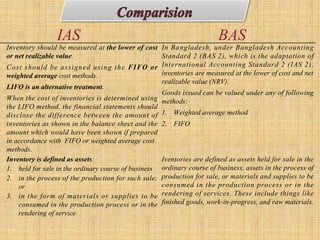
Inventory should bemeasured at the lower of cost
or net realizable value.
Cost should be assigned using the FIFO or
weighted average cost methods.
LIFO is an alternative treatment.
When the cost of inventories is determined using
the LIFO method, the financial statements should
disclose the difference between the amount of
inventories as shown in the balance sheet and the
amount which would have been shown if prepared
in accordance with FIFO or weighted average cost
methods.
In Bangladesh, under Bangladesh Accounting
Standard 2 (BAS 2), which is the adaptation of
International Accounting Standard 2 (IAS 2),
inventories are measured at the lower of cost and net
realizable value (NRV).
Goods issued can be valued under any of following
methods:
1. Weighted average method
2. FIFO
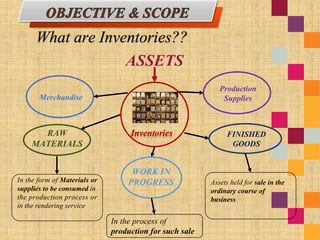
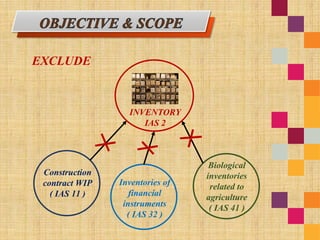
Inventory is defined as assets:
1. held for sale in the ordinary course of business
2. in the process of the production for such sale;
or
3. in the form of materials or supplies to be
consumed in the production process or in the
rendering of service
Iventories are defined as assets held for sale in the
ordinary course of business, assets in the process of
production for sale, or materials and supplies to be
consumed in the production process or in the
rendering of services. These include things like
finished goods, work-in-progress, and raw materials.
IAS BAS