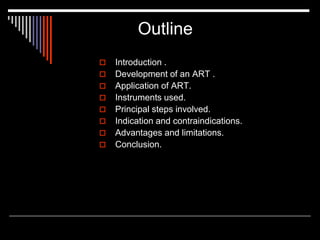
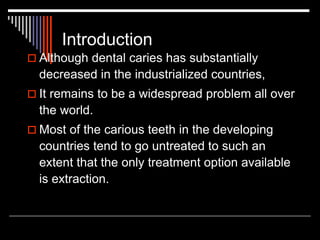
ART
Atraumatic Restorative Treatment
Dr. ZAHEER
PROF
DEPT OF PUBLIC HEALTH DENTISTRY
NAVODAYA DENTAL COLLEGE AND HOSPITAL
TARGET STUDENTS : 3RD & 4TH BDS
Outline
 Introduction .
 Development of an ART .
 Application of ART.
 Instruments used.
 Principal steps involved.
 Indication and contraindications.
 Advantages and limitations.
 Conclusion.
Introduction
 Although dental caries has substantially
decreased in the industrialized countries,
 It remains to be a widespread problem all over
the world.
 Most of the carious teeth in the developing
countries tend to go untreated to such an
extent that the only treatment option available
is extraction.
 Atraumatic restorative treatment Approach was
developed
 ART approach includes both prevention and
treatment of dental caries.
 Often abbreviated to the acronym ART.
 Based on Minimal intervention technique.
Principle of ART
This procedure is based on the principles
 Removing caries using hand instruments
only.
 Restoring the tooth with an adhesive filling
material - glass ionomer .
Development of ART
 The technique of ART was pioneered in Tanzania
in the mid 1980’s. - Jo Frencken.
 In 1988 ,Jo Frencken and T. Pilot worked for
WHO collaborating center , to develop a model
for primary oral health care for refugees.
 A symposium devoted to ART was held at the
1995 IADR.
 A community field trail to compare ART with the
mobile conventional equipment cavity
preparation – amalgam approach was started in
1991 in Thailand
 Drawing on his experiences in Thailand, Jo
Frencken started another series of community
field trails in Zimbabwe during 1993.
 This was followed by Evert Van in Pakistan,
Christopher Holmgren in China and Frencken
and Beiruti in Syria.
 In April 1994, the World Health Organization
introduced ART as part of the world health day.
 ART has been placed on the agenda of the
International Dental Federation (FDI) to
consider ART’s appropriateness, effectiveness
and potential training programmes.
 At least 25 countries around the world are
carrying out clinical or laboratory experiments
on ART related questions.
Applications of ART
 Introducing oral care to very young not
previously exposed to dentistry.
 For patients with extreme fear/anxiety.
 For mentally and / or physically handicapped
patients.
 For home – bound elderly and those living in
nursing homes.
 In high – risk caries clinics as an intermediate
treatment to stabilize conditions.
Instruments and
Materials used in ART
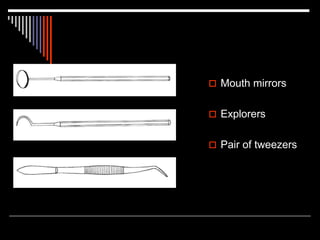
 Mouth mirrors
 Explorers
 Pair of tweezers
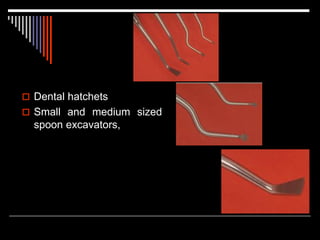
 Dental hatchets
 Small and medium sized
spoon excavators,
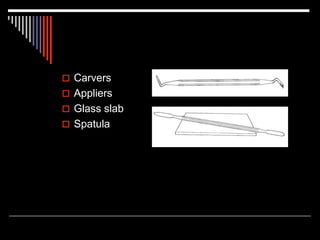
 Carvers
 Appliers
 Glass slab
 Spatula
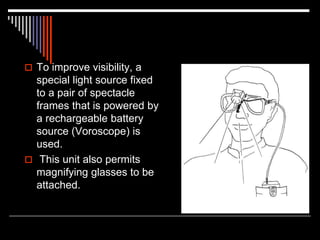
 To improve visibility, a
special light source fixed
to a pair of spectacle
frames that is powered by
a rechargeable battery
source (Voroscope) is
used.
 This unit also permits
magnifying glasses to be
attached.
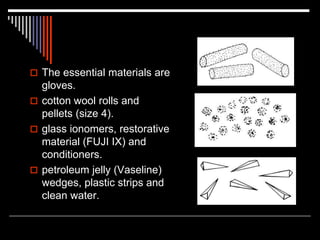
 The essential materials are
gloves.
 cotton wool rolls and
pellets (size 4).
 glass ionomers, restorative
material (FUJI IX) and
conditioners.
 petroleum jelly (Vaseline)
wedges, plastic strips and
clean water.
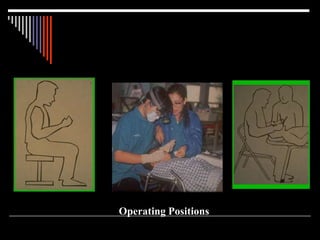
Operating Positions
The principal steps
of ART
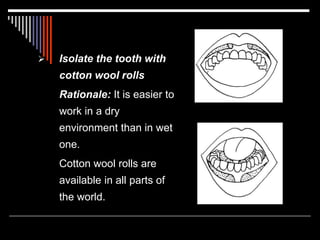
 Isolate the tooth with
cotton wool rolls
Rationale: It is easier to
work in a dry
environment than in wet
one.
Cotton wool rolls are
available in all parts of
the world.
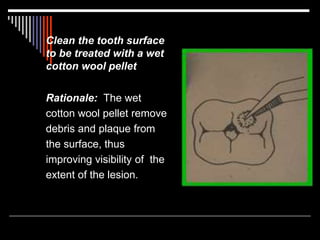
Clean the tooth surface
to be treated with a wet
cotton wool pellet
Rationale: The wet
cotton wool pellet remove
debris and plaque from
the surface, thus
improving visibility of the
extent of the lesion.
 Widen the entrance of the lesion
Rationale: The hatches replaces the bur, by
rotating the instruments tip, unsupported enamel
will break off, making an opening large enough for
the small excavator to enter.
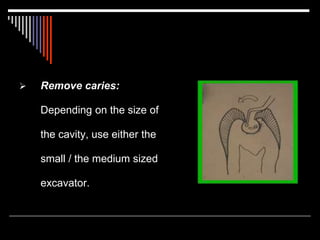
 Remove caries:
Depending on the size of
the cavity, use either the
small / the medium sized
excavator.
 Rationale: All soft caries should be removed.
To prevent caries progression and to obtain a
good seal of the coronal part of the restoration.
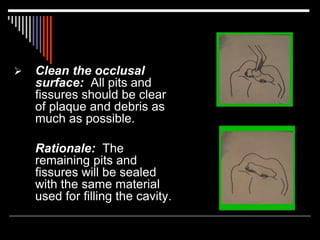
 Clean the occlusal
surface: All pits and
fissures should be clear
of plaque and debris as
much as possible.
Rationale: The
remaining pits and
fissures will be sealed
with the same material
used for filling the cavity.
 Provide pulpal protection if
necessary
Rationale: Calcium hydroxide
stimulates repair of dentin and glass
ionomers are biocompatible.
 Condition the cavity and occlusal
surface.
 Rationale: Conditioning increases the
bond strength of glass ionomers.
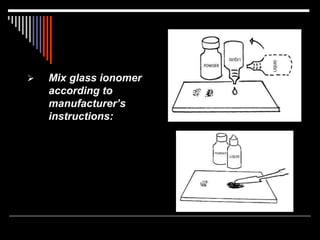
 Mix glass ionomer
according to
manufacturer’s
instructions:
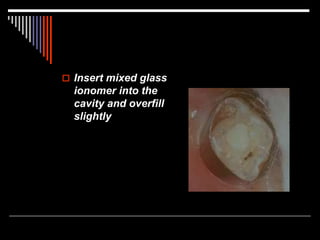
 Insert mixed glass
ionomer into the
cavity and overfill
slightly
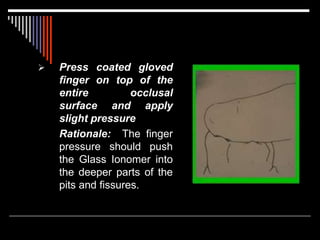
 Press coated gloved
finger on top of the
entire occlusal
surface and apply
slight pressure
Rationale: The finger
pressure should push
the Glass Ionomer into
the deeper parts of the
pits and fissures.
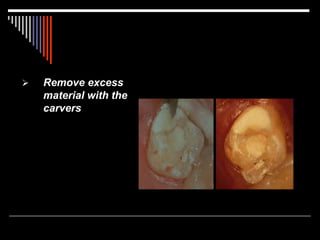
 Remove excess
material with the
carvers
 Cover filling / sealant with petroleum jelly
(Vaseline) / apply varnish.
 Instructs the patient not to eat for at least
one hour
 For restoring approximal cavities, a plastic
strip and wedges are used to produce a
correct contour to the filling.
Indications and Contra-Indications
for ART
 In general ART is carried out only in the small
cavities (involving dentine) and in those that
are accessible to hand instruments.
 ART is not used when:
1. There is an abscess (swelling) near the
carious tooth.
2. The pulp of the tooth is exposed.
3. Carious cavity not reachable with hand
instruments.
Advantages of ART
 Easily available and relatively inexpensive
hand instruments are used rather than
expensive electrically driven dental
equipment.
 A biologically friendly approach involving the
removal of only decalcified tooth tissues,
which results in relatively small cavities and
conserve sound tooth tissue.
 The limitation of pain, thereby minimizing the
need for local anesthesia.
 A straightforward and simple infection control
practice without the need to use sequentially
electroclaved hand pieces.
 The chemical adhesion of Glass Ionomer that
reduces the need to cut sound tissues for
retention of the restorative materials.
 The leaching of fluoride from glass ionomers,
which prevents secondary caries development
and probably remineralizes carious dentin.
 The combination of a preventive and curative
treatment in one procedure.
 The low cost.
Limitations of ART
 Survival rate - the largest study reported so
far is of 3 years duration.
 The techniques acceptance by oral health
care personnel is not yet assured.
 limited to small and medium sized, one
surface lesions
 The possibility exists for hand fatigue from
the use of hand instruments over long
periods.
 Hand mixing might produce a relatively
unstandardized mix of glass ionomers
 A misconception by the public that the new
glass ionomer “white fillings” only temporary
dressings.
Conclusion
 ART is NOT a compromise but a perfect
alternative treatment approach for developing
countries and special groups in the
industrialized world.
 There is great potentials for its use among
children, fearful adults, physically and mentally
handicapped and the elderly.
 It makes restorative care more accessible for
all population groups.
ART.ppt

ART.ppt

  • 1.
    ART Atraumatic Restorative Treatment Dr.ZAHEER PROF DEPT OF PUBLIC HEALTH DENTISTRY NAVODAYA DENTAL COLLEGE AND HOSPITAL TARGET STUDENTS : 3RD & 4TH BDS
  • 2.
    Outline  Introduction . Development of an ART .  Application of ART.  Instruments used.  Principal steps involved.  Indication and contraindications.  Advantages and limitations.  Conclusion.
  • 3.
    Introduction  Although dentalcaries has substantially decreased in the industrialized countries,  It remains to be a widespread problem all over the world.  Most of the carious teeth in the developing countries tend to go untreated to such an extent that the only treatment option available is extraction.
  • 4.
     Atraumatic restorativetreatment Approach was developed  ART approach includes both prevention and treatment of dental caries.  Often abbreviated to the acronym ART.  Based on Minimal intervention technique.
  • 5.
    Principle of ART Thisprocedure is based on the principles  Removing caries using hand instruments only.  Restoring the tooth with an adhesive filling material - glass ionomer .
  • 6.
  • 7.
     The techniqueof ART was pioneered in Tanzania in the mid 1980’s. - Jo Frencken.  In 1988 ,Jo Frencken and T. Pilot worked for WHO collaborating center , to develop a model for primary oral health care for refugees.  A symposium devoted to ART was held at the 1995 IADR.
  • 8.
     A communityfield trail to compare ART with the mobile conventional equipment cavity preparation – amalgam approach was started in 1991 in Thailand  Drawing on his experiences in Thailand, Jo Frencken started another series of community field trails in Zimbabwe during 1993.  This was followed by Evert Van in Pakistan, Christopher Holmgren in China and Frencken and Beiruti in Syria.
  • 9.
     In April1994, the World Health Organization introduced ART as part of the world health day.  ART has been placed on the agenda of the International Dental Federation (FDI) to consider ART’s appropriateness, effectiveness and potential training programmes.  At least 25 countries around the world are carrying out clinical or laboratory experiments on ART related questions.
  • 10.
    Applications of ART Introducing oral care to very young not previously exposed to dentistry.  For patients with extreme fear/anxiety.  For mentally and / or physically handicapped patients.  For home – bound elderly and those living in nursing homes.  In high – risk caries clinics as an intermediate treatment to stabilize conditions.
  • 11.
  • 12.
     Mouth mirrors Explorers  Pair of tweezers
  • 13.
     Dental hatchets Small and medium sized spoon excavators,
  • 14.
     Carvers  Appliers Glass slab  Spatula
  • 15.
     To improvevisibility, a special light source fixed to a pair of spectacle frames that is powered by a rechargeable battery source (Voroscope) is used.  This unit also permits magnifying glasses to be attached.
  • 16.
     The essentialmaterials are gloves.  cotton wool rolls and pellets (size 4).  glass ionomers, restorative material (FUJI IX) and conditioners.  petroleum jelly (Vaseline) wedges, plastic strips and clean water.
  • 17.
  • 18.
  • 19.
     Isolate thetooth with cotton wool rolls Rationale: It is easier to work in a dry environment than in wet one. Cotton wool rolls are available in all parts of the world.
  • 20.
    Clean the toothsurface to be treated with a wet cotton wool pellet Rationale: The wet cotton wool pellet remove debris and plaque from the surface, thus improving visibility of the extent of the lesion.
  • 21.
     Widen theentrance of the lesion Rationale: The hatches replaces the bur, by rotating the instruments tip, unsupported enamel will break off, making an opening large enough for the small excavator to enter.
  • 22.
     Remove caries: Dependingon the size of the cavity, use either the small / the medium sized excavator.
  • 23.
     Rationale: Allsoft caries should be removed. To prevent caries progression and to obtain a good seal of the coronal part of the restoration.
  • 24.
     Clean theocclusal surface: All pits and fissures should be clear of plaque and debris as much as possible. Rationale: The remaining pits and fissures will be sealed with the same material used for filling the cavity.
  • 25.
     Provide pulpalprotection if necessary Rationale: Calcium hydroxide stimulates repair of dentin and glass ionomers are biocompatible.
  • 26.
     Condition thecavity and occlusal surface.  Rationale: Conditioning increases the bond strength of glass ionomers.
  • 27.
     Mix glassionomer according to manufacturer’s instructions:
  • 28.
     Insert mixedglass ionomer into the cavity and overfill slightly
  • 29.
     Press coatedgloved finger on top of the entire occlusal surface and apply slight pressure Rationale: The finger pressure should push the Glass Ionomer into the deeper parts of the pits and fissures.
  • 30.
  • 31.
     Cover filling/ sealant with petroleum jelly (Vaseline) / apply varnish.  Instructs the patient not to eat for at least one hour  For restoring approximal cavities, a plastic strip and wedges are used to produce a correct contour to the filling.
  • 32.
    Indications and Contra-Indications forART  In general ART is carried out only in the small cavities (involving dentine) and in those that are accessible to hand instruments.  ART is not used when: 1. There is an abscess (swelling) near the carious tooth. 2. The pulp of the tooth is exposed. 3. Carious cavity not reachable with hand instruments.
  • 33.
    Advantages of ART Easily available and relatively inexpensive hand instruments are used rather than expensive electrically driven dental equipment.  A biologically friendly approach involving the removal of only decalcified tooth tissues, which results in relatively small cavities and conserve sound tooth tissue.  The limitation of pain, thereby minimizing the need for local anesthesia.
  • 34.
     A straightforwardand simple infection control practice without the need to use sequentially electroclaved hand pieces.  The chemical adhesion of Glass Ionomer that reduces the need to cut sound tissues for retention of the restorative materials.
  • 35.
     The leachingof fluoride from glass ionomers, which prevents secondary caries development and probably remineralizes carious dentin.  The combination of a preventive and curative treatment in one procedure.  The low cost.
  • 36.
    Limitations of ART Survival rate - the largest study reported so far is of 3 years duration.  The techniques acceptance by oral health care personnel is not yet assured.  limited to small and medium sized, one surface lesions
  • 37.
     The possibilityexists for hand fatigue from the use of hand instruments over long periods.  Hand mixing might produce a relatively unstandardized mix of glass ionomers
  • 38.
     A misconceptionby the public that the new glass ionomer “white fillings” only temporary dressings.
  • 39.
    Conclusion  ART isNOT a compromise but a perfect alternative treatment approach for developing countries and special groups in the industrialized world.  There is great potentials for its use among children, fearful adults, physically and mentally handicapped and the elderly.
  • 40.
     It makesrestorative care more accessible for all population groups.