By
Dr. Lasya
OBJECTIVES
• Definition
• Principles
• Indications
• Contraindications
• Procedure
• Advantages
• Conclusion
DEFINITION
• ART is defined as a minimally invasive care approach in preventing
dental caries and stopping its further progression.
- Jo E. Frencken, 2012
PRINCIPLES
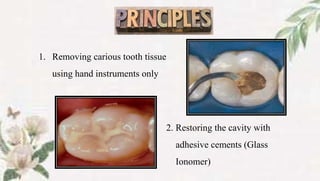
1. Removing carious tooth tissue
using hand instruments only
2. Restoring the cavity with
adhesive cements (Glass
Ionomer)
INDICATIONS
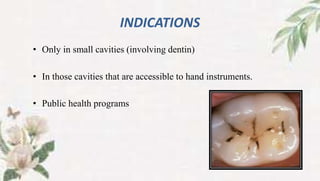
• Only in small cavities (involving dentin)
• In those cavities that are accessible to hand instruments.
• Public health programs
CONTRA INDICATIONS
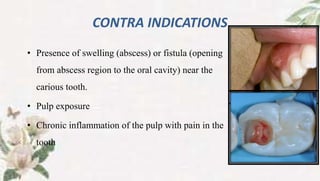
• Presence of swelling (abscess) or fistula (opening
from abscess region to the oral cavity) near the
carious tooth.
• Pulp exposure
• Chronic inflammation of the pulp with pain in the
tooth
• There is an obvious carious cavity, but the opening is inaccessible to
hand instruments
• There are clear signs of a cavity for example in a proximal surface, but
the cavity cannot be entered from the proximal or the occlusal direction.
Reasons for using hand Instruments
• With this technique, restorative care is made available to all
population groups.
• This technique is said to be tooth friendly as this conserves sound
tooth tissues and causes less trauma to the teeth by requiring minimal
cavity preparation.
• Cost effective technique as this uses hand instruments in place of
costly electrically driven dental equipment.
• Use of local anesthesia for pain management is minimal there by
reducing the psychological trauma to patients.
• Hand instruments are easy clean and sterilize after every use, thus
making infection control simplified
Reasons for using GIC
• GIC sticks chemically both to enamel and dentine- the need to cut
sound tooth tissue to prepare the cavity is reduced.
• Fluoride is released from the restoration which will prevent and arrest
caries.
• Biocompatible cement as this restoration does not cause any irritation
to pulp and gingiva, and has a co-efficient of thermal expansion
similar to tooth structure.
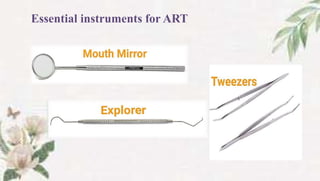
Essential instruments for ART
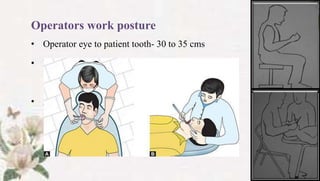
Operators work posture
• Operator eye to patient tooth- 30 to 35 cms
• Positions – Direct rear - 12 o’ clock
Right rear – 10 o’clock position
• Assistant head - 10 to 15 cms higher than operator
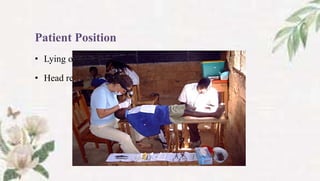
Patient Position
• Lying on back on flat surface
• Head rest- firm foam or rubber ring
PROCEDURE
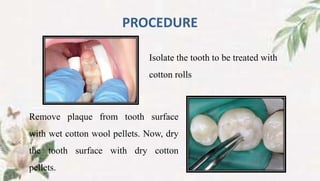
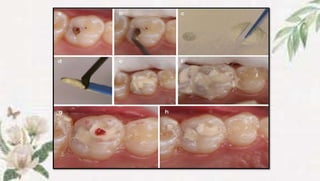
Isolate the tooth to be treated with
cotton rolls
Remove plaque from tooth surface
with wet cotton wool pellets. Now, dry
the tooth surface with dry cotton
pellets.
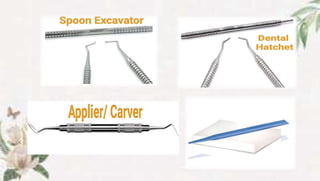
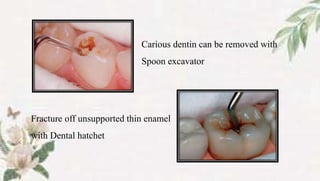
Carious dentin can be removed with
Spoon excavator
Fracture off unsupported thin enamel
with Dental hatchet
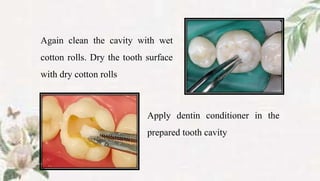
Again clean the cavity with wet
cotton rolls. Dry the tooth surface
with dry cotton rolls
Apply dentin conditioner in the
prepared tooth cavity
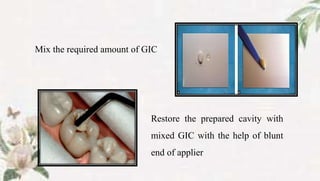
Mix the required amount of GIC
Restore the prepared cavity with
mixed GIC with the help of blunt
end of applier
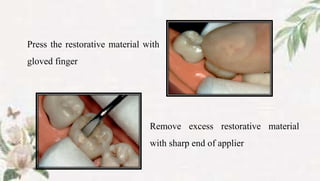
Press the restorative material with
gloved finger
Remove excess restorative material
with sharp end of applier
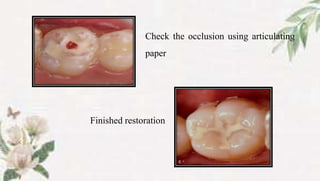
Finished restoration
Check the occlusion using articulating
paper
ADVANTAGES
1. Biological approach
2. Painless
3. Simplified infection control
4. No electrically driven and expensive dental equipment is needed
5. Technique is simple enough to train non-dental personnel or primary
health care workers
6. Cost effective
7. Friendly procedure
CONCLUSION
• ART is a combined preventive and curative oral care approach which
must be administered along with health promoting messages about diet,
hygiene, use of fluoride tooth paste.
• This approach is a good approach for the treatment in the remote areas
and for the special group of people.
ART - Atraumatic Restorative Treatment.pptx

ART - Atraumatic Restorative Treatment.pptx

  • 1.
  • 2.
    OBJECTIVES • Definition • Principles •Indications • Contraindications • Procedure • Advantages • Conclusion
  • 3.
    DEFINITION • ART isdefined as a minimally invasive care approach in preventing dental caries and stopping its further progression. - Jo E. Frencken, 2012
  • 4.
    PRINCIPLES 1. Removing carioustooth tissue using hand instruments only 2. Restoring the cavity with adhesive cements (Glass Ionomer)
  • 5.
    INDICATIONS • Only insmall cavities (involving dentin) • In those cavities that are accessible to hand instruments. • Public health programs
  • 6.
    CONTRA INDICATIONS • Presenceof swelling (abscess) or fistula (opening from abscess region to the oral cavity) near the carious tooth. • Pulp exposure • Chronic inflammation of the pulp with pain in the tooth
  • 7.
    • There isan obvious carious cavity, but the opening is inaccessible to hand instruments • There are clear signs of a cavity for example in a proximal surface, but the cavity cannot be entered from the proximal or the occlusal direction.
  • 8.
    Reasons for usinghand Instruments • With this technique, restorative care is made available to all population groups. • This technique is said to be tooth friendly as this conserves sound tooth tissues and causes less trauma to the teeth by requiring minimal cavity preparation. • Cost effective technique as this uses hand instruments in place of costly electrically driven dental equipment.
  • 9.
    • Use oflocal anesthesia for pain management is minimal there by reducing the psychological trauma to patients. • Hand instruments are easy clean and sterilize after every use, thus making infection control simplified
  • 10.
    Reasons for usingGIC • GIC sticks chemically both to enamel and dentine- the need to cut sound tooth tissue to prepare the cavity is reduced. • Fluoride is released from the restoration which will prevent and arrest caries. • Biocompatible cement as this restoration does not cause any irritation to pulp and gingiva, and has a co-efficient of thermal expansion similar to tooth structure.
  • 11.
  • 13.
    Operators work posture •Operator eye to patient tooth- 30 to 35 cms • Positions – Direct rear - 12 o’ clock Right rear – 10 o’clock position • Assistant head - 10 to 15 cms higher than operator
  • 14.
    Patient Position • Lyingon back on flat surface • Head rest- firm foam or rubber ring
  • 15.
    PROCEDURE Isolate the toothto be treated with cotton rolls Remove plaque from tooth surface with wet cotton wool pellets. Now, dry the tooth surface with dry cotton pellets.
  • 16.
    Carious dentin canbe removed with Spoon excavator Fracture off unsupported thin enamel with Dental hatchet
  • 17.
    Again clean thecavity with wet cotton rolls. Dry the tooth surface with dry cotton rolls Apply dentin conditioner in the prepared tooth cavity
  • 18.
    Mix the requiredamount of GIC Restore the prepared cavity with mixed GIC with the help of blunt end of applier
  • 19.
    Press the restorativematerial with gloved finger Remove excess restorative material with sharp end of applier
  • 20.
    Finished restoration Check theocclusion using articulating paper
  • 21.
    ADVANTAGES 1. Biological approach 2.Painless 3. Simplified infection control 4. No electrically driven and expensive dental equipment is needed 5. Technique is simple enough to train non-dental personnel or primary health care workers 6. Cost effective 7. Friendly procedure
  • 22.
    CONCLUSION • ART isa combined preventive and curative oral care approach which must be administered along with health promoting messages about diet, hygiene, use of fluoride tooth paste. • This approach is a good approach for the treatment in the remote areas and for the special group of people.