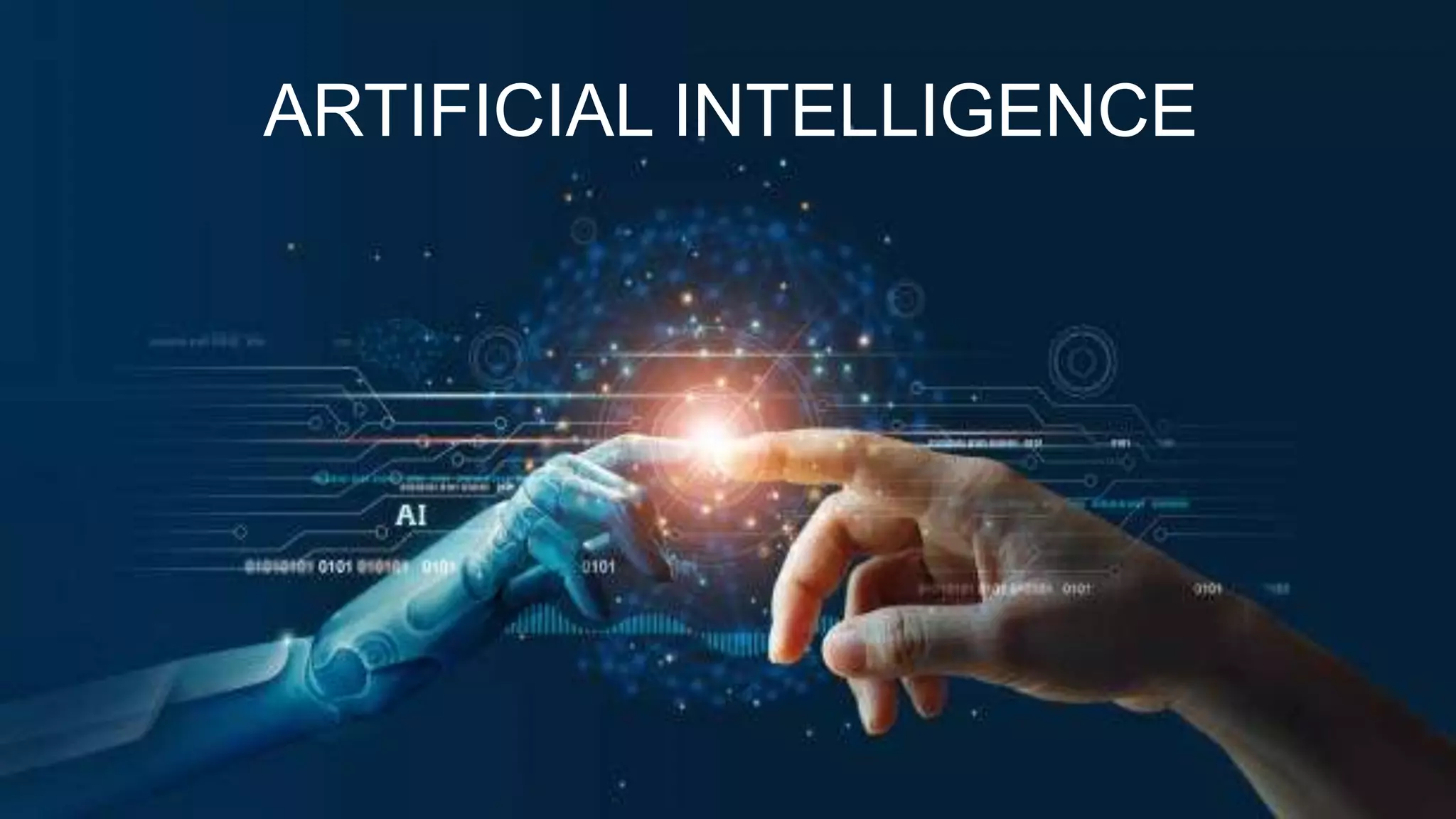
ARTIFICIAL INTELLIGENCE
Contents:
• Introduction
• History
• Definition
• Examples
• New Related Literature
• Advantage
• Disadvantage
• Summary
• Conclusion
• From way back people dreamed of machines being like humans, so they
can help them in different places of the life. Even before computers and
internet being so popular . One of the best examples is the Terminator
movie, that have made the robotic machine very powerful and clever to find
certain human beings and kill them. Then after that movie, many other
movies came and coming to reflect the idea of clever machinery or robots .
INTRODUCTION
HISTORY
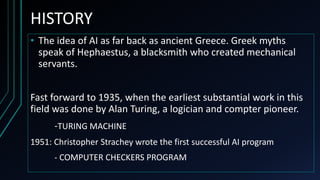
• The idea of AI as far back as ancient Greece. Greek myths
speak of Hephaestus, a blacksmith who created mechanical
servants.
Fast forward to 1935, when the earliest substantial work in this
field was done by Alan Turing, a logician and compter pioneer.
-TURING MACHINE
1951: Christopher Strachey wrote the first successful AI program
- COMPUTER CHECKERS PROGRAM
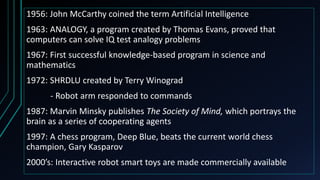
1956: John McCarthy coined the term Artificial Intelligence
1963: ANALOGY, a program created by Thomas Evans, proved that
computers can solve IQ test analogy problems
1967: First successful knowledge-based program in science and
mathematics
1972: SHRDLU created by Terry Winograd
- Robot arm responded to commands
1987: Marvin Minsky publishes The Society of Mind, which portrays the
brain as a series of cooperating agents
1997: A chess program, Deep Blue, beats the current world chess
champion, Gary Kasparov
2000’s: Interactive robot smart toys are made commercially available
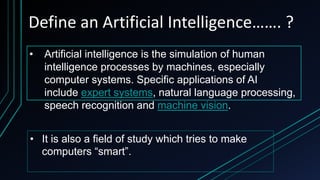
Define an Artificial Intelligence……. ?
• Artificial intelligence is the simulation of human
intelligence processes by machines, especially
computer systems. Specific applications of AI
include expert systems, natural language processing,
speech recognition and machine vision.
• It is also a field of study which tries to make
computers “smart”.
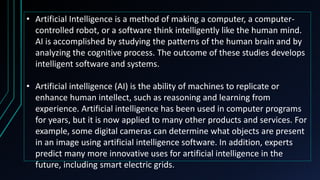
• Artificial Intelligence is a method of making a computer, a computer-
controlled robot, or a software think intelligently like the human mind.
AI is accomplished by studying the patterns of the human brain and by
analyzing the cognitive process. The outcome of these studies develops
intelligent software and systems.
• Artificial intelligence (AI) is the ability of machines to replicate or
enhance human intellect, such as reasoning and learning from
experience. Artificial intelligence has been used in computer programs
for years, but it is now applied to many other products and services. For
example, some digital cameras can determine what objects are present
in an image using artificial intelligence software. In addition, experts
predict many more innovative uses for artificial intelligence in the
future, including smart electric grids.
EXAMPLES
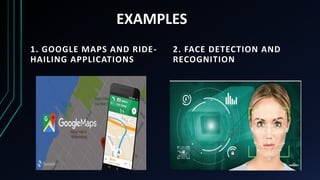
1. GOOGLE MAPS AND RIDE-
HAILING APPLICATIONS
2. FACE DETECTION AND
RECOGNITION
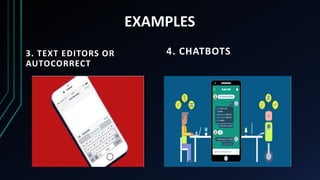
3. TEXT EDITORS OR
AUTOCORRECT
4. CHATBOTS
EXAMPLES
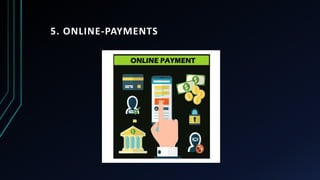
5. ONLINE-PAYMENTS
NEWS RELATED LITERATURE
1. Google AI breakthrough
2. Amazon uses AI to enforce social distancing in its
warehouse.
3. AI is making it easier to diagnose Alzheimer’s before
symptoms emerge.
4. AI-powered robots are helping to fight the pandemic.
5. Facebook AI develops system to see objects in photos for
visually impaired.
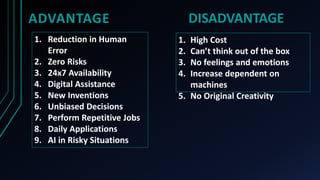
ADVANTAGE
1. Reduction in Human
Error
2. Zero Risks
3. 24x7 Availability
4. Digital Assistance
5. New Inventions
6. Unbiased Decisions
7. Perform Repetitive Jobs
8. Daily Applications
9. AI in Risky Situations
DISADVANTAGE
1. High Cost
2. Can’t think out of the box
3. No feelings and emotions
4. Increase dependent on
machines
5. No Original Creativity
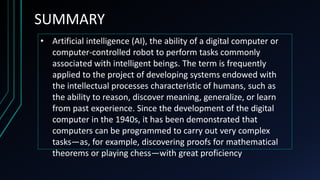
SUMMARY
• Artificial intelligence (AI), the ability of a digital computer or
computer-controlled robot to perform tasks commonly
associated with intelligent beings. The term is frequently
applied to the project of developing systems endowed with
the intellectual processes characteristic of humans, such as
the ability to reason, discover meaning, generalize, or learn
from past experience. Since the development of the digital
computer in the 1940s, it has been demonstrated that
computers can be programmed to carry out very complex
tasks—as, for example, discovering proofs for mathematical
theorems or playing chess—with great proficiency
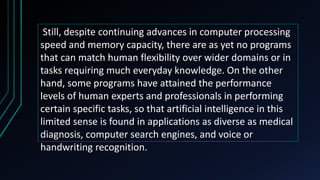
Still, despite continuing advances in computer processing
speed and memory capacity, there are as yet no programs
that can match human flexibility over wider domains or in
tasks requiring much everyday knowledge. On the other
hand, some programs have attained the performance
levels of human experts and professionals in performing
certain specific tasks, so that artificial intelligence in this
limited sense is found in applications as diverse as medical
diagnosis, computer search engines, and voice or
handwriting recognition.
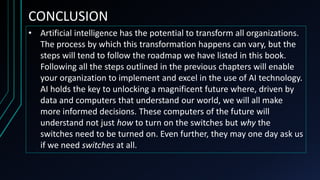
CONCLUSION
• Artificial intelligence has the potential to transform all organizations.
The process by which this transformation happens can vary, but the
steps will tend to follow the roadmap we have listed in this book.
Following all the steps outlined in the previous chapters will enable
your organization to implement and excel in the use of AI technology.
AI holds the key to unlocking a magnificent future where, driven by
data and computers that understand our world, we will all make
more informed decisions. These computers of the future will
understand not just how to turn on the switches but why the
switches need to be turned on. Even further, they may one day ask us
if we need switches at all.
• Although AI cannot solve all your organization's problems, it
has the potential to completely change how business is done. It
affects every sector, from manufacturing to finance, bringing
about never before seen increases in efficiency. As more
industries adopt and start experimenting with this technology,
newer applications will be invented. AI will bring a change even
more widespread and sweeping than the introduction of
computing devices. It will change the way we transact, get
diagnosed, perform surgeries, and drive our cars. It is already
changing industrial processes, medical imaging, financial
modeling, and computer vision. We are well on our way to
tapping into this enormous potential, and as a result, the future
holds better decision-making potential and faster
https://www.geeksforgeeks.org/advantages-and-disadvantage-of-artificial-
intelligence/
https://www.techtarget.com/searchenterpriseai/definition/AI-Artificial-Intelligence
https://www.investopedia.com/terms/a/artificial-intelligence-ai.asp
https://www.slideshare.net/AnushkaGhosh5/ppt-presentation-on-artificial-
intelligence
https://www.slideshare.net/AnushkaGhosh5/power-point-presentation-on-artificial-
intelligence
https://www.slideshare.net/vikaschandrayadav/artificial-intelligence-ppt-61739696
https://www.oreilly.com/library/view/artificial-intelligence-
for/9781119651734/c08.xhtml
https://sites.google.com/a/cas.edu.om/ai/conclusion
REFERENCES:

ARTIFICIAL INTELLIGENCE.pptx

  • 1.
  • 2.
    Contents: • Introduction • History •Definition • Examples • New Related Literature • Advantage • Disadvantage • Summary • Conclusion
  • 3.
    • From wayback people dreamed of machines being like humans, so they can help them in different places of the life. Even before computers and internet being so popular . One of the best examples is the Terminator movie, that have made the robotic machine very powerful and clever to find certain human beings and kill them. Then after that movie, many other movies came and coming to reflect the idea of clever machinery or robots . INTRODUCTION
  • 4.
    HISTORY • The ideaof AI as far back as ancient Greece. Greek myths speak of Hephaestus, a blacksmith who created mechanical servants. Fast forward to 1935, when the earliest substantial work in this field was done by Alan Turing, a logician and compter pioneer. -TURING MACHINE 1951: Christopher Strachey wrote the first successful AI program - COMPUTER CHECKERS PROGRAM
  • 5.
    1956: John McCarthycoined the term Artificial Intelligence 1963: ANALOGY, a program created by Thomas Evans, proved that computers can solve IQ test analogy problems 1967: First successful knowledge-based program in science and mathematics 1972: SHRDLU created by Terry Winograd - Robot arm responded to commands 1987: Marvin Minsky publishes The Society of Mind, which portrays the brain as a series of cooperating agents 1997: A chess program, Deep Blue, beats the current world chess champion, Gary Kasparov 2000’s: Interactive robot smart toys are made commercially available
  • 6.
    Define an ArtificialIntelligence……. ? • Artificial intelligence is the simulation of human intelligence processes by machines, especially computer systems. Specific applications of AI include expert systems, natural language processing, speech recognition and machine vision. • It is also a field of study which tries to make computers “smart”.
  • 7.
    • Artificial Intelligenceis a method of making a computer, a computer- controlled robot, or a software think intelligently like the human mind. AI is accomplished by studying the patterns of the human brain and by analyzing the cognitive process. The outcome of these studies develops intelligent software and systems. • Artificial intelligence (AI) is the ability of machines to replicate or enhance human intellect, such as reasoning and learning from experience. Artificial intelligence has been used in computer programs for years, but it is now applied to many other products and services. For example, some digital cameras can determine what objects are present in an image using artificial intelligence software. In addition, experts predict many more innovative uses for artificial intelligence in the future, including smart electric grids.
  • 8.
    EXAMPLES 1. GOOGLE MAPSAND RIDE- HAILING APPLICATIONS 2. FACE DETECTION AND RECOGNITION
  • 9.
    3. TEXT EDITORSOR AUTOCORRECT 4. CHATBOTS EXAMPLES
  • 10.
  • 11.
    NEWS RELATED LITERATURE 1.Google AI breakthrough 2. Amazon uses AI to enforce social distancing in its warehouse. 3. AI is making it easier to diagnose Alzheimer’s before symptoms emerge. 4. AI-powered robots are helping to fight the pandemic. 5. Facebook AI develops system to see objects in photos for visually impaired.
  • 12.
    ADVANTAGE 1. Reduction inHuman Error 2. Zero Risks 3. 24x7 Availability 4. Digital Assistance 5. New Inventions 6. Unbiased Decisions 7. Perform Repetitive Jobs 8. Daily Applications 9. AI in Risky Situations DISADVANTAGE 1. High Cost 2. Can’t think out of the box 3. No feelings and emotions 4. Increase dependent on machines 5. No Original Creativity
  • 13.
    SUMMARY • Artificial intelligence(AI), the ability of a digital computer or computer-controlled robot to perform tasks commonly associated with intelligent beings. The term is frequently applied to the project of developing systems endowed with the intellectual processes characteristic of humans, such as the ability to reason, discover meaning, generalize, or learn from past experience. Since the development of the digital computer in the 1940s, it has been demonstrated that computers can be programmed to carry out very complex tasks—as, for example, discovering proofs for mathematical theorems or playing chess—with great proficiency
  • 14.
    Still, despite continuingadvances in computer processing speed and memory capacity, there are as yet no programs that can match human flexibility over wider domains or in tasks requiring much everyday knowledge. On the other hand, some programs have attained the performance levels of human experts and professionals in performing certain specific tasks, so that artificial intelligence in this limited sense is found in applications as diverse as medical diagnosis, computer search engines, and voice or handwriting recognition.
  • 15.
    CONCLUSION • Artificial intelligencehas the potential to transform all organizations. The process by which this transformation happens can vary, but the steps will tend to follow the roadmap we have listed in this book. Following all the steps outlined in the previous chapters will enable your organization to implement and excel in the use of AI technology. AI holds the key to unlocking a magnificent future where, driven by data and computers that understand our world, we will all make more informed decisions. These computers of the future will understand not just how to turn on the switches but why the switches need to be turned on. Even further, they may one day ask us if we need switches at all.
  • 16.
    • Although AIcannot solve all your organization's problems, it has the potential to completely change how business is done. It affects every sector, from manufacturing to finance, bringing about never before seen increases in efficiency. As more industries adopt and start experimenting with this technology, newer applications will be invented. AI will bring a change even more widespread and sweeping than the introduction of computing devices. It will change the way we transact, get diagnosed, perform surgeries, and drive our cars. It is already changing industrial processes, medical imaging, financial modeling, and computer vision. We are well on our way to tapping into this enormous potential, and as a result, the future holds better decision-making potential and faster
  • 17.