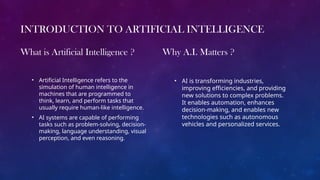
INTRODUCTION TO ARTIFICIALINTELLIGENCE
• Artificial Intelligence refers to the
simulation of human intelligence in
machines that are programmed to
think, learn, and perform tasks that
usually require human-like intelligence.
• AI systems are capable of performing
tasks such as problem-solving, decision-
making, language understanding, visual
perception, and even reasoning.
• AI is transforming industries,
improving efficiencies, and providing
new solutions to complex problems.
It enables automation, enhances
decision-making, and enables new
technologies such as autonomous
vehicles and personalized services.
What is Artificial Intelligence ? Why A.I. Matters ?
3.
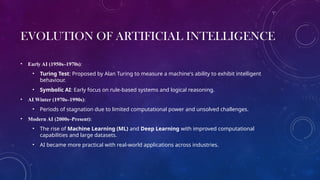
EVOLUTION OF ARTIFICIALINTELLIGENCE
• Early AI (1950s–1970s):
• Turing Test: Proposed by Alan Turing to measure a machine's ability to exhibit intelligent
behaviour.
• Symbolic AI: Early focus on rule-based systems and logical reasoning.
• AI Winter (1970s–1990s):
• Periods of stagnation due to limited computational power and unsolved challenges.
• Modern AI (2000s–Present):
• The rise of Machine Learning (ML) and Deep Learning with improved computational
capabilities and large datasets.
• AI became more practical with real-world applications across industries.
4.
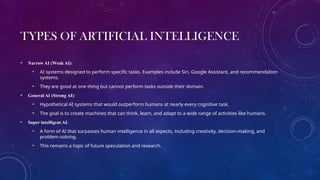
TYPES OF ARTIFICIALINTELLIGENCE
• Narrow AI (Weak AI):
• AI systems designed to perform specific tasks. Examples include Siri, Google Assistant, and recommendation
systems.
• They are good at one thing but cannot perform tasks outside their domain.
• General AI (Strong AI):
• Hypothetical AI systems that would outperform humans at nearly every cognitive task.
• The goal is to create machines that can think, learn, and adapt to a wide range of activities like humans.
• Super intelligent AI:
• A form of AI that surpasses human intelligence in all aspects, including creativity, decision-making, and
problem-solving.
• This remains a topic of future speculation and research.
5.
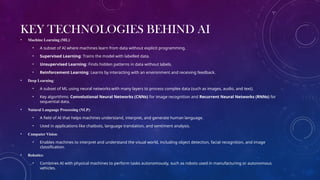
KEY TECHNOLOGIES BEHINDAI
• Machine Learning (ML):
• A subset of AI where machines learn from data without explicit programming.
• Supervised Learning: Trains the model with labelled data.
• Unsupervised Learning: Finds hidden patterns in data without labels.
• Reinforcement Learning: Learns by interacting with an environment and receiving feedback.
• Deep Learning:
• A subset of ML using neural networks with many layers to process complex data (such as images, audio, and text).
• Key algorithms: Convolutional Neural Networks (CNNs) for image recognition and Recurrent Neural Networks (RNNs) for
sequential data.
• Natural Language Processing (NLP):
• A field of AI that helps machines understand, interpret, and generate human language.
• Used in applications like chatbots, language translation, and sentiment analysis.
• Computer Vision:
• Enables machines to interpret and understand the visual world, including object detection, facial recognition, and image
classification.
• Robotics:
• Combines AI with physical machines to perform tasks autonomously, such as robots used in manufacturing or autonomous
vehicles.
6.
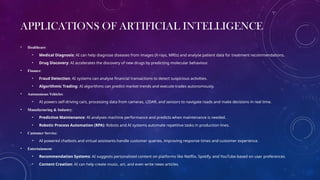
APPLICATIONS OF ARTIFICIALINTELLIGENCE
• Healthcare:
• Medical Diagnosis: AI can help diagnose diseases from images (X-rays, MRIs) and analyse patient data for treatment recommendations.
• Drug Discovery: AI accelerates the discovery of new drugs by predicting molecular behaviour.
• Finance:
• Fraud Detection: AI systems can analyse financial transactions to detect suspicious activities.
• Algorithmic Trading: AI algorithms can predict market trends and execute trades autonomously.
• Autonomous Vehicles:
• AI powers self-driving cars, processing data from cameras, LIDAR, and sensors to navigate roads and make decisions in real time.
• Manufacturing & Industry:
• Predictive Maintenance: AI analyses machine performance and predicts when maintenance is needed.
• Robotic Process Automation (RPA): Robots and AI systems automate repetitive tasks in production lines.
• Customer Service:
• AI-powered chatbots and virtual assistants handle customer queries, improving response times and customer experience.
• Entertainment:
• Recommendation Systems: AI suggests personalized content on platforms like Netflix, Spotify, and YouTube based on user preferences.
• Content Creation: AI can help create music, art, and even write news articles.
7.
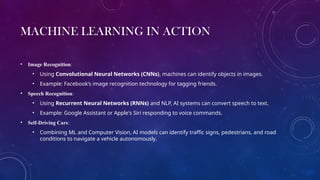
MACHINE LEARNING INACTION
• Image Recognition:
• Using Convolutional Neural Networks (CNNs), machines can identify objects in images.
• Example: Facebook’s image recognition technology for tagging friends.
• Speech Recognition:
• Using Recurrent Neural Networks (RNNs) and NLP, AI systems can convert speech to text.
• Example: Google Assistant or Apple's Siri responding to voice commands.
• Self-Driving Cars:
• Combining ML and Computer Vision, AI models can identify traffic signs, pedestrians, and road
conditions to navigate a vehicle autonomously.
8.
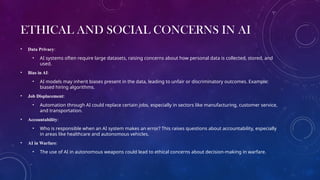
ETHICAL AND SOCIALCONCERNS IN AI
• Data Privacy:
• AI systems often require large datasets, raising concerns about how personal data is collected, stored, and
used.
• Bias in AI:
• AI models may inherit biases present in the data, leading to unfair or discriminatory outcomes. Example:
biased hiring algorithms.
• Job Displacement:
• Automation through AI could replace certain jobs, especially in sectors like manufacturing, customer service,
and transportation.
• Accountability:
• Who is responsible when an AI system makes an error? This raises questions about accountability, especially
in areas like healthcare and autonomous vehicles.
• AI in Warfare:
• The use of AI in autonomous weapons could lead to ethical concerns about decision-making in warfare.
9.
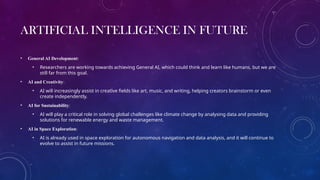
ARTIFICIAL INTELLIGENCE INFUTURE
• General AI Development:
• Researchers are working towards achieving General AI, which could think and learn like humans, but we are
still far from this goal.
• AI and Creativity:
• AI will increasingly assist in creative fields like art, music, and writing, helping creators brainstorm or even
create independently.
• AI for Sustainability:
• AI will play a critical role in solving global challenges like climate change by analysing data and providing
solutions for renewable energy and waste management.
• AI in Space Exploration:
• AI is already used in space exploration for autonomous navigation and data analysis, and it will continue to
evolve to assist in future missions.
10.
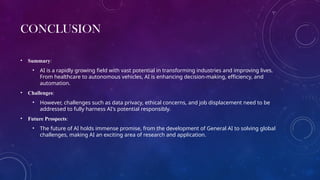
CONCLUSION
• Summary:
• AIis a rapidly growing field with vast potential in transforming industries and improving lives.
From healthcare to autonomous vehicles, AI is enhancing decision-making, efficiency, and
automation.
• Challenges:
• However, challenges such as data privacy, ethical concerns, and job displacement need to be
addressed to fully harness AI's potential responsibly.
• Future Prospects:
• The future of AI holds immense promise, from the development of General AI to solving global
challenges, making AI an exciting area of research and application.
11.
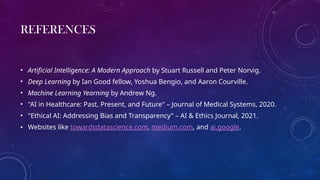
REFERENCES
• Artificial Intelligence:A Modern Approach by Stuart Russell and Peter Norvig.
• Deep Learning by Ian Good fellow, Yoshua Bengio, and Aaron Courville.
• Machine Learning Yearning by Andrew Ng.
• "AI in Healthcare: Past, Present, and Future" – Journal of Medical Systems, 2020.
• "Ethical AI: Addressing Bias and Transparency" – AI & Ethics Journal, 2021.
• Websites like towardsdatascience.com, medium.com, and ai.google.



![AI_presentation_AICT[1] [Read-Only].pptx](https://cdn.slidesharecdn.com/ss_thumbnails/aipresentationaict1read-only-250905174825-38ac6625-thumbnail.jpg?width=640&height=640&fit=bounds)
![AI_presentation_AICT[1] [Read-Only].pptx](https://cdn.slidesharecdn.com/ss_thumbnails/aipresentationaict1read-only-250905174916-d5ef4934-thumbnail.jpg?width=640&height=640&fit=bounds)
![AI_presentation_AICT[1] [Read-Only].pptx](https://cdn.slidesharecdn.com/ss_thumbnails/aipresentationaict1read-only-250905175118-16902bff-thumbnail.jpg?width=640&height=640&fit=bounds)


![Download Chimera Tool Setup V42.47.0924 [Latest Version]](https://cdn.slidesharecdn.com/ss_thumbnails/artificialintelligence4-250505221011-8e660a4e-thumbnail.jpg?width=640&height=640&fit=bounds)


![Getting Started with Apache Spark: Big Data Made Simple [Free Meetup]](https://cdn.slidesharecdn.com/ss_thumbnails/apachesparkgettingstarted-260203175547-8361bcc3-thumbnail.jpg?width=640&height=640&fit=bounds)


