Artificial
intelligence
Done by:
Tafool
Atsloom
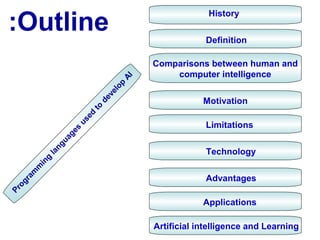
Outline:
History
Definition
Motivation
Limitations
Technology
Advantages
Applications
Comparisons between human and
computer intelligence
Artificial intelligence and Learning
Program
m
ing
languages
used
to
develop
AI
History
"machines will be capable, within 20 years, of
doing any work a man can do." Two years later,
MIT researcher Marvin Minsky predicted, "Within
a generation ... the problem of creating 'artificial
intelligence' will substantially be solved."
(artificial intelligence innovator Herbert
Simon.1965)
Definition
• Artificial intelligence (AI) is the intelligence of
machines and the branch of computer science
which aims to create it
• Artificial intelligence (AI) is the intelligence of
machines and the branch of computer science
which aims to create it
Comparisons between human and computer
intelligence
Normal humans have the same intellectual mechanisms and
that differences in intelligence are related to ``quantitative
biochemical and physiological conditions' , but computer
programs have plenty of speed and memory but their abilities
correspond to the intellectual mechanisms that program
designers understand well enough to put in programs.
Whenever people do better than computers on some task or
computers use a lot of computation to do as well as people,
this demonstrates that the program designers lack
understanding of the intellectual mechanisms required to do
the task efficiently.
Motivation
Why Artificial Intelligence?
• Computers are fundamentally well suited to performing
mechanical computations, using fixed programmed rules.
• Artificial machines perform simple monotonous tasks
efficiently and reliably, which humans are ill-suited to.
• For more complex problems, things get more difficult... Unlike
humans, computers have trouble understanding specific
situations, and adapting to new situations.
• Artificial Intelligence aims to improve machine behavior in
tackling such complex tasks.
Cont, Motivation
• Humans have an interesting approach to problem-
solving, based on abstract thought, high-level
deliberative reasoning and pattern recognition.
• AI research is allowing us to understand our intelligent
behavior.
• Artificial Intelligence can help us understand this
process by recreating it, then potentially enabling us to
enhance it beyond our current capabilities.
Limitations
• When will Computers become truly intelligent?
• To date, all the traits of human intelligence have not been
captured and applied together to spawn an intelligent
artificial creature.
• Currently, Artificial Intelligence rather seems to focus on
lucrative domain specific applications, which do not
necessarily require the full extent of AI capabilities.
• There is little doubt among the community that artificial
machines will be capable of intelligent thought in the near
future.
Technology
• How does Artificial Intelligence work?
• There are many different approaches to Artificial Intelligence.
Some are obviously more suited than others in some cases.
• Over the past five decades, AI research has mostly been
focusing on solving specific problems. Numerous solutions
have been devised and improved to do so efficiently and
reliably.
• This explains why the field of Artificial Intelligence is split into
many branches, ranging from Pattern Recognition to Artificial
Life, including Evolutionary Computation and Planning.
Advantage
• it can help improve our way of life
• machines will be able to do jobs that require detailed
instructions
• mental alertness and decision making capabilities
• use robots for heavy construction, military benefits, or even
for personal assistance at private homes
• there will be less injuries and stress to human beings
• Many of our health problems now have possible solutions
with the use of Artificial Intelligence in studies at universities
•scientists have been using AI to test theories and notions
about how our brains work
•AI opens up new and exciting avenues for entertainment
possibilities.
• AI also makes interactive electronic games more fun by
making the computer controlled characters more realistic
and human-like.
Cont, Advantage
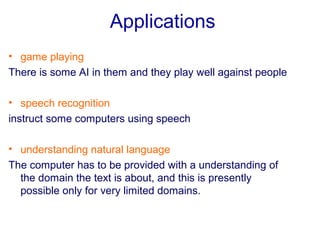
Applications
• game playing
There is some AI in them and they play well against people
• speech recognition
instruct some computers using speech
• understanding natural language
The computer has to be provided with a understanding of
the domain the text is about, and this is presently
possible only for very limited domains.
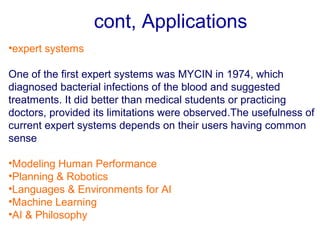
cont, Applications
•expert systems
One of the first expert systems was MYCIN in 1974, which
diagnosed bacterial infections of the blood and suggested
treatments. It did better than medical students or practicing
doctors, provided its limitations were observed.The usefulness of
current expert systems depends on their users having common
sense
•Modeling Human Performance
•Planning & Robotics
•Languages & Environments for AI
•Machine Learning
•AI & Philosophy
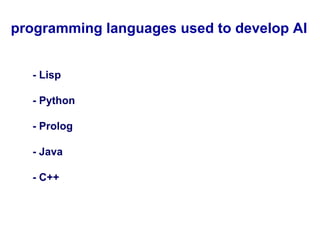
- Lisp
- Python
- Prolog
- Java
- C++
programming languages used to develop AI
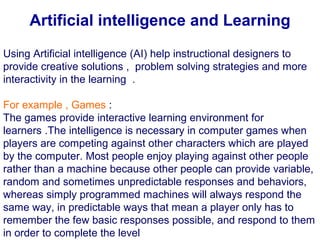
Using Artificial intelligence (AI) help instructional designers to
provide creative solutions , problem solving strategies and more
interactivity in the learning .
For example , Games :
The games provide interactive learning environment for
learners .The intelligence is necessary in computer games when
players are competing against other characters which are played
by the computer. Most people enjoy playing against other people
rather than a machine because other people can provide variable,
random and sometimes unpredictable responses and behaviors,
whereas simply programmed machines will always respond the
same way, in predictable ways that mean a player only has to
remember the few basic responses possible, and respond to them
in order to complete the level
Artificial intelligence and Learning
• ref:
• http://machineslikeus.com/news/whatever-
happened-artificial-intelligence
• http://en.wikipedia.org/wiki/
Artificial_intelligence
• http://www.6moo7.com/VB/showthread.
php?t=18346
Reference:

arti-ficial-inte-lligence

  • 1.
  • 2.
    Outline: History Definition Motivation Limitations Technology Advantages Applications Comparisons between humanand computer intelligence Artificial intelligence and Learning Program m ing languages used to develop AI
  • 3.
    History "machines will becapable, within 20 years, of doing any work a man can do." Two years later, MIT researcher Marvin Minsky predicted, "Within a generation ... the problem of creating 'artificial intelligence' will substantially be solved." (artificial intelligence innovator Herbert Simon.1965)
  • 4.
    Definition • Artificial intelligence(AI) is the intelligence of machines and the branch of computer science which aims to create it • Artificial intelligence (AI) is the intelligence of machines and the branch of computer science which aims to create it
  • 5.
    Comparisons between humanand computer intelligence Normal humans have the same intellectual mechanisms and that differences in intelligence are related to ``quantitative biochemical and physiological conditions' , but computer programs have plenty of speed and memory but their abilities correspond to the intellectual mechanisms that program designers understand well enough to put in programs. Whenever people do better than computers on some task or computers use a lot of computation to do as well as people, this demonstrates that the program designers lack understanding of the intellectual mechanisms required to do the task efficiently.
  • 6.
    Motivation Why Artificial Intelligence? •Computers are fundamentally well suited to performing mechanical computations, using fixed programmed rules. • Artificial machines perform simple monotonous tasks efficiently and reliably, which humans are ill-suited to. • For more complex problems, things get more difficult... Unlike humans, computers have trouble understanding specific situations, and adapting to new situations. • Artificial Intelligence aims to improve machine behavior in tackling such complex tasks.
  • 7.
    Cont, Motivation • Humanshave an interesting approach to problem- solving, based on abstract thought, high-level deliberative reasoning and pattern recognition. • AI research is allowing us to understand our intelligent behavior. • Artificial Intelligence can help us understand this process by recreating it, then potentially enabling us to enhance it beyond our current capabilities.
  • 8.
    Limitations • When willComputers become truly intelligent? • To date, all the traits of human intelligence have not been captured and applied together to spawn an intelligent artificial creature. • Currently, Artificial Intelligence rather seems to focus on lucrative domain specific applications, which do not necessarily require the full extent of AI capabilities. • There is little doubt among the community that artificial machines will be capable of intelligent thought in the near future.
  • 9.
    Technology • How doesArtificial Intelligence work? • There are many different approaches to Artificial Intelligence. Some are obviously more suited than others in some cases. • Over the past five decades, AI research has mostly been focusing on solving specific problems. Numerous solutions have been devised and improved to do so efficiently and reliably. • This explains why the field of Artificial Intelligence is split into many branches, ranging from Pattern Recognition to Artificial Life, including Evolutionary Computation and Planning.
  • 10.
    Advantage • it canhelp improve our way of life • machines will be able to do jobs that require detailed instructions • mental alertness and decision making capabilities • use robots for heavy construction, military benefits, or even for personal assistance at private homes • there will be less injuries and stress to human beings • Many of our health problems now have possible solutions with the use of Artificial Intelligence in studies at universities
  • 11.
    •scientists have beenusing AI to test theories and notions about how our brains work •AI opens up new and exciting avenues for entertainment possibilities. • AI also makes interactive electronic games more fun by making the computer controlled characters more realistic and human-like. Cont, Advantage
  • 12.
    Applications • game playing Thereis some AI in them and they play well against people • speech recognition instruct some computers using speech • understanding natural language The computer has to be provided with a understanding of the domain the text is about, and this is presently possible only for very limited domains.
  • 13.
    cont, Applications •expert systems Oneof the first expert systems was MYCIN in 1974, which diagnosed bacterial infections of the blood and suggested treatments. It did better than medical students or practicing doctors, provided its limitations were observed.The usefulness of current expert systems depends on their users having common sense •Modeling Human Performance •Planning & Robotics •Languages & Environments for AI •Machine Learning •AI & Philosophy
  • 14.
    - Lisp - Python -Prolog - Java - C++ programming languages used to develop AI
  • 15.
    Using Artificial intelligence(AI) help instructional designers to provide creative solutions , problem solving strategies and more interactivity in the learning . For example , Games : The games provide interactive learning environment for learners .The intelligence is necessary in computer games when players are competing against other characters which are played by the computer. Most people enjoy playing against other people rather than a machine because other people can provide variable, random and sometimes unpredictable responses and behaviors, whereas simply programmed machines will always respond the same way, in predictable ways that mean a player only has to remember the few basic responses possible, and respond to them in order to complete the level Artificial intelligence and Learning
  • 16.
    • ref: • http://machineslikeus.com/news/whatever- happened-artificial-intelligence •http://en.wikipedia.org/wiki/ Artificial_intelligence • http://www.6moo7.com/VB/showthread. php?t=18346 Reference: