ARTIFICIAL
INTELLIGENCE
~ MIDHUN
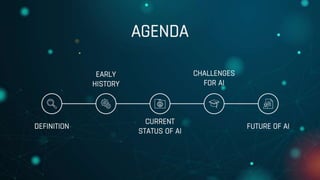
AGENDA
EARLY
HISTORY
CHALLENGES
FOR AI
DEFINITION FUTURE OF AI
CURRENT
STATUS OF AI
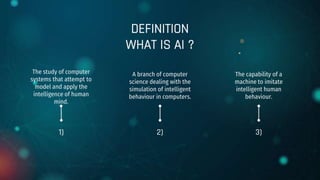
DEFINITION
WHAT IS AI ?
The study of computer
systems that attempt to
model and apply the
intelligence of human
mind.
The capability of a
machine to imitate
intelligent human
behaviour.
A branch of computer
science dealing with the
simulation of intelligent
behaviour in computers.
1) 3)
2)
“THE MEASURE OF
INTELLIGENCE IS
THE ABILITY TO
CHANGE.”
EARLY
HISTORY
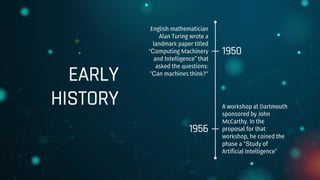
English mathematician
Alan Turing wrote a
landmark paper titled
“Computing Machinery
and Intelligence” that
asked the questions:
“Can machines think?”
1950
A workshop at Dartmouth
sponsored by John
McCarthy. In the
proposal for that
workshop, he coined the
phase a “Study of
Artificial Intelligence”
1956
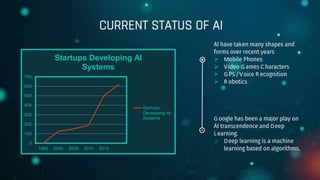
CURRENT STATUS OF AI
AI have taken many shapes and
forms over recent years
 Mobile Phones
 Video Games C haracters
 GPS /Voice R ecognition
 R obotics
Google has been a major play on
AI transcendence and Deep
Learning.
o Deep learning is a machine
learning based on algorithms.
0
100
200
300
400
500
600
700
1995 2000 2005 2010 2015
Startups Developing AI
Systems
Startups
Developing AI
Systems
CHALLENGES
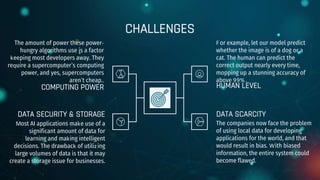
The amount of power these power-
hungry algorithms use is a factor
keeping most developers away. They
require a supercomputer’s computing
power, and yes, supercomputers
aren’t cheap..
For example, let our model predict
whether the image is of a dog or a
cat. The human can predict the
correct output nearly every time,
mopping up a stunning accuracy of
above 99% .
Most AI applications make use of a
significant amount of data for
learning and making intelligent
decisions. The drawback of utilizing
large volumes of data is that it may
create a storage issue for businesses.
The companies now face the problem
of using local data for developing
applications for the world, and that
would result in bias. With biased
information, the entire system could
become flawed.
COMPUTING POWER HUMAN LEVEL
DATA SECURITY & STORAGE DATA SCARCITY
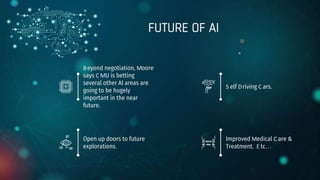
Beyond negotiation, Moore
says C MU is betting
several other AI areas are
going to be hugely
important in the near
future.
S elf Driving C ars.
Open up doors to future
explorations.
Improved Medical C are &
Treatment. E tc…
FUTURE OF AI
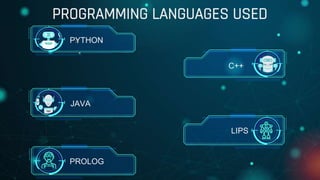
PYTHON
C++
JAVA
LIPS
PROGRAMMING LANGUAGES USED
PROLOG
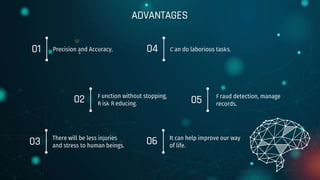
Precision and Accuracy. C an do laborious tasks.
Function without stopping,
R isk R educing.
Fraud detection, manage
records.
02
01
05
04
ADVANTAGES
There will be less injuries
and stress to human beings.
It can help improve our way
of life.
03 06
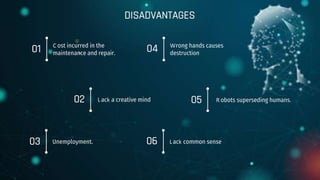
C ost incurred in the
maintenance and repair.
Wrong hands causes
destruction
Lack a creative mind R obots superseding humans.
02
01
05
04
DISADVANTAGES
Unemployment. Lack common sense
03 06
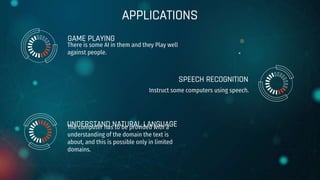
APPLICATIONS
GAME PLAYING
There is some AI in them and they Play well
against people.
SPEECH RECOGNITION
Instruct some computers using speech.
UNDERSTAND NATURAL LANGUAGE
The computer has to be provided with a
understanding of the domain the text is
about, and this is possible only in limited
domains.
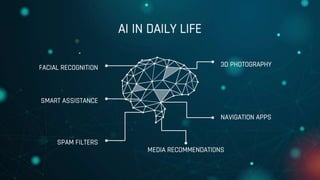
AI IN DAILY LIFE
NAVIGATION APPS
3D PHOTOGRAPHY
FACIAL RECOGNITION
SMART ASSISTANCE
SPAM FILTERS
MEDIA RECOMMENDATIONS
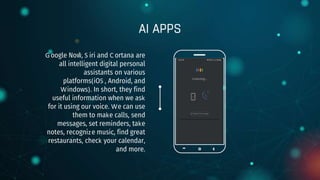
AI APPS
Google Now, S iri and C ortana are
all intelligent digital personal
assistants on various
platforms(iOS , Android, and
Windows). In short, they find
useful information when we ask
for it using our voice. We can use
them to make calls, send
messages, set reminders, take
notes, recognize music, find great
restaurants, check your calendar,
and more.
CONCLUSION
F inally, AI is at the centre of a new enterprise to build computational models
of intelligence. The main assumption is that intelligence (human or
otherwise) can be represented in terms of symbol structures and symbolic
operations which can be programmed in a digital computer.
“THE TRUE SIGN OF
INTELLIGENCE IS
NOT KNOWLEDGE
BUT IMAGINATION"
THANK YOU

Artificial Intelligence

  • 1.
  • 2.
  • 3.
    DEFINITION WHAT IS AI? The study of computer systems that attempt to model and apply the intelligence of human mind. The capability of a machine to imitate intelligent human behaviour. A branch of computer science dealing with the simulation of intelligent behaviour in computers. 1) 3) 2)
  • 4.
    “THE MEASURE OF INTELLIGENCEIS THE ABILITY TO CHANGE.”
  • 5.
    EARLY HISTORY English mathematician Alan Turingwrote a landmark paper titled “Computing Machinery and Intelligence” that asked the questions: “Can machines think?” 1950 A workshop at Dartmouth sponsored by John McCarthy. In the proposal for that workshop, he coined the phase a “Study of Artificial Intelligence” 1956
  • 6.
    CURRENT STATUS OFAI AI have taken many shapes and forms over recent years  Mobile Phones  Video Games C haracters  GPS /Voice R ecognition  R obotics Google has been a major play on AI transcendence and Deep Learning. o Deep learning is a machine learning based on algorithms. 0 100 200 300 400 500 600 700 1995 2000 2005 2010 2015 Startups Developing AI Systems Startups Developing AI Systems
  • 7.
    CHALLENGES The amount ofpower these power- hungry algorithms use is a factor keeping most developers away. They require a supercomputer’s computing power, and yes, supercomputers aren’t cheap.. For example, let our model predict whether the image is of a dog or a cat. The human can predict the correct output nearly every time, mopping up a stunning accuracy of above 99% . Most AI applications make use of a significant amount of data for learning and making intelligent decisions. The drawback of utilizing large volumes of data is that it may create a storage issue for businesses. The companies now face the problem of using local data for developing applications for the world, and that would result in bias. With biased information, the entire system could become flawed. COMPUTING POWER HUMAN LEVEL DATA SECURITY & STORAGE DATA SCARCITY
  • 8.
    Beyond negotiation, Moore saysC MU is betting several other AI areas are going to be hugely important in the near future. S elf Driving C ars. Open up doors to future explorations. Improved Medical C are & Treatment. E tc… FUTURE OF AI
  • 9.
  • 10.
    Precision and Accuracy.C an do laborious tasks. Function without stopping, R isk R educing. Fraud detection, manage records. 02 01 05 04 ADVANTAGES There will be less injuries and stress to human beings. It can help improve our way of life. 03 06
  • 12.
    C ost incurredin the maintenance and repair. Wrong hands causes destruction Lack a creative mind R obots superseding humans. 02 01 05 04 DISADVANTAGES Unemployment. Lack common sense 03 06
  • 14.
    APPLICATIONS GAME PLAYING There issome AI in them and they Play well against people. SPEECH RECOGNITION Instruct some computers using speech. UNDERSTAND NATURAL LANGUAGE The computer has to be provided with a understanding of the domain the text is about, and this is possible only in limited domains.
  • 15.
    AI IN DAILYLIFE NAVIGATION APPS 3D PHOTOGRAPHY FACIAL RECOGNITION SMART ASSISTANCE SPAM FILTERS MEDIA RECOMMENDATIONS
  • 16.
    AI APPS Google Now,S iri and C ortana are all intelligent digital personal assistants on various platforms(iOS , Android, and Windows). In short, they find useful information when we ask for it using our voice. We can use them to make calls, send messages, set reminders, take notes, recognize music, find great restaurants, check your calendar, and more.
  • 17.
    CONCLUSION F inally, AIis at the centre of a new enterprise to build computational models of intelligence. The main assumption is that intelligence (human or otherwise) can be represented in terms of symbol structures and symbolic operations which can be programmed in a digital computer.
  • 18.
    “THE TRUE SIGNOF INTELLIGENCE IS NOT KNOWLEDGE BUT IMAGINATION"
  • 19.