COGNITIVE PSYCHOLOGY
►KNOWLEDGE REPRESENTATION
►REPRESENATION OF DECLARATIVE
KNOWLEDGE
► B
Objectives
After completion of this presentation, the participants will be able to understand
► Define Knowledge
► Types of knowledge
► what is Knowledge Representation
► Explain declarative knowledge and procedural Knowledge
knowledge
⮚ Knowledge is the facts, information, and skills acquired through experience or
education the theoretical or practical understanding of a subject.
► Knowledge is a familiarity, awareness, or understanding of someone or
something, such as facts, skills, or objects.
► Types of Knowledge:
► There are many types of knowledge but we discuss only two types:
► Declarative knowledge
► Procedural Knowledge
Knowledge Representation
► Knowledge Representation:
Knowledge Representation in AI describes the
representation of knowledge. Basically, it is a study of how
the beliefs, intentions, and judgments of an intelligent
agent can be expressed suitably for automated reasoning. One
of the primary purposes of Knowledge Representation includes
modeling intelligent behavior for an agent.
Representations of Declarative
Knowledge
► Declarative knowledge:
Declarative knowledge refers to facts or information stored in the
memory, that is considered static in nature. Declarative knowledge, also
referred to as conceptual, propositional or descriptive knowledge, describes
things, events, or processes; their attributes; and their relation to each other.
► Concepts And Schemas:
Concept mean “idea” and Schemas mean “Bits of
information”. Concept is an idea about something (APPLE) maybe
related to other concepts (Redness) and maybe organized into
prepositions concept maybe organized into schemas which are
mental framework for representing knowledge encompassing an
array of interrelated concepts into a meaningful organization.
schemas have flexibility in use,
► FOR EXAMPLE: Schemas can include other schemas
(COW,APES),vary in the degree of abstraction
(JUSTIC,APPLE).
► Schemas are how we represent knowledge in memory and how
children develop cognitive understanding of how world works.
Komatsu 1992 said that schemas include inform about
relationship among following:
► Concepts: (Truck, Car)
► Attributes with concepts: (Height and Weight of an Elephant)
► Attribute in related concepts: (Redness of cherry and of Apple)
► Concepts and particular context: (Fish and Ocean)
► Specific concepts and general background knowledge (Concept
about Iqbal, and General Knowledge about Tehreek and
Emergence of Pakistan).
Frame:
⮚ Frames are an artificial intelligence data structure used to
divide knowledge into substructures by representing "stereotyped situations".
► Frames are record-like structures that have slots & slot-values for an entity
► Using frames, the knowledge about an object/event can be stored together in
the KB as a unit
► A slot in a frame
► specify a characteristic of the entity which the frame represents
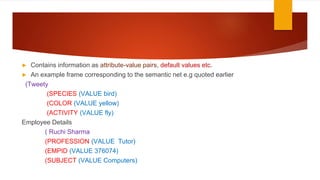
► Contains information as attribute-value pairs, default values etc.
► An example frame corresponding to the semantic net e.g quoted earlier
(Tweety
(SPECIES (VALUE bird)
(COLOR (VALUE yellow)
(ACTIVITY (VALUE fly)
Employee Details
( Ruchi Sharma
(PROFESSION (VALUE Tutor)
(EMPID (VALUE 376074)
(SUBJECT (VALUE Computers)
Semantic Network Model:
► A web of interconnected elements is used for representing declarative model.
► The elements termed nodes represents concepts. The connections between
nodes are labeled relationships, which might involve category relationship (pig
Is mammal), attribute (furry to mammal), have hierarchical model (from highest
to lowest to all have same characteristics.
► A semantic network is a directed graph with labeled nodes & arrows. Nodes
are commonly used for objects & the arrows for relations.
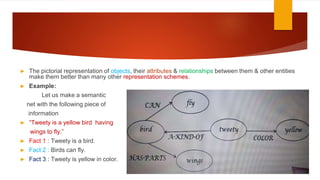
► The pictorial representation of objects, their attributes & relationships between them & other entities
make them better than many other representation schemes.
► Example:
Let us make a semantic
net with the following piece of
information
► “Tweety is a yellow bird having
wings to fly.”
► Fact 1 : Tweety is a bird.
► Fact 2 : Birds can fly.
► Fact 3 : Tweety is yellow in color.
Representation of procedural
knowledge:
► It Came from Artificial intelligence and computer stimulation in which
researcher try to get computers to perform tasks intelligently, like
human being. Cognitive psychologists have learned a great deal about
presenting and using procedural knowledge because of problems
posed in getting computers to implements based on a series of
instructions (programs). These attempts, at getting computers to
simulates intelligent cognitive process, Cognitive psychology
developed some models about how information is represented and
processed.
► These attempts, at getting computers to simulates intelligent
cognitive process, Cognitive psychology developed some
models about how information is represented and
processed. Each model involves the serial processing of
information. Computers represent procedural knowledge
through a set of procedure (If-then rule). For driving a car. If
have car, License, key, patrol,.…) then you can drive.
Homework Assignment
► What you know about knowledge?
► What are the main types of knowledge?
► Explain the Declarative knowledge?
► What is the name and intention of your project?
► How does the project contribute to the well-being of your target group? Which
problem does it solve?
► What is frame?
► What are the different examples of the Frame?
► Define Procedural knowledge?
► What are the prerequisites and the framework for the success of
your project?
References
1) https://www.youtube.com/watch?v=HrBbtbBLp4E
2) https://www.youtube.com/watch?v=-gl5hwqITU0
3) https://www.youtube.com/watch?v=CnmFTBFs3co
4) https://www.youtube.com/watch?v=AqkIJDiCG0I
REPRESENTATION OF DECLARATIVE KNOWLEDGE

REPRESENTATION OF DECLARATIVE KNOWLEDGE

  • 1.
  • 2.
    Objectives After completion ofthis presentation, the participants will be able to understand ► Define Knowledge ► Types of knowledge ► what is Knowledge Representation ► Explain declarative knowledge and procedural Knowledge
  • 3.
    knowledge ⮚ Knowledge isthe facts, information, and skills acquired through experience or education the theoretical or practical understanding of a subject. ► Knowledge is a familiarity, awareness, or understanding of someone or something, such as facts, skills, or objects. ► Types of Knowledge: ► There are many types of knowledge but we discuss only two types: ► Declarative knowledge ► Procedural Knowledge
  • 4.
    Knowledge Representation ► KnowledgeRepresentation: Knowledge Representation in AI describes the representation of knowledge. Basically, it is a study of how the beliefs, intentions, and judgments of an intelligent agent can be expressed suitably for automated reasoning. One of the primary purposes of Knowledge Representation includes modeling intelligent behavior for an agent.
  • 5.
    Representations of Declarative Knowledge ►Declarative knowledge: Declarative knowledge refers to facts or information stored in the memory, that is considered static in nature. Declarative knowledge, also referred to as conceptual, propositional or descriptive knowledge, describes things, events, or processes; their attributes; and their relation to each other.
  • 6.
    ► Concepts AndSchemas: Concept mean “idea” and Schemas mean “Bits of information”. Concept is an idea about something (APPLE) maybe related to other concepts (Redness) and maybe organized into prepositions concept maybe organized into schemas which are mental framework for representing knowledge encompassing an array of interrelated concepts into a meaningful organization. schemas have flexibility in use,
  • 7.
    ► FOR EXAMPLE:Schemas can include other schemas (COW,APES),vary in the degree of abstraction (JUSTIC,APPLE). ► Schemas are how we represent knowledge in memory and how children develop cognitive understanding of how world works. Komatsu 1992 said that schemas include inform about relationship among following: ► Concepts: (Truck, Car)
  • 8.
    ► Attributes withconcepts: (Height and Weight of an Elephant) ► Attribute in related concepts: (Redness of cherry and of Apple) ► Concepts and particular context: (Fish and Ocean) ► Specific concepts and general background knowledge (Concept about Iqbal, and General Knowledge about Tehreek and Emergence of Pakistan).
  • 9.
    Frame: ⮚ Frames arean artificial intelligence data structure used to divide knowledge into substructures by representing "stereotyped situations". ► Frames are record-like structures that have slots & slot-values for an entity ► Using frames, the knowledge about an object/event can be stored together in the KB as a unit ► A slot in a frame ► specify a characteristic of the entity which the frame represents
  • 10.
    ► Contains informationas attribute-value pairs, default values etc. ► An example frame corresponding to the semantic net e.g quoted earlier (Tweety (SPECIES (VALUE bird) (COLOR (VALUE yellow) (ACTIVITY (VALUE fly) Employee Details ( Ruchi Sharma (PROFESSION (VALUE Tutor) (EMPID (VALUE 376074) (SUBJECT (VALUE Computers)
  • 11.
    Semantic Network Model: ►A web of interconnected elements is used for representing declarative model. ► The elements termed nodes represents concepts. The connections between nodes are labeled relationships, which might involve category relationship (pig Is mammal), attribute (furry to mammal), have hierarchical model (from highest to lowest to all have same characteristics. ► A semantic network is a directed graph with labeled nodes & arrows. Nodes are commonly used for objects & the arrows for relations.
  • 12.
    ► The pictorialrepresentation of objects, their attributes & relationships between them & other entities make them better than many other representation schemes. ► Example: Let us make a semantic net with the following piece of information ► “Tweety is a yellow bird having wings to fly.” ► Fact 1 : Tweety is a bird. ► Fact 2 : Birds can fly. ► Fact 3 : Tweety is yellow in color.
  • 13.
    Representation of procedural knowledge: ►It Came from Artificial intelligence and computer stimulation in which researcher try to get computers to perform tasks intelligently, like human being. Cognitive psychologists have learned a great deal about presenting and using procedural knowledge because of problems posed in getting computers to implements based on a series of instructions (programs). These attempts, at getting computers to simulates intelligent cognitive process, Cognitive psychology developed some models about how information is represented and processed.
  • 14.
    ► These attempts,at getting computers to simulates intelligent cognitive process, Cognitive psychology developed some models about how information is represented and processed. Each model involves the serial processing of information. Computers represent procedural knowledge through a set of procedure (If-then rule). For driving a car. If have car, License, key, patrol,.…) then you can drive.
  • 15.
    Homework Assignment ► Whatyou know about knowledge? ► What are the main types of knowledge? ► Explain the Declarative knowledge? ► What is the name and intention of your project? ► How does the project contribute to the well-being of your target group? Which problem does it solve?
  • 16.
    ► What isframe? ► What are the different examples of the Frame? ► Define Procedural knowledge? ► What are the prerequisites and the framework for the success of your project?
  • 17.
    References 1) https://www.youtube.com/watch?v=HrBbtbBLp4E 2) https://www.youtube.com/watch?v=-gl5hwqITU0 3)https://www.youtube.com/watch?v=CnmFTBFs3co 4) https://www.youtube.com/watch?v=AqkIJDiCG0I