Representation and using
Domain Knowledge
BY:
Sulthan Meghana
23011DB011
What is knowledge representation?
• Knowledge is cognizance or understanding expanded by experiences of
facts, data, and circumstances.
• Humans are best at understanding, reasoning, and interpreting knowledge.
But how machines will be able to do all these comes under knowledge
representation and reasoning.
• Knowledge: Knowledge is awareness or familiarity gained by experiences
of facts, data, and situations.
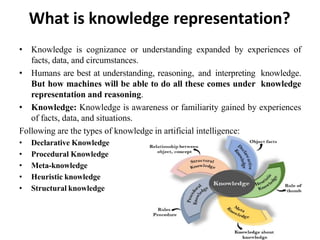
Following are the types of knowledge in artificial intelligence:
• Declarative Knowledge
• Procedural Knowledge
• Meta-knowledge
• Heuristic knowledge
• Structural knowledge
1. Declarative Knowledge:
Declarative knowledge is to know about something.
It includes concepts, facts, and objects.
It is also called descriptive knowledge and expressed in declarativesentences.
It is simpler than procedural language.
2. Procedural Knowledge
It is also known as imperative knowledge.
Procedural knowledge is a type of knowledge which is responsible for knowing how to do
something.
It can be directly applied to any task.
It includes rules, strategies, procedures, agendas, etc.
In this approach, one important rule is used which is If-Then rule.
In this knowledge, we can use various coding languages such as LISP language and Prolog
language.
We can easily represent heuristic or domain-specific knowledge using this approach.
3. Meta-knowledge:
Knowledge about the other types of knowledge is called Meta-knowledge.
In other words, It is the knowledge about what we know.
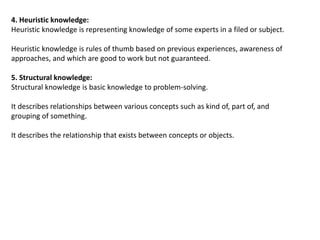
4. Heuristic knowledge:
Heuristic knowledge is representing knowledge of some experts in a filed or subject.
Heuristic knowledge is rules of thumb based on previous experiences, awareness of
approaches, and which are good to work but not guaranteed.
5. Structural knowledge:
Structural knowledge is basic knowledge to problem-solving.
It describes relationships between various concepts such as kind of, part of, and
grouping of something.
It describes the relationship that exists between concepts or objects.
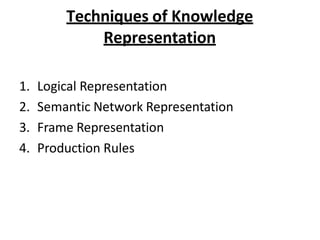
Techniques of Knowledge
Representation
1. Logical Representation
2. Semantic Network Representation
3. Frame Representation
4. Production Rules
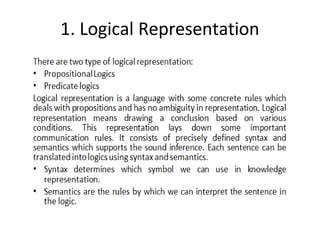
1. Logical Representation
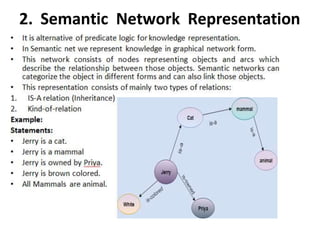
2. Semantic Network Representation
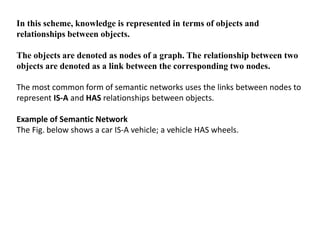
In this scheme, knowledge is represented in terms of objects and
relationships between objects.
The objects are denoted as nodes of a graph. The relationship between two
objects are denoted as a link between the corresponding two nodes.
The most common form of semantic networks uses the links between nodes to
represent IS-A and HAS relationships between objects.
Example of Semantic Network
The Fig. below shows a car IS-A vehicle; a vehicle HAS wheels.
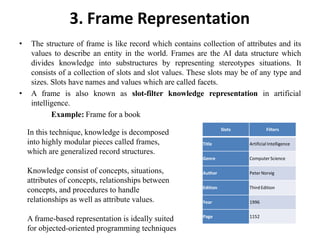
3. Frame Representation
• The structure of frame is like record which contains collection of attributes and its
values to describe an entity in the world. Frames are the AI data structure which
divides knowledge into substructures by representing stereotypes situations. It
consists of a collection of slots and slot values. These slots may be of any type and
sizes. Slots have names and values which are called facets.
• A frame is also known as slot-filter knowledge representation in artificial
intelligence.
Example: Frame for a book
Slots Filters
Title Artificial Intelligence
Genre ComputerScience
Author Peter Norvig
Edition Third Edition
Year 1996
Page 1152
In this technique, knowledge is decomposed
into highly modular pieces called frames,
which are generalized record structures.
Knowledge consist of concepts, situations,
attributes of concepts, relationships between
concepts, and procedures to handle
relationships as well as attribute values.
A frame-based representation is ideally suited
for objected-oriented programming techniques
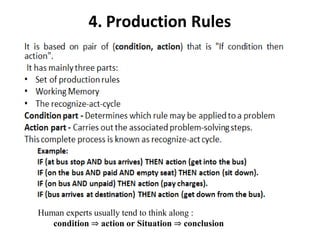
4. Production Rules
Human experts usually tend to think along :
condition ⇒ action or Situation ⇒ conclusion
_Artificial_Intelligence_Knowledge_Representation (1).pptx

_Artificial_Intelligence_Knowledge_Representation (1).pptx

  • 1.
    Representation and using DomainKnowledge BY: Sulthan Meghana 23011DB011
  • 2.
    What is knowledgerepresentation? • Knowledge is cognizance or understanding expanded by experiences of facts, data, and circumstances. • Humans are best at understanding, reasoning, and interpreting knowledge. But how machines will be able to do all these comes under knowledge representation and reasoning. • Knowledge: Knowledge is awareness or familiarity gained by experiences of facts, data, and situations. Following are the types of knowledge in artificial intelligence: • Declarative Knowledge • Procedural Knowledge • Meta-knowledge • Heuristic knowledge • Structural knowledge
  • 3.
    1. Declarative Knowledge: Declarativeknowledge is to know about something. It includes concepts, facts, and objects. It is also called descriptive knowledge and expressed in declarativesentences. It is simpler than procedural language. 2. Procedural Knowledge It is also known as imperative knowledge. Procedural knowledge is a type of knowledge which is responsible for knowing how to do something. It can be directly applied to any task. It includes rules, strategies, procedures, agendas, etc. In this approach, one important rule is used which is If-Then rule. In this knowledge, we can use various coding languages such as LISP language and Prolog language. We can easily represent heuristic or domain-specific knowledge using this approach. 3. Meta-knowledge: Knowledge about the other types of knowledge is called Meta-knowledge. In other words, It is the knowledge about what we know.
  • 4.
    4. Heuristic knowledge: Heuristicknowledge is representing knowledge of some experts in a filed or subject. Heuristic knowledge is rules of thumb based on previous experiences, awareness of approaches, and which are good to work but not guaranteed. 5. Structural knowledge: Structural knowledge is basic knowledge to problem-solving. It describes relationships between various concepts such as kind of, part of, and grouping of something. It describes the relationship that exists between concepts or objects.
  • 5.
    Techniques of Knowledge Representation 1.Logical Representation 2. Semantic Network Representation 3. Frame Representation 4. Production Rules
  • 6.
  • 7.
    2. Semantic NetworkRepresentation
  • 8.
    In this scheme,knowledge is represented in terms of objects and relationships between objects. The objects are denoted as nodes of a graph. The relationship between two objects are denoted as a link between the corresponding two nodes. The most common form of semantic networks uses the links between nodes to represent IS-A and HAS relationships between objects. Example of Semantic Network The Fig. below shows a car IS-A vehicle; a vehicle HAS wheels.
  • 9.
    3. Frame Representation •The structure of frame is like record which contains collection of attributes and its values to describe an entity in the world. Frames are the AI data structure which divides knowledge into substructures by representing stereotypes situations. It consists of a collection of slots and slot values. These slots may be of any type and sizes. Slots have names and values which are called facets. • A frame is also known as slot-filter knowledge representation in artificial intelligence. Example: Frame for a book Slots Filters Title Artificial Intelligence Genre ComputerScience Author Peter Norvig Edition Third Edition Year 1996 Page 1152 In this technique, knowledge is decomposed into highly modular pieces called frames, which are generalized record structures. Knowledge consist of concepts, situations, attributes of concepts, relationships between concepts, and procedures to handle relationships as well as attribute values. A frame-based representation is ideally suited for objected-oriented programming techniques
  • 10.
    4. Production Rules Humanexperts usually tend to think along : condition ⇒ action or Situation ⇒ conclusion