Techniques of knowledge representation
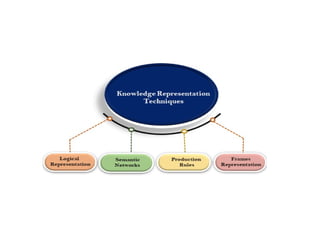
• There are mainly four ways of knowledge
representation which are given as follows:
1. Logical Representation
2. Semantic Network Representation
3. Frame Representation
4. Production Rules
1. Logical Representation
• Logical representation is a language with some
concrete rules which deals with propositions and has
no ambiguity in representation.
• Logical representation means drawing a conclusion
based on various conditions. This representation lays
down some important communication rules.
• It consists of precisely defined syntax and semantics
which supports the sound inference. Each sentence
can be translated into logics using syntax and
semantics.
Syntax:
• Syntaxes are the rules which decide how we can construct legal
sentences in the logic.
• It determines which symbol we can use in knowledge
representation.
• How to write those symbols
• Semantics:
• Semantics are the rules by which we can interpret the sentence in
the logic.
• Semantic also involves assigning a meaning to each sentence.
• Logical representation can be categorised into mainly two logics:
• Propositional Logics
• Predicate logics
Advantages of logical representation:
Logical representation enables us to do logical reasoning.
Logical representation is the basis for the programming
languages.
Disadvantages of logical Representation:
Logical representations have some restrictions and are
challenging to work with.
Logical representation technique may not be very
natural, and inference may not be so efficient
2. Semantic Network Representation
• Semantic networks are alternative of predicate logic for
knowledge representation. In Semantic networks, we
can represent our knowledge in the form of graphical
networks.
• This network consists of nodes representing objects and
arcs which describe the relationship between those
objects.
• Semantic networks can categorize the object in different
forms and can also link those objects. Semantic networks
are easy to understand and can be easily extended.
This representation consist of mainly two types of relations:
• IS-A relation (Inheritance)
• Kind-of-relation
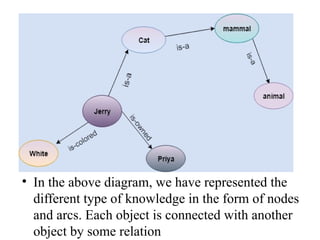
• Example: Following are some statements which we need to
represent in the form of nodes and arcs.
Statements:
• Jerry is a cat.
• Jerry is a mammal
• Jerry is owned by Priya.
• Jerry is brown colored.
• All Mammals are animal
• In the above diagram, we have represented the
different type of knowledge in the form of nodes
and arcs. Each object is connected with another
object by some relation
Advantages of Semantic network
• Semantic networks are a natural
representation of knowledge.
• Semantic networks convey meaning in a
transparent manner.
• These networks are simple and easily
understandable
Drawbacks in Semantic representation
• Semantic networks do not have any standard
definition for the link names.
• These networks are not intelligent and depend
on the creator of the system
3. Frame Representation
• A frame is a record like structure which consists
of a collection of attributes and its values to
describe an entity in the world.
• Frames are the AI data structure which divides
knowledge into substructures by representing
stereotypes situations.
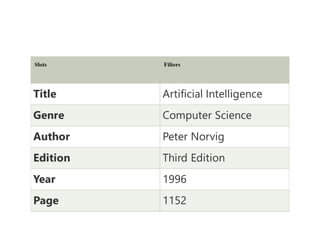
• It consists of a collection of slots and slot values.
These slots may be of any type and sizes. Slots
have names and values which are called facets.
4. Production Rules
• Production rules system consist of (condition,
action) pairs which mean, "If condition then
action". It has mainly three parts:
• The set of production rules
• Working Memory
• The recognize-act-cycle
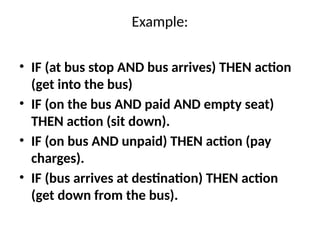
Example:
• IF (at bus stop AND bus arrives) THEN action
(get into the bus)
• IF (on the bus AND paid AND empty seat)
THEN action (sit down).
• IF (on bus AND unpaid) THEN action (pay
charges).
• IF (bus arrives at destination) THEN action
(get down from the bus).
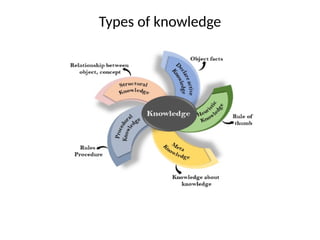
Types of knowledge
• Declarative Knowledge
• Procedural Knowledge
• Meta-knowledge
• Heuristic knowledge
• Structural knowledge
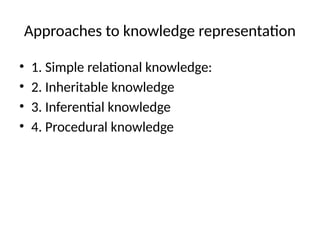
Approaches to knowledge representation
• 1. Simple relational knowledge:
• 2. Inheritable knowledge
• 3. Inferential knowledge
• 4. Procedural knowledge
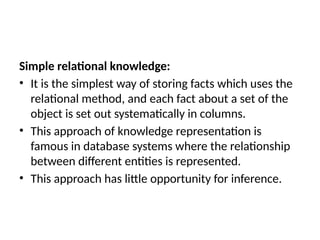
Simple relational knowledge:
• It is the simplest way of storing facts which uses the
relational method, and each fact about a set of the
object is set out systematically in columns.
• This approach of knowledge representation is
famous in database systems where the relationship
between different entities is represented.
• This approach has little opportunity for inference.
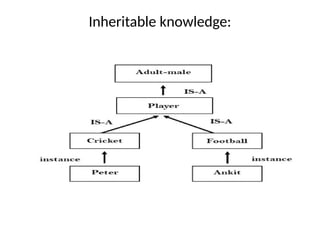
Inheritable knowledge:
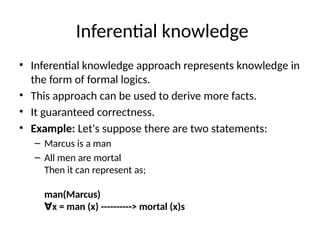
Inferential knowledge
• Inferential knowledge approach represents knowledge in
the form of formal logics.
• This approach can be used to derive more facts.
• It guaranteed correctness.
• Example: Let's suppose there are two statements:
– Marcus is a man
– All men are mortal
Then it can represent as;
man(Marcus)
x = man (x) ----------> mortal (x)s
∀
Procedural knowledge:
• Procedural knowledge approach uses small
programs and codes which describes how to
do specific things, and how to proceed.
• In this approach, one important rule is used
which is If-Then rule.
• In this knowledge, we can use various coding
languages such as Prolog language.
Requirements for knowledge Representation
system
• A good knowledge representation system must possess the following
properties.
1. Representational Accuracy:
KR system should have the ability to represent all kind of required
knowledge.
2. Inferential Adequacy:
KR system should have ability to manipulate the representational
structures to produce new knowledge corresponding to existing structure.
3. Inferential Efficiency:
The ability to direct the inferential knowledge mechanism into the most
productive directions by storing appropriate guides.
4. Acquisitional efficiency- The ability to acquire the new knowledge easily
using automatic methods.
Issues in Knowledge Representation
The fundamental goal of Knowledge
Representation is to facilitate inferencing
(conclusions) from knowledge
Issues that should be raised when using a knowledge representation
technique:
– Are any attributes of objects so basic that they occur in
almost every problem domain?
– Are there any important relationships that exist among
attributes of objects?
– At what level should knowledge be represented? Is there
a good set of primitives into which all knowledge can be
broken down?
– How should sets of objects be represented?
– Given a large amount of knowledge stored in a database,
how can relevant parts be accessed when they are
needed?
Important Attributes :
• Any attribute of objects so basic that they occur in almost
every problem domain ?
– Relationship among attributes:
• Any important relationship that exists among object
attributes ?
– Choosing Granularity :
• At what level of detail should the knowledge be
represented ?
– Set of objects :
• How sets of objects be represented ?
– Finding Right structure :
1. Important Attributed:
• Any attribute of objects so basic that they
occur in almost every problem domain?
• There are two attributed “instance” and “isa”,
that are general significance. These attributes
are important because they support property
inheritance
Relationship among attributes:
Any important relationship that exists among
object attributed?
• The attributes we use to describe objects are
themselves entities that we represent.
• The relationship between the attributes of an
object, independent of specific knowledge
they encode, may hold properties like:
.
Properties of Attributes
1. Inverse — This is about consistency check, while a
value is added to one attribute. The entities are
related to each other in many different ways.
2. Existence in an isa hierarchy — This is about
generalization-specification, like, classes of objects and
specialized subsets of those classes, For example, the
attribute height is a specialization of general attribute
physical-size which is, in turn, a specialization of
physical-attribute. they support inheritance
3. Technique for reasoning about values — This is
about reasoning values of attributes not given
explicitly. Several kinds of information are used in
reasoning, like, height: must be in a unit of length,
Age: of a person cannot be greater than the age of
person’s parents.
4. Single valued attributes — This is about a specific
attribute that is guaranteed to take a unique value.
For example, a baseball player can at time have only
a single height and be a member of only one team.
2.Choosing Granularity
• At what level of detail should the knowledge be
represented?
• Regardless of the KR formalism, it is necessary to know:
• At what level should the knowledge be represented
and what are the primitives?
• Should there be a small number or should there be a
large number of low-level primitives or High-level facts.
• High-level facts may not be adequate for inference
while Low-level primitives may require a lot of storage.
Example of Granularity:
• Suppose we are interested in following facts:
– John spotted Sue.
– This could be represented as
– Spotted (agent(John),object (Sue))
– Such a representation would make it easy to answer questions such
are:
– Who spotted Sue?
– Suppose we want to know:
– Did John see Sue?
– Given only one fact, we cannot discover that answer.
– We can add other facts, such as
– Spotted(x, y) -> saw(x, y)
3.Set of objects
• How should sets of objects be represented?
• There are certain properties of objects that are true as
member of a set but not as individual;
• Example: Consider the assertion made in the sentences:
• “there are more sheep than people in Australia”, and
• “English speakers can be found all over the world.”
• To describe these facts, the only way is to attach
assertion to the sets representing people, sheep, and
English.
• The reason to represent sets of objects is: if a
property is true for all or most elements of a set,
then it is more efficient to associate it once with the
set rather than to associate it explicitly with every
elements of the set.
• This is done,in logical representation through the use
of universal quantifier, and
• in hierarchical structure where node represent sets
and inheritance propagate set level assertion down
to individual.
4.Finding Right structure
• Given a large amount of knowledge stored in a
database, how can relevant parts are accessed
when they are needed?
• This is about access to right structure for
describing a particular situation.
• This requires, selecting an initial structure and
then revising the choice
While doing so, it is necessary to solve
following problems
• How to perform an initial selection of the most
appropriate structure.
• How to fill in appropriate details from the current
situations.
• How to find a better structure if the one chosen
initially turns out not to be appropriate.
• What to do if none of the available structures is
appropriate.
• When to create and remember a new structure.
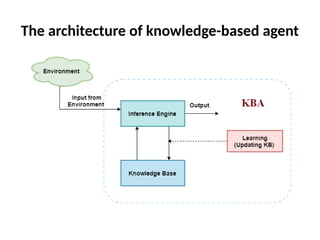
Knowledge-Based Agent in Artificial intelligence
• An intelligent agent needs knowledge about the real
world for taking decisions and reasoning to act
efficiently.
• Knowledge-based agents are those agents who have
the capability of maintaining an internal state of
knowledge, reason over that knowledge, update
their knowledge after observations and take
actions. These agents can represent the world with
some formal representation and act intelligently
• Knowledge-based agents are composed of two
main parts:
– Knowledge-base and
– Inference system.
• A knowledge-based agent must able to do the following:
• An agent should be able to represent states, actions,
etc.
• An agent Should be able to incorporate new percepts
• An agent can update the internal representation of the
world
• An agent can deduce the internal representation of the
world
• An agent can deduce appropriate actions
The architecture of knowledge-based agent
Inference system
• Inference means deriving new sentences from old.
Inference system allows us to add a new sentence to
the knowledge base. A sentence is a proposition about
the world. Inference system applies logical rules to the
KB to deduce new information.
• Inference system generates new facts so that an agent
can update the KB. An inference system works mainly
in two rules which are given as:
• Forward chaining
• Backward chaining
Operations Performed by KBA
• Following are three operations which are
performed by KBA in order to show the
intelligent behavior:
• TELL: This operation tells the knowledge base
what it perceives from the environment.
• ASK: This operation asks the knowledge base
what action it should perform.
• Perform: It performs the selected action
Various levels of knowledge-based agent
• 1. Knowledge level
• 2. Logical level
• 3. Implementation level
First-Order Logic
• In Propositional logic, we represent statements
using propositional logic. But unfortunately, in
propositional logic, we can only represent the
facts, which are either true or false.
• PL is not sufficient to represent the complex
sentences or natural language statements. The
propositional logic has very limited expressive
power. Consider the following sentence, which
we cannot represent using PL logic.
• "Some humans are intelligent", or
• "Sachin likes cricket."
• To represent the above statements, PL logic is
not sufficient, so we required some more
powerful logic, such as first-order logic.
First-Order logic
• First-order logic is another way of knowledge representation in artificial
intelligence. It is an extension to propositional logic.
• FOL is sufficiently expressive to represent the natural language statements in a
concise way.
• First-order logic is also known as Predicate logic or First-order predicate logic.
First-order logic is a powerful language that develops information about the
objects in a more easy way and can also express the relationship between those
objects.
• First-order logic (like natural language) does not only assume that the world
contains facts like propositional logic but also assumes the following things in
the world:
– Objects: A, B, people, numbers, colors, wars, theories, squares, pits, wumpus, ......
– Relations: It can be unary relation such as: red, round, is adjacent, or n-any relation
such as: the sister of, brother of, has color, comes between
– Function: Father of, best friend, third inning of, end of,
• As a natural language, first-order logic also has two
main parts:
– Syntax
– Semantics
• Syntax of First-Order logic:
• The syntax of FOL determines which collection of
symbols is a logical expression in first-order logic.
The basic elements of first-order logic are symbols.
We write statements in short-hand notation in FOL.
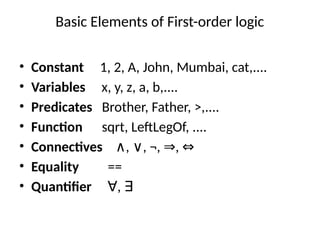
Basic Elements of First-order logic
• Constant 1, 2, A, John, Mumbai, cat,....
• Variables x, y, z, a, b,....
• Predicates Brother, Father, >,....
• Function sqrt, LeftLegOf, ....
• Connectives , , ¬, ,
∧ ∨ ⇒ ⇔
• Equality ==
• Quantifier ,
∀ ∃
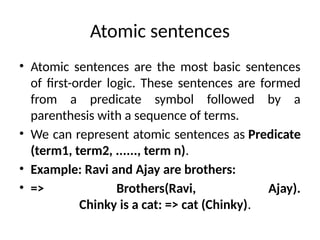
Atomic sentences
• Atomic sentences are the most basic sentences
of first-order logic. These sentences are formed
from a predicate symbol followed by a
parenthesis with a sequence of terms.
• We can represent atomic sentences as Predicate
(term1, term2, ......, term n).
• Example: Ravi and Ajay are brothers:
• => Brothers(Ravi, Ajay).
Chinky is a cat: => cat (Chinky).
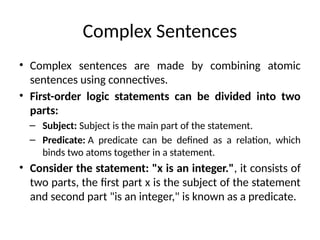
Complex Sentences
• Complex sentences are made by combining atomic
sentences using connectives.
• First-order logic statements can be divided into two
parts:
– Subject: Subject is the main part of the statement.
– Predicate: A predicate can be defined as a relation, which
binds two atoms together in a statement.
• Consider the statement: "x is an integer.", it consists of
two parts, the first part x is the subject of the statement
and second part "is an integer," is known as a predicate.
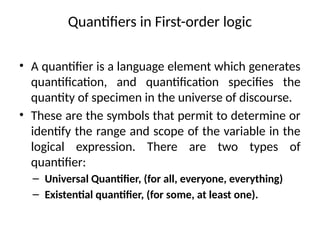
Quantifiers in First-order logic
• A quantifier is a language element which generates
quantification, and quantification specifies the
quantity of specimen in the universe of discourse.
• These are the symbols that permit to determine or
identify the range and scope of the variable in the
logical expression. There are two types of
quantifier:
– Universal Quantifier, (for all, everyone, everything)
– Existential quantifier, (for some, at least one).
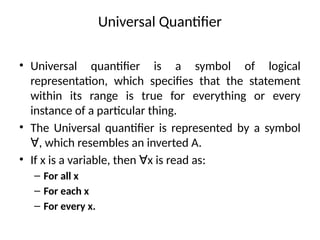
Universal Quantifier
• Universal quantifier is a symbol of logical
representation, which specifies that the statement
within its range is true for everything or every
instance of a particular thing.
• The Universal quantifier is represented by a symbol
, which resembles an inverted A.
∀
• If x is a variable, then x is read as:
∀
– For all x
– For each x
– For every x.
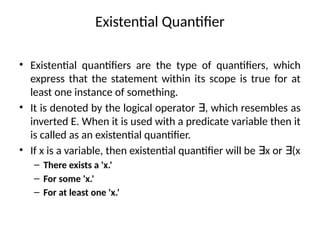
Existential Quantifier
• Existential quantifiers are the type of quantifiers, which
express that the statement within its scope is true for at
least one instance of something.
• It is denoted by the logical operator , which resembles as
∃
inverted E. When it is used with a predicate variable then it
is called as an existential quantifier.
• If x is a variable, then existential quantifier will be x or (x
∃ ∃
– There exists a 'x.'
– For some 'x.'
– For at least one 'x.'
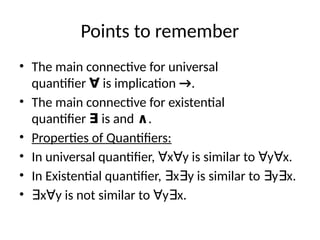
Points to remember
• The main connective for universal
quantifier ∀ is implication →.
• The main connective for existential
quantifier ∃ is and ∧.
• Properties of Quantifiers:
• In universal quantifier, x y is similar to y x.
∀ ∀ ∀ ∀
• In Existential quantifier, x y is similar to y x.
∃ ∃ ∃ ∃
• ∃x y is not similar to y x.
∀ ∀ ∃
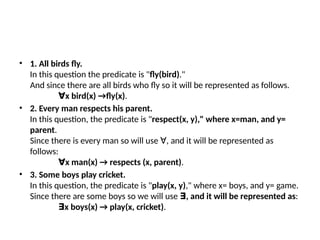
• 1. All birds fly.
In this question the predicate is "fly(bird)."
And since there are all birds who fly so it will be represented as follows.
x bird(x) →fly(x)
∀ .
• 2. Every man respects his parent.
In this question, the predicate is "respect(x, y)," where x=man, and y=
parent.
Since there is every man so will use , and it will be represented as
∀
follows:
x man(x) → respects (x, parent)
∀ .
• 3. Some boys play cricket.
In this question, the predicate is "play(x, y)," where x= boys, and y= game.
Since there are some boys so we will use , and it will be represented as
∃ :
x boys(x) → play(x, cricket)
∃ .
• 4. Not all students like both Mathematics and Science.
In this question, the predicate is "like(x, y)," where x= student, and y=
subject.
Since there are not all students, so we will use with negation,
∀
so following representation for this:
¬ (x) [ student(x) → like(x, Mathematics) like(x, Science)].
∀ ∧
• 5. Only one student failed in Mathematics.
In this question, the predicate is "failed(x, y)," where x= student, and y=
subject.
Since there is only one student who failed in Mathematics, so we will
use following representation for this:
(x) [ student(x) → failed (x, Mathematics) (y) [¬(x==y)
∃ ∧∀ ∧
student(y) → ¬failed (x, Mathematics)].

PAIML - UNIT 2dfbdfbvdfvdvdfvdfvdfv.pptx

  • 1.
    Techniques of knowledgerepresentation • There are mainly four ways of knowledge representation which are given as follows: 1. Logical Representation 2. Semantic Network Representation 3. Frame Representation 4. Production Rules
  • 3.
    1. Logical Representation •Logical representation is a language with some concrete rules which deals with propositions and has no ambiguity in representation. • Logical representation means drawing a conclusion based on various conditions. This representation lays down some important communication rules. • It consists of precisely defined syntax and semantics which supports the sound inference. Each sentence can be translated into logics using syntax and semantics.
  • 4.
    Syntax: • Syntaxes arethe rules which decide how we can construct legal sentences in the logic. • It determines which symbol we can use in knowledge representation. • How to write those symbols • Semantics: • Semantics are the rules by which we can interpret the sentence in the logic. • Semantic also involves assigning a meaning to each sentence. • Logical representation can be categorised into mainly two logics: • Propositional Logics • Predicate logics
  • 5.
    Advantages of logicalrepresentation: Logical representation enables us to do logical reasoning. Logical representation is the basis for the programming languages. Disadvantages of logical Representation: Logical representations have some restrictions and are challenging to work with. Logical representation technique may not be very natural, and inference may not be so efficient
  • 6.
    2. Semantic NetworkRepresentation • Semantic networks are alternative of predicate logic for knowledge representation. In Semantic networks, we can represent our knowledge in the form of graphical networks. • This network consists of nodes representing objects and arcs which describe the relationship between those objects. • Semantic networks can categorize the object in different forms and can also link those objects. Semantic networks are easy to understand and can be easily extended.
  • 7.
    This representation consistof mainly two types of relations: • IS-A relation (Inheritance) • Kind-of-relation • Example: Following are some statements which we need to represent in the form of nodes and arcs. Statements: • Jerry is a cat. • Jerry is a mammal • Jerry is owned by Priya. • Jerry is brown colored. • All Mammals are animal
  • 8.
    • In theabove diagram, we have represented the different type of knowledge in the form of nodes and arcs. Each object is connected with another object by some relation
  • 9.
    Advantages of Semanticnetwork • Semantic networks are a natural representation of knowledge. • Semantic networks convey meaning in a transparent manner. • These networks are simple and easily understandable
  • 10.
    Drawbacks in Semanticrepresentation • Semantic networks do not have any standard definition for the link names. • These networks are not intelligent and depend on the creator of the system
  • 11.
    3. Frame Representation •A frame is a record like structure which consists of a collection of attributes and its values to describe an entity in the world. • Frames are the AI data structure which divides knowledge into substructures by representing stereotypes situations. • It consists of a collection of slots and slot values. These slots may be of any type and sizes. Slots have names and values which are called facets.
  • 13.
    4. Production Rules •Production rules system consist of (condition, action) pairs which mean, "If condition then action". It has mainly three parts: • The set of production rules • Working Memory • The recognize-act-cycle
  • 14.
    Example: • IF (atbus stop AND bus arrives) THEN action (get into the bus) • IF (on the bus AND paid AND empty seat) THEN action (sit down). • IF (on bus AND unpaid) THEN action (pay charges). • IF (bus arrives at destination) THEN action (get down from the bus).
  • 15.
  • 16.
    • Declarative Knowledge •Procedural Knowledge • Meta-knowledge • Heuristic knowledge • Structural knowledge
  • 17.
    Approaches to knowledgerepresentation • 1. Simple relational knowledge: • 2. Inheritable knowledge • 3. Inferential knowledge • 4. Procedural knowledge
  • 18.
    Simple relational knowledge: •It is the simplest way of storing facts which uses the relational method, and each fact about a set of the object is set out systematically in columns. • This approach of knowledge representation is famous in database systems where the relationship between different entities is represented. • This approach has little opportunity for inference.
  • 19.
  • 20.
    Inferential knowledge • Inferentialknowledge approach represents knowledge in the form of formal logics. • This approach can be used to derive more facts. • It guaranteed correctness. • Example: Let's suppose there are two statements: – Marcus is a man – All men are mortal Then it can represent as; man(Marcus) x = man (x) ----------> mortal (x)s ∀
  • 21.
    Procedural knowledge: • Proceduralknowledge approach uses small programs and codes which describes how to do specific things, and how to proceed. • In this approach, one important rule is used which is If-Then rule. • In this knowledge, we can use various coding languages such as Prolog language.
  • 22.
    Requirements for knowledgeRepresentation system • A good knowledge representation system must possess the following properties. 1. Representational Accuracy: KR system should have the ability to represent all kind of required knowledge. 2. Inferential Adequacy: KR system should have ability to manipulate the representational structures to produce new knowledge corresponding to existing structure. 3. Inferential Efficiency: The ability to direct the inferential knowledge mechanism into the most productive directions by storing appropriate guides. 4. Acquisitional efficiency- The ability to acquire the new knowledge easily using automatic methods.
  • 23.
    Issues in KnowledgeRepresentation The fundamental goal of Knowledge Representation is to facilitate inferencing (conclusions) from knowledge
  • 24.
    Issues that shouldbe raised when using a knowledge representation technique: – Are any attributes of objects so basic that they occur in almost every problem domain? – Are there any important relationships that exist among attributes of objects? – At what level should knowledge be represented? Is there a good set of primitives into which all knowledge can be broken down? – How should sets of objects be represented? – Given a large amount of knowledge stored in a database, how can relevant parts be accessed when they are needed?
  • 25.
    Important Attributes : •Any attribute of objects so basic that they occur in almost every problem domain ? – Relationship among attributes: • Any important relationship that exists among object attributes ? – Choosing Granularity : • At what level of detail should the knowledge be represented ? – Set of objects : • How sets of objects be represented ? – Finding Right structure :
  • 26.
    1. Important Attributed: •Any attribute of objects so basic that they occur in almost every problem domain? • There are two attributed “instance” and “isa”, that are general significance. These attributes are important because they support property inheritance
  • 27.
    Relationship among attributes: Anyimportant relationship that exists among object attributed? • The attributes we use to describe objects are themselves entities that we represent. • The relationship between the attributes of an object, independent of specific knowledge they encode, may hold properties like: .
  • 28.
    Properties of Attributes 1.Inverse — This is about consistency check, while a value is added to one attribute. The entities are related to each other in many different ways. 2. Existence in an isa hierarchy — This is about generalization-specification, like, classes of objects and specialized subsets of those classes, For example, the attribute height is a specialization of general attribute physical-size which is, in turn, a specialization of physical-attribute. they support inheritance
  • 29.
    3. Technique forreasoning about values — This is about reasoning values of attributes not given explicitly. Several kinds of information are used in reasoning, like, height: must be in a unit of length, Age: of a person cannot be greater than the age of person’s parents. 4. Single valued attributes — This is about a specific attribute that is guaranteed to take a unique value. For example, a baseball player can at time have only a single height and be a member of only one team.
  • 30.
    2.Choosing Granularity • Atwhat level of detail should the knowledge be represented? • Regardless of the KR formalism, it is necessary to know: • At what level should the knowledge be represented and what are the primitives? • Should there be a small number or should there be a large number of low-level primitives or High-level facts. • High-level facts may not be adequate for inference while Low-level primitives may require a lot of storage.
  • 31.
    Example of Granularity: •Suppose we are interested in following facts: – John spotted Sue. – This could be represented as – Spotted (agent(John),object (Sue)) – Such a representation would make it easy to answer questions such are: – Who spotted Sue? – Suppose we want to know: – Did John see Sue? – Given only one fact, we cannot discover that answer. – We can add other facts, such as – Spotted(x, y) -> saw(x, y)
  • 32.
    3.Set of objects •How should sets of objects be represented? • There are certain properties of objects that are true as member of a set but not as individual; • Example: Consider the assertion made in the sentences: • “there are more sheep than people in Australia”, and • “English speakers can be found all over the world.” • To describe these facts, the only way is to attach assertion to the sets representing people, sheep, and English.
  • 33.
    • The reasonto represent sets of objects is: if a property is true for all or most elements of a set, then it is more efficient to associate it once with the set rather than to associate it explicitly with every elements of the set. • This is done,in logical representation through the use of universal quantifier, and • in hierarchical structure where node represent sets and inheritance propagate set level assertion down to individual.
  • 34.
    4.Finding Right structure •Given a large amount of knowledge stored in a database, how can relevant parts are accessed when they are needed? • This is about access to right structure for describing a particular situation. • This requires, selecting an initial structure and then revising the choice
  • 35.
    While doing so,it is necessary to solve following problems • How to perform an initial selection of the most appropriate structure. • How to fill in appropriate details from the current situations. • How to find a better structure if the one chosen initially turns out not to be appropriate. • What to do if none of the available structures is appropriate. • When to create and remember a new structure.
  • 36.
    Knowledge-Based Agent inArtificial intelligence • An intelligent agent needs knowledge about the real world for taking decisions and reasoning to act efficiently. • Knowledge-based agents are those agents who have the capability of maintaining an internal state of knowledge, reason over that knowledge, update their knowledge after observations and take actions. These agents can represent the world with some formal representation and act intelligently
  • 37.
    • Knowledge-based agentsare composed of two main parts: – Knowledge-base and – Inference system.
  • 38.
    • A knowledge-basedagent must able to do the following: • An agent should be able to represent states, actions, etc. • An agent Should be able to incorporate new percepts • An agent can update the internal representation of the world • An agent can deduce the internal representation of the world • An agent can deduce appropriate actions
  • 39.
    The architecture ofknowledge-based agent
  • 40.
    Inference system • Inferencemeans deriving new sentences from old. Inference system allows us to add a new sentence to the knowledge base. A sentence is a proposition about the world. Inference system applies logical rules to the KB to deduce new information. • Inference system generates new facts so that an agent can update the KB. An inference system works mainly in two rules which are given as: • Forward chaining • Backward chaining
  • 41.
    Operations Performed byKBA • Following are three operations which are performed by KBA in order to show the intelligent behavior: • TELL: This operation tells the knowledge base what it perceives from the environment. • ASK: This operation asks the knowledge base what action it should perform. • Perform: It performs the selected action
  • 42.
    Various levels ofknowledge-based agent • 1. Knowledge level • 2. Logical level • 3. Implementation level
  • 43.
    First-Order Logic • InPropositional logic, we represent statements using propositional logic. But unfortunately, in propositional logic, we can only represent the facts, which are either true or false. • PL is not sufficient to represent the complex sentences or natural language statements. The propositional logic has very limited expressive power. Consider the following sentence, which we cannot represent using PL logic.
  • 44.
    • "Some humansare intelligent", or • "Sachin likes cricket." • To represent the above statements, PL logic is not sufficient, so we required some more powerful logic, such as first-order logic.
  • 45.
    First-Order logic • First-orderlogic is another way of knowledge representation in artificial intelligence. It is an extension to propositional logic. • FOL is sufficiently expressive to represent the natural language statements in a concise way. • First-order logic is also known as Predicate logic or First-order predicate logic. First-order logic is a powerful language that develops information about the objects in a more easy way and can also express the relationship between those objects. • First-order logic (like natural language) does not only assume that the world contains facts like propositional logic but also assumes the following things in the world: – Objects: A, B, people, numbers, colors, wars, theories, squares, pits, wumpus, ...... – Relations: It can be unary relation such as: red, round, is adjacent, or n-any relation such as: the sister of, brother of, has color, comes between – Function: Father of, best friend, third inning of, end of,
  • 46.
    • As anatural language, first-order logic also has two main parts: – Syntax – Semantics • Syntax of First-Order logic: • The syntax of FOL determines which collection of symbols is a logical expression in first-order logic. The basic elements of first-order logic are symbols. We write statements in short-hand notation in FOL.
  • 47.
    Basic Elements ofFirst-order logic • Constant 1, 2, A, John, Mumbai, cat,.... • Variables x, y, z, a, b,.... • Predicates Brother, Father, >,.... • Function sqrt, LeftLegOf, .... • Connectives , , ¬, , ∧ ∨ ⇒ ⇔ • Equality == • Quantifier , ∀ ∃
  • 48.
    Atomic sentences • Atomicsentences are the most basic sentences of first-order logic. These sentences are formed from a predicate symbol followed by a parenthesis with a sequence of terms. • We can represent atomic sentences as Predicate (term1, term2, ......, term n). • Example: Ravi and Ajay are brothers: • => Brothers(Ravi, Ajay). Chinky is a cat: => cat (Chinky).
  • 49.
    Complex Sentences • Complexsentences are made by combining atomic sentences using connectives. • First-order logic statements can be divided into two parts: – Subject: Subject is the main part of the statement. – Predicate: A predicate can be defined as a relation, which binds two atoms together in a statement. • Consider the statement: "x is an integer.", it consists of two parts, the first part x is the subject of the statement and second part "is an integer," is known as a predicate.
  • 50.
    Quantifiers in First-orderlogic • A quantifier is a language element which generates quantification, and quantification specifies the quantity of specimen in the universe of discourse. • These are the symbols that permit to determine or identify the range and scope of the variable in the logical expression. There are two types of quantifier: – Universal Quantifier, (for all, everyone, everything) – Existential quantifier, (for some, at least one).
  • 51.
    Universal Quantifier • Universalquantifier is a symbol of logical representation, which specifies that the statement within its range is true for everything or every instance of a particular thing. • The Universal quantifier is represented by a symbol , which resembles an inverted A. ∀ • If x is a variable, then x is read as: ∀ – For all x – For each x – For every x.
  • 52.
    Existential Quantifier • Existentialquantifiers are the type of quantifiers, which express that the statement within its scope is true for at least one instance of something. • It is denoted by the logical operator , which resembles as ∃ inverted E. When it is used with a predicate variable then it is called as an existential quantifier. • If x is a variable, then existential quantifier will be x or (x ∃ ∃ – There exists a 'x.' – For some 'x.' – For at least one 'x.'
  • 53.
    Points to remember •The main connective for universal quantifier ∀ is implication →. • The main connective for existential quantifier ∃ is and ∧. • Properties of Quantifiers: • In universal quantifier, x y is similar to y x. ∀ ∀ ∀ ∀ • In Existential quantifier, x y is similar to y x. ∃ ∃ ∃ ∃ • ∃x y is not similar to y x. ∀ ∀ ∃
  • 54.
    • 1. Allbirds fly. In this question the predicate is "fly(bird)." And since there are all birds who fly so it will be represented as follows. x bird(x) →fly(x) ∀ . • 2. Every man respects his parent. In this question, the predicate is "respect(x, y)," where x=man, and y= parent. Since there is every man so will use , and it will be represented as ∀ follows: x man(x) → respects (x, parent) ∀ . • 3. Some boys play cricket. In this question, the predicate is "play(x, y)," where x= boys, and y= game. Since there are some boys so we will use , and it will be represented as ∃ : x boys(x) → play(x, cricket) ∃ .
  • 55.
    • 4. Notall students like both Mathematics and Science. In this question, the predicate is "like(x, y)," where x= student, and y= subject. Since there are not all students, so we will use with negation, ∀ so following representation for this: ¬ (x) [ student(x) → like(x, Mathematics) like(x, Science)]. ∀ ∧ • 5. Only one student failed in Mathematics. In this question, the predicate is "failed(x, y)," where x= student, and y= subject. Since there is only one student who failed in Mathematics, so we will use following representation for this: (x) [ student(x) → failed (x, Mathematics) (y) [¬(x==y) ∃ ∧∀ ∧ student(y) → ¬failed (x, Mathematics)].