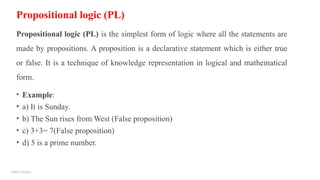
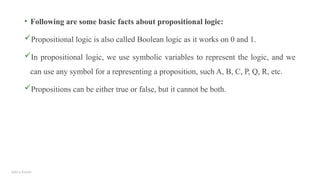
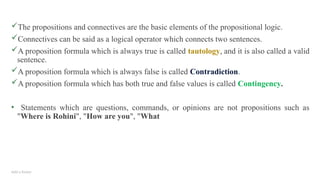
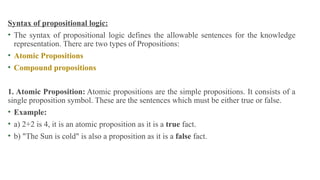
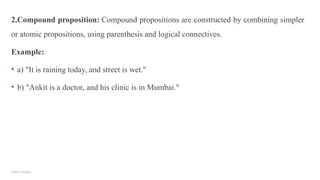
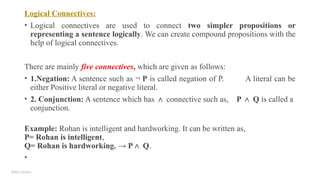
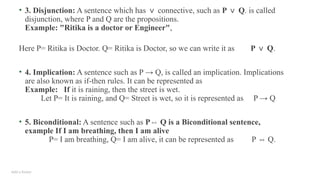
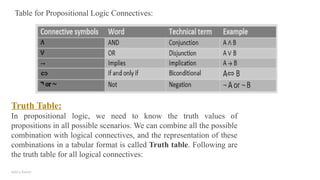
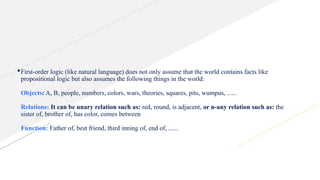
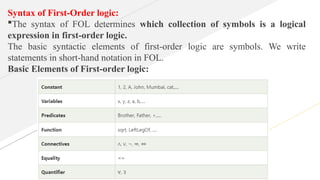
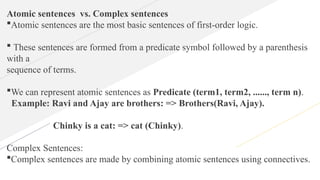
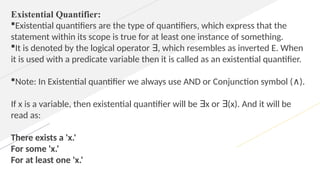
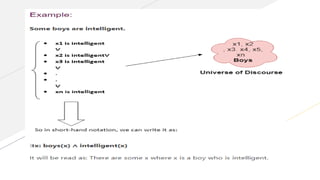
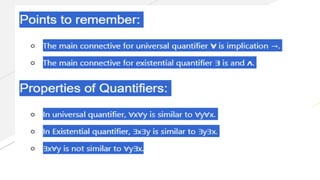
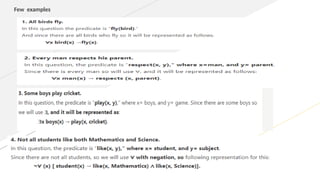
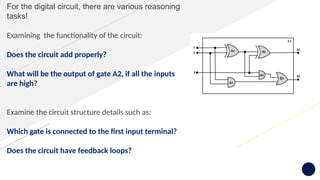
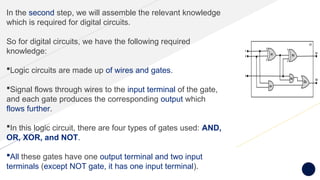
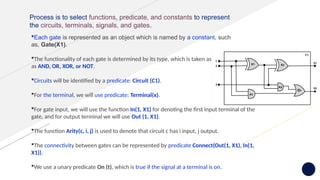
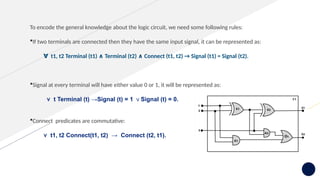
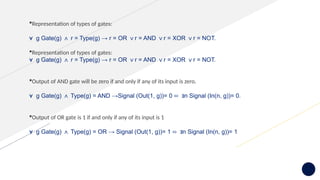
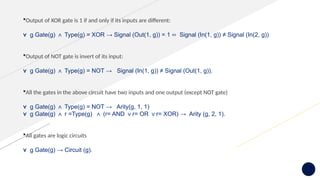
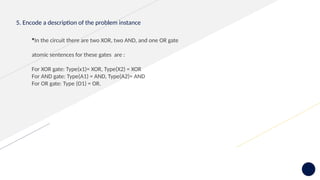
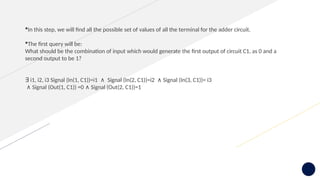
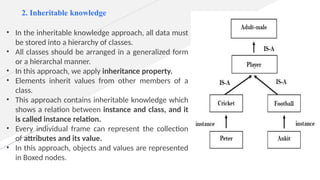
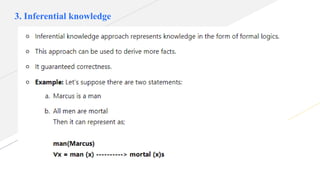
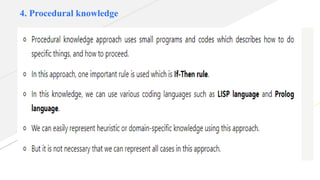
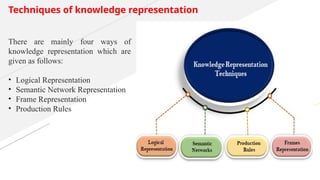
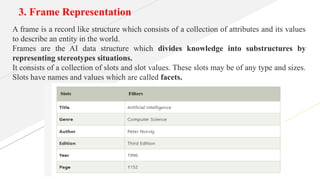
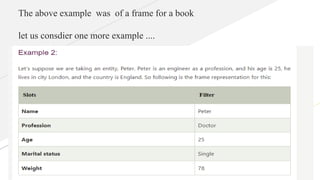
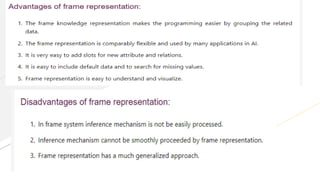
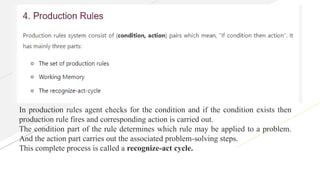
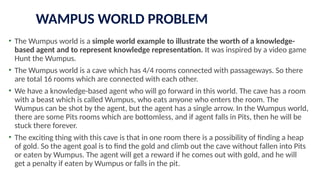
Knowledge representation and reasoning (KRR) in AI involves how machines understand, interpret, and utilize knowledge to solve real-world problems, mimicking human cognitive abilities. Types of knowledge include declarative, procedural, meta-knowledge, heuristic, and structural, which together form a knowledge base that supports intelligent behavior through perception, learning, planning, and execution. Various representation techniques—such as logical representation, semantic networks, frames, and production rules—are used to model knowledge effectively, with specific focus on practical applications like the Wumpus World problem.

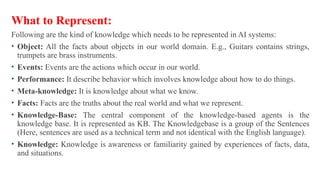
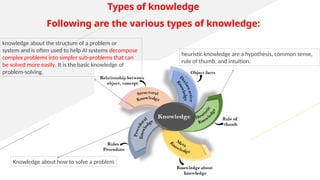
![Add a footer
PEAS description of Wumpus world:
• To explain the Wumpus world we have given PEAS description as below:
Performance measure:
• +1000 reward points if the agent comes out of the cave with the gold.
• -1000 points penalty for being eaten by the Wumpus or falling into the pit.
• -1 for each action, and -10 for using an arrow.
• The game ends if either agent dies or came out of the cave.
Environment:
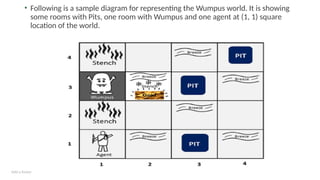
• A 4*4 grid of rooms.
• The agent initially in room square [1, 1], facing toward the right.
• Location of Wumpus and gold are chosen randomly except the first square [1,1].
• Each square of the cave can be a pit with probability 0.2 except the first square.](https://image.slidesharecdn.com/module-2ai-241126144234-eb0c3829/85/MODULE-2_AI_Computer_Science_Engineering-pptx-29-320.jpg)
![Add a footer
Agent's First step:
• Initially, the agent is in the first room or on the square [1,1], and we already know that
this room is safe for the agent, so to represent on the below diagram (a) that room is safe
we will add symbol OK. Symbol A is used to represent agent, symbol B for the breeze, G
for Glitter or gold, V for the visited room, P for pits, W for Wumpus.
• At Room [1,1] agent does not feel any breeze or any Stench which means the adjacent
squares are also OK.](https://image.slidesharecdn.com/module-2ai-241126144234-eb0c3829/85/MODULE-2_AI_Computer_Science_Engineering-pptx-31-320.jpg)
![Add a footer
Agent's second Step:
Now agent needs to move forward, so it will either move to [1, 2], or [2,1]. Let's suppose
agent moves to the room [2, 1], at this room agent perceives some breeze which means Pit is
around this room. The pit can be in [3, 1], or [2,2], so we will add symbol P? to say that, is
this Pit room?
Now agent will stop and think and will not make any harmful move. The agent will go back to
the [1, 1] room. The room [1,1], and [2,1] are visited by the agent, so we will use symbol V to
represent the visited squares.
Agent's third step:
At the third step, now agent will move to the room [1,2] which is OK. In the room [1,2] agent
perceives a stench which means there must be a Wumpus nearby. But Wumpus cannot be in
the room [1,1] as by rules of the game, and also not in [2,2] (Agent had not detected any
stench when he was at [2,1]). Therefore agent infers that Wumpus is in the room [1,3], and
in current state, there is no breeze which means in [2,2] there is no Pit and no Wumpus. So it
is safe, and we will mark it OK, and the agent moves further in [2,2].](https://image.slidesharecdn.com/module-2ai-241126144234-eb0c3829/85/MODULE-2_AI_Computer_Science_Engineering-pptx-32-320.jpg)
![Add a footer
Agent's fourth step:
• At room [2,2], here no stench and no breezes present so let's suppose agent decides
to move to [2,3]. At room [2,3] agent perceives glitter, so it should grab the gold and
climb out of the cave.](https://image.slidesharecdn.com/module-2ai-241126144234-eb0c3829/85/MODULE-2_AI_Computer_Science_Engineering-pptx-33-320.jpg)