
Artificial Intelligence (AI) in Cybersecurity &
Intelligence
Dr. A. Prabaharan
Professor & Research Director,
Public Action
www.indopraba.blogspot.com
AI in Cybersecurity & Intelligence
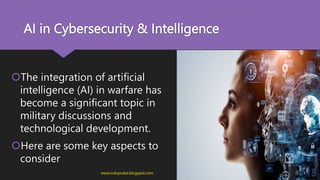
The integration of artificial
intelligence (AI) in warfare has
become a significant topic in
military discussions and
technological development.
Here are some key aspects to
consider
www.indopraba.blogspot.com
AI in Warfare
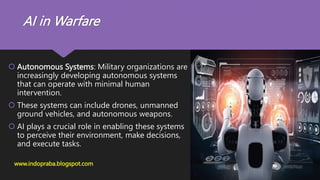
 Autonomous Systems: Military organizations are
increasingly developing autonomous systems
that can operate with minimal human
intervention.
 These systems can include drones, unmanned
ground vehicles, and autonomous weapons.
 AI plays a crucial role in enabling these systems
to perceive their environment, make decisions,
and execute tasks.
www.indopraba.blogspot.com
Autonomous Warfare
 Autonomous Systems
Military organizations are increasingly developing autonomous systems that can
operate with minimal human intervention.
These systems can include drones, unmanned ground vehicles, and autonomous
weapons.
AI plays a crucial role in enabling these systems to perceive their environment,
make decisions, and execute tasks.
 Decision Support
AI algorithms are used to process vast amounts of data from various sources,
including sensors, satellites, and reconnaissance aircraft.
These algorithms can analyze the data to provide commanders with actionable
intelligence, helping them make informed decisions more rapidly.
www.indopraba.blogspot.com
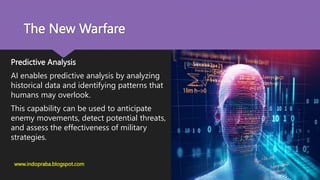
The New Warfare
Predictive Analysis
AI enables predictive analysis by analyzing
historical data and identifying patterns that
humans may overlook.
This capability can be used to anticipate
enemy movements, detect potential threats,
and assess the effectiveness of military
strategies.
www.indopraba.blogspot.com
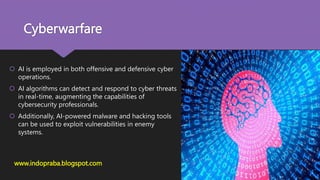
Cyberwarfare
 AI is employed in both offensive and defensive cyber
operations.
 AI algorithms can detect and respond to cyber threats
in real-time, augmenting the capabilities of
cybersecurity professionals.
 Additionally, AI-powered malware and hacking tools
can be used to exploit vulnerabilities in enemy
systems.
www.indopraba.blogspot.com
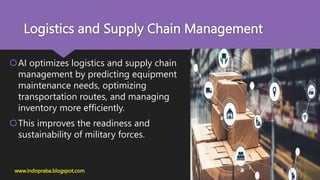
Logistics and Supply Chain Management
AI optimizes logistics and supply chain
management by predicting equipment
maintenance needs, optimizing
transportation routes, and managing
inventory more efficiently.
This improves the readiness and
sustainability of military forces.
www.indopraba.blogspot.com
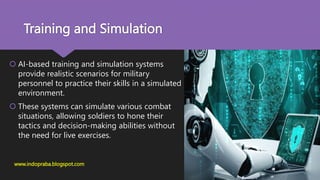
Training and Simulation
 AI-based training and simulation systems
provide realistic scenarios for military
personnel to practice their skills in a simulated
environment.
 These systems can simulate various combat
situations, allowing soldiers to hone their
tactics and decision-making abilities without
the need for live exercises.
www.indopraba.blogspot.com
Ethical and Legal Concerns
 The integration of AI in warfare raises ethical and legal
concerns, particularly regarding the use of autonomous
weapons and the potential for unintended consequences.
 There are ongoing debates about the necessity for human
oversight and accountability in the use of AI systems in
conflict situations.
www.indopraba.blogspot.com
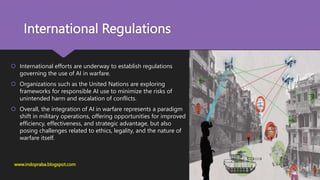
International Regulations
 International efforts are underway to establish regulations
governing the use of AI in warfare.
 Organizations such as the United Nations are exploring
frameworks for responsible AI use to minimize the risks of
unintended harm and escalation of conflicts.
 Overall, the integration of AI in warfare represents a paradigm
shift in military operations, offering opportunities for improved
efficiency, effectiveness, and strategic advantage, but also
posing challenges related to ethics, legality, and the nature of
warfare itself.
www.indopraba.blogspot.com

Artificial Intelligence (AI) in Cybersecurity.pptx

  • 1.
    Artificial Intelligence (AI)in Cybersecurity & Intelligence Dr. A. Prabaharan Professor & Research Director, Public Action www.indopraba.blogspot.com
  • 2.
    AI in Cybersecurity& Intelligence The integration of artificial intelligence (AI) in warfare has become a significant topic in military discussions and technological development. Here are some key aspects to consider www.indopraba.blogspot.com
  • 3.
    AI in Warfare Autonomous Systems: Military organizations are increasingly developing autonomous systems that can operate with minimal human intervention.  These systems can include drones, unmanned ground vehicles, and autonomous weapons.  AI plays a crucial role in enabling these systems to perceive their environment, make decisions, and execute tasks. www.indopraba.blogspot.com
  • 4.
    Autonomous Warfare  AutonomousSystems Military organizations are increasingly developing autonomous systems that can operate with minimal human intervention. These systems can include drones, unmanned ground vehicles, and autonomous weapons. AI plays a crucial role in enabling these systems to perceive their environment, make decisions, and execute tasks.  Decision Support AI algorithms are used to process vast amounts of data from various sources, including sensors, satellites, and reconnaissance aircraft. These algorithms can analyze the data to provide commanders with actionable intelligence, helping them make informed decisions more rapidly. www.indopraba.blogspot.com
  • 5.
    The New Warfare PredictiveAnalysis AI enables predictive analysis by analyzing historical data and identifying patterns that humans may overlook. This capability can be used to anticipate enemy movements, detect potential threats, and assess the effectiveness of military strategies. www.indopraba.blogspot.com
  • 6.
    Cyberwarfare  AI isemployed in both offensive and defensive cyber operations.  AI algorithms can detect and respond to cyber threats in real-time, augmenting the capabilities of cybersecurity professionals.  Additionally, AI-powered malware and hacking tools can be used to exploit vulnerabilities in enemy systems. www.indopraba.blogspot.com
  • 7.
    Logistics and SupplyChain Management AI optimizes logistics and supply chain management by predicting equipment maintenance needs, optimizing transportation routes, and managing inventory more efficiently. This improves the readiness and sustainability of military forces. www.indopraba.blogspot.com
  • 8.
    Training and Simulation AI-based training and simulation systems provide realistic scenarios for military personnel to practice their skills in a simulated environment.  These systems can simulate various combat situations, allowing soldiers to hone their tactics and decision-making abilities without the need for live exercises. www.indopraba.blogspot.com
  • 9.
    Ethical and LegalConcerns  The integration of AI in warfare raises ethical and legal concerns, particularly regarding the use of autonomous weapons and the potential for unintended consequences.  There are ongoing debates about the necessity for human oversight and accountability in the use of AI systems in conflict situations. www.indopraba.blogspot.com
  • 10.
    International Regulations  Internationalefforts are underway to establish regulations governing the use of AI in warfare.  Organizations such as the United Nations are exploring frameworks for responsible AI use to minimize the risks of unintended harm and escalation of conflicts.  Overall, the integration of AI in warfare represents a paradigm shift in military operations, offering opportunities for improved efficiency, effectiveness, and strategic advantage, but also posing challenges related to ethics, legality, and the nature of warfare itself. www.indopraba.blogspot.com
  • 11.