
CS552
Artificial Intelligence
BSCS-5th Semester-2020
Prepared By:
Mr. Rahat Ullah
r2mpak@gmail.com
Department Of
Computer Science
Government Degree
College Gulabad Dir (L)
KPK Pakistan
What is AI?
 In the simplest form, artificial intelligence
means creating computing systems that have
the ability to perform tasks like humans or even
better than humans.
 It is a field of computer science that develops
machines or software having human intelligence
such as speech recognition, decision
making, and translation abilities.
 Think of Siri and Alexa, and Google Assistant
the artificial intelligence systems we utilize on a
daily basis.
Applied Artificial Intelligence?
 Applied artificial intelligence is the utilization of
existing tools to extract useful information.
 The open-source technology has a major role
to play here for offering free, easy-to-use tools.
 However, it is important to note that tools are not
a magic box.
 To utilize these tools effectively, You should
know the potential biases and limitations of
various models, methods, and techniques.
Research Artificial Intelligence?
 Research artificial intelligence are a lot harder
than applied AI.
 This is due to the fact that research AI requires
you to understand math, algorithm, and
several other related disciplines.
 For instance, how neural networks enhance the
results of visual recognition.
Types of AI?
 Artificial intelligence has various subdivisions
and other technologies such as neural
networks, machine learning, etc., but all these
can be divided into three basic categories:
1. Weak Artificial Intelligence
2. True Artificial Intelligence
3. Artificial SuperIntelligence
1. Weak Artificial Intelligence?
 Many artificial intelligence Experts points also
define it as narrow AI.
 It is called weak because it doesn’t have any
intelligence or self-awareness.
 For instance, an assistant developed using
narrow AI would have the capability of
resolving your queries, but this assistant won’t
be able to have a conversation with you.
 They may have a limited perspective and
learning involved in this perspective.
2. True Artificial Intelligence?
 True AI is also referred to as strong AI.
 The machines built using this technology would
react similarly to human beings.
 The tasks that can be accomplished by human
beings can also be achieved by these
machines.
 However, there is still a lot of research going on
in this area that is yet to show results.
3. Artificial Superintelligence?
 Artificial superintelligence is what makes us
think that human extinction can be led by
machines.
 Many scientists believe that this field has the
power to create machines that can be better
than humans in every field including creativity
and intellect.
Importance of AI…
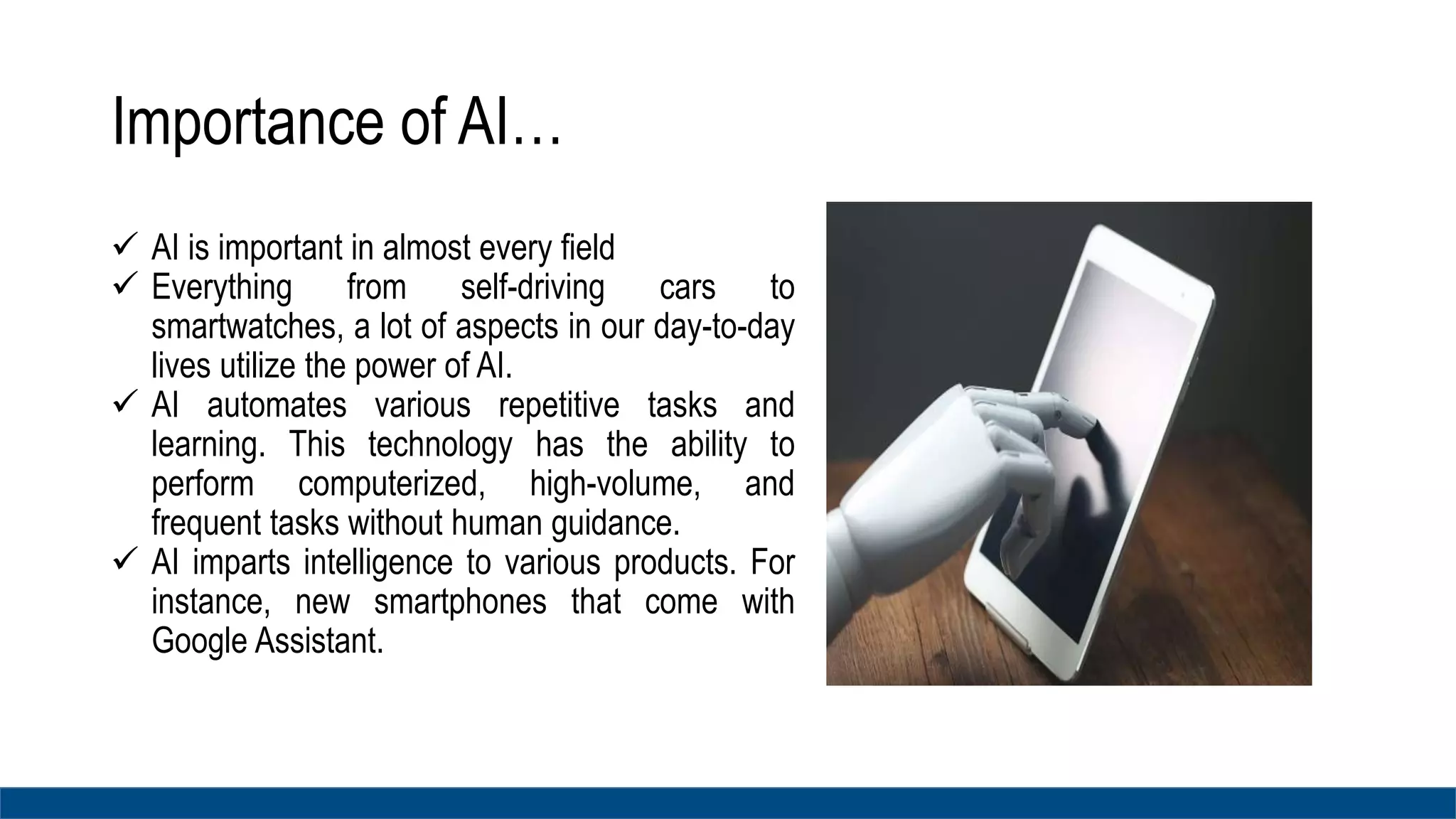
 AI is important in almost every field
 Everything from self-driving cars to
smartwatches, a lot of aspects in our day-to-day
lives utilize the power of AI.
 AI automates various repetitive tasks and
learning. This technology has the ability to
perform computerized, high-volume, and
frequent tasks without human guidance.
 AI imparts intelligence to various products. For
instance, new smartphones that come with
Google Assistant.
Importance of AI…
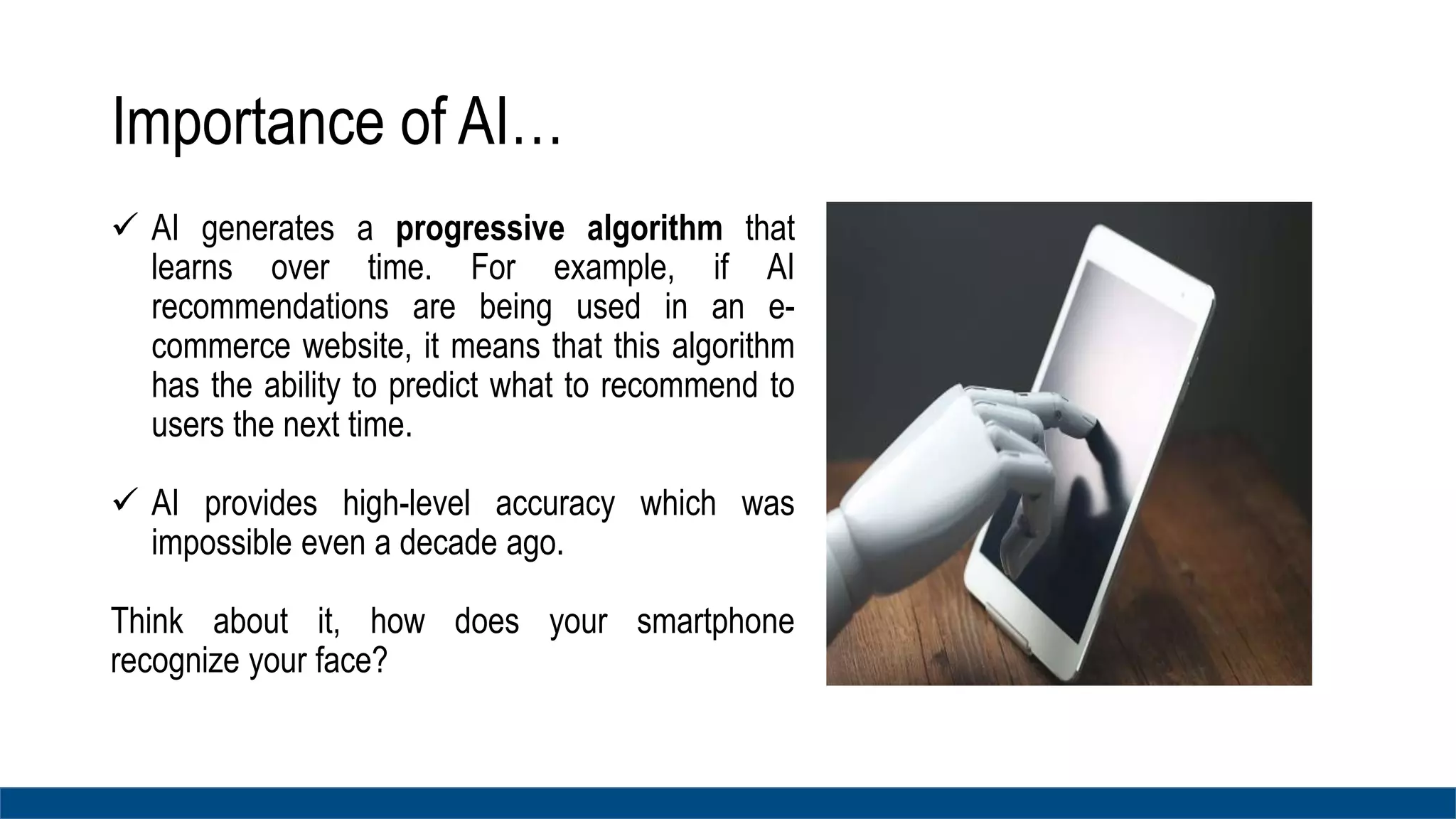
 AI generates a progressive algorithm that
learns over time. For example, if AI
recommendations are being used in an e-
commerce website, it means that this algorithm
has the ability to predict what to recommend to
users the next time.
 AI provides high-level accuracy which was
impossible even a decade ago.
Think about it, how does your smartphone
recognize your face?
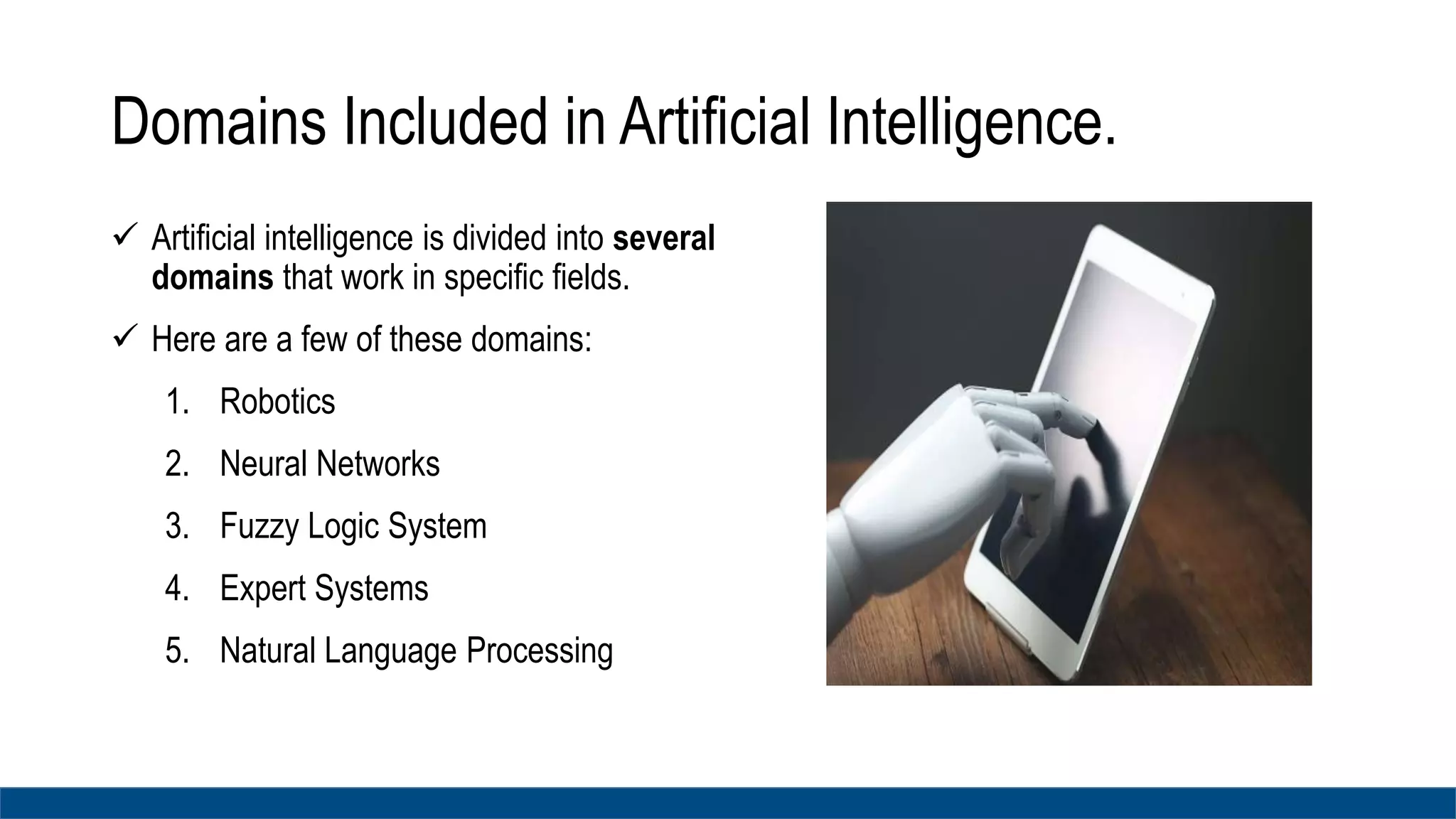
Domains Included in Artificial Intelligence.
 Artificial intelligence is divided into several
domains that work in specific fields.
 Here are a few of these domains:
1. Robotics
2. Neural Networks
3. Fuzzy Logic System
4. Expert Systems
5. Natural Language Processing
1. Robotics
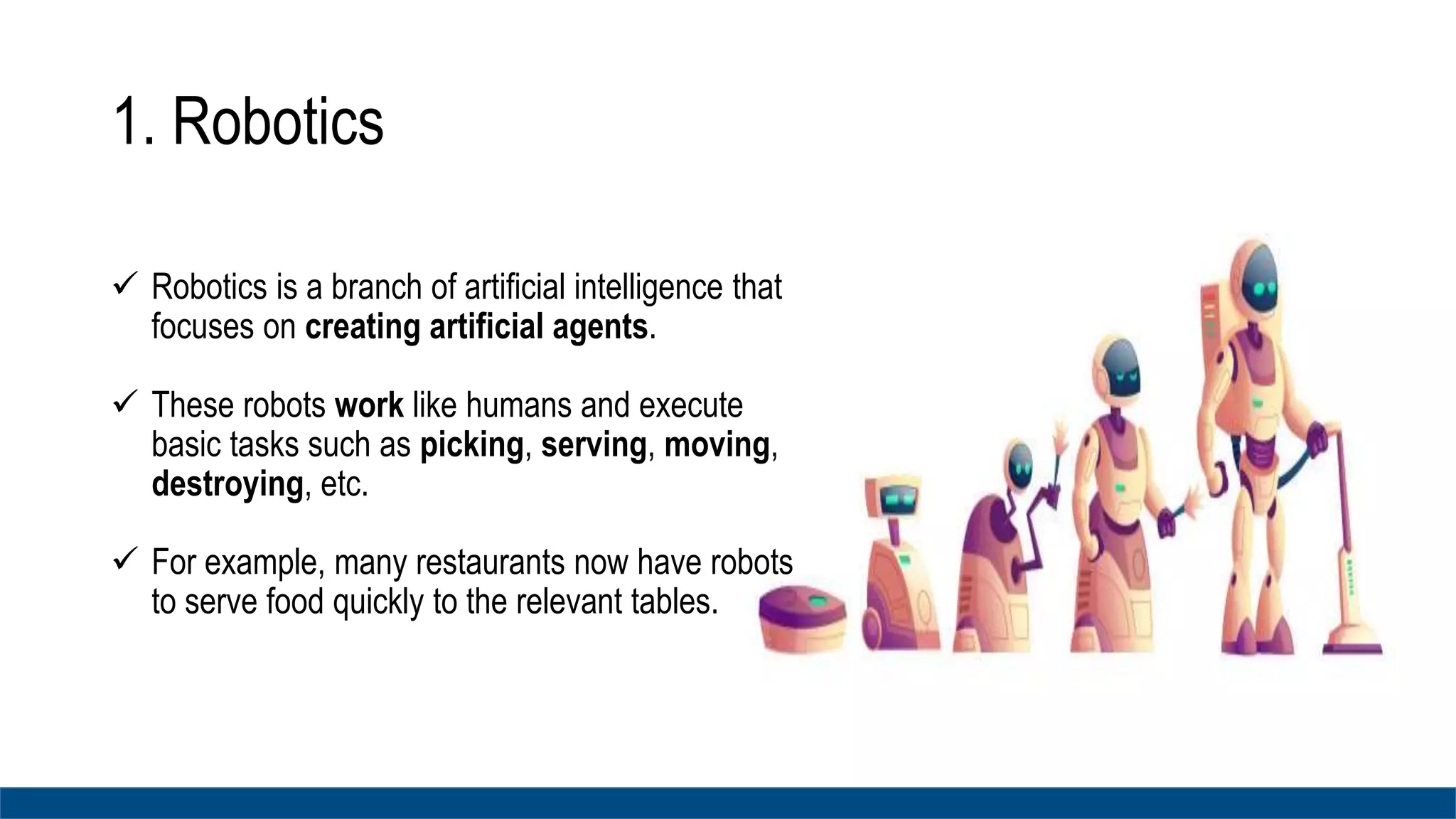
 Robotics is a branch of artificial intelligence that
focuses on creating artificial agents.
 These robots work like humans and execute
basic tasks such as picking, serving, moving,
destroying, etc.
 For example, many restaurants now have robots
to serve food quickly to the relevant tables.
2. Neural Networks
 Neural networks are really important in artificial
intelligence. This domain forms algorithms to
detect patterns and trends.
 The name is based on neurons of the human
brain as the structure of the neural networks
resembles the human brain.
 These systems learn with examples just as we
learn from our mistakes or experiences.
3. Fuzzy Logic Systems
 Instead of explicitly stating true or false,
a fuzzy logic system tells the degree of
truth.
 These systems even have the
capability to process noisy, imprecise,
or distorted inputs.
4. Expert Systems
 Expert systems judge human decision-
making capabilities.
 It is a machine that judges how an
organization or a human being behaves
or reacts according to their experience
and knowledge in a given field.
5. Natural Language Processing (NLP)
 Natural language processing (NLP) is
an essential field of artificial
intelligence.
 It helps in various tasks such as
translation, sentiment analysis,
named entity recognition, topic
segmentation, and speech
recognition.
Applications Related to Artificial Intelligence.
 New applications of artificial intelligence
emerge every day.
 There is no industry or field that is left
untouched by this intelligent technology.
 Below are some of the leading
applications of Artificial Intelligence.
i. Machine Translation
ii. Speech Recognition
iii. Chatbots
iv. Facial Recognition
v. Virtual Assistants
1. Machine Translation
 Machine translation is a field of artificial
intelligence and computational
linguistics that allow translation from
one language to another.
 These systems additionally assist in
estimating turnaround time,
reviewing linguistics, analyzing files,
managing language resource, etc.
2. Speech Recognition
 Similar to machine translation, speech
recognition is a field of artificial
intelligence that recognizes the voice
and converts it to text in a computer
system.
 Many effective speech recognition
methods utilize long short-term memory
system by deep learning.
3. Chatbots
 Chatbots are definitely one of the most
useful and valuable inventions of
artificial intelligence.
 These are messaging bots that
respond to users and solve their
queries.
 These bots have natural language
processing capabilities that help them
to analyze the question raised by the
user and answer it appropriately.
4. Facial Recognition
 Facial recognition is an ability given to
the machine to recognize the facial
pattern of a human.
 These machines compare the facial
features of the human to the ones given
in the database.
 This artificial intelligence system is also
referred to as biometric artificial
intelligence as it analyzes the unique
patterns of the face of an individual
based on facial shape and texture.
5. Virtual Assistants
 Virtual assistants are often used
synonymously to chatbots but they are
not.
 Most of the virtual assistants now have
the ability to interpret human voice and
respond in a synthesized voice. For
instance, Alexa.
 It is also the basic function of virtual
assistants to interpret voice commands
and execute them accordingly.
How To get Started?
 To get started with Artificial Intelligence,
you need to first learn the basics of the
following technologies.
1. SQL & Python
2. Machine Learning
3. Probability and Statistics
Learn SQL and Python.
 Python language allows you to
maximize your knowledge of hardware.
This language is used in collaboration
with C and C++ and it delivers high-
performance due to great libraries and
toolkits.
 SQL is necessary for effective
functioning. For instance, if your AI
needs to work on updated data and
most of your data is in a relational
database, then you need to know SQL
for correct execution.
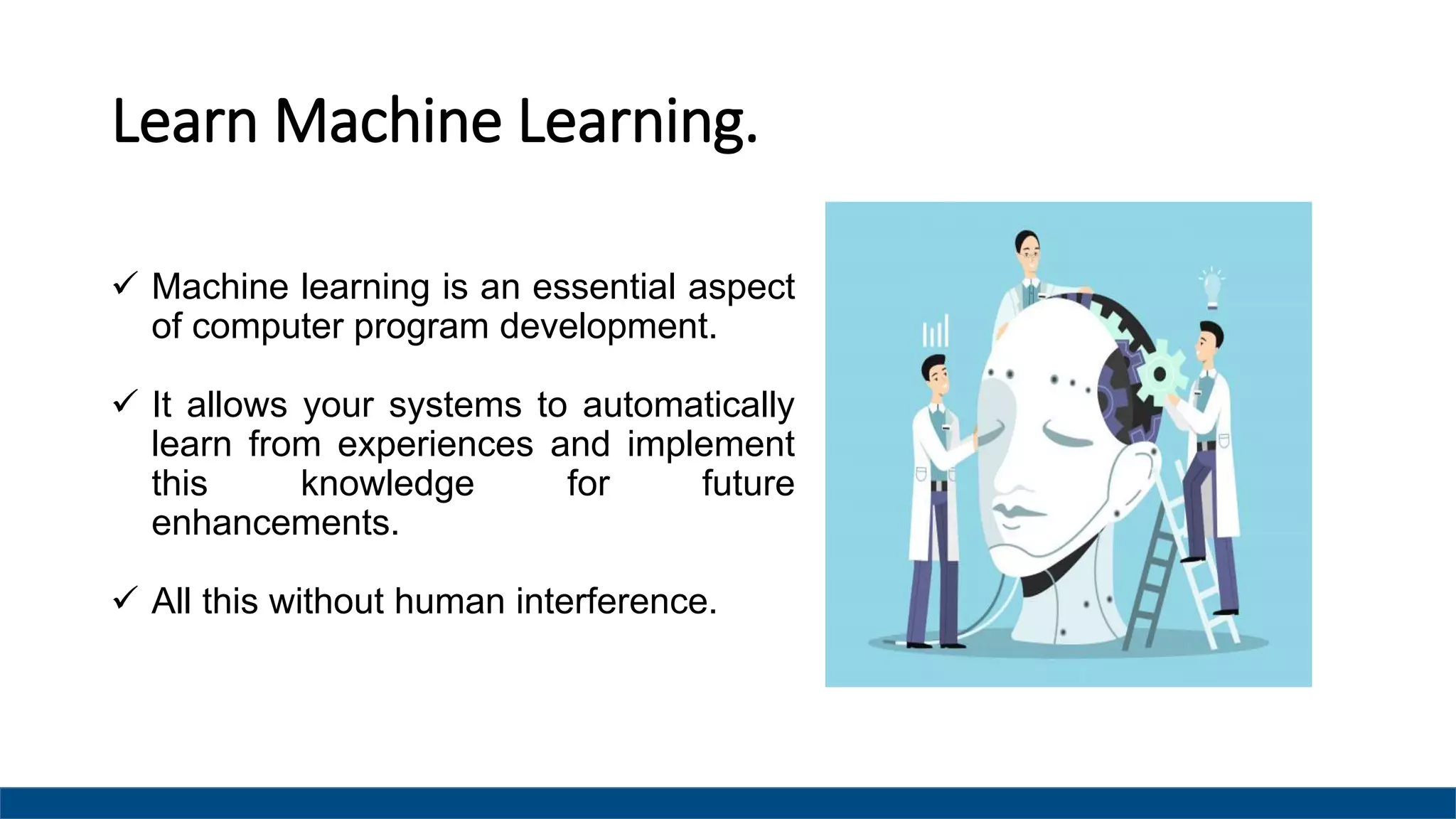
Learn Machine Learning.
 Machine learning is an essential aspect
of computer program development.
 It allows your systems to automatically
learn from experiences and implement
this knowledge for future
enhancements.
 All this without human interference.
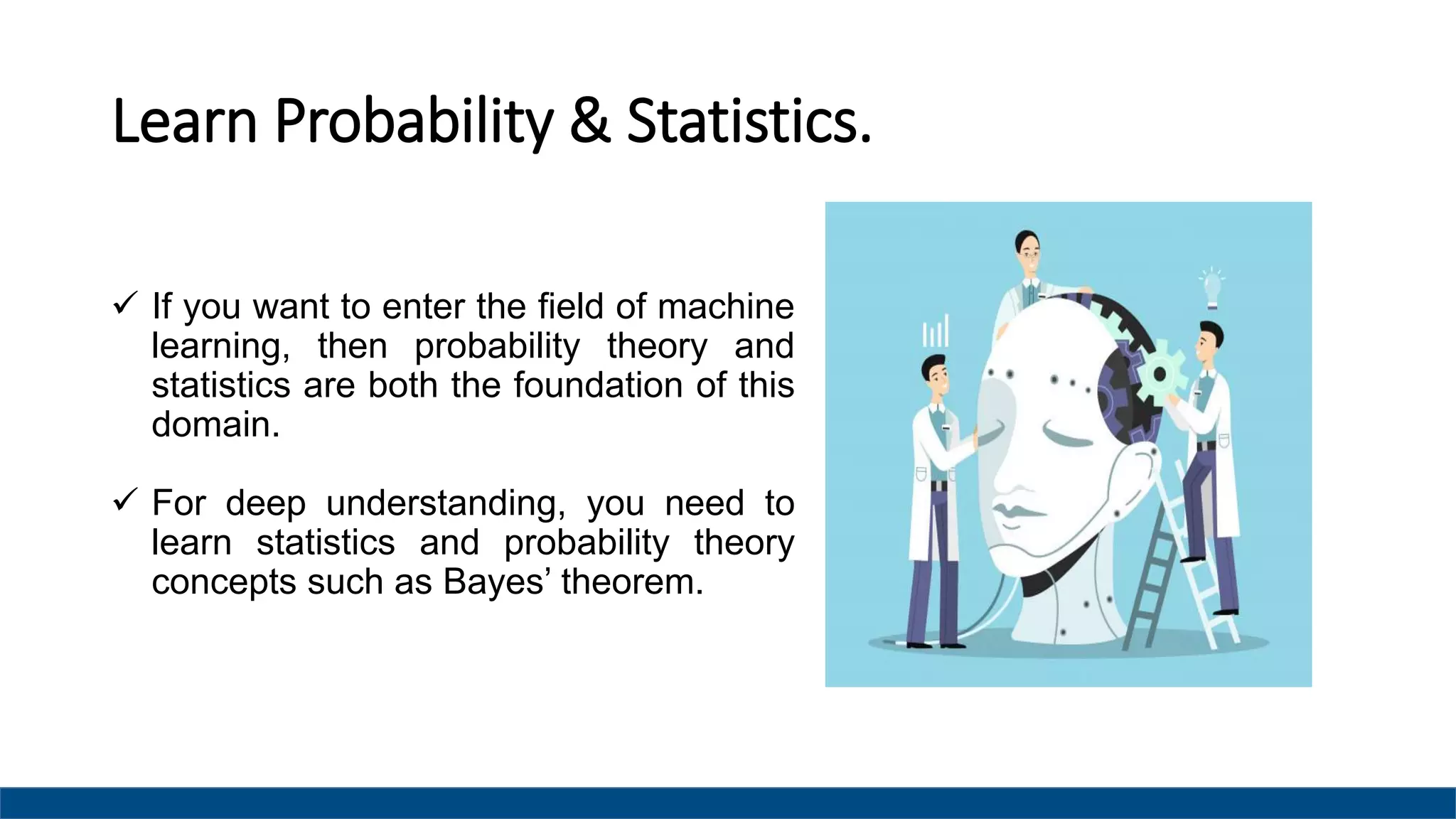
Learn Probability & Statistics.
 If you want to enter the field of machine
learning, then probability theory and
statistics are both the foundation of this
domain.
 For deep understanding, you need to
learn statistics and probability theory
concepts such as Bayes’ theorem.
Department Of Computer Science
Government Degree College Gulabad Dir (L)
KPK Pakistan | r2mpak@gmail.com
Thanks for the
Attention!

Lecture 1- Artificial Intelligence - Introduction

  • 1.
    CS552 Artificial Intelligence BSCS-5th Semester-2020 PreparedBy: Mr. Rahat Ullah r2mpak@gmail.com Department Of Computer Science Government Degree College Gulabad Dir (L) KPK Pakistan
  • 2.
    What is AI? In the simplest form, artificial intelligence means creating computing systems that have the ability to perform tasks like humans or even better than humans.  It is a field of computer science that develops machines or software having human intelligence such as speech recognition, decision making, and translation abilities.  Think of Siri and Alexa, and Google Assistant the artificial intelligence systems we utilize on a daily basis.
  • 3.
    Applied Artificial Intelligence? Applied artificial intelligence is the utilization of existing tools to extract useful information.  The open-source technology has a major role to play here for offering free, easy-to-use tools.  However, it is important to note that tools are not a magic box.  To utilize these tools effectively, You should know the potential biases and limitations of various models, methods, and techniques.
  • 4.
    Research Artificial Intelligence? Research artificial intelligence are a lot harder than applied AI.  This is due to the fact that research AI requires you to understand math, algorithm, and several other related disciplines.  For instance, how neural networks enhance the results of visual recognition.
  • 5.
    Types of AI? Artificial intelligence has various subdivisions and other technologies such as neural networks, machine learning, etc., but all these can be divided into three basic categories: 1. Weak Artificial Intelligence 2. True Artificial Intelligence 3. Artificial SuperIntelligence
  • 6.
    1. Weak ArtificialIntelligence?  Many artificial intelligence Experts points also define it as narrow AI.  It is called weak because it doesn’t have any intelligence or self-awareness.  For instance, an assistant developed using narrow AI would have the capability of resolving your queries, but this assistant won’t be able to have a conversation with you.  They may have a limited perspective and learning involved in this perspective.
  • 7.
    2. True ArtificialIntelligence?  True AI is also referred to as strong AI.  The machines built using this technology would react similarly to human beings.  The tasks that can be accomplished by human beings can also be achieved by these machines.  However, there is still a lot of research going on in this area that is yet to show results.
  • 8.
    3. Artificial Superintelligence? Artificial superintelligence is what makes us think that human extinction can be led by machines.  Many scientists believe that this field has the power to create machines that can be better than humans in every field including creativity and intellect.
  • 9.
    Importance of AI… AI is important in almost every field  Everything from self-driving cars to smartwatches, a lot of aspects in our day-to-day lives utilize the power of AI.  AI automates various repetitive tasks and learning. This technology has the ability to perform computerized, high-volume, and frequent tasks without human guidance.  AI imparts intelligence to various products. For instance, new smartphones that come with Google Assistant.
  • 10.
    Importance of AI… AI generates a progressive algorithm that learns over time. For example, if AI recommendations are being used in an e- commerce website, it means that this algorithm has the ability to predict what to recommend to users the next time.  AI provides high-level accuracy which was impossible even a decade ago. Think about it, how does your smartphone recognize your face?
  • 11.
    Domains Included inArtificial Intelligence.  Artificial intelligence is divided into several domains that work in specific fields.  Here are a few of these domains: 1. Robotics 2. Neural Networks 3. Fuzzy Logic System 4. Expert Systems 5. Natural Language Processing
  • 12.
    1. Robotics  Roboticsis a branch of artificial intelligence that focuses on creating artificial agents.  These robots work like humans and execute basic tasks such as picking, serving, moving, destroying, etc.  For example, many restaurants now have robots to serve food quickly to the relevant tables.
  • 13.
    2. Neural Networks Neural networks are really important in artificial intelligence. This domain forms algorithms to detect patterns and trends.  The name is based on neurons of the human brain as the structure of the neural networks resembles the human brain.  These systems learn with examples just as we learn from our mistakes or experiences.
  • 14.
    3. Fuzzy LogicSystems  Instead of explicitly stating true or false, a fuzzy logic system tells the degree of truth.  These systems even have the capability to process noisy, imprecise, or distorted inputs.
  • 15.
    4. Expert Systems Expert systems judge human decision- making capabilities.  It is a machine that judges how an organization or a human being behaves or reacts according to their experience and knowledge in a given field.
  • 16.
    5. Natural LanguageProcessing (NLP)  Natural language processing (NLP) is an essential field of artificial intelligence.  It helps in various tasks such as translation, sentiment analysis, named entity recognition, topic segmentation, and speech recognition.
  • 17.
    Applications Related toArtificial Intelligence.  New applications of artificial intelligence emerge every day.  There is no industry or field that is left untouched by this intelligent technology.  Below are some of the leading applications of Artificial Intelligence. i. Machine Translation ii. Speech Recognition iii. Chatbots iv. Facial Recognition v. Virtual Assistants
  • 18.
    1. Machine Translation Machine translation is a field of artificial intelligence and computational linguistics that allow translation from one language to another.  These systems additionally assist in estimating turnaround time, reviewing linguistics, analyzing files, managing language resource, etc.
  • 19.
    2. Speech Recognition Similar to machine translation, speech recognition is a field of artificial intelligence that recognizes the voice and converts it to text in a computer system.  Many effective speech recognition methods utilize long short-term memory system by deep learning.
  • 20.
    3. Chatbots  Chatbotsare definitely one of the most useful and valuable inventions of artificial intelligence.  These are messaging bots that respond to users and solve their queries.  These bots have natural language processing capabilities that help them to analyze the question raised by the user and answer it appropriately.
  • 21.
    4. Facial Recognition Facial recognition is an ability given to the machine to recognize the facial pattern of a human.  These machines compare the facial features of the human to the ones given in the database.  This artificial intelligence system is also referred to as biometric artificial intelligence as it analyzes the unique patterns of the face of an individual based on facial shape and texture.
  • 22.
    5. Virtual Assistants Virtual assistants are often used synonymously to chatbots but they are not.  Most of the virtual assistants now have the ability to interpret human voice and respond in a synthesized voice. For instance, Alexa.  It is also the basic function of virtual assistants to interpret voice commands and execute them accordingly.
  • 23.
    How To getStarted?  To get started with Artificial Intelligence, you need to first learn the basics of the following technologies. 1. SQL & Python 2. Machine Learning 3. Probability and Statistics
  • 24.
    Learn SQL andPython.  Python language allows you to maximize your knowledge of hardware. This language is used in collaboration with C and C++ and it delivers high- performance due to great libraries and toolkits.  SQL is necessary for effective functioning. For instance, if your AI needs to work on updated data and most of your data is in a relational database, then you need to know SQL for correct execution.
  • 25.
    Learn Machine Learning. Machine learning is an essential aspect of computer program development.  It allows your systems to automatically learn from experiences and implement this knowledge for future enhancements.  All this without human interference.
  • 26.
    Learn Probability &Statistics.  If you want to enter the field of machine learning, then probability theory and statistics are both the foundation of this domain.  For deep understanding, you need to learn statistics and probability theory concepts such as Bayes’ theorem.
  • 27.
    Department Of ComputerScience Government Degree College Gulabad Dir (L) KPK Pakistan | r2mpak@gmail.com Thanks for the Attention!