



•Derived from Equine Areteritis virus
•Spherical virions
•50-70 nm in diameter
•Enveloped
•Linear positive sense
•Single-stranded RNA
•13-15 kb in size
•Infectious genomic RNA
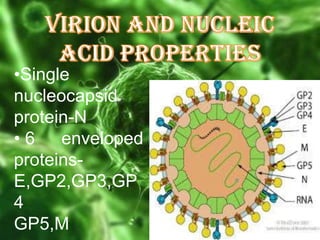
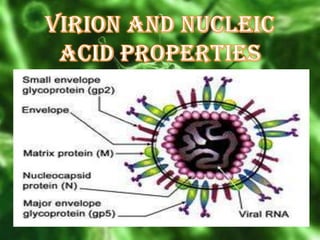
•Single
nucleocapsid
protein-N
• 6 enveloped
proteinsE,GP2,GP3,GP
4
GP5,M
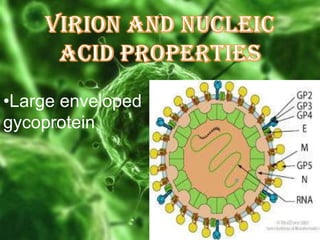
•Large enveloped
gycoprotein
Order: Nidovirales
Family: Arteriviridae
Genus: Arterivirus
Species: Equine Arterivirus
Lactate Dehydrogenase
Elevating
virus
Porcine Reproductive and
Respiratory Syndrome Virus
•Replicate mostly in macrophages
•Very minimal in other cell types
•Host range is highly restricted
•Can subvert protective host innate
immune responses
•Apoptosis
•IFN signaling pathways
•Receptors for PRRS
1. CD163
2.Sialoadhesin
3. Heparin Sulfate
Glycosaminoglycans
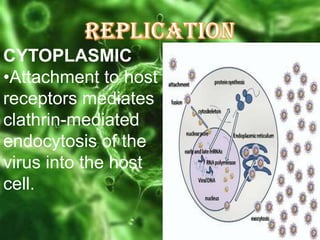
CYTOPLASMIC
•Attachment to host
receptors mediates
clathrin-mediated
endocytosis of the
virus into the host
cell.
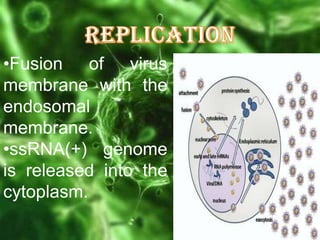
•Fusion of virus
membrane with the
endosomal
membrane.
•ssRNA(+) genome
is released into the
cytoplasm.
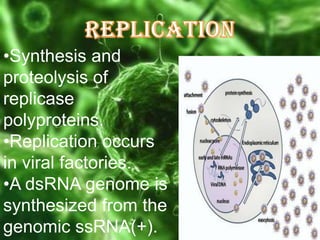
•Synthesis and
proteolysis of
replicase
polyproteins.
•Replication occurs
in viral factories.
•A dsRNA genome is
synthesized from the
genomic ssRNA(+).
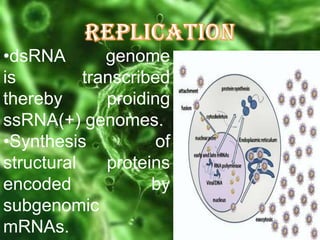
•dsRNA
genome
is
transcribed
thereby
proiding
ssRNA(+) genomes.
•Synthesis
of
structural
proteins
encoded
by
subgenomic
mRNAs.
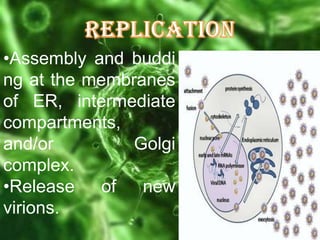
•Assembly and buddi
ng at the membranes
of ER, intermediate
compartments,
and/or
Golgi
complex.
•Release
of
new
virions.
1. Equine Viral Arteritis
2. Porcine Reproductie and
Respiratory Syndrome
3. Lactate Dehydrogenase Elevating
Disease
4. Simian Hemorrhagic Fever
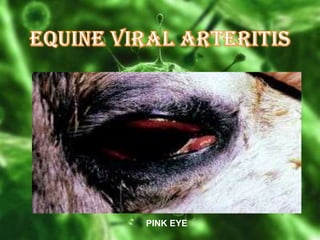
PINK EYE
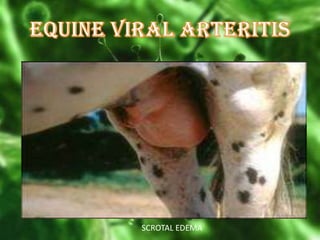
SCROTAL EDEMA
•1st designated as “mystery swine
disease”
•“lelystad virus”-Netherland
•Causative virus first appeared-US,
Asia, Europe
•Infects only domestic and wild pigs
•initially characterized by
•Anorexia
•Fever
•Lethargy
•Affected animals:
•Dyspnea/ hyperpnea
•Transient hyperemia
•Cyanosis of the extremities
Dry sows-first month of infection
•Short periods of inappetence
•The body temperature may be
elevated
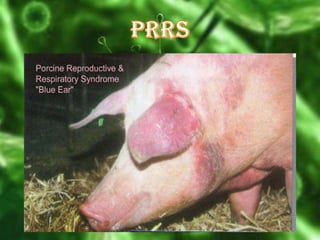
•Transient discoloration (blueing) of the
ears
•Premature births
•Sows in late gestation
•Abortion
•Premature births
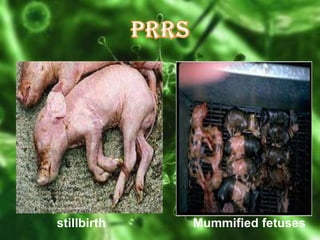
•Stillbirths
•Mummified fetuses
stillbirth

Mummified fetuses
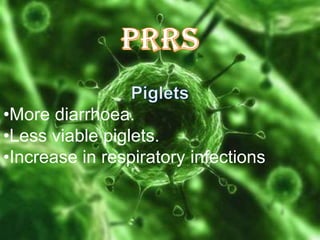
•More diarrhoea.
•Less viable piglets.
•Increase in respiratory infections
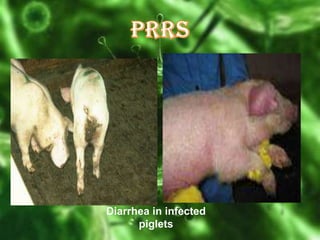
Diarrhea in infected
piglets
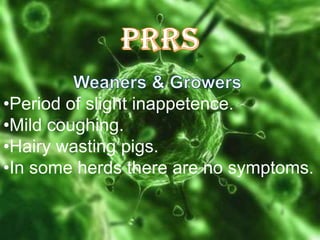
•Period of slight inappetence.
•Mild coughing.
•Hairy wasting pigs.
•In some herds there are no symptoms.
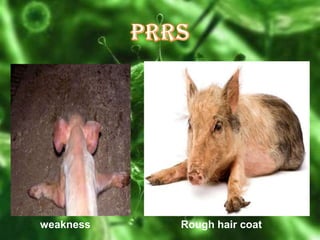
weakness

Rough hair coat
•Inappetence
•Increased body temperature
•Lethargy
•Loss of libido
•Lowered fertility
•Poor litter sizes
•Lowered sperm output
•Droplet contamination
•Nasal secretions, saliva, feces and
urine
•Permanently populated houses
•Movement of carrier pigs.
•Airborne transmission
•Mechanical means via faeces, dust,
droplets and contaminated equipment,
etc.
•Contaminated boots and clothing.
•Vehicles.
•Artificial insemination
•Mortality is high
•Direct contact
•Through secretions
•Excretions
•Transplacental transmission
PATHOGENESIS
• virus replicates in the macrophages
of the lungs, lymphoid tissue and
endothelial cells
•Viremia-24 hours
Lesions of acute infection
•Lymph node enlargement
•Intestinal pneumonia
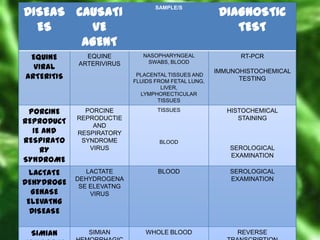
DISEAS CAUSATI
ES
VE
AGENT

SAMPLE/S

DIAGNOSTIC
TEST

NASOPHARYNGEAL
SWABS, BLOOD

RT-PCR

EQUINE
VIRAL
ARTERITIS

EQUINE
ARTERIVIRUS

PORCINE
REPRODUCT
IE AND
RESPIRATO
RY
SYNDROME

PORCINE
REPRODUCTIE
AND
RESPIRATORY
SYNDROME
VIRUS

TISSUES

LACTATE
DEHYDROGE
GENASE
ELEVATNG
DISEASE

LACTATE
DEHYDROGENA
SE ELEVATNG
VIRUS

BLOOD

SEROLOGICAL
EXAMINATION

SIMIAN

SIMIAN

WHOLE BLOOD

REVERSE

PLACENTAL TISSUES AND
FLUIDS FROM FETAL LUNG,
LIVER,
LYMPHORECTICULAR
TISSUES

IMMUNOHISTOCHEMICAL
TESTING

HISTOCHEMICAL
STAINING

BLOOD

SEROLOGICAL
EXAMINATION
•Infected pigs are immune to reinfection
•Vaccination-live attenuated, inactivated
•limit the frequency of seed stock
introductions to the sow herd
•assure that the replacement gilts be
well-acclimatized to the PRRS virus
•Boars introduced into negative herds
should be quarantined for 60-90 days
after purchase and confirmed negative
serologically
•depopulate, clean and disinfect the
facilities and, after a few weeks,
repopulate with stock free of PRRS
•Control is by exclusion
•no specific treatment
•Broad-spectrum antibiotics.
•Anti-inflammatory products (e.g.
aspirin)
• Other helpful techniques
• Early weaning and isolation of piglets
•Regular serologic monitoring
• Testing (ELISA, PCR and IFA)
•Removal of persistent carriers in herds
•improving biosecurity.
Arteriviridae

Arteriviridae