For many people Art is a specific thing; a painting, sculpture or
photograph, a dance, a poem or a play. It is all of these things, and more.
They are mediums of artistic expression. Webster’s New Collegiate
dictionary defines art as “The conscious use of skill and creative
imagination especially in the production of aesthetic objects.” Yet art is
much more than a medium, or words on a page. It is the expression of
our experience.
Joseph Brodsky hints at a definition of
art in his poem “New Life“ :Ultimately,
one’s unbound curiosity about these empty zones,
about these objectless vistas, is what art seems to be
all about.”
Art is uniquely human and tied directly to culture. It takes the
ordinary and makes it extraordinary. It asks questions about who
we are, what we value, the meaning of beauty and the human
condition. As an expressive medium it allows us to experience
sublime joy, deep sorrow, confusion and clarity. It tests our
strengths, vulnerabilities and resolve. It gives voice to ideas and
feelings, connects us to the past, reflects the present and
anticipates the future.
Along these lines, art history, combined with anthropology and
literature, are three main sources in observing, recording and
interpreting our human past. Visual art is a rich and complex subject
whose definition is in flux as the culture around it changes. Because
of this, how we define art is in essence a question of agreement. In
this respect, we can look again to the dictionary’s definition for an
understanding of exactly what to look for when we proclaim
something as ‘art’.
Major constituents of the arts include
visual arts (including architecture, ceramics,
drawing, filmmaking, painting, photography,
and sculpting), literary arts (including
fiction, drama, poetry, and prose),
performing arts (including dance, music,
and theatre), and culinary arts (including
cooking, chocolate making and winemaking).
Two basic considerations we need to be acquainted with are form: the
physical and visible characteristics inherent in works of art, and content: the
meaning we derive from them. Formal distinctions include a work’s size,
medium (painting, drawing, sculpture or other kind of work) and
descriptions of compositional elements such as the lines, shapes and colors
involved. Issues of content include any visual clues that provide an
understanding of what the art tells us. Sometimes an artwork’s content is
vague or hidden and needs more information than is present in the work
itself. Ultimately these two terms are roped together in the climb to
understand what art has to offer us. As we examine art from different time
periods, styles and cultures, the issues of form and content will apply to all
of them.
Aesthetics is the philosophical argument about the nature of beauty. It’s
an idea central to any exploration of art. Aesthetics deals with notions of
taste, cultural conventions – ideas of art being ‘good’ and ‘bad’ based on
specific cultural information and beliefs and the judgments we make
based on our perceptions.
As deep as visual art is embedded in the fabric of our lives, it still is the
source of controversy and irony. It thrives on common experience yet
contradicts ideas of ourselves. Art is part of the culture it’s created in,
but can reflect many cultures at once. From where you and I stand today
art has become probably more complex than ever in its use of imagery,
mediums and meanings. We need a way to access the visual information
of our society, of past cultures, and cultures not known to us to have a
way to understand what we are looking at.
The first level in approaching art is learning to LOOK at it. In future discussions
we will spend more time in pure observation than you probably have done before.
Generally, we tend to look at art in terms of "liking" it FIRST, and "looking" at it
later. From this perspective, the subjective (knowledge residing in the emotions
and thoughts of the viewer) almost completely dominates
our way of looking at art. In the arts, it’s especially important to begin to
develop an informed or objective opinion rather than just an instinctual reaction.
An objective view is one that focuses on the
object’s physical characteristics as the main source of information. This does
not mean that you will remove or invalidate your subjective feelings about a work,
in fact you will find that the more informed you become, the more artwork will
affect you emotionally and intellectually. It does mean that you will learn alternative
ways to approach art, ways that allow you to find clues to meaning and to
understand how art reflects and affects our lives.
It’s complex, but the satisfaction of looking at art comes from exploring the
work to find meaning, not shying away from it simply because we may not
understand it.
Art history spans the entire history of humankind, from prehistoric times
to the twenty-first century. Whether you like to observe caveman paintings
or Botticelli angels, you can find visual arts that challenge your creative side
and inspire you to find beauty in manmade forms. In modern times, art
history has emerged as a discipline that specializes in teaching people how to
evaluate and interpret works of art based on their own perspective. Art
history has frequently been criticized for its subjectivity because the
definition of what is beautiful varies from individual to individual. Learning
to evaluate what you see by building on the art forms you already know can
develop your aesthetic understanding.
Claude Monet once said, “It’s on the strength of observation and
reflection that one finds a way. So we must dig and delve unceasingly.”
In keeping with Monet, consider how to observe as many works of art as
possible. You will develop a sense of your favorite styles and time periods,
and you will be able to use the vocabulary of art to discuss your
appreciation of art with others. If you love Botticelli, you will be able to
recognize the theme he chooses for each painting and which symbols and
figures he uses most often during the Renaissance.
Combining exposure to art history with the desire to foster art
appreciation in others represents a happy medium. The art teacher or art
historian can inspire you with a survey of the many time periods in art
history. For example, you can become a huge fan of the Renaissance
because, like the French, Dutch, Italian, and Spanish masters, you share the
same desire to reconcile humanism with human religion.
Art history requires you to study and describe what you see in terms of the
design elements of line, shape, color, value, and texture. Once you write a
response to one work of art, you can compare it to another work of art. An
alternative is to make comparisons and contrasts between artists and their
artistic works with the mind’s eye. As you explore the fascinating world of
art, a beautiful collection of thousands of years of human experience, you
will want to travel farther from your home to see works of art in person.
The great thing about the Internet is that the world’s art repositories bring
famous works of visual art to you through online exhibitions and virtual
tours. However, you decide to develop your sense of art history and
appreciation, look for every opportunity to enrich your life with paintings,
prints, mixed media, sculpture, and drawings.
Don’t forget to share your art appreciation with others because art makes
every ordinary life just a little bit more exquisite!
The term art appreciation is referred to the knowledge of the general
and everlasting qualities that classify all great art. It is seen used to refer
to the exploration of visual art forms or the introduction of basic
principles of visual literacy. It refers to analyzing the form of an artwork
to general audiences to enhance their enjoyment of such works of art. It
may be analyzed without reference to subject matter, symbolism or
historical context. Art appreciation can be subjective depending on
personal preference to aesthetics and form, or it can be based on several
elements and principle of design and also depends on social and cultural
acceptance. Most of the modern art critics and art historians draw back
from this term, underrating art appreciation as demanding too little
serious thought.
Because it informs, entertains and betters us, bringing us closer
together as a society in the process. But at its best art is a true
celebration of humanity – and we can know for a fact our
descendants will care about it as much as we do! Creativity is the act
of turning new and imaginative ideas into reality. Creativity is
characterized by the ability to perceive the world in new ways, to find
hidden patterns, to make connections between seemingly unrelated
phenomena, and to generate solutions. Creativity involves two
processes: thinking, then producing. If you have ideas, but don’t act
on them, you are imaginative but not creative. ( Marcelo Negri Soares,
2015).
Creativity is the intellectual ability to make creations, inventions, and
discoveries that brings novel relations, entities, and/or unexpected solutions
into existence [Wang, 2009, 2013]. Creativity is a gifted ability of humans in
thinking, inference, problem solving, and product development. - The
cognitive foundation of creativity is a new and unusual relation,
neurophysiological represented by a synaptic connection, between two or
more objects that generates a novel and meaningful concept, solution,
method, explanation, or product. - As a cognitive process, the first-phase of
creativity is searchbased for discovering a novel relation; while the second-
phase of creativity known as justification is inductive and logical.
Creativity drives us to not only create but to innovate. Consider all of the
minds behind what it took to give us the smartphone of today. Thousands
of individuals, from the coders to the marketers to the app developers,
conspired to bring something into existence that once was unimaginable.
Not only does it have a significant impact on their lives, but as one of the
greatest single developments of any century, the smartphone has profoundly
impacted the day to day life of every person who owns one.
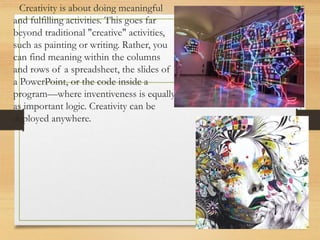
Creativity is about doing meaningful
and fulfilling activities. This goes far
beyond traditional "creative" activities,
such as painting or writing. Rather, you
can find meaning within the columns
and rows of a spreadsheet, the slides of
a PowerPoint, or the code inside a
program—where inventiveness is equally
as important logic. Creativity can be
deployed anywhere.
Art causes people to look a little closer at social issues, at other people
and their emotions, at the environment that surrounds them, and the
everyday objects and life forms around them. Art helps them see what is
there but not easily perceived. The artist brings out that which cannot be
seen or felt easily. When society has clarity on issues, opportunities for
change in thought exist, as well as an appreciation of the message behind
the art. Art can cause people to re-examine their thinking on the subject
that’s put before them.
Art is usually about self-expression because artists have to feel strongly
enough about something to try and put it into a form that they, and others,
can come to terms with. This product of their self-expression can help
others because there will always be people who feel the same way but
cannot express it themselves. These people will identify with the artist and
draw encouragement, purpose, and excitement about the thing expressed.
One of the functions of the artist is to make a statement of some kind. It
may be a simple statement, the beauty of the landscape for example, but it is
a statement. In one way or another, artists are trying to communicate an
idea, an emotion, or a purpose in their work.
Art as Decoration or
Ornamentation
Unfortunately, most people still think of art as decoration. The
problem with thinking that way about a piece of art is that people get
tired of the decoration and want to change the décor after a few years.
Good art does not go out of style. I like to think of art as a separate
entity. It may not match the room. There are lots of cheap prints out
there that can be used as decoration and, in a way, yes, it's art, and yes, it's
decoration. But the idea that art is decoration undervalues a work.
The combined words "arts and culture" have been around for a long
time. In many ways what sits in national museums should reflect a
society. But from what I understand and have seen in the big galleries, it
doesn’t seem to reflect the average person on the street. Some of the art
in the museums can actually add to the impoverishment. But, if art builds
up the human spirit rather than breaking it down, then it can build up a
culture. We make art because there is something inside the creative
person that needs to get out. The poet, musician, actor, and visual artist
all have a desire to express what they feel and to create something of
great value. It’s a type of therapy or a form of meditation. Many do art
for the pure joy of it.
ARTS PPT 1.pptx
ARTS PPT 1.pptx

ARTS PPT 1.pptx

  • 2.
    For many peopleArt is a specific thing; a painting, sculpture or photograph, a dance, a poem or a play. It is all of these things, and more. They are mediums of artistic expression. Webster’s New Collegiate dictionary defines art as “The conscious use of skill and creative imagination especially in the production of aesthetic objects.” Yet art is much more than a medium, or words on a page. It is the expression of our experience.
  • 3.
    Joseph Brodsky hintsat a definition of art in his poem “New Life“ :Ultimately, one’s unbound curiosity about these empty zones, about these objectless vistas, is what art seems to be all about.”
  • 4.
    Art is uniquelyhuman and tied directly to culture. It takes the ordinary and makes it extraordinary. It asks questions about who we are, what we value, the meaning of beauty and the human condition. As an expressive medium it allows us to experience sublime joy, deep sorrow, confusion and clarity. It tests our strengths, vulnerabilities and resolve. It gives voice to ideas and feelings, connects us to the past, reflects the present and anticipates the future.
  • 5.
    Along these lines,art history, combined with anthropology and literature, are three main sources in observing, recording and interpreting our human past. Visual art is a rich and complex subject whose definition is in flux as the culture around it changes. Because of this, how we define art is in essence a question of agreement. In this respect, we can look again to the dictionary’s definition for an understanding of exactly what to look for when we proclaim something as ‘art’.
  • 6.
    Major constituents ofthe arts include visual arts (including architecture, ceramics, drawing, filmmaking, painting, photography, and sculpting), literary arts (including fiction, drama, poetry, and prose), performing arts (including dance, music, and theatre), and culinary arts (including cooking, chocolate making and winemaking).
  • 7.
    Two basic considerationswe need to be acquainted with are form: the physical and visible characteristics inherent in works of art, and content: the meaning we derive from them. Formal distinctions include a work’s size, medium (painting, drawing, sculpture or other kind of work) and descriptions of compositional elements such as the lines, shapes and colors involved. Issues of content include any visual clues that provide an understanding of what the art tells us. Sometimes an artwork’s content is vague or hidden and needs more information than is present in the work itself. Ultimately these two terms are roped together in the climb to understand what art has to offer us. As we examine art from different time periods, styles and cultures, the issues of form and content will apply to all of them.
  • 8.
    Aesthetics is thephilosophical argument about the nature of beauty. It’s an idea central to any exploration of art. Aesthetics deals with notions of taste, cultural conventions – ideas of art being ‘good’ and ‘bad’ based on specific cultural information and beliefs and the judgments we make based on our perceptions. As deep as visual art is embedded in the fabric of our lives, it still is the source of controversy and irony. It thrives on common experience yet contradicts ideas of ourselves. Art is part of the culture it’s created in, but can reflect many cultures at once. From where you and I stand today art has become probably more complex than ever in its use of imagery, mediums and meanings. We need a way to access the visual information of our society, of past cultures, and cultures not known to us to have a way to understand what we are looking at.
  • 9.
    The first levelin approaching art is learning to LOOK at it. In future discussions we will spend more time in pure observation than you probably have done before. Generally, we tend to look at art in terms of "liking" it FIRST, and "looking" at it later. From this perspective, the subjective (knowledge residing in the emotions and thoughts of the viewer) almost completely dominates our way of looking at art. In the arts, it’s especially important to begin to develop an informed or objective opinion rather than just an instinctual reaction. An objective view is one that focuses on the object’s physical characteristics as the main source of information. This does not mean that you will remove or invalidate your subjective feelings about a work, in fact you will find that the more informed you become, the more artwork will affect you emotionally and intellectually. It does mean that you will learn alternative ways to approach art, ways that allow you to find clues to meaning and to understand how art reflects and affects our lives. It’s complex, but the satisfaction of looking at art comes from exploring the work to find meaning, not shying away from it simply because we may not understand it.
  • 10.
    Art history spansthe entire history of humankind, from prehistoric times to the twenty-first century. Whether you like to observe caveman paintings or Botticelli angels, you can find visual arts that challenge your creative side and inspire you to find beauty in manmade forms. In modern times, art history has emerged as a discipline that specializes in teaching people how to evaluate and interpret works of art based on their own perspective. Art history has frequently been criticized for its subjectivity because the definition of what is beautiful varies from individual to individual. Learning to evaluate what you see by building on the art forms you already know can develop your aesthetic understanding.
  • 11.
    Claude Monet oncesaid, “It’s on the strength of observation and reflection that one finds a way. So we must dig and delve unceasingly.” In keeping with Monet, consider how to observe as many works of art as possible. You will develop a sense of your favorite styles and time periods, and you will be able to use the vocabulary of art to discuss your appreciation of art with others. If you love Botticelli, you will be able to recognize the theme he chooses for each painting and which symbols and figures he uses most often during the Renaissance. Combining exposure to art history with the desire to foster art appreciation in others represents a happy medium. The art teacher or art historian can inspire you with a survey of the many time periods in art history. For example, you can become a huge fan of the Renaissance because, like the French, Dutch, Italian, and Spanish masters, you share the same desire to reconcile humanism with human religion.
  • 12.
    Art history requiresyou to study and describe what you see in terms of the design elements of line, shape, color, value, and texture. Once you write a response to one work of art, you can compare it to another work of art. An alternative is to make comparisons and contrasts between artists and their artistic works with the mind’s eye. As you explore the fascinating world of art, a beautiful collection of thousands of years of human experience, you will want to travel farther from your home to see works of art in person. The great thing about the Internet is that the world’s art repositories bring famous works of visual art to you through online exhibitions and virtual tours. However, you decide to develop your sense of art history and appreciation, look for every opportunity to enrich your life with paintings, prints, mixed media, sculpture, and drawings. Don’t forget to share your art appreciation with others because art makes every ordinary life just a little bit more exquisite!
  • 14.
    The term artappreciation is referred to the knowledge of the general and everlasting qualities that classify all great art. It is seen used to refer to the exploration of visual art forms or the introduction of basic principles of visual literacy. It refers to analyzing the form of an artwork to general audiences to enhance their enjoyment of such works of art. It may be analyzed without reference to subject matter, symbolism or historical context. Art appreciation can be subjective depending on personal preference to aesthetics and form, or it can be based on several elements and principle of design and also depends on social and cultural acceptance. Most of the modern art critics and art historians draw back from this term, underrating art appreciation as demanding too little serious thought.
  • 15.
    Because it informs,entertains and betters us, bringing us closer together as a society in the process. But at its best art is a true celebration of humanity – and we can know for a fact our descendants will care about it as much as we do! Creativity is the act of turning new and imaginative ideas into reality. Creativity is characterized by the ability to perceive the world in new ways, to find hidden patterns, to make connections between seemingly unrelated phenomena, and to generate solutions. Creativity involves two processes: thinking, then producing. If you have ideas, but don’t act on them, you are imaginative but not creative. ( Marcelo Negri Soares, 2015).
  • 16.
    Creativity is theintellectual ability to make creations, inventions, and discoveries that brings novel relations, entities, and/or unexpected solutions into existence [Wang, 2009, 2013]. Creativity is a gifted ability of humans in thinking, inference, problem solving, and product development. - The cognitive foundation of creativity is a new and unusual relation, neurophysiological represented by a synaptic connection, between two or more objects that generates a novel and meaningful concept, solution, method, explanation, or product. - As a cognitive process, the first-phase of creativity is searchbased for discovering a novel relation; while the second- phase of creativity known as justification is inductive and logical.
  • 17.
    Creativity drives usto not only create but to innovate. Consider all of the minds behind what it took to give us the smartphone of today. Thousands of individuals, from the coders to the marketers to the app developers, conspired to bring something into existence that once was unimaginable. Not only does it have a significant impact on their lives, but as one of the greatest single developments of any century, the smartphone has profoundly impacted the day to day life of every person who owns one.
  • 18.
    Creativity is aboutdoing meaningful and fulfilling activities. This goes far beyond traditional "creative" activities, such as painting or writing. Rather, you can find meaning within the columns and rows of a spreadsheet, the slides of a PowerPoint, or the code inside a program—where inventiveness is equally as important logic. Creativity can be deployed anywhere.
  • 20.
    Art causes peopleto look a little closer at social issues, at other people and their emotions, at the environment that surrounds them, and the everyday objects and life forms around them. Art helps them see what is there but not easily perceived. The artist brings out that which cannot be seen or felt easily. When society has clarity on issues, opportunities for change in thought exist, as well as an appreciation of the message behind the art. Art can cause people to re-examine their thinking on the subject that’s put before them.
  • 22.
    Art is usuallyabout self-expression because artists have to feel strongly enough about something to try and put it into a form that they, and others, can come to terms with. This product of their self-expression can help others because there will always be people who feel the same way but cannot express it themselves. These people will identify with the artist and draw encouragement, purpose, and excitement about the thing expressed. One of the functions of the artist is to make a statement of some kind. It may be a simple statement, the beauty of the landscape for example, but it is a statement. In one way or another, artists are trying to communicate an idea, an emotion, or a purpose in their work.
  • 23.
    Art as Decorationor Ornamentation
  • 24.
    Unfortunately, most peoplestill think of art as decoration. The problem with thinking that way about a piece of art is that people get tired of the decoration and want to change the décor after a few years. Good art does not go out of style. I like to think of art as a separate entity. It may not match the room. There are lots of cheap prints out there that can be used as decoration and, in a way, yes, it's art, and yes, it's decoration. But the idea that art is decoration undervalues a work.
  • 25.
    The combined words"arts and culture" have been around for a long time. In many ways what sits in national museums should reflect a society. But from what I understand and have seen in the big galleries, it doesn’t seem to reflect the average person on the street. Some of the art in the museums can actually add to the impoverishment. But, if art builds up the human spirit rather than breaking it down, then it can build up a culture. We make art because there is something inside the creative person that needs to get out. The poet, musician, actor, and visual artist all have a desire to express what they feel and to create something of great value. It’s a type of therapy or a form of meditation. Many do art for the pure joy of it.