The Getty Museum 
By: Jacqueline Hannah Kaplan 
Anthropology 121 
Dr. Leanna Wolfe 
December 10, 2014
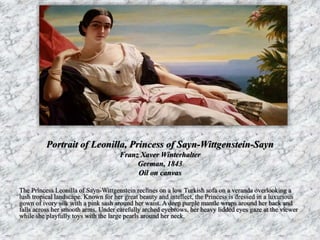
Portrait of Leonilla, Princess of Sayn-Wittgenstein-Sayn 
Franz XaverWinterhalter 
German, 1843 
Oil on canvas 
The Princess Leonilla of Sayn-Wittgenstein reclines on a low Turkish sofa on a veranda overlooking a 
lush tropical landscape. Known for her great beauty and intellect, the Princess is dressed in a luxurious 
gown of ivory silk with a pink sash around her waist. A deep purple mantle wraps around her back and 
falls across her smooth arms. Under carefully arched eyebrows, her heavy lidded eyes gaze at the viewer 
while she playfully toys with the large pearls around her neck.
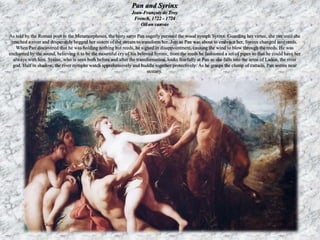
Pan and Syrinx 
Jean-François de Troy 
French, 1722 - 1724 
Oil on canvas 
As told by the Roman poet in the Metamorphoses, the lusty satyr Pan eagerly pursued the wood nymph Syrinx. Guarding her virtue, she ran until she 
reached a river and desperately begged her sisters of the stream to transform her. Just as Pan was about to embrace her, Syrinx changed into reeds. 
When Pan discovered that he was holding nothing but reeds, he sighed in disappointment, causing the wind to blow through the reeds. He was 
enchanted by the sound, believing it to be the mournful cry of his beloved Syrinx; from the reeds he fashioned a set of pipes so that he could have her 
always with him. Syrinx, who is seen both before and after the transformation, looks fearfully at Pan as she falls into the arms of Ladon, the river 
god. Half in shadow, the river nymphs watch apprehensively and huddle together protectively. As he grasps the clump of cattails, Pan seems near 
ecstasy.
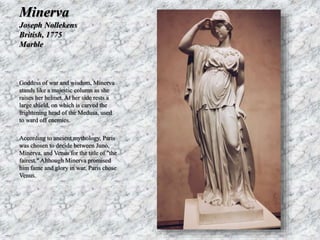
Minerva 
Joseph Nollekens 
British, 1775 
Marble 
Goddess of war and wisdom, Minerva 
stands like a majestic column as she 
raises her helmet. At her side rests a 
large shield, on which is carved the 
frightening head of the Medusa, used 
to ward off enemies. 
According to ancient mythology, Paris 
was chosen to decide between Juno, 
Minerva, and Venus for the title of "the 
fairest." Although Minerva promised 
him fame and glory in war, Paris chose 
Venus.
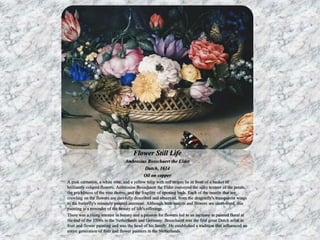
Flower Still Life 
Ambrosius Bosschaert the Elder 
Dutch, 1614 
Oil on copper 
A pink carnation, a white rose, and a yellow tulip with red stripes lie in front of a basket of 
brilliantly colored flowers. Ambrosius Bosschaert the Elder conveyed the silky texture of the petals, 
the prickliness of the rose thorns, and the fragility of opening buds. Each of the insects that are 
crawling on the flowers are carefully described and observed, from the dragonfly's transparent wings 
to the butterfly's minutely painted antennae. Although both insects and flowers are short-lived, this 
painting is a reminder of the beauty of life's offerings. 
There was a rising interest in botany and a passion for flowers led to an increase in painted floral at 
the end of the 1500s in the Netherlands and Germany. Bosschaert was the first great Dutch artist in 
fruit and flower painting and was the head of his family. He established a tradition that influenced an 
entire generation of fruit and flower painters in the Netherlands.
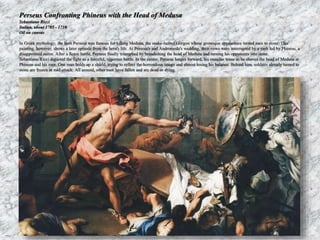
Perseus Confronting Phineus with the Head of Medusa 
Sebastiano Ricci 
Italian, about 1705 - 1710 
Oil on canvas 
In Greek mythology, the hero Perseus was famous for killing Medusa, the snake-haired Gorgon whose grotesque appearance turned men to stone. This 
painting, however, shows a later episode from the hero's life. At Perseus's and Andromeda's wedding, their vows were interrupted by a mob led by Phineus, a 
disappointed suitor. After a fierce battle, Perseus finally triumphed by brandishing the head of Medusa and turning his opponents into stone. 
Sebastiano Ricci depicted the fight as a forceful, vigorous battle. In the center, Perseus lunges forward, his muscles tense as he shoves the head of Medusa at 
Phineus and his men. One man holds up a shield, trying to reflect the horrendous image and almost losing his balance. Behind him, soldiers already turned to 
stone are frozen in mid-attack. All around, other men have fallen and are dead or dying.
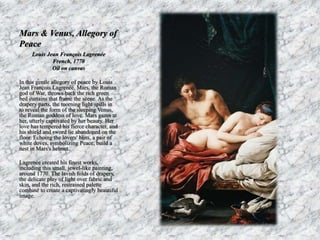
Mars & Venus, Allegory of 
Peace 
Louis Jean François Lagrenée 
French, 1770 
Oil on canvas 
In this gentle allegory of peace by Louis 
Jean François Lagrenée, Mars, the Roman 
god of War, throws back the rich green 
bed curtains that frame the scene. As the 
drapery parts, the morning light spills in 
to reveal the form of the sleeping Venus, 
the Roman goddess of love. Mars gazes at 
her, utterly captivated by her beauty. Her 
love has tempered his fierce character, and 
his shield and sword lie abandoned on the 
floor. Echoing the lovers' bliss, a pair of 
white doves, symbolizing Peace, build a 
nest in Mars's helmet. 
Lagrenée created his finest works, 
including this small, jewel-like painting, 
around 1770. The lavish folds of drapery, 
the delicate play of light over fabric and 
skin, and the rich, restrained palette 
combine to create a captivatingly beautiful 
image.
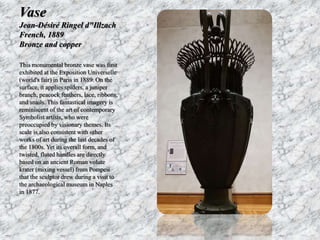
Vase 
Jean-Désiré Ringel d"Illzach 
French, 1889 
Bronze and copper 
This monumental bronze vase was first 
exhibited at the Exposition Universelle 
(world's fair) in Paris in 1889. On the 
surface, it applies spiders, a juniper 
branch, peacock feathers, lace, ribbons, 
and snails. This fantastical imagery is 
reminiscent of the art of contemporary 
Symbolist artists, who were 
preoccupied by visionary themes. Its 
scale is also consistent with other 
works of art during the last decades of 
the 1800s. Yet its overall form, and 
twisted, fluted handles are directly 
based on an ancient Roman volute 
krater (mixing vessel) from Pompeii 
that the sculptor drew during a visit to 
the archaeological museum in Naples 
in 1877.
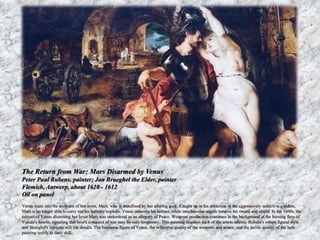
The Return from War: Mars Disarmed by Venus 
Peter Paul Rubens, painter; Jan Brueghel the Elder, painter 
Flemish, Antwerp, about 1610 - 1612 
Oil on panel 
Venus leans into the embrace of her lover, Mars, who is transfixed by her alluring gaze. Caught up in his attraction to the aggressively seductive goddess, 
Mars is no longer able to carry out his military exploits. Venus removes his helmet, while mischievous angels remove his sword and shield. In the 1600s, the 
subject of Venus disarming her lover Mars was understood as an allegory of Peace. Weapons production continues in the background at the burning fires of 
Vulcan's hearth, signaling that love's conquest of war may be only temporary. This painting displays each of the artists talents: Rubens's robust figural style 
and Brueghel's intricate still life details. The luminous figure of Venus, the reflective quality of the weapons and armor, and the tactile quality of the lush 
painting testify to their skill.
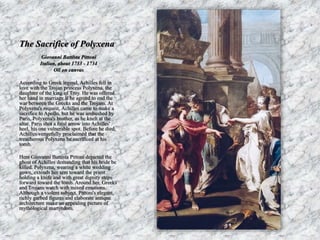
The Sacrifice of Polyxena 
Giovanni Battista Pittoni 
Italian, about 1733 - 1734 
Oil on canvas 
According to Greek legend, Achilles fell in 
love with the Trojan princess Polyxena, the 
daughter of the king of Troy. He was offered 
her hand in marriage if he agreed to end the 
war between the Greeks and the Trojans. At 
Polyxena's request, Achilles came to make a 
sacrifice to Apollo, but he was ambushed by 
Paris, Polyxena's brother, as he knelt at the 
altar. Paris shot a fatal arrow into Achilles' 
heel, his one vulnerable spot. Before he died, 
Achilles vengefully proclaimed that the 
treacherous Polyxena be sacrificed at his 
tomb. 
Here Giovanni Battista Pittoni depicted the 
ghost of Achilles demanding that his bride be 
killed. Polyxena, wearing a white wedding 
gown, extends her arm toward the priest 
holding a knife and with great dignity steps 
forward toward the tomb. Around her, Greeks 
and Trojans watch with mixed emotions. 
Although a violent subject, Pittoni's elegant, 
richly garbed figures and elaborate antique 
architecture make an appealing picture of 
mythological martyrdom.
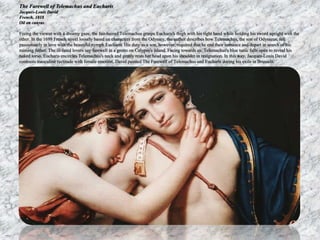
The Farewell of Telemachus and Eucharis 
Jacques-Louis David 
French, 1818 
Oil on canvas 
Fixing the viewer with a dreamy gaze, the fair-haired Telemachus grasps Eucharis's thigh with his right hand while holding his sword upright with the 
other. In the 1699 French novel loosely based on characters from the Odyssey, the author describes how Telemachus, the son of Odysseus, fell 
passionately in love with the beautiful nymph Eucharis. His duty as a son, however, required that he end their romance and depart in search of his 
missing father. The ill-fated lovers say farewell in a grotto on Calypso's island. Facing towards us, Telemachus's blue tunic falls open to reveal his 
naked torso. Eucharis encircles Telemachus's neck and gently rests her head upon his shoulder in resignation. In this way, Jacques-Louis David 
contrasts masculine rectitude with female emotion. David painted The Farewell of Telemachus and Eucharis during his exile in Brussels.

The Getty Museum

  • 1.
    The Getty Museum By: Jacqueline Hannah Kaplan Anthropology 121 Dr. Leanna Wolfe December 10, 2014
  • 2.
    Portrait of Leonilla,Princess of Sayn-Wittgenstein-Sayn Franz XaverWinterhalter German, 1843 Oil on canvas The Princess Leonilla of Sayn-Wittgenstein reclines on a low Turkish sofa on a veranda overlooking a lush tropical landscape. Known for her great beauty and intellect, the Princess is dressed in a luxurious gown of ivory silk with a pink sash around her waist. A deep purple mantle wraps around her back and falls across her smooth arms. Under carefully arched eyebrows, her heavy lidded eyes gaze at the viewer while she playfully toys with the large pearls around her neck.
  • 3.
    Pan and Syrinx Jean-François de Troy French, 1722 - 1724 Oil on canvas As told by the Roman poet in the Metamorphoses, the lusty satyr Pan eagerly pursued the wood nymph Syrinx. Guarding her virtue, she ran until she reached a river and desperately begged her sisters of the stream to transform her. Just as Pan was about to embrace her, Syrinx changed into reeds. When Pan discovered that he was holding nothing but reeds, he sighed in disappointment, causing the wind to blow through the reeds. He was enchanted by the sound, believing it to be the mournful cry of his beloved Syrinx; from the reeds he fashioned a set of pipes so that he could have her always with him. Syrinx, who is seen both before and after the transformation, looks fearfully at Pan as she falls into the arms of Ladon, the river god. Half in shadow, the river nymphs watch apprehensively and huddle together protectively. As he grasps the clump of cattails, Pan seems near ecstasy.
  • 4.
    Minerva Joseph Nollekens British, 1775 Marble Goddess of war and wisdom, Minerva stands like a majestic column as she raises her helmet. At her side rests a large shield, on which is carved the frightening head of the Medusa, used to ward off enemies. According to ancient mythology, Paris was chosen to decide between Juno, Minerva, and Venus for the title of "the fairest." Although Minerva promised him fame and glory in war, Paris chose Venus.
  • 5.
    Flower Still Life Ambrosius Bosschaert the Elder Dutch, 1614 Oil on copper A pink carnation, a white rose, and a yellow tulip with red stripes lie in front of a basket of brilliantly colored flowers. Ambrosius Bosschaert the Elder conveyed the silky texture of the petals, the prickliness of the rose thorns, and the fragility of opening buds. Each of the insects that are crawling on the flowers are carefully described and observed, from the dragonfly's transparent wings to the butterfly's minutely painted antennae. Although both insects and flowers are short-lived, this painting is a reminder of the beauty of life's offerings. There was a rising interest in botany and a passion for flowers led to an increase in painted floral at the end of the 1500s in the Netherlands and Germany. Bosschaert was the first great Dutch artist in fruit and flower painting and was the head of his family. He established a tradition that influenced an entire generation of fruit and flower painters in the Netherlands.
  • 6.
    Perseus Confronting Phineuswith the Head of Medusa Sebastiano Ricci Italian, about 1705 - 1710 Oil on canvas In Greek mythology, the hero Perseus was famous for killing Medusa, the snake-haired Gorgon whose grotesque appearance turned men to stone. This painting, however, shows a later episode from the hero's life. At Perseus's and Andromeda's wedding, their vows were interrupted by a mob led by Phineus, a disappointed suitor. After a fierce battle, Perseus finally triumphed by brandishing the head of Medusa and turning his opponents into stone. Sebastiano Ricci depicted the fight as a forceful, vigorous battle. In the center, Perseus lunges forward, his muscles tense as he shoves the head of Medusa at Phineus and his men. One man holds up a shield, trying to reflect the horrendous image and almost losing his balance. Behind him, soldiers already turned to stone are frozen in mid-attack. All around, other men have fallen and are dead or dying.
  • 7.
    Mars & Venus,Allegory of Peace Louis Jean François Lagrenée French, 1770 Oil on canvas In this gentle allegory of peace by Louis Jean François Lagrenée, Mars, the Roman god of War, throws back the rich green bed curtains that frame the scene. As the drapery parts, the morning light spills in to reveal the form of the sleeping Venus, the Roman goddess of love. Mars gazes at her, utterly captivated by her beauty. Her love has tempered his fierce character, and his shield and sword lie abandoned on the floor. Echoing the lovers' bliss, a pair of white doves, symbolizing Peace, build a nest in Mars's helmet. Lagrenée created his finest works, including this small, jewel-like painting, around 1770. The lavish folds of drapery, the delicate play of light over fabric and skin, and the rich, restrained palette combine to create a captivatingly beautiful image.
  • 8.
    Vase Jean-Désiré Ringeld"Illzach French, 1889 Bronze and copper This monumental bronze vase was first exhibited at the Exposition Universelle (world's fair) in Paris in 1889. On the surface, it applies spiders, a juniper branch, peacock feathers, lace, ribbons, and snails. This fantastical imagery is reminiscent of the art of contemporary Symbolist artists, who were preoccupied by visionary themes. Its scale is also consistent with other works of art during the last decades of the 1800s. Yet its overall form, and twisted, fluted handles are directly based on an ancient Roman volute krater (mixing vessel) from Pompeii that the sculptor drew during a visit to the archaeological museum in Naples in 1877.
  • 9.
    The Return fromWar: Mars Disarmed by Venus Peter Paul Rubens, painter; Jan Brueghel the Elder, painter Flemish, Antwerp, about 1610 - 1612 Oil on panel Venus leans into the embrace of her lover, Mars, who is transfixed by her alluring gaze. Caught up in his attraction to the aggressively seductive goddess, Mars is no longer able to carry out his military exploits. Venus removes his helmet, while mischievous angels remove his sword and shield. In the 1600s, the subject of Venus disarming her lover Mars was understood as an allegory of Peace. Weapons production continues in the background at the burning fires of Vulcan's hearth, signaling that love's conquest of war may be only temporary. This painting displays each of the artists talents: Rubens's robust figural style and Brueghel's intricate still life details. The luminous figure of Venus, the reflective quality of the weapons and armor, and the tactile quality of the lush painting testify to their skill.
  • 10.
    The Sacrifice ofPolyxena Giovanni Battista Pittoni Italian, about 1733 - 1734 Oil on canvas According to Greek legend, Achilles fell in love with the Trojan princess Polyxena, the daughter of the king of Troy. He was offered her hand in marriage if he agreed to end the war between the Greeks and the Trojans. At Polyxena's request, Achilles came to make a sacrifice to Apollo, but he was ambushed by Paris, Polyxena's brother, as he knelt at the altar. Paris shot a fatal arrow into Achilles' heel, his one vulnerable spot. Before he died, Achilles vengefully proclaimed that the treacherous Polyxena be sacrificed at his tomb. Here Giovanni Battista Pittoni depicted the ghost of Achilles demanding that his bride be killed. Polyxena, wearing a white wedding gown, extends her arm toward the priest holding a knife and with great dignity steps forward toward the tomb. Around her, Greeks and Trojans watch with mixed emotions. Although a violent subject, Pittoni's elegant, richly garbed figures and elaborate antique architecture make an appealing picture of mythological martyrdom.
  • 11.
    The Farewell ofTelemachus and Eucharis Jacques-Louis David French, 1818 Oil on canvas Fixing the viewer with a dreamy gaze, the fair-haired Telemachus grasps Eucharis's thigh with his right hand while holding his sword upright with the other. In the 1699 French novel loosely based on characters from the Odyssey, the author describes how Telemachus, the son of Odysseus, fell passionately in love with the beautiful nymph Eucharis. His duty as a son, however, required that he end their romance and depart in search of his missing father. The ill-fated lovers say farewell in a grotto on Calypso's island. Facing towards us, Telemachus's blue tunic falls open to reveal his naked torso. Eucharis encircles Telemachus's neck and gently rests her head upon his shoulder in resignation. In this way, Jacques-Louis David contrasts masculine rectitude with female emotion. David painted The Farewell of Telemachus and Eucharis during his exile in Brussels.