Misc. images of Hesiod’s
account of the creation of the
    world and the gods.
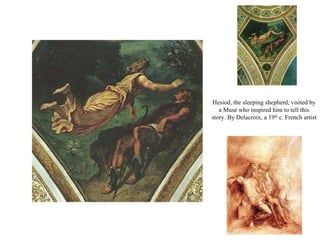
Hesiod, the sleeping shepherd, visited by
   a Muse who inspired him to tell this
story. By Delacroix, a 19th c. French artist
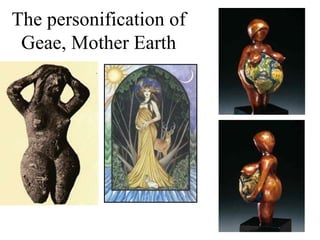
The personification of
 Geae, Mother Earth
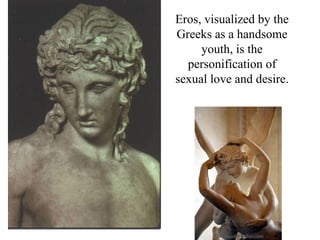
Eros, visualized by the
Greeks as a handsome
     youth, is the
  personification of
sexual love and desire.
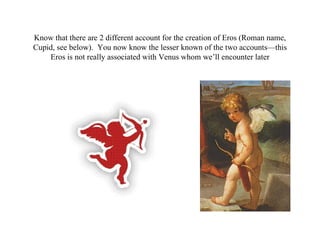
Know that there are 2 different account for the creation of Eros (Roman name,
Cupid, see below). You now know the lesser known of the two accounts—this
    Eros is not really associated with Venus whom we’ll encounter later
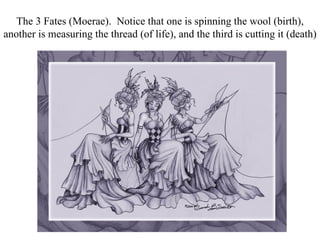
The 3 Fates (Moerae). Notice that one is spinning the wool (birth),
another is measuring the thread (of life), and the third is cutting it (death)
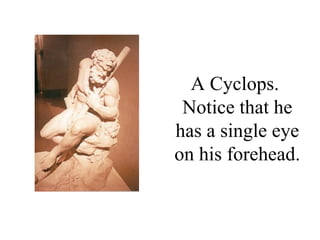
A Cyclops.
 Notice that he
has a single eye
on his forehead.
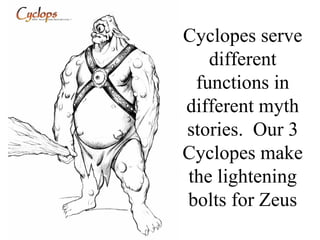
Cyclopes serve
   different
 functions in
different myth
stories. Our 3
Cyclopes make
the lightening
bolts for Zeus
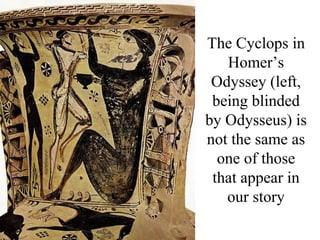
The Cyclops in
   Homer’s
 Odyssey (left,
 being blinded
by Odysseus) is
not the same as
  one of those
 that appear in
   our story
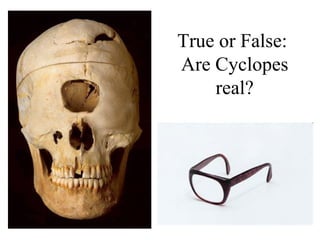
True or False:
Are Cyclopes
    real?
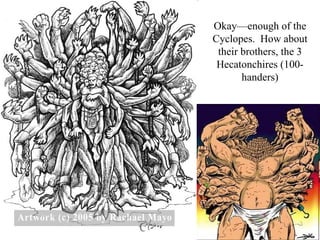
Okay—enough of the
Cyclopes. How about
 their brothers, the 3
 Hecatonchires (100-
       handers)
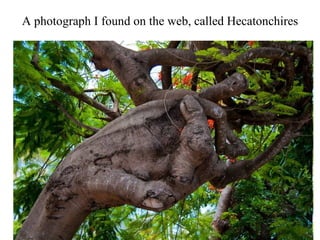
A photograph I found on the web, called Hecatonchires
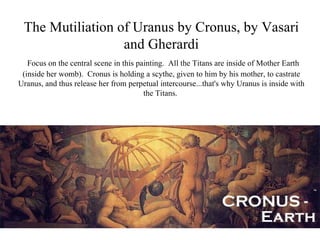
The Mutiliation of Uranus by Cronus, by Vasari
                  and Gherardi
   Focus on the central scene in this painting. All the Titans are inside of Mother Earth
 (inside her womb). Cronus is holding a scythe, given to him by his mother, to castrate
Uranus, and thus release her from perpetual intercourse...that's why Uranus is inside with
                                        the Titans.
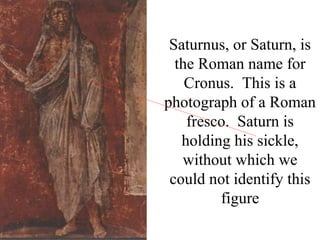
Saturnus, or Saturn, is
  the Roman name for
    Cronus. This is a
photograph of a Roman
    fresco. Saturn is
   holding his sickle,
   without which we
 could not identify this
         figure
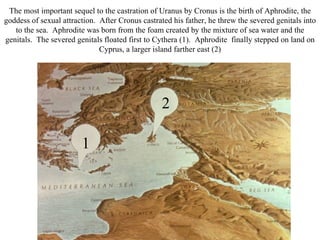
The most important sequel to the castration of Uranus by Cronus is the birth of Aphrodite, the
goddess of sexual attraction. After Cronus castrated his father, he threw the severed genitals into
   to the sea. Aphrodite was born from the foam created by the mixture of sea water and the
genitals. The severed genitals floated first to Cythera (1). Aphrodite finally stepped on land on
                              Cyprus, a larger island farther east (2)


                                                  2

                        1
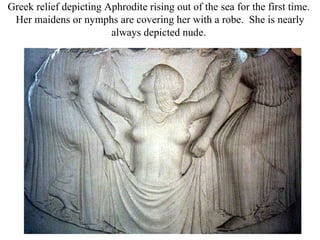
Greek relief depicting Aphrodite rising out of the sea for the first time.
 Her maidens or nymphs are covering her with a robe. She is nearly
                        always depicted nude.
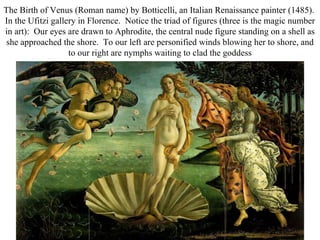
The Birth of Venus (Roman name) by Botticelli, an Italian Renaissance painter (1485).
In the Ufitzi gallery in Florence. Notice the triad of figures (three is the magic number
in art): Our eyes are drawn to Aphrodite, the central nude figure standing on a shell as
 she approached the shore. To our left are personified winds blowing her to shore, and
                   to our right are nymphs waiting to clad the goddess
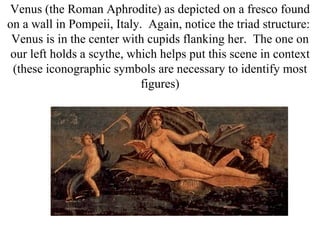
Venus (the Roman Aphrodite) as depicted on a fresco found
on a wall in Pompeii, Italy. Again, notice the triad structure:
 Venus is in the center with cupids flanking her. The one on
 our left holds a scythe, which helps put this scene in context
 (these iconographic symbols are necessary to identify most
                            figures)
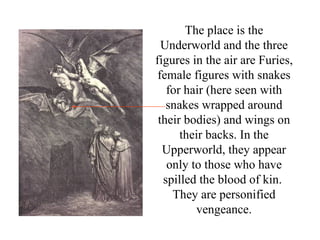
The place is the
  Underworld and the three
figures in the air are Furies,
 female figures with snakes
   for hair (here seen with
   snakes wrapped around
 their bodies) and wings on
      their backs. In the
  Upperworld, they appear
   only to those who have
  spilled the blood of kin.
    They are personified
         vengeance.
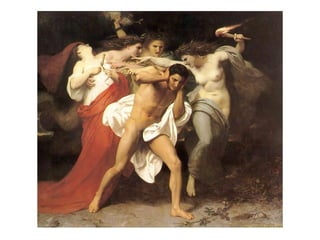
In the following slide you’ll see the 3 Furies
   haunting Orestes, the young male in the
 foreground, after he killed his mother (left,
  with the knife in her chest). He killed his
mother because she killed his father (her own
husband). She killed her husband because he
   killed their daughter. We’ll learn about
 myth’s most dysfunctional family in several
  weeks. But for now, check out the Furies
              haunting Orestes…
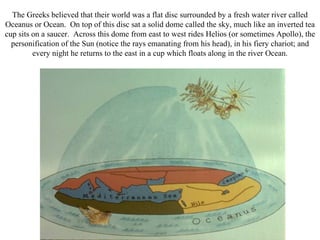
The Greeks believed that their world was a flat disc surrounded by a fresh water river called
Oceanus or Ocean. On top of this disc sat a solid dome called the sky, much like an inverted tea
cup sits on a saucer. Across this dome from east to west rides Helios (or sometimes Apollo), the
  personification of the Sun (notice the rays emanating from his head), in his fiery chariot; and
         every night he returns to the east in a cup which floats along in the river Ocean.
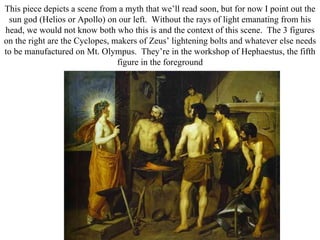
This piece depicts a scene from a myth that we’ll read soon, but for now I point out the
 sun god (Helios or Apollo) on our left. Without the rays of light emanating from his
head, we would not know both who this is and the context of this scene. The 3 figures
on the right are the Cyclopes, makers of Zeus’ lightening bolts and whatever else needs
to be manufactured on Mt. Olympus. They’re in the workshop of Hephaestus, the fifth
                                figure in the foreground
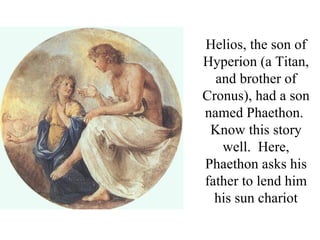
Helios, the son of
Hyperion (a Titan,
  and brother of
Cronus), had a son
named Phaethon.
 Know this story
   well. Here,
Phaethon asks his
father to lend him
  his sun chariot
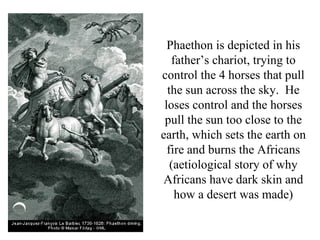
Phaethon is depicted in his
   father’s chariot, trying to
control the 4 horses that pull
  the sun across the sky. He
 loses control and the horses
 pull the sun too close to the
earth, which sets the earth on
  fire and burns the Africans
   (aetiological story of why
Africans have dark skin and
    how a desert was made)
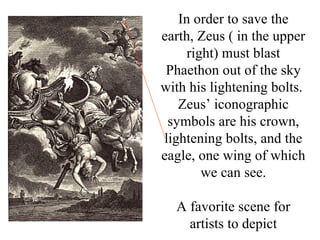
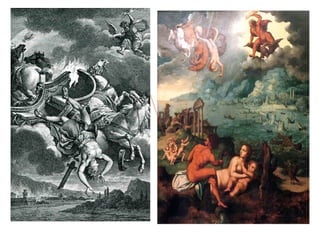
In order to save the
earth, Zeus ( in the upper
     right) must blast
 Phaethon out of the sky
with his lightening bolts.
   Zeus’ iconographic
 symbols are his crown,
lightening bolts, and the
eagle, one wing of which
        we can see.

  A favorite scene for
    artists to depict
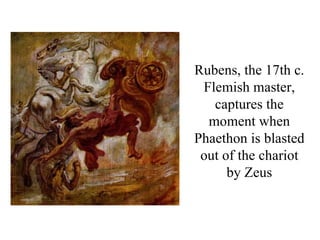
Rubens, the 17th c.
 Flemish master,
   captures the
  moment when
Phaethon is blasted
 out of the chariot
      by Zeus
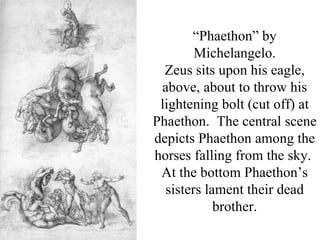
“Phaethon” by
        Michelangelo.
  Zeus sits upon his eagle,
 above, about to throw his
 lightening bolt (cut off) at
Phaethon. The central scene
depicts Phaethon among the
horses falling from the sky.
 At the bottom Phaethon’s
  sisters lament their dead
            brother.
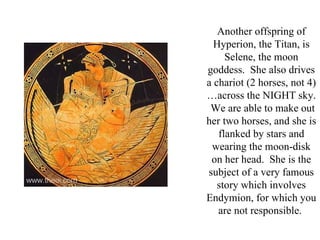
Another offspring of
  Hyperion, the Titan, is
     Selene, the moon
goddess. She also drives
a chariot (2 horses, not 4)
…across the NIGHT sky.
 We are able to make out
her two horses, and she is
   flanked by stars and
 wearing the moon-disk
 on her head. She is the
subject of a very famous
   story which involves
Endymion, for which you
   are not responsible.
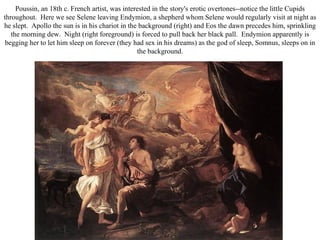
Poussin, an 18th c. French artist, was interested in the story's erotic overtones--notice the little Cupids
throughout. Here we see Selene leaving Endymion, a shepherd whom Selene would regularly visit at night as
he slept. Apollo the sun is in his chariot in the background (right) and Eos the dawn precedes him, sprinkling
   the morning dew. Night (right foreground) is forced to pull back her black pall. Endymion apparently is
 begging her to let him sleep on forever (they had sex in his dreams) as the god of sleep, Somnus, sleeps on in
                                                 the background.
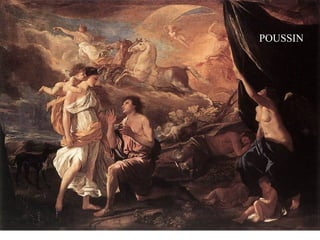
POUSSIN
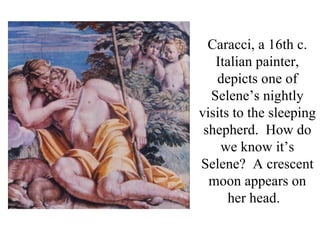
Caracci, a 16th c.
   Italian painter,
   depicts one of
  Selene’s nightly
visits to the sleeping
 shepherd. How do
    we know it’s
Selene? A crescent
  moon appears on
      her head.
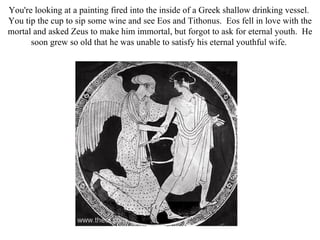
You're looking at a painting fired into the inside of a Greek shallow drinking vessel.
You tip the cup to sip some wine and see Eos and Tithonus. Eos fell in love with the
mortal and asked Zeus to make him immortal, but forgot to ask for eternal youth. He
      soon grew so old that he was unable to satisfy his eternal youthful wife.
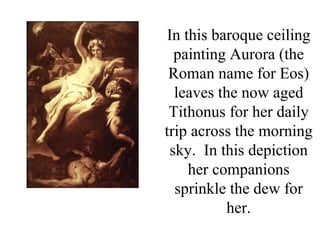
In this baroque ceiling
  painting Aurora (the
 Roman name for Eos)
  leaves the now aged
 Tithonus for her daily
trip across the morning
 sky. In this depiction
     her companions
  sprinkle the dew for
           her.
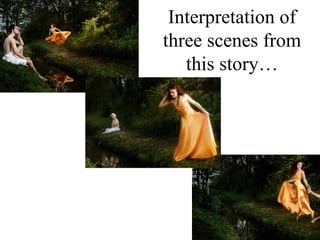
Interpretation of
three scenes from
   this story…
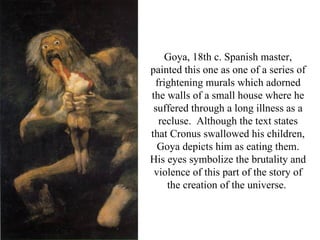
Goya, 18th c. Spanish master,
painted this one as one of a series of
 frightening murals which adorned
the walls of a small house where he
 suffered through a long illness as a
  recluse. Although the text states
that Cronus swallowed his children,
  Goya depicts him as eating them.
His eyes symbolize the brutality and
 violence of this part of the story of
    the creation of the universe.
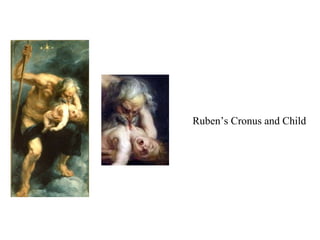
Ruben’s Cronus and Child
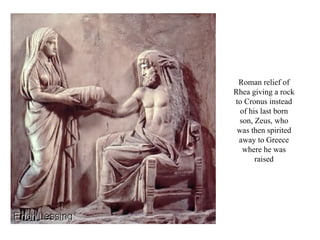
Roman relief of
Rhea giving a rock
to Cronus instead
  of his last born
  son, Zeus, who
 was then spirited
 away to Greece
   where he was
       raised
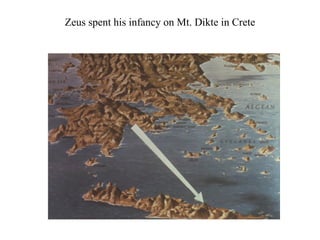
Zeus spent his infancy on Mt. Dikte in Crete
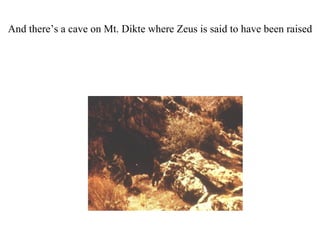
And there’s a cave on Mt. Dikte where Zeus is said to have been raised
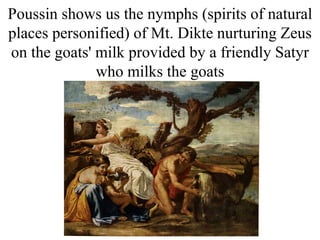
Poussin shows us the nymphs (spirits of natural
places personified) of Mt. Dikte nurturing Zeus
on the goats' milk provided by a friendly Satyr
              who milks the goats
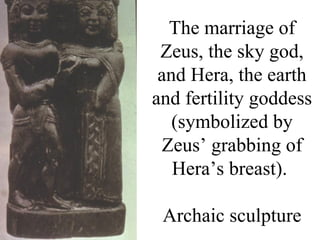
The marriage of
 Zeus, the sky god,
 and Hera, the earth
and fertility goddess
   (symbolized by
 Zeus’ grabbing of
   Hera’s breast).

 Archaic sculpture
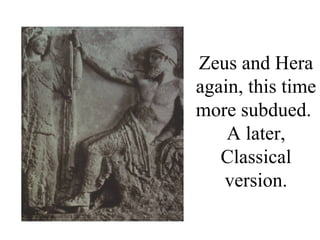
Zeus and Hera
again, this time
more subdued.
    A later,
   Classical
   version.
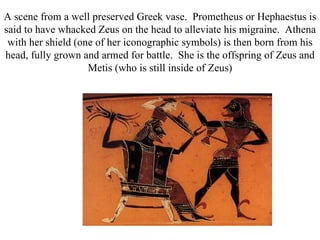
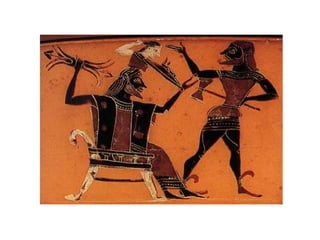
A scene from a well preserved Greek vase. Prometheus or Hephaestus is
said to have whacked Zeus on the head to alleviate his migraine. Athena
 with her shield (one of her iconographic symbols) is then born from his
head, fully grown and armed for battle. She is the offspring of Zeus and
                    Metis (who is still inside of Zeus)
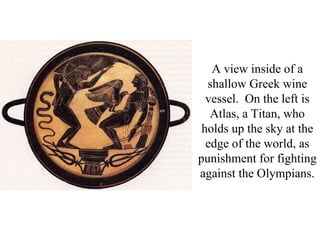
A view inside of a
  shallow Greek wine
  vessel. On the left is
   Atlas, a Titan, who
 holds up the sky at the
  edge of the world, as
punishment for fighting
against the Olympians.

Creation from gaea_to_athena 2012

  • 1.
    Misc. images ofHesiod’s account of the creation of the world and the gods.
  • 2.
    Hesiod, the sleepingshepherd, visited by a Muse who inspired him to tell this story. By Delacroix, a 19th c. French artist
  • 3.
    The personification of Geae, Mother Earth
  • 4.
    Eros, visualized bythe Greeks as a handsome youth, is the personification of sexual love and desire.
  • 5.
    Know that thereare 2 different account for the creation of Eros (Roman name, Cupid, see below). You now know the lesser known of the two accounts—this Eros is not really associated with Venus whom we’ll encounter later
  • 6.
    The 3 Fates(Moerae). Notice that one is spinning the wool (birth), another is measuring the thread (of life), and the third is cutting it (death)
  • 7.
    A Cyclops. Noticethat he has a single eye on his forehead.
  • 8.
    Cyclopes serve different functions in different myth stories. Our 3 Cyclopes make the lightening bolts for Zeus
  • 9.
    The Cyclops in Homer’s Odyssey (left, being blinded by Odysseus) is not the same as one of those that appear in our story
  • 10.
    True or False: AreCyclopes real?
  • 13.
    Okay—enough of the Cyclopes.How about their brothers, the 3 Hecatonchires (100- handers)
  • 14.
    A photograph Ifound on the web, called Hecatonchires
  • 15.
    The Mutiliation ofUranus by Cronus, by Vasari and Gherardi Focus on the central scene in this painting. All the Titans are inside of Mother Earth (inside her womb). Cronus is holding a scythe, given to him by his mother, to castrate Uranus, and thus release her from perpetual intercourse...that's why Uranus is inside with the Titans.
  • 16.
    Saturnus, or Saturn,is the Roman name for Cronus. This is a photograph of a Roman fresco. Saturn is holding his sickle, without which we could not identify this figure
  • 17.
    The most importantsequel to the castration of Uranus by Cronus is the birth of Aphrodite, the goddess of sexual attraction. After Cronus castrated his father, he threw the severed genitals into to the sea. Aphrodite was born from the foam created by the mixture of sea water and the genitals. The severed genitals floated first to Cythera (1). Aphrodite finally stepped on land on Cyprus, a larger island farther east (2) 2 1
  • 18.
    Greek relief depictingAphrodite rising out of the sea for the first time. Her maidens or nymphs are covering her with a robe. She is nearly always depicted nude.
  • 19.
    The Birth ofVenus (Roman name) by Botticelli, an Italian Renaissance painter (1485). In the Ufitzi gallery in Florence. Notice the triad of figures (three is the magic number in art): Our eyes are drawn to Aphrodite, the central nude figure standing on a shell as she approached the shore. To our left are personified winds blowing her to shore, and to our right are nymphs waiting to clad the goddess
  • 20.
    Venus (the RomanAphrodite) as depicted on a fresco found on a wall in Pompeii, Italy. Again, notice the triad structure: Venus is in the center with cupids flanking her. The one on our left holds a scythe, which helps put this scene in context (these iconographic symbols are necessary to identify most figures)
  • 21.
    The place isthe Underworld and the three figures in the air are Furies, female figures with snakes for hair (here seen with snakes wrapped around their bodies) and wings on their backs. In the Upperworld, they appear only to those who have spilled the blood of kin. They are personified vengeance.
  • 22.
    In the followingslide you’ll see the 3 Furies haunting Orestes, the young male in the foreground, after he killed his mother (left, with the knife in her chest). He killed his mother because she killed his father (her own husband). She killed her husband because he killed their daughter. We’ll learn about myth’s most dysfunctional family in several weeks. But for now, check out the Furies haunting Orestes…
  • 24.
    The Greeks believedthat their world was a flat disc surrounded by a fresh water river called Oceanus or Ocean. On top of this disc sat a solid dome called the sky, much like an inverted tea cup sits on a saucer. Across this dome from east to west rides Helios (or sometimes Apollo), the personification of the Sun (notice the rays emanating from his head), in his fiery chariot; and every night he returns to the east in a cup which floats along in the river Ocean.
  • 25.
    This piece depictsa scene from a myth that we’ll read soon, but for now I point out the sun god (Helios or Apollo) on our left. Without the rays of light emanating from his head, we would not know both who this is and the context of this scene. The 3 figures on the right are the Cyclopes, makers of Zeus’ lightening bolts and whatever else needs to be manufactured on Mt. Olympus. They’re in the workshop of Hephaestus, the fifth figure in the foreground
  • 26.
    Helios, the sonof Hyperion (a Titan, and brother of Cronus), had a son named Phaethon. Know this story well. Here, Phaethon asks his father to lend him his sun chariot
  • 27.
    Phaethon is depictedin his father’s chariot, trying to control the 4 horses that pull the sun across the sky. He loses control and the horses pull the sun too close to the earth, which sets the earth on fire and burns the Africans (aetiological story of why Africans have dark skin and how a desert was made)
  • 28.
    In order tosave the earth, Zeus ( in the upper right) must blast Phaethon out of the sky with his lightening bolts. Zeus’ iconographic symbols are his crown, lightening bolts, and the eagle, one wing of which we can see. A favorite scene for artists to depict
  • 30.
    Rubens, the 17thc. Flemish master, captures the moment when Phaethon is blasted out of the chariot by Zeus
  • 31.
    “Phaethon” by Michelangelo. Zeus sits upon his eagle, above, about to throw his lightening bolt (cut off) at Phaethon. The central scene depicts Phaethon among the horses falling from the sky. At the bottom Phaethon’s sisters lament their dead brother.
  • 33.
    Another offspring of Hyperion, the Titan, is Selene, the moon goddess. She also drives a chariot (2 horses, not 4) …across the NIGHT sky. We are able to make out her two horses, and she is flanked by stars and wearing the moon-disk on her head. She is the subject of a very famous story which involves Endymion, for which you are not responsible.
  • 34.
    Poussin, an 18thc. French artist, was interested in the story's erotic overtones--notice the little Cupids throughout. Here we see Selene leaving Endymion, a shepherd whom Selene would regularly visit at night as he slept. Apollo the sun is in his chariot in the background (right) and Eos the dawn precedes him, sprinkling the morning dew. Night (right foreground) is forced to pull back her black pall. Endymion apparently is begging her to let him sleep on forever (they had sex in his dreams) as the god of sleep, Somnus, sleeps on in the background.
  • 35.
  • 36.
    Caracci, a 16thc. Italian painter, depicts one of Selene’s nightly visits to the sleeping shepherd. How do we know it’s Selene? A crescent moon appears on her head.
  • 37.
    You're looking ata painting fired into the inside of a Greek shallow drinking vessel. You tip the cup to sip some wine and see Eos and Tithonus. Eos fell in love with the mortal and asked Zeus to make him immortal, but forgot to ask for eternal youth. He soon grew so old that he was unable to satisfy his eternal youthful wife.
  • 38.
    In this baroqueceiling painting Aurora (the Roman name for Eos) leaves the now aged Tithonus for her daily trip across the morning sky. In this depiction her companions sprinkle the dew for her.
  • 39.
  • 40.
    Goya, 18th c.Spanish master, painted this one as one of a series of frightening murals which adorned the walls of a small house where he suffered through a long illness as a recluse. Although the text states that Cronus swallowed his children, Goya depicts him as eating them. His eyes symbolize the brutality and violence of this part of the story of the creation of the universe.
  • 41.
  • 42.
    Roman relief of Rheagiving a rock to Cronus instead of his last born son, Zeus, who was then spirited away to Greece where he was raised
  • 43.
    Zeus spent hisinfancy on Mt. Dikte in Crete
  • 44.
    And there’s acave on Mt. Dikte where Zeus is said to have been raised
  • 45.
    Poussin shows usthe nymphs (spirits of natural places personified) of Mt. Dikte nurturing Zeus on the goats' milk provided by a friendly Satyr who milks the goats
  • 46.
    The marriage of Zeus, the sky god, and Hera, the earth and fertility goddess (symbolized by Zeus’ grabbing of Hera’s breast). Archaic sculpture
  • 47.
    Zeus and Hera again,this time more subdued. A later, Classical version.
  • 48.
    A scene froma well preserved Greek vase. Prometheus or Hephaestus is said to have whacked Zeus on the head to alleviate his migraine. Athena with her shield (one of her iconographic symbols) is then born from his head, fully grown and armed for battle. She is the offspring of Zeus and Metis (who is still inside of Zeus)
  • 50.
    A view insideof a shallow Greek wine vessel. On the left is Atlas, a Titan, who holds up the sky at the edge of the world, as punishment for fighting against the Olympians.