Working Effectively with Line Managers


                                   Dr. Sanjay Garg
                         Chief, Controls and Dynamics Branch
                                  Ph: (216) 433-2685
                                 FAX: (216) 433-8990
                            email: sanjay.garg@nasa.gov
                                http://www.lerc.nasa.gov/WWW/cdtb

                      Presented at: NASA PM Challenge 2011, Feb. 9-10, 2011
                                         Long Beach, CA


 Glenn Research Center
 Controls and Dynamics Branch                              at Lewis Field
Outline
       Matrix Organization – Purpose and Challenges
       Role of a Line Manager
       Role of a Project Manager
       Effective Partnership Between LM and PM
       Dos and Don’ts of PM – LM Perspective
       Dos and Don’ts of LM – PM Perspective Discussion
       Summary


     Disclaimer: My knowledge of Project Management and PM Role is based on
     my limited experience in working with PMs in the Aeronautics Research and
     Space Exploration Technology Development projects, and a week long Project
     Management class I had early in my career.


Glenn Research Center
Controls and Dynamics Branch                            at Lewis Field
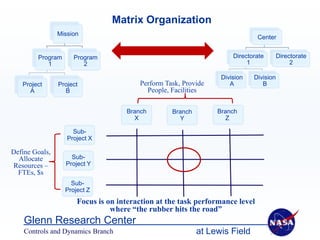
Matrix Organization
                Mission
                                                                              Center


        Program      Program                                         Directorate       Directorate
           1            2                                                 1                 2

                                                                 Division   Division
   Project      Project                 Perform Task, Provide       A          B
     A            B                       People, Facilities

                                    Branch        Branch        Branch
                                      X             Y              Z

                     Sub-
                   Project X

Define Goals,
  Allocate          Sub-
Resources –       Project Y
  FTEs, $s
                    Sub-
                  Project Z
                      Focus is on interaction at the task performance level
                                where “the rubber hits the road”
    Glenn Research Center
    Controls and Dynamics Branch                           at Lewis Field
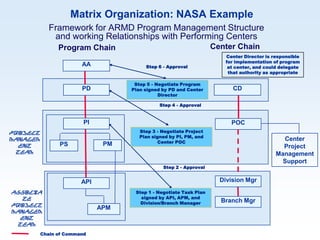
Matrix Organization: NASA Example
          Framework for ARMD Program Management Structure
           and working Relationships with Performing Centers
            Program Chain                                       Center Chain
                                                                   Center Director is responsible
                                                                   for implementation of program
                    AA               Step 6 - Approval              at center, and could delegate
                                                                    that authority as appropriate

                                 Step 5 - Negotiate Program
                    PD          Plan signed by PD and Center          CD
                                           Director

                                           Step 4 - Approval


                     PI                                              POC
Project                            Step 3 - Negotiate Project
                                   Plan signed by PI, PM, and
Managem                                                                                  Center
                                           Center POC
  ent       PS             PM                                                            Project
 Team                                                                                  Management
                                                                                         Support
                                            Step 2 - Approval


                    API                                           Division Mgr
Associa                          Step 1 - Negotiate Task Plan
   te                              signed by API, APM, and
                                   Division/Branch Manager        Branch Mgr
Project
Managem
                          APM
  ent
 Team
      Chain of Command
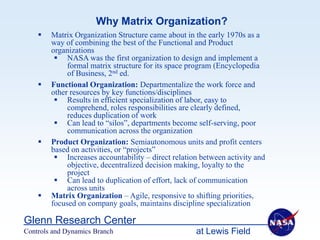
Why Matrix Organization?
       Matrix Organization Structure came about in the early 1970s as a
        way of combining the best of the Functional and Product
        organizations
          NASA was the first organization to design and implement a
             formal matrix structure for its space program (Encyclopedia
             of Business, 2nd ed.
       Functional Organization: Departmentalize the work force and
        other resources by key functions/disciplines
          Results in efficient specialization of labor, easy to
             comprehend, roles responsibilities are clearly defined,
             reduces duplication of work
          Can lead to “silos”, departments become self-serving, poor
             communication across the organization
       Product Organization: Semiautonomous units and profit centers
        based on activities, or “projects”
          Increases accountability – direct relation between activity and
             objective, decentralized decision making, loyalty to the
             project
          Can lead to duplication of effort, lack of communication
             across units
       Matrix Organization – Agile, responsive to shifting priorities,
        focused on company goals, maintains discipline specialization

Glenn Research Center
Controls and Dynamics Branch                        at Lewis Field
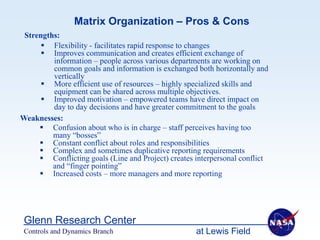
Matrix Organization – Pros & Cons
 Strengths:
       Flexibility - facilitates rapid response to changes
       Improves communication and creates efficient exchange of
         information – people across various departments are working on
         common goals and information is exchanged both horizontally and
         vertically
       More efficient use of resources – highly specialized skills and
         equipment can be shared across multiple objectives.
       Improved motivation – empowered teams have direct impact on
         day to day decisions and have greater commitment to the goals
Weaknesses:
      Confusion about who is in charge – staff perceives having too
         many “bosses”
      Constant conflict about roles and responsibilities
      Complex and sometimes duplicative reporting requirements
      Conflicting goals (Line and Project) creates interpersonal conflict
         and “finger pointing”
      Increased costs – more managers and more reporting


 Glenn Research Center
 Controls and Dynamics Branch                       at Lewis Field
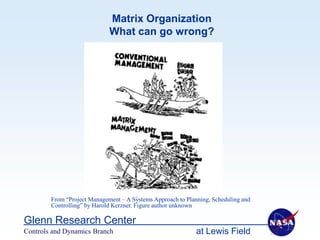
Matrix Organization
                             What can go wrong?


        From “Project Management – A Systems Approach to Planning, Scheduling and
        Controlling” by Harold Kerzner. Figure author unknown

Glenn Research Center
Controls and Dynamics Branch                                 at Lewis Field
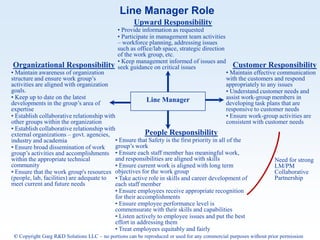
Line Manager Role
                                                     Upward Responsibility
                                              • Provide information as requested
                                              • Participate in management team activities
                                              – workforce planning, addressing issues
                                              such as office/lab space, strategic direction
                                              of the work group, etc.
                                              • Keep management informed of issues and
Organizational Responsibility                 seek guidance on critical issues                   Customer Responsibility
• Maintain awareness of organization                                                         • Maintain effective communication
structure and ensure work group’s                                                            with the customers and respond
activities are aligned with organization                                                     appropriately to any issues
goals.                                                                                       • Understand customer needs and
• Keep up to date on the latest                         Line Manager                         assist work-group members in
developments in the group’s area of                                                          developing task plans that are
expertise                                                                                    responsive to customer needs
• Establish collaborative relationship with                                                  • Ensure work-group activities are
other groups within the organization                                                         consistent with customer needs
• Establish collaborative relationship with
external organizations – govt. agencies,                People Responsibility
industry and academia                      • Ensure that Safety is the first priority in all of the
• Ensure broad dissemination of work       group’s work
group’s activities and accomplishments • Ensure each staff member has meaningful work,
within the appropriate technical           and responsibilities are aligned with skills                          Need for strong
community                                  • Ensure current work is aligned with long term                       LM/PM
• Ensure that the work group's resources objectives for the work group                                           Collaborative
(people, lab, facilities) are adequate to • Take active role in skills and career development of                 Partnership
meet current and future needs              each staff member
                                           • Ensure employees receive appropriate recognition
                                           for their accomplishments
                                           • Ensure employee performance level is
                                           commensurate with their skills and capabilities
                                           • Listen actively to employee issues and put the best
                                           effort in addressing them
                                           • Treat employees equitably and fairly
 © Copyright Garg R&D Solutions LLC – no portions can be reproduced or used for any commercial purposes without prior permission
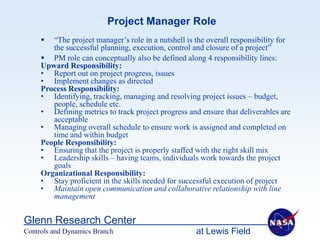
Project Manager Role
       “The project manager’s role in a nutshell is the overall responsibility for
        the successful planning, execution, control and closure of a project”
      PM role can conceptually also be defined along 4 responsibility lines:
     Upward Responsibility:
     • Report out on project progress, issues
     • Implement changes as directed
     Process Responsibility:
     • Identifying, tracking, managing and resolving project issues – budget,
        people, schedule etc.
     • Defining metrics to track project progress and ensure that deliverables are
        acceptable
     • Managing overall schedule to ensure work is assigned and completed on
        time and within budget
     People Responsibility:
     • Ensuring that the project is properly staffed with the right skill mix
     • Leadership skills – having teams, individuals work towards the project
        goals
     Organizational Responsibility:
     • Stay proficient in the skills needed for successful execution of project
     • Maintain open communication and collaborative relationship with line
        management


Glenn Research Center
Controls and Dynamics Branch                         at Lewis Field
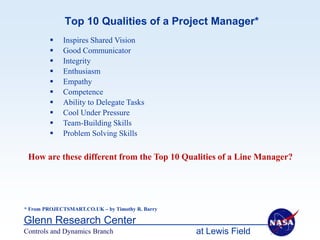
Top 10 Qualities of a Project Manager*
            Inspires Shared Vision
            Good Communicator
            Integrity
            Enthusiasm
            Empathy
            Competence
            Ability to Delegate Tasks
            Cool Under Pressure
            Team-Building Skills
            Problem Solving Skills

 How are these different from the Top 10 Qualities of a Line Manager?


* From PROJECTSMART.CO.UK – by Timothy R. Barry

Glenn Research Center
Controls and Dynamics Branch                      at Lewis Field
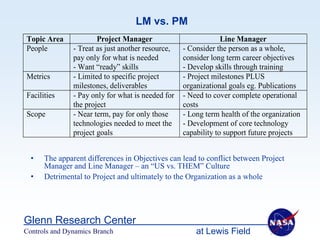
LM vs. PM
Topic Area             Project Manager                          Line Manager
People         - Treat as just another resource,   - Consider the person as a whole,
               pay only for what is needed         consider long term career objectives
               - Want “ready” skills               - Develop skills through training
Metrics        - Limited to specific project       - Project milestones PLUS
               milestones, deliverables            organizational goals eg. Publications
Facilities     - Pay only for what is needed for   - Need to cover complete operational
               the project                         costs
Scope          - Near term, pay for only those     - Long term health of the organization
               technologies needed to meet the     - Development of core technology
               project goals                       capability to support future projects


  •   The apparent differences in Objectives can lead to conflict between Project
      Manager and Line Manager – an “US vs. THEM” Culture
  •   Detrimental to Project and ultimately to the Organization as a whole


Glenn Research Center
Controls and Dynamics Branch                           at Lewis Field
The Case for LM/PM Collaboration
        A Collaborative Partnership between Line Managers and Project
         Managers can:
          Leverage the strengths of the Matrix Organization to the Max
          Minimize the impact of weaknesses of the Matrix Organization
          Create a “Balanced Matrix” where LM/PM are working in harmony
             to cchieve Project and Organization Goals
        What a Line Manager brings to the Partnership:
          Knowledge of the discipline work being done across Projects
               Help leverage the investment across projects
               Assess how changes in one Project might impact another
                  Project
          Discipline expertise and technical knowledge to ensure that Project
            Goals are achievable within allocated resources
          Knowledge to assign the right people to the Project
               Balance Project Goals with individual interests, skills and
                  career objectives
          Manage the performance of the technical staff to ensure Project
            Goals are being met
          Broad Organizational knowledge to be able to identify and help
            address issues in a timely manner

Glenn Research Center
Controls and Dynamics Branch                       at Lewis Field
LM/PM Collaboration – Motivating the Technical Staff
                      Motivated Staff Achieves Results
 • Top Motivators of Scientists and the Technical Staff
         - Acknowledgement, Recognition & Respect
         - Trust, Freedom & Independence
         - Growth & Development: Tech & Touch
         - Meaningful & Challenging Work
         - Empowerment & Control: Decision Making/Recommendary Authority
         - To be Listened to & Taken Seriously
         - Supportive Relationships
         - Sufficient Resources to Accomplish Goals
         - Self Actualization


 •    Only by Working Collaboratively Can the Line Manager and Project Manager
      Expect to Keep the Staff Motivated
       • Neither can Achieve this by Themselves


Glenn Research Center
Controls and Dynamics Branch                      at Lewis Field
Characteristics of a Healthy LM/PM Collaboration
        A Collaborative Partnership between Line Managers and Project
         Managers can:
          Leverage the strengths of the Matrix Organization to the Max
          Minimize the impact of weaknesses of the Matrix Organization
          Create a “Balanced Matrix” where LM/PM are working in harmony
             to cchieve Project and Organization Goals


Glenn Research Center
Controls and Dynamics Branch                   at Lewis Field
Dos and Don’ts of PM – LM Perspective

          This chart will provide a LM perspective on what
          they will like to see the PM do (emphasize in the
          collaborative partnership) and things that PM
          should not do


Glenn Research Center
Controls and Dynamics Branch            at Lewis Field
Dos and Don’ts of LM – PM Perspective

          This chart will be used interactively to get the PM
          perspective on what they will like to see the LM
          do and what they don’t want LM doing. An intial
          list will be provided based on my discussions with
          the PMs that we work with.


Glenn Research Center
Controls and Dynamics Branch             at Lewis Field
Summary

          The Summary chart will list the major benefits of
          LM/PM collaboration and will summarize the key
          expectations of each other to develop and
          maintain a strong partnership


Glenn Research Center
Controls and Dynamics Branch             at Lewis Field

Garg.sanjay

  • 1.
    Working Effectively withLine Managers Dr. Sanjay Garg Chief, Controls and Dynamics Branch Ph: (216) 433-2685 FAX: (216) 433-8990 email: sanjay.garg@nasa.gov http://www.lerc.nasa.gov/WWW/cdtb Presented at: NASA PM Challenge 2011, Feb. 9-10, 2011 Long Beach, CA Glenn Research Center Controls and Dynamics Branch at Lewis Field
  • 2.
    Outline  Matrix Organization – Purpose and Challenges  Role of a Line Manager  Role of a Project Manager  Effective Partnership Between LM and PM  Dos and Don’ts of PM – LM Perspective  Dos and Don’ts of LM – PM Perspective Discussion  Summary Disclaimer: My knowledge of Project Management and PM Role is based on my limited experience in working with PMs in the Aeronautics Research and Space Exploration Technology Development projects, and a week long Project Management class I had early in my career. Glenn Research Center Controls and Dynamics Branch at Lewis Field
  • 3.
    Matrix Organization Mission Center Program Program Directorate Directorate 1 2 1 2 Division Division Project Project Perform Task, Provide A B A B People, Facilities Branch Branch Branch X Y Z Sub- Project X Define Goals, Allocate Sub- Resources – Project Y FTEs, $s Sub- Project Z Focus is on interaction at the task performance level where “the rubber hits the road” Glenn Research Center Controls and Dynamics Branch at Lewis Field
  • 4.
    Matrix Organization: NASAExample Framework for ARMD Program Management Structure and working Relationships with Performing Centers Program Chain Center Chain Center Director is responsible for implementation of program AA Step 6 - Approval at center, and could delegate that authority as appropriate Step 5 - Negotiate Program PD Plan signed by PD and Center CD Director Step 4 - Approval PI POC Project Step 3 - Negotiate Project Plan signed by PI, PM, and Managem Center Center POC ent PS PM Project Team Management Support Step 2 - Approval API Division Mgr Associa Step 1 - Negotiate Task Plan te signed by API, APM, and Division/Branch Manager Branch Mgr Project Managem APM ent Team Chain of Command
  • 5.
    Why Matrix Organization?  Matrix Organization Structure came about in the early 1970s as a way of combining the best of the Functional and Product organizations  NASA was the first organization to design and implement a formal matrix structure for its space program (Encyclopedia of Business, 2nd ed.  Functional Organization: Departmentalize the work force and other resources by key functions/disciplines  Results in efficient specialization of labor, easy to comprehend, roles responsibilities are clearly defined, reduces duplication of work  Can lead to “silos”, departments become self-serving, poor communication across the organization  Product Organization: Semiautonomous units and profit centers based on activities, or “projects”  Increases accountability – direct relation between activity and objective, decentralized decision making, loyalty to the project  Can lead to duplication of effort, lack of communication across units  Matrix Organization – Agile, responsive to shifting priorities, focused on company goals, maintains discipline specialization Glenn Research Center Controls and Dynamics Branch at Lewis Field
  • 6.
    Matrix Organization –Pros & Cons Strengths:  Flexibility - facilitates rapid response to changes  Improves communication and creates efficient exchange of information – people across various departments are working on common goals and information is exchanged both horizontally and vertically  More efficient use of resources – highly specialized skills and equipment can be shared across multiple objectives.  Improved motivation – empowered teams have direct impact on day to day decisions and have greater commitment to the goals Weaknesses:  Confusion about who is in charge – staff perceives having too many “bosses”  Constant conflict about roles and responsibilities  Complex and sometimes duplicative reporting requirements  Conflicting goals (Line and Project) creates interpersonal conflict and “finger pointing”  Increased costs – more managers and more reporting Glenn Research Center Controls and Dynamics Branch at Lewis Field
  • 7.
    Matrix Organization What can go wrong? From “Project Management – A Systems Approach to Planning, Scheduling and Controlling” by Harold Kerzner. Figure author unknown Glenn Research Center Controls and Dynamics Branch at Lewis Field
  • 8.
    Line Manager Role Upward Responsibility • Provide information as requested • Participate in management team activities – workforce planning, addressing issues such as office/lab space, strategic direction of the work group, etc. • Keep management informed of issues and Organizational Responsibility seek guidance on critical issues Customer Responsibility • Maintain awareness of organization • Maintain effective communication structure and ensure work group’s with the customers and respond activities are aligned with organization appropriately to any issues goals. • Understand customer needs and • Keep up to date on the latest Line Manager assist work-group members in developments in the group’s area of developing task plans that are expertise responsive to customer needs • Establish collaborative relationship with • Ensure work-group activities are other groups within the organization consistent with customer needs • Establish collaborative relationship with external organizations – govt. agencies, People Responsibility industry and academia • Ensure that Safety is the first priority in all of the • Ensure broad dissemination of work group’s work group’s activities and accomplishments • Ensure each staff member has meaningful work, within the appropriate technical and responsibilities are aligned with skills Need for strong community • Ensure current work is aligned with long term LM/PM • Ensure that the work group's resources objectives for the work group Collaborative (people, lab, facilities) are adequate to • Take active role in skills and career development of Partnership meet current and future needs each staff member • Ensure employees receive appropriate recognition for their accomplishments • Ensure employee performance level is commensurate with their skills and capabilities • Listen actively to employee issues and put the best effort in addressing them • Treat employees equitably and fairly © Copyright Garg R&D Solutions LLC – no portions can be reproduced or used for any commercial purposes without prior permission
  • 9.
    Project Manager Role  “The project manager’s role in a nutshell is the overall responsibility for the successful planning, execution, control and closure of a project”  PM role can conceptually also be defined along 4 responsibility lines: Upward Responsibility: • Report out on project progress, issues • Implement changes as directed Process Responsibility: • Identifying, tracking, managing and resolving project issues – budget, people, schedule etc. • Defining metrics to track project progress and ensure that deliverables are acceptable • Managing overall schedule to ensure work is assigned and completed on time and within budget People Responsibility: • Ensuring that the project is properly staffed with the right skill mix • Leadership skills – having teams, individuals work towards the project goals Organizational Responsibility: • Stay proficient in the skills needed for successful execution of project • Maintain open communication and collaborative relationship with line management Glenn Research Center Controls and Dynamics Branch at Lewis Field
  • 10.
    Top 10 Qualitiesof a Project Manager*  Inspires Shared Vision  Good Communicator  Integrity  Enthusiasm  Empathy  Competence  Ability to Delegate Tasks  Cool Under Pressure  Team-Building Skills  Problem Solving Skills How are these different from the Top 10 Qualities of a Line Manager? * From PROJECTSMART.CO.UK – by Timothy R. Barry Glenn Research Center Controls and Dynamics Branch at Lewis Field
  • 11.
    LM vs. PM TopicArea Project Manager Line Manager People - Treat as just another resource, - Consider the person as a whole, pay only for what is needed consider long term career objectives - Want “ready” skills - Develop skills through training Metrics - Limited to specific project - Project milestones PLUS milestones, deliverables organizational goals eg. Publications Facilities - Pay only for what is needed for - Need to cover complete operational the project costs Scope - Near term, pay for only those - Long term health of the organization technologies needed to meet the - Development of core technology project goals capability to support future projects • The apparent differences in Objectives can lead to conflict between Project Manager and Line Manager – an “US vs. THEM” Culture • Detrimental to Project and ultimately to the Organization as a whole Glenn Research Center Controls and Dynamics Branch at Lewis Field
  • 12.
    The Case forLM/PM Collaboration  A Collaborative Partnership between Line Managers and Project Managers can:  Leverage the strengths of the Matrix Organization to the Max  Minimize the impact of weaknesses of the Matrix Organization  Create a “Balanced Matrix” where LM/PM are working in harmony to cchieve Project and Organization Goals  What a Line Manager brings to the Partnership:  Knowledge of the discipline work being done across Projects  Help leverage the investment across projects  Assess how changes in one Project might impact another Project  Discipline expertise and technical knowledge to ensure that Project Goals are achievable within allocated resources  Knowledge to assign the right people to the Project  Balance Project Goals with individual interests, skills and career objectives  Manage the performance of the technical staff to ensure Project Goals are being met  Broad Organizational knowledge to be able to identify and help address issues in a timely manner Glenn Research Center Controls and Dynamics Branch at Lewis Field
  • 13.
    LM/PM Collaboration –Motivating the Technical Staff Motivated Staff Achieves Results • Top Motivators of Scientists and the Technical Staff - Acknowledgement, Recognition & Respect - Trust, Freedom & Independence - Growth & Development: Tech & Touch - Meaningful & Challenging Work - Empowerment & Control: Decision Making/Recommendary Authority - To be Listened to & Taken Seriously - Supportive Relationships - Sufficient Resources to Accomplish Goals - Self Actualization • Only by Working Collaboratively Can the Line Manager and Project Manager Expect to Keep the Staff Motivated • Neither can Achieve this by Themselves Glenn Research Center Controls and Dynamics Branch at Lewis Field
  • 14.
    Characteristics of aHealthy LM/PM Collaboration  A Collaborative Partnership between Line Managers and Project Managers can:  Leverage the strengths of the Matrix Organization to the Max  Minimize the impact of weaknesses of the Matrix Organization  Create a “Balanced Matrix” where LM/PM are working in harmony to cchieve Project and Organization Goals Glenn Research Center Controls and Dynamics Branch at Lewis Field
  • 15.
    Dos and Don’tsof PM – LM Perspective This chart will provide a LM perspective on what they will like to see the PM do (emphasize in the collaborative partnership) and things that PM should not do Glenn Research Center Controls and Dynamics Branch at Lewis Field
  • 16.
    Dos and Don’tsof LM – PM Perspective This chart will be used interactively to get the PM perspective on what they will like to see the LM do and what they don’t want LM doing. An intial list will be provided based on my discussions with the PMs that we work with. Glenn Research Center Controls and Dynamics Branch at Lewis Field
  • 17.
    Summary The Summary chart will list the major benefits of LM/PM collaboration and will summarize the key expectations of each other to develop and maintain a strong partnership Glenn Research Center Controls and Dynamics Branch at Lewis Field