Synchronic study of artGroup 1 ReportersUniversity of Southeastern Philippines( Obrero Campus)Presents BS in Mining Engineering
Art…	Art is a selective re-creation of reality according to an artist’s metaphysical value-judgments. Man’s profound need of art lies in the fact that his cognitive faculty is conceptual, i.e., that he acquires knowledge by means of abstractions, and needs the power to bring his widest metaphysical abstractions into his immediate, perceptual awareness.
Course OutlineSYNCHRONIC STUDYDefining terms:SubjectFunctionMedium, elements and techniqueThe artist and his mediumThe artist and his techniqueStyleAesthetics and Judgment [critical judgment approach]Formal qualitiesMediumsElementsOrganizing in space and timePrinciples of design (RVC, harmony, unity, balance, proportion, rhythm, emphasis, subordination)Expressive content
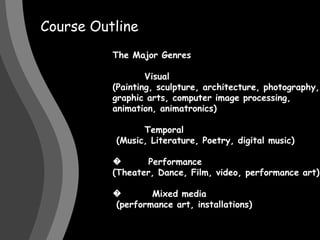
Course OutlineThe Major Genres	Visual (Painting, sculpture, architecture, photography, graphic arts, computer image processing, animation, animatronics)	Temporal (Music, Literature, Poetry, digital music)�    	 Performance (Theater, Dance, Film, video, performance art)�   	  Mixed media (performance art, installations)
Subject	 The subject is not the only attribute of art, but it is the fundamental one, it is the end to which all the others are the means. 	Two distinct, but interrelated, elements of a work of art are the crucial means of projecting its sense of life: the subject and the style—what an artist chooses to present and how he presents it.	The subject of an art work expresses a view of man’s existence, while the style expresses a view of man’s consciousness. The subject reveals an artist’s metaphysics; the style reveals his psycho-epistemology.
Subject	Psycho-epistemology is the study of man’s cognitive processes from the aspect of the interaction between the conscious mind and the automatic functions of the subconscious.Metaphysics—the study of existence as such or, in Aristotle’s words, of “being qua being”—the basic branch of philosophy.
Subject	 The term subjects in art refers to the main idea that is represented in the artwork. The subject in art is basically the essence of the piece. In this section, we'll learn about 5 main subjects that artists have been exploring in art for centuries:still life- a collection of inanimate objects arranged together in a specific waylandscape - natural scenery such as mountains, cliffs, rivers, etcnature - a focused view or interpretation of specific natural elementsportraiture - an image of a particular person or animal, or group thereofabstract - a non-representational work of art
Functions 	The functions of art normally fall within three categories. 	These are personal, social or physical functions. These categories can, and (often) do, overlap in any given piece of art.	The physical functions of art.	 The social functions of art.	 The Political functions of art.	 The personal functions of art.	 A need for self-expression
Medium 	A medium of art is constituted by its genres, that is, the specific uses to which it is employed.  Pigment and canvas (or cave walls) do not necessitate the invention of painting as an art medium, any more than the alphabet prescribes the emergence of writing as a medium of art. Radio is a medium, while tapes and CDs are formats for the reproduction of works in several media, which exist independently of these modalities.
Medium 	1. presentational media:"the web", or interlinked electronic space, a medium organized by means of home pages, which themselves can be characterized by genre (institutional, personal, government, educational);	2. Interactive screen arts, most notably video games, but also "close-ended" hypertext works (unlike the open-ended hyper textual space of the web); 		3.interconnected electronic space, a medium constituted by its principal genres: e-mail, newsgroups, list serves, multi-user environments.
Elements 	Art has given wings for creativity to many and has been expressed in various ways, whether through realism or abstract, impressionism or cubism. Although some of the most famous artists have not always been trained formally in any specific way, there are certain basic elements of art that need to be followed for any basic design.Seven Elements of Art:Line		       Shape	            Form	Value		      Texture    	Color Light 		      Volume	          Mass Perspective     Movement 	Size	Number	     Space
Technique  	TECHNIQUE – means the manner of making or method used in achieving an artwork. The manner of artistic execution or performance or the skills used in making artworks. 	For example, traditional western oil painting on canvas or the Impressionists “dab” technique. The coiling technique in pottery or the photographic silk screen print making technique. 
Artist and His Medium	In art, "medium" refers to the substance the artist uses to create his or her artwork. For example, the medium Michelangelo used to create David was marble, Calder's stabiles employ painted steel plates and Duchamp's infamous Fountain had porcelain as its medium.	Far more commonly, you'll see notations following the titles of paintings that read along the lines of:"Gouache on paper""Tempera on board""Oil on canvas“        "Ink on bamboo"
Artist and His Medium	Any other physical material - from used chewing gum to dog hair - is fair game as an artistic medium. 	Sometimes artists can become extremely creative about this whole media business, and you may run across things in The Art World that defy belief.

Synchronic Study of Art

  • 1.
    Synchronic study ofartGroup 1 ReportersUniversity of Southeastern Philippines( Obrero Campus)Presents BS in Mining Engineering
  • 2.
    Art… Art is aselective re-creation of reality according to an artist’s metaphysical value-judgments. Man’s profound need of art lies in the fact that his cognitive faculty is conceptual, i.e., that he acquires knowledge by means of abstractions, and needs the power to bring his widest metaphysical abstractions into his immediate, perceptual awareness.
  • 3.
    Course OutlineSYNCHRONIC STUDYDefiningterms:SubjectFunctionMedium, elements and techniqueThe artist and his mediumThe artist and his techniqueStyleAesthetics and Judgment [critical judgment approach]Formal qualitiesMediumsElementsOrganizing in space and timePrinciples of design (RVC, harmony, unity, balance, proportion, rhythm, emphasis, subordination)Expressive content
  • 4.
    Course OutlineThe MajorGenres Visual (Painting, sculpture, architecture, photography, graphic arts, computer image processing, animation, animatronics) Temporal (Music, Literature, Poetry, digital music)� Performance (Theater, Dance, Film, video, performance art)� Mixed media (performance art, installations)
  • 5.
    Subject The subjectis not the only attribute of art, but it is the fundamental one, it is the end to which all the others are the means. Two distinct, but interrelated, elements of a work of art are the crucial means of projecting its sense of life: the subject and the style—what an artist chooses to present and how he presents it. The subject of an art work expresses a view of man’s existence, while the style expresses a view of man’s consciousness. The subject reveals an artist’s metaphysics; the style reveals his psycho-epistemology.
  • 6.
    Subject Psycho-epistemology is thestudy of man’s cognitive processes from the aspect of the interaction between the conscious mind and the automatic functions of the subconscious.Metaphysics—the study of existence as such or, in Aristotle’s words, of “being qua being”—the basic branch of philosophy.
  • 7.
    Subject The term subjects inart refers to the main idea that is represented in the artwork. The subject in art is basically the essence of the piece. In this section, we'll learn about 5 main subjects that artists have been exploring in art for centuries:still life- a collection of inanimate objects arranged together in a specific waylandscape - natural scenery such as mountains, cliffs, rivers, etcnature - a focused view or interpretation of specific natural elementsportraiture - an image of a particular person or animal, or group thereofabstract - a non-representational work of art
  • 8.
    Subject The term subjects inart refers to the main idea that is represented in the artwork. The subject in art is basically the essence of the piece. In this section, we'll learn about 5 main subjects that artists have been exploring in art for centuries:still life- a collection of inanimate objects arranged together in a specific waylandscape - natural scenery such as mountains, cliffs, rivers, etcnature - a focused view or interpretation of specific natural elementsportraiture - an image of a particular person or animal, or group thereofabstract - a non-representational work of art
  • 9.
    Functions The functions ofart normally fall within three categories. These are personal, social or physical functions. These categories can, and (often) do, overlap in any given piece of art. The physical functions of art. The social functions of art. The Political functions of art. The personal functions of art. A need for self-expression
  • 10.
    Medium A mediumof art is constituted by its genres, that is, the specific uses to which it is employed. Pigment and canvas (or cave walls) do not necessitate the invention of painting as an art medium, any more than the alphabet prescribes the emergence of writing as a medium of art. Radio is a medium, while tapes and CDs are formats for the reproduction of works in several media, which exist independently of these modalities.
  • 11.
    Medium 1. presentational media:"theweb", or interlinked electronic space, a medium organized by means of home pages, which themselves can be characterized by genre (institutional, personal, government, educational); 2. Interactive screen arts, most notably video games, but also "close-ended" hypertext works (unlike the open-ended hyper textual space of the web); 3.interconnected electronic space, a medium constituted by its principal genres: e-mail, newsgroups, list serves, multi-user environments.
  • 12.
    Elements Art hasgiven wings for creativity to many and has been expressed in various ways, whether through realism or abstract, impressionism or cubism. Although some of the most famous artists have not always been trained formally in any specific way, there are certain basic elements of art that need to be followed for any basic design.Seven Elements of Art:Line Shape Form Value Texture Color Light  Volume Mass Perspective Movement Size Number Space
  • 13.
    Technique   TECHNIQUE – meansthe manner of making or method used in achieving an artwork. The manner of artistic execution or performance or the skills used in making artworks. For example, traditional western oil painting on canvas or the Impressionists “dab” technique. The coiling technique in pottery or the photographic silk screen print making technique. 
  • 14.
    Artist and HisMedium In art, "medium" refers to the substance the artist uses to create his or her artwork. For example, the medium Michelangelo used to create David was marble, Calder's stabiles employ painted steel plates and Duchamp's infamous Fountain had porcelain as its medium. Far more commonly, you'll see notations following the titles of paintings that read along the lines of:"Gouache on paper""Tempera on board""Oil on canvas“ "Ink on bamboo"
  • 15.
    Artist and HisMedium Any other physical material - from used chewing gum to dog hair - is fair game as an artistic medium. Sometimes artists can become extremely creative about this whole media business, and you may run across things in The Art World that defy belief.