
Environmental Chemistry
Go Green – With Green
Department of Chemistry
IIT Guwahati
15/11/2014
Term Paper Presentation
Arsenic Sensors
Guided by :-
Professor Kingsuk Mahata
Assistant Professor
Department of Chemistry
Team Members- The Arsenic Group
• SKV
Shreyash Rai
Gaurav Agrawal
Saurav Pandey
Contents
1. Arsenics – The metalloid
2. Arsenate Poisoning
3. Arsenic contamination of ground water
4. Chemical Sensing -Fluorophore and
receptor
5. What is APC-Merrified Polymer
6. Detection of Arsenic
7. Estimation of Arsenic Concentration
8. Removal of Arsenic from Drinking water
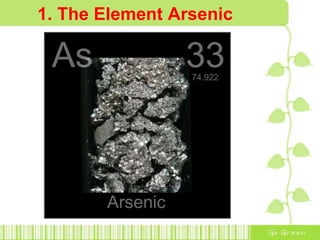
1. The Element Arsenic
ARSENIC
Chemical Properties
• When heated in air, arsenic oxidizes to arsenic
trioxide; the fumes from this reaction have an odor
resembling garlic.
• This odor can be detected on striking arsenide
minerals such as arsenopyrite with a hammer.
• Arsenic sublimes upon heating at atmospheric
pressure, converting directly to a gaseous form
without an intervening liquid state at 887 K (614
°C.Arsenic makes arsenic acid with concentrated
nitric acid, arsenious acid with dilute nitric acid, and
arsenic trioxide with concentrated sulfuric acid.
2. Arsenic Poisoning
• Arsenic poisoning is a medical condition
caused by elevated levels of arsenic in the
body.
• The dominant basis of arsenic poisoning is
from ground water that naturally contains
high concentrations of arsenic.
• A 2007 study found that over 137 million
people in more than 70 countries are
probably affected by arsenic poisoning from
drinking water
Relative Toxicity
Biological Action
• Arsenic interferes with cellular longevity by
inhibition of an essential metabolic enzyme
pyruvate dehydrogenase (PDH) complex,
which catalyzes the oxidation of pyruvate to
acetyl-CoA by NAD+.
• With the enzyme inhibited, the energy
system of the cell is disrupted resulting in a
cellular apoptosis episode.
Signs and Symptoms
• Symptoms of arsenic poisoning begin with
headaches, confusion, severe diarrhea, and
drowsiness.
• As the poisoning develops, convulsions and
changes in fingernail pigmentation called
leukonychia striata may occur. Aldrich Mee’s lines
(leuchoparonychia) on nails are also seen.
• When the poisoning becomes acute, symptoms
may include diarrhea, vomiting, blood in the urine,
cramping muscles, hair loss, stomach pain, and
more convulsions. The organs of the body that are
usually affected by arsenic poisoning are the lungs,
skin, kidneys, and liver.
Ground Water Contamination
• Arsenic contamination of groundwater is often due
to naturally occurring high concentrations of arsenic
in deeper levels of groundwater.
• It is a high-profile problem due to the use of deep
tubewells for water supply in the Ganges Delta,
causing serious arsenic poisoning to large numbers
of people
• A 2007 study found that over 137 million people in
more than 70 countries are probably affected by
arsenic poisoning of drinking water
Occurence in Water
• However, cationic As(III) species rarely exist in the
environment; rather, toxic arsenic species existing
in the environment are either [HAsO4]2− (AsV ) or
[HAsO3]2− (AsIII ).
• Although inorganic arsenic species(AsIII and AsV )
are present to a greater extent in natural water,
lesser amounts of Monomethylarsonic acid(MMA)
and Dimethylarsonic acid (DMA) also exist
• . Arsenic acid tends to exist as the ions [HAsO4]2−
and [H2AsO4]− in neutral water, whereas arsenous
acid is not ionized.These occur due to erosion of
arsenic rocks.
Contaminated Forms
•
Arsenic Acid Arsenous Acid
Arsenic and Arsenous Acids and their derivatives
are responsible for ground water contamination
Tolerance Level
World Health Organization
recommended tolerance value of 10
ppb for drinking water.
World Map
Affected areas of ASSAM
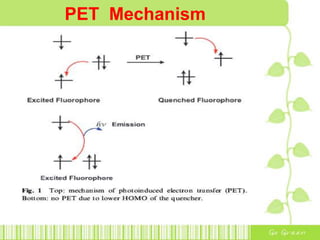
4. Chemical Sensors
PET Mechanism
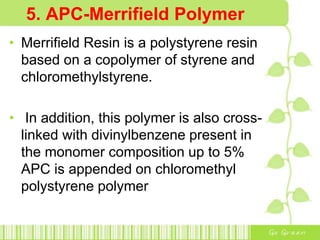
5. APC-Merrifield Polymer
• Merrifield Resin is a polystyrene resin
based on a copolymer of styrene and
chloromethylstyrene.
• In addition, this polymer is also cross-
linked with divinylbenzene present in
the monomer composition up to 5%
APC is appended on chloromethyl
polystyrene polymer
Preparation
2,6-bis((Z)-(2-((pyridin-2-yl)methylthio)phenylimino)methyl)-4-
methylphenol (APC)
6. Sensing Technique by PET
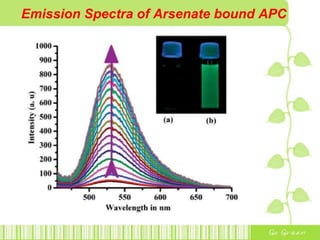
Emission Spectra of Arsenate bound APC
7. Estimation of Concentration of arsenate ion
Comparision of Spectra
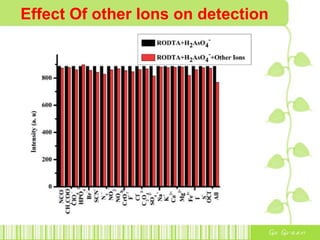
Effect Of other Ions on detection
Detection of intracellular arsenate
• The arsenate compounds may exist as free ions in
the water or may be found combined with one or
more organism.
• Many bacteria has arsenic components in their cell.
This is called intracellular arsenic. Even this
arsenate in cells can be detected by APC sensors.
• The APC is cell permeable and generates bright
green fluorescence upon interaction with
intracellular arsenate. Hence the APC can be
useful in detection of intracellular arsenate
8. Removal Of Arsenic
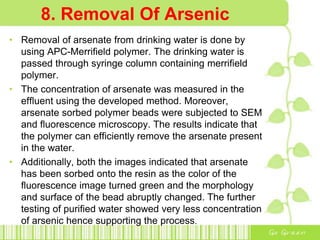
• Removal of arsenate from drinking water is done by
using APC-Merrifield polymer. The drinking water is
passed through syringe column containing merrifield
polymer.
• The concentration of arsenate was measured in the
effluent using the developed method. Moreover,
arsenate sorbed polymer beads were subjected to SEM
and fluorescence microscopy. The results indicate that
the polymer can efficiently remove the arsenate present
in the water.
• Additionally, both the images indicated that arsenate
has been sorbed onto the resin as the color of the
fluorescence image turned green and the morphology
and surface of the bead abruptly changed. The further
testing of purified water showed very less concentration
of arsenic hence supporting the process.
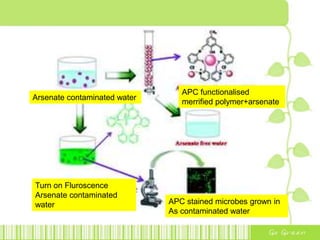
Arsenate contaminated water
APC functionalised
merrified polymer+arsenate
Turn on Fluroscence
Arsenate contaminated
water APC stained microbes grown in
As contaminated water
Arsenic treatment
• Coagulation/filtration (also known as flocculation)
removes arsenic by coprecipitation and adsorption
using iron coagulants. Coagulation/filtration using
alum is already used by some utilities to remove
suspended solids and may be adjusted to remove
arsenic.
• Iron oxide adsorption filters the water through a
granular medium containing ferric oxide. Ferric
oxide has a high affinity for adsorbing dissolved
metals such as arsenic. The iron oxide medium
eventually becomes saturated, and must be
replaced.
coagulation
Arsenic treatment
• Activated Alumina is an adsorbent that effectively
removes arsenic. Activated alumina columns
connected to shallow tube wells in India and
Bangladesh have removed both As(III) and As(V)
from groundwater for decades
• Ion Exchange has long been used as a water-
softening process, although usually on a single-
home basis. Traditional anion exchange resins are
effective in removing As(V)
• Both Reverse osmosis and electrodialysis (also
called electrodialysis reversal) can remove arsenic
with a net ionic charge.
APPLICATIONS
• This method can be used to detect arsenic in the
form of arsenate ions from groundwater. Even the
intracellular arsenic present inside cells of bacteria
can also be detected by this method.
• The sensor can be used to calculate and maintain
the composition of arsenic in medicines used by
people. Further applications includes determination
of the arsenic concentration in arsenic based
pesticides.
• It can also be used to get the arsenic composition
in arsenic based semiconductors like Gallium-
Arsenic which is used as LED and in solar panels
Conclusion
• APC, a new low cost arsenate sensor with visible
light excitation can detect as low as 0.001 mM
arsenate.
• Estimation of Arsenate concentration is obtained
from the plot of intensity vs concentration.
• Removal of arsenate concentration is done by APC-
implanted Merrified polymer.
• Simultaneous detection, determination and removal
of arsenate by fluorescence method using a single
substance are reported for the 1st time.
• The presence of other ions doesn’t affect the
detection process of arsenate by APC sensor.
• The method can be used to remove arsenate
impurities from water and make it fit for drinking.
Arsenic sensors

Arsenic sensors

  • 1.
    Environmental Chemistry Go Green– With Green Department of Chemistry IIT Guwahati 15/11/2014
  • 2.
    Term Paper Presentation ArsenicSensors Guided by :- Professor Kingsuk Mahata Assistant Professor Department of Chemistry
  • 3.
    Team Members- TheArsenic Group • SKV Shreyash Rai Gaurav Agrawal Saurav Pandey
  • 4.
    Contents 1. Arsenics –The metalloid 2. Arsenate Poisoning 3. Arsenic contamination of ground water 4. Chemical Sensing -Fluorophore and receptor 5. What is APC-Merrified Polymer 6. Detection of Arsenic 7. Estimation of Arsenic Concentration 8. Removal of Arsenic from Drinking water
  • 5.
  • 6.
  • 7.
    Chemical Properties • Whenheated in air, arsenic oxidizes to arsenic trioxide; the fumes from this reaction have an odor resembling garlic. • This odor can be detected on striking arsenide minerals such as arsenopyrite with a hammer. • Arsenic sublimes upon heating at atmospheric pressure, converting directly to a gaseous form without an intervening liquid state at 887 K (614 °C.Arsenic makes arsenic acid with concentrated nitric acid, arsenious acid with dilute nitric acid, and arsenic trioxide with concentrated sulfuric acid.
  • 8.
    2. Arsenic Poisoning •Arsenic poisoning is a medical condition caused by elevated levels of arsenic in the body. • The dominant basis of arsenic poisoning is from ground water that naturally contains high concentrations of arsenic. • A 2007 study found that over 137 million people in more than 70 countries are probably affected by arsenic poisoning from drinking water
  • 9.
  • 10.
    Biological Action • Arsenicinterferes with cellular longevity by inhibition of an essential metabolic enzyme pyruvate dehydrogenase (PDH) complex, which catalyzes the oxidation of pyruvate to acetyl-CoA by NAD+. • With the enzyme inhibited, the energy system of the cell is disrupted resulting in a cellular apoptosis episode.
  • 11.
    Signs and Symptoms •Symptoms of arsenic poisoning begin with headaches, confusion, severe diarrhea, and drowsiness. • As the poisoning develops, convulsions and changes in fingernail pigmentation called leukonychia striata may occur. Aldrich Mee’s lines (leuchoparonychia) on nails are also seen. • When the poisoning becomes acute, symptoms may include diarrhea, vomiting, blood in the urine, cramping muscles, hair loss, stomach pain, and more convulsions. The organs of the body that are usually affected by arsenic poisoning are the lungs, skin, kidneys, and liver.
  • 12.
    Ground Water Contamination •Arsenic contamination of groundwater is often due to naturally occurring high concentrations of arsenic in deeper levels of groundwater. • It is a high-profile problem due to the use of deep tubewells for water supply in the Ganges Delta, causing serious arsenic poisoning to large numbers of people • A 2007 study found that over 137 million people in more than 70 countries are probably affected by arsenic poisoning of drinking water
  • 13.
    Occurence in Water •However, cationic As(III) species rarely exist in the environment; rather, toxic arsenic species existing in the environment are either [HAsO4]2− (AsV ) or [HAsO3]2− (AsIII ). • Although inorganic arsenic species(AsIII and AsV ) are present to a greater extent in natural water, lesser amounts of Monomethylarsonic acid(MMA) and Dimethylarsonic acid (DMA) also exist • . Arsenic acid tends to exist as the ions [HAsO4]2− and [H2AsO4]− in neutral water, whereas arsenous acid is not ionized.These occur due to erosion of arsenic rocks.
  • 14.
    Contaminated Forms • Arsenic AcidArsenous Acid Arsenic and Arsenous Acids and their derivatives are responsible for ground water contamination
  • 15.
    Tolerance Level World HealthOrganization recommended tolerance value of 10 ppb for drinking water.
  • 16.
  • 17.
  • 18.
  • 19.
  • 20.
    5. APC-Merrifield Polymer •Merrifield Resin is a polystyrene resin based on a copolymer of styrene and chloromethylstyrene. • In addition, this polymer is also cross- linked with divinylbenzene present in the monomer composition up to 5% APC is appended on chloromethyl polystyrene polymer
  • 21.
  • 22.
  • 23.
    Emission Spectra ofArsenate bound APC
  • 24.
    7. Estimation ofConcentration of arsenate ion
  • 25.
  • 26.
    Effect Of otherIons on detection
  • 27.
    Detection of intracellulararsenate • The arsenate compounds may exist as free ions in the water or may be found combined with one or more organism. • Many bacteria has arsenic components in their cell. This is called intracellular arsenic. Even this arsenate in cells can be detected by APC sensors. • The APC is cell permeable and generates bright green fluorescence upon interaction with intracellular arsenate. Hence the APC can be useful in detection of intracellular arsenate
  • 28.
    8. Removal OfArsenic • Removal of arsenate from drinking water is done by using APC-Merrifield polymer. The drinking water is passed through syringe column containing merrifield polymer. • The concentration of arsenate was measured in the effluent using the developed method. Moreover, arsenate sorbed polymer beads were subjected to SEM and fluorescence microscopy. The results indicate that the polymer can efficiently remove the arsenate present in the water. • Additionally, both the images indicated that arsenate has been sorbed onto the resin as the color of the fluorescence image turned green and the morphology and surface of the bead abruptly changed. The further testing of purified water showed very less concentration of arsenic hence supporting the process.
  • 29.
    Arsenate contaminated water APCfunctionalised merrified polymer+arsenate Turn on Fluroscence Arsenate contaminated water APC stained microbes grown in As contaminated water
  • 30.
    Arsenic treatment • Coagulation/filtration(also known as flocculation) removes arsenic by coprecipitation and adsorption using iron coagulants. Coagulation/filtration using alum is already used by some utilities to remove suspended solids and may be adjusted to remove arsenic. • Iron oxide adsorption filters the water through a granular medium containing ferric oxide. Ferric oxide has a high affinity for adsorbing dissolved metals such as arsenic. The iron oxide medium eventually becomes saturated, and must be replaced.
  • 31.
  • 32.
    Arsenic treatment • ActivatedAlumina is an adsorbent that effectively removes arsenic. Activated alumina columns connected to shallow tube wells in India and Bangladesh have removed both As(III) and As(V) from groundwater for decades • Ion Exchange has long been used as a water- softening process, although usually on a single- home basis. Traditional anion exchange resins are effective in removing As(V) • Both Reverse osmosis and electrodialysis (also called electrodialysis reversal) can remove arsenic with a net ionic charge.
  • 33.
    APPLICATIONS • This methodcan be used to detect arsenic in the form of arsenate ions from groundwater. Even the intracellular arsenic present inside cells of bacteria can also be detected by this method. • The sensor can be used to calculate and maintain the composition of arsenic in medicines used by people. Further applications includes determination of the arsenic concentration in arsenic based pesticides. • It can also be used to get the arsenic composition in arsenic based semiconductors like Gallium- Arsenic which is used as LED and in solar panels
  • 34.
    Conclusion • APC, anew low cost arsenate sensor with visible light excitation can detect as low as 0.001 mM arsenate. • Estimation of Arsenate concentration is obtained from the plot of intensity vs concentration. • Removal of arsenate concentration is done by APC- implanted Merrified polymer. • Simultaneous detection, determination and removal of arsenate by fluorescence method using a single substance are reported for the 1st time. • The presence of other ions doesn’t affect the detection process of arsenate by APC sensor. • The method can be used to remove arsenate impurities from water and make it fit for drinking.