Defining Purchase Management also known as procurement management
1.
Purchase Mange
Management:
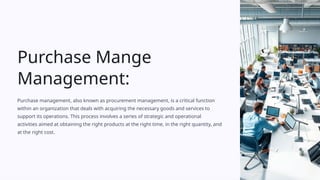
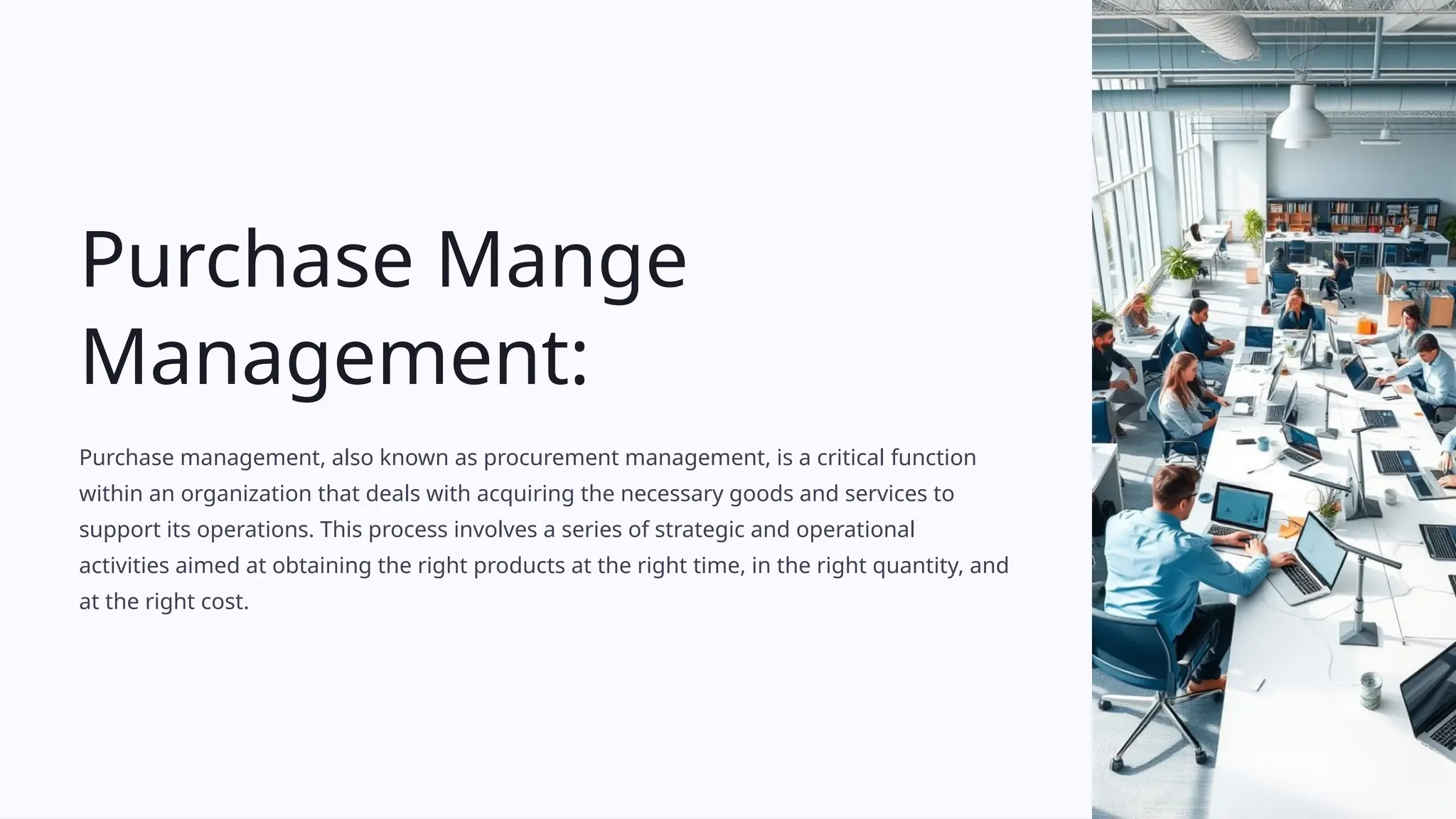
Purchase management,also known as procurement management, is a critical function
within an organization that deals with acquiring the necessary goods and services to
support its operations. This process involves a series of strategic and operational
activities aimed at obtaining the right products at the right time, in the right quantity, and
at the right cost.
2.
Defining Purchase Management
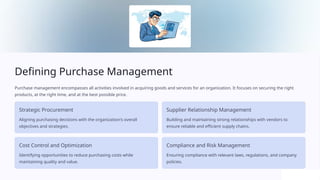
Purchasemanagement encompasses all activities involved in acquiring goods and services for an organization. It focuses on securing the right
products, at the right time, and at the best possible price.
Strategic Procurement
Aligning purchasing decisions with the organization's overall
objectives and strategies.
Supplier Relationship Management
Building and maintaining strong relationships with vendors to
ensure reliable and efficient supply chains.
Cost Control and Optimization
Identifying opportunities to reduce purchasing costs while
maintaining quality and value.
Compliance and Risk Management
Ensuring compliance with relevant laws, regulations, and company
policies.
3.
Procurement Process
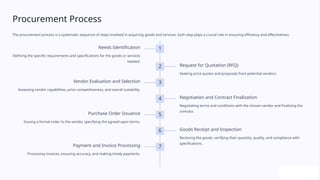
The procurementprocess is a systematic sequence of steps involved in acquiring goods and services. Each step plays a crucial role in ensuring efficiency and effectiveness.
1
Needs Identification
Defining the specific requirements and specifications for the goods or services
needed.
2 Request for Quotation (RFQ)
Seeking price quotes and proposals from potential vendors.
3
Vendor Evaluation and Selection
Assessing vendor capabilities, price competitiveness, and overall suitability.
4 Negotiation and Contract Finalization
Negotiating terms and conditions with the chosen vendor and finalizing the
contract.
5
Purchase Order Issuance
Issuing a formal order to the vendor, specifying the agreed-upon terms.
6 Goods Receipt and Inspection
Receiving the goods, verifying their quantity, quality, and compliance with
specifications.
7
Payment and Invoice Processing
Processing invoices, ensuring accuracy, and making timely payments.
4.
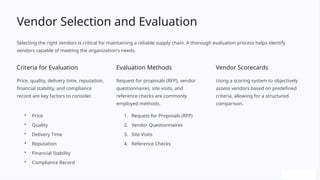
Vendor Selection andEvaluation
Selecting the right vendors is critical for maintaining a reliable supply chain. A thorough evaluation process helps identify
vendors capable of meeting the organization's needs.
Criteria for Evaluation
Price, quality, delivery time, reputation,
financial stability, and compliance
record are key factors to consider.
• Price
• Quality
• Delivery Time
• Reputation
• Financial Stability
• Compliance Record
Evaluation Methods
Request for proposals (RFP), vendor
questionnaires, site visits, and
reference checks are commonly
employed methods.
1. Request for Proposals (RFP)
2. Vendor Questionnaires
3. Site Visits
4. Reference Checks
Vendor Scorecards
Using a scoring system to objectively
assess vendors based on predefined
criteria, allowing for a structured
comparison.
5.
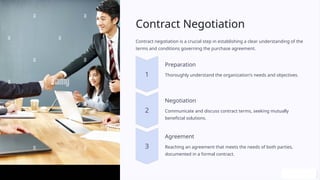
Contract Negotiation
Contract negotiationis a crucial step in establishing a clear understanding of the
terms and conditions governing the purchase agreement.
Preparation
Thoroughly understand the organization's needs and objectives.
Negotiation
Communicate and discuss contract terms, seeking mutually
beneficial solutions.
Agreement
Reaching an agreement that meets the needs of both parties,
documented in a formal contract.
6.
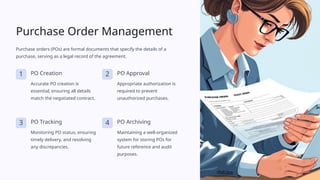
Purchase Order Management
Purchaseorders (POs) are formal documents that specify the details of a
purchase, serving as a legal record of the agreement.
1 PO Creation
Accurate PO creation is
essential, ensuring all details
match the negotiated contract.
2 PO Approval
Appropriate authorization is
required to prevent
unauthorized purchases.
3 PO Tracking
Monitoring PO status, ensuring
timely delivery, and resolving
any discrepancies.
4 PO Archiving
Maintaining a well-organized
system for storing POs for
future reference and audit
purposes.
7.
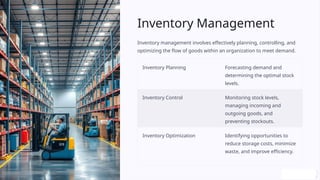
Inventory Management
Inventory managementinvolves effectively planning, controlling, and
optimizing the flow of goods within an organization to meet demand.
Inventory Planning Forecasting demand and
determining the optimal stock
levels.
Inventory Control Monitoring stock levels,
managing incoming and
outgoing goods, and
preventing stockouts.
Inventory Optimization Identifying opportunities to
reduce storage costs, minimize
waste, and improve efficiency.
8.
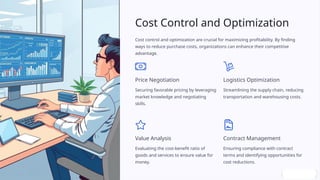
Cost Control andOptimization
Cost control and optimization are crucial for maximizing profitability. By finding
ways to reduce purchase costs, organizations can enhance their competitive
advantage.
Price Negotiation
Securing favorable pricing by leveraging
market knowledge and negotiating
skills.
Logistics Optimization
Streamlining the supply chain, reducing
transportation and warehousing costs.
Value Analysis
Evaluating the cost-benefit ratio of
goods and services to ensure value for
money.
Contract Management
Ensuring compliance with contract
terms and identifying opportunities for
cost reductions.
9.
Compliance and RegulatoryConsiderations
Organizations must comply with relevant laws, regulations, and industry standards to ensure ethical and sustainable
purchasing practices.
Legal Compliance
Adhering to local and international
laws governing procurement, including
antitrust regulations.
Ethical Standards
Prioritizing ethical sourcing, avoiding
conflict of interest, and promoting
sustainable practices.
Traceability
Maintaining records of product origin
and ensuring compliance with relevant
traceability requirements.
10.
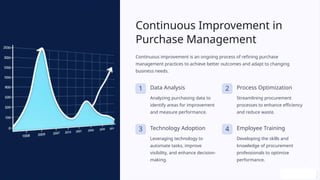
Continuous Improvement in
PurchaseManagement
Continuous improvement is an ongoing process of refining purchase
management practices to achieve better outcomes and adapt to changing
business needs.
1 Data Analysis
Analyzing purchasing data to
identify areas for improvement
and measure performance.
2 Process Optimization
Streamlining procurement
processes to enhance efficiency
and reduce waste.
3 Technology Adoption
Leveraging technology to
automate tasks, improve
visibility, and enhance decision-
making.
4 Employee Training
Developing the skills and
knowledge of procurement
professionals to optimize
performance.
11.
Popular Purchasing Systems
Severalsoftware solutions are available to support purchase management, including:
• SAP Ariba: A comprehensive procurement and supply chain management solution.
• Coupa: An integrated spend management platform that offers procurement, invoicing, and expense management.
• Oracle Procurement Cloud: Part of Oracle’s suite of cloud applications, providing tools for procurement and supply
chain management.
• Microsoft Dynamics 365: Offers purchasing and procurement capabilities as part of its ERP suite.
In summary, a purchasing system is essential for managing the procurement process efficiently, ensuring cost-effectiveness,
and maintaining strong supplier relationships. By implementing a robust purchasing system, organizations can enhance
their procurement operations and achieve strategic business objectives.