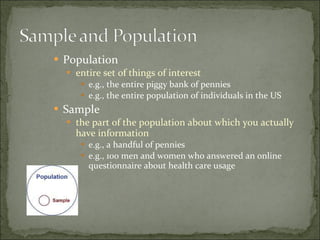
Population entire set of things of interest e.g., the entire piggy bank of pennies e.g., the entire population of individuals in the US Sample the part of the population about which you actually have information e.g., a handful of pennies e.g., 100 men and women who answered an online questionnaire about health care usage
It is usually more practical to obtain information from a sample than from the entire population. The goal of research is to make generalizations or predictions about populations or events in general. Much of social and behavioral research is conducted by evaluating a sample of individuals who are representative of a population of interest.
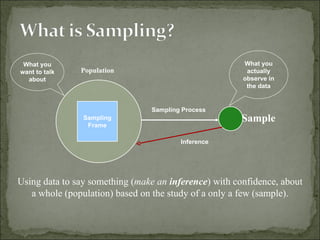
Population  Sample Using data to say something ( make an   inference ) with confidence, about a whole (population) based on the study of a only a few (sample). Sampling Frame Sampling Process What you want to talk about What you actually observe in the data Inference
Random Selection method of choosing a sample in which each individual in the population has an equal chance of being selected  A sample “n” is selection from population ‘N” Selection process with no pattern; unpredictable Reduces the likelihood of researcher bias  Researcher can calculate the probability of certain outcomes  Several different ways to conduct random sampling Random numbers table, drawing out of a hat, coin flips, etc Why Random Assignment is best? Samples that are assigned in a random fashion are most likely to be truly representative of the population under consideration. Haphazard Selection (Convenience Sampling) method of selecting a sample of individuals to study by taking whoever is available or happens to be first on a list This method of selection can result in a sample that is not representative of the population.
Sample selection is usually mentioned in the methods section of a research article. Appropriate sampling methods must be evaluated.  All other things being equal, smaller samples (e.g., those with fewer than 1,000 respondents) have greater  sampling error  than larger samples.  To better understand the notion of sampling error, it is helpful to recall that data from a sample provide merely an estimate of the true proportion of the population that has a particular characteristic
Population Parameters mean, variance, and standard deviation of a population are usually unknown and can be estimated from information obtained from a sample of the population Sample Statistics mean, variance, and standard deviation you figure for the sample calculated from known information Copyright © 2011 by Pearson Education, Inc. All rights reserved
Expected relative frequency of a particular outcome outcome term used for discussing probability for the result of an experiment expected relative frequency number of successful outcomes divided by the number of total outcomes you would expect to get if you repeated an experiment a large number of times long-run relative-frequency interpretation of probability understanding of probability as the proportion of a particular outcome that you would get if the experiment were repeated many times Copyright © 2011 by Pearson Education, Inc. All rights reserved
Determine the number of possible successful outcomes. Determine the number of all possible outcomes. Divide the number of possible successful outcomes by the number of all possible outcomes. Copyright © 2011 by Pearson Education, Inc. All rights reserved
You have a jar that contains 100 jelly beans. 9 of the jelly beans are green. The probability of picking a green jelly bean would be  9 (# of successful outcomes)  or 9% 100 (# of possible outcomes) Copyright © 2011 by Pearson Education, Inc. All rights reserved
Probability cannot be less than 0 or greater than 1. Something with a probability of 0 has no chance of happening. Something with a probability of 1 has a 100% chance of happening. Copyright © 2011 by Pearson Education, Inc. All rights reserved
p  is a symbol for probability. Probability is usually written as a decimal, but can also be written as a fraction or percentage. p < .05 Threshold for significance in research the probability is less than .05 So, you are saying that there is less than a 5% chance of the differences you see in your research results being from something other than random chance variation Probability is discussed in the context of reporting statistical significance of study results.  The p-value is the probability of the findings being by something other than chance occurrence. Researcher will set the threshold prior to doing the research;  Threshold p-value is usually p< .05 or p< .01
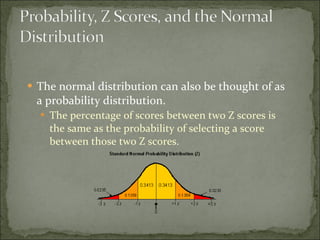
The normal distribution can also be thought of as a probability distribution. The percentage of scores between two Z scores is the same as the probability of selecting a score between those two Z scores.

Aron chpt 4 sample and probability

  • 1.
    Population entire setof things of interest e.g., the entire piggy bank of pennies e.g., the entire population of individuals in the US Sample the part of the population about which you actually have information e.g., a handful of pennies e.g., 100 men and women who answered an online questionnaire about health care usage
  • 2.
    It is usuallymore practical to obtain information from a sample than from the entire population. The goal of research is to make generalizations or predictions about populations or events in general. Much of social and behavioral research is conducted by evaluating a sample of individuals who are representative of a population of interest.
  • 3.
    Population SampleUsing data to say something ( make an inference ) with confidence, about a whole (population) based on the study of a only a few (sample). Sampling Frame Sampling Process What you want to talk about What you actually observe in the data Inference
  • 4.
    Random Selection methodof choosing a sample in which each individual in the population has an equal chance of being selected A sample “n” is selection from population ‘N” Selection process with no pattern; unpredictable Reduces the likelihood of researcher bias Researcher can calculate the probability of certain outcomes Several different ways to conduct random sampling Random numbers table, drawing out of a hat, coin flips, etc Why Random Assignment is best? Samples that are assigned in a random fashion are most likely to be truly representative of the population under consideration. Haphazard Selection (Convenience Sampling) method of selecting a sample of individuals to study by taking whoever is available or happens to be first on a list This method of selection can result in a sample that is not representative of the population.
  • 5.
    Sample selection isusually mentioned in the methods section of a research article. Appropriate sampling methods must be evaluated. All other things being equal, smaller samples (e.g., those with fewer than 1,000 respondents) have greater sampling error than larger samples. To better understand the notion of sampling error, it is helpful to recall that data from a sample provide merely an estimate of the true proportion of the population that has a particular characteristic
  • 6.
    Population Parameters mean,variance, and standard deviation of a population are usually unknown and can be estimated from information obtained from a sample of the population Sample Statistics mean, variance, and standard deviation you figure for the sample calculated from known information Copyright © 2011 by Pearson Education, Inc. All rights reserved
  • 7.
    Expected relative frequencyof a particular outcome outcome term used for discussing probability for the result of an experiment expected relative frequency number of successful outcomes divided by the number of total outcomes you would expect to get if you repeated an experiment a large number of times long-run relative-frequency interpretation of probability understanding of probability as the proportion of a particular outcome that you would get if the experiment were repeated many times Copyright © 2011 by Pearson Education, Inc. All rights reserved
  • 8.
    Determine the numberof possible successful outcomes. Determine the number of all possible outcomes. Divide the number of possible successful outcomes by the number of all possible outcomes. Copyright © 2011 by Pearson Education, Inc. All rights reserved
  • 9.
    You have ajar that contains 100 jelly beans. 9 of the jelly beans are green. The probability of picking a green jelly bean would be 9 (# of successful outcomes) or 9% 100 (# of possible outcomes) Copyright © 2011 by Pearson Education, Inc. All rights reserved
  • 10.
    Probability cannot beless than 0 or greater than 1. Something with a probability of 0 has no chance of happening. Something with a probability of 1 has a 100% chance of happening. Copyright © 2011 by Pearson Education, Inc. All rights reserved
  • 11.
    p isa symbol for probability. Probability is usually written as a decimal, but can also be written as a fraction or percentage. p < .05 Threshold for significance in research the probability is less than .05 So, you are saying that there is less than a 5% chance of the differences you see in your research results being from something other than random chance variation Probability is discussed in the context of reporting statistical significance of study results. The p-value is the probability of the findings being by something other than chance occurrence. Researcher will set the threshold prior to doing the research; Threshold p-value is usually p< .05 or p< .01
  • 12.
    The normal distributioncan also be thought of as a probability distribution. The percentage of scores between two Z scores is the same as the probability of selecting a score between those two Z scores.