Three phase system
Flux density
B [T]
l
d


L
A
M
N
Generator for single phase
Current induces in the coil as the
coil moves in the magnetic field
Current produced at terminal
Note
Induction motor cannot start
by itself. This problem is
solved by introducing three
phase system
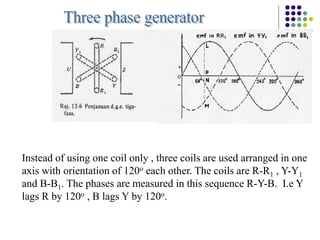
Instead of using one coil only , three coils are used arranged in one
axis with orientation of 120o each other. The coils are R-R1 , Y-Y1
and B-B1. The phases are measured in this sequence R-Y-B. I.e Y
lags R by 120o , B lags Y by 120o.
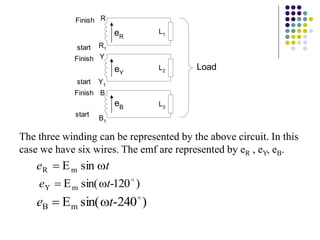
The three winding can be represented by the above circuit. In this
case we have six wires. The emf are represented by eR , eY, eB.
t
e 
 sin
Em
R
)
120
-
sin(
Em
Y

t
e 

)
240
-
sin(
Em
B

t
e 

Load
Finish
Finish
Finish
start
start
start
R
R1
Y
Y1
B
B1
L1
L2
L3
eR
eY
eB
The circuit can be simplified as follows, where R1 can be
connected to Y and Y1 can be connected to B. In this case
the circuit is reduced to 4 wires.
B
Y
R
1
RB e
e
e
e 


)]
240
sin(
)
120
sin(
[sin
Em









 t
t
t


120
sin
t
cos
120
cos
t
sin
t
[sin 



 


m
E
]
240
sin
t
cos
240
cos
t
sin 




 

]
t
866
.
0
t
sin
5
.
0
t
cos
866
.
0
t
sin
5
0
t
[sin 



 kos
.
Em 




0

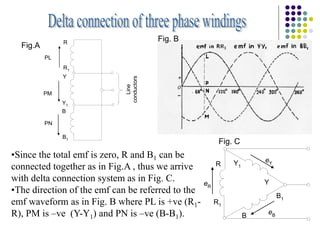
Since the total emf is zero, R and B1 can be connected together, thus
we arrive with delta connection system.
Finish
Finish
Finish
start
start
start
R
R1
Y
Y1
B
B1
eR+eY+eB
eR
eY
eB
R
R1
Y
Y1
B
B1
eB
eR
eY
Line
conductors
R
R1
Y
Y1
B
B1
PL
PM
PN
•Since the total emf is zero, R and B1 can be
connected together as in Fig.A , thus we arrive
with delta connection system as in Fig. C.
•The direction of the emf can be referred to the
emf waveform as in Fig. B where PL is +ve (R1-
R), PM is –ve (Y-Y1) and PN is –ve (B-B1).
Fig.A
Fig. B
Fig. C
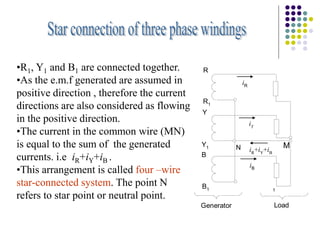
•R1, Y1 and B1 are connected together.
•As the e.m.f generated are assumed in
positive direction , therefore the current
directions are also considered as flowing
in the positive direction.
•The current in the common wire (MN)
is equal to the sum of the generated
currents. i.e iR+iY+iB .
•This arrangement is called four –wire
star-connected system. The point N
refers to star point or neutral point.
R
R1
Y
Y1
B
B1
Generator Load
N
iR
iB
iY
1
iR+iY+iB
M
t
sin
i 
m
R I

)
120
t
sin(
i 
-
Im
Y 

)
240
t
sin(
i 
-
Im
B 

The instantaneous current in loads L1 , L2 and L3 are
B
Y
R
N i
i
i
i 


0
)]
240
t
sin(
)
120
t
sin(
t
[sin











m
I
R
R
1
Y Y
1
B
B1
Line
conductors
R
N
iR
iB
iY
iR
+iY
+iB
L3
L1
L2
B
Y
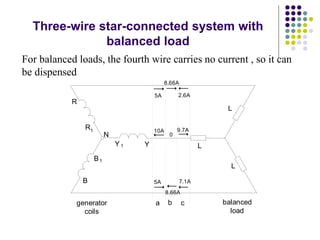
Three-wire star-connected system with
balanced load
For balanced loads, the fourth wire carries no current , so it can
be dispensed
R
R
1
Y Y
1
B
B1
N
L
L
L
a b c balanced
load
generator
coils
5A
10A
5A
0
8.66A
2.6A
9.7A
7.1A
8.66A
phase
and
line
current
in
ampere
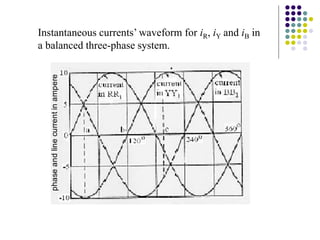
Instantaneous currents’ waveform for iR, iY and iB in
a balanced three-phase system.
VR
VY
VB
-VY
-VB
-VR
VRY
VYB
VBR
)
( Y
R
Y
R
RY V
V
V
V
V 




R
Y
B
N
VRY
VYB
IR
IB
IY
R
Y
B
N
V
VRY
VBR
VYB
IR
IB
IY
R
VY
VB
)
( B
Y
B
Y
YB V
V
V
V
V 




)
( R
B
R
B
BR V
V
V
V
V 




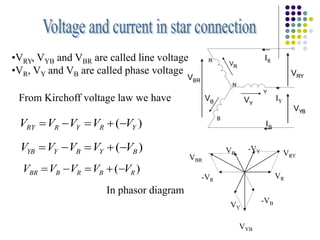
•VRY, VYB and VBR are called line voltage
•VR, VY and VB are called phase voltage
From Kirchoff voltage law we have
In phasor diagram
VR
VY
VB
-VY
-VB
-VR
VRY
VYB
VBR
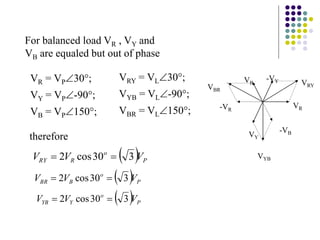
For balanced load VR , VY and
VB are equaled but out of phase
VR = VP30;
VY = VP-90;
VB = VP150;
  P
o
R
RY V
V
V 3
30
cos
2 

therefore
VRY = VL30;
VYB = VL-90;
VBR = VL150;
  P
o
Y
YB V
V
V 3
30
cos
2 

  P
o
B
BR V
V
V 3
30
cos
2 

  P
L V
V 3

P
L I
I 
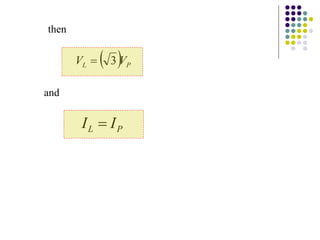
then
and
I3
R
Y
B
IB
IR
IY
I2
I1
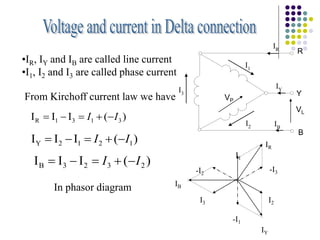
•IR, IY and IB are called line current
•I1, I2 and I3 are called phase current
)
(
I
I
I 3
1
3
1
R I
I 




)
(
I
I
I 1
2
1
2
Y I
I 




)
(
I
I
I 2
3
2
3
B I
I 




I2
I1
I3
-I3
-I2
-I1
IR
IY
IB
From Kirchoff current law we have
In phasor diagram
VL
VP
I2
I1
I3
-I3
-I2
-I1
IR
IY
IB
P
R I
I
I )
3
(
30
cos
2 1 
 
P
Y I
I
I )
3
(
30
cos
2 2 
 
  P
B I
I
I 3
30
cos
2 3 
 
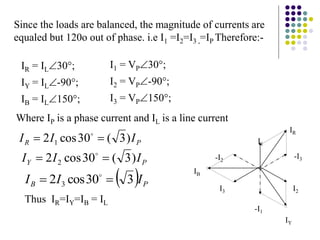
Since the loads are balanced, the magnitude of currents are
equaled but 120o out of phase. i.e I1 =I2=I3 ,=IP Therefore:-
Thus IR=IY=IB = IL
Where IP is a phase current and IL is a line current
I1 = VP30;
I2 = VP-90;
I3 = VP150;
IR = IL30;
IY = IL-90;
IB = IL150;
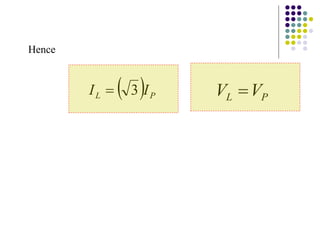
Hence
  P
L I
I 3
 P
L V
V 
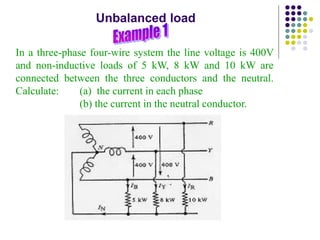
Unbalanced load
In a three-phase four-wire system the line voltage is 400V
and non-inductive loads of 5 kW, 8 kW and 10 kW are
connected between the three conductors and the neutral.
Calculate: (a) the current in each phase
(b) the current in the neutral conductor.
V
V
V L
P 230
3
400
3



A
V
P
I
P
B
B 7
.
21
230
10
5 3




A
V
P
I
P
Y
Y 8
.
34
230
10
8 3




A
V
P
I
P
R
R 5
.
43
230
104



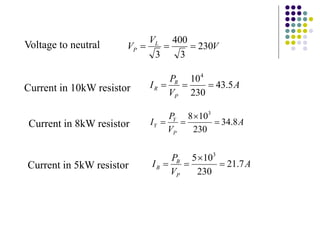
Voltage to neutral
Current in 8kW resistor
Current in 10kW resistor
Current in 5kW resistor
IR
IY
IB
IYH
IYV
IBH
IBV
  A
.
I
I
I o
B
Y
H 3
.
11
7
.
21
8
.
34
866
0
30
cos
30
cos 



 
A
I
I
I
I o
B
Y
R
V 0
.
13
)
7
.
21
8
.
34
(
5
.
0
5
.
43
60
cos
60
cos 





 
INV
INH
IN
A
.
I
I
I NV
NH
N 2
.
17
0
.
13
3
11 2
2
2
2





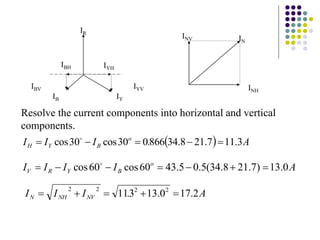
Resolve the current components into horizontal and vertical
components.
R
B
Y
400V
400V
400V
IR
IB
IY
I3
I2
I1
R1=100
R2=20
C=30F
X2=60
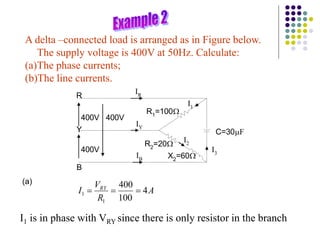
A delta –connected load is arranged as in Figure below.
The supply voltage is 400V at 50Hz. Calculate:
(a)The phase currents;
(b)The line currents.
A
R
V
I RY
4
100
400
1
1 


I1 is in phase with VRY since there is only resistor in the branch
(a)
2
2
2
2
Y X
R
Z 
 2
2
60
20 










 
2
2
1
Y
R
X
tan 





 
20
60
tan 1
C
BR
3
X
V
I  
90
)
10
30
50
2
/(
1
400
6






 
A
77
.
3

A
Z
V
I
Y
YB
32
.
6
60
20
400
2
2
2 



o
90

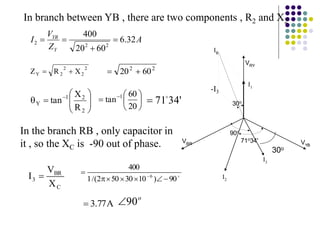
In branch between YB , there are two components , R2 and X2
In the branch RB , only capacitor in
it , so the XC is -90 out of phase.
'
34
71

VRY
IR
I3
I2
VYB
VBR
I1
71o34'
90o
30o
-I3
30o
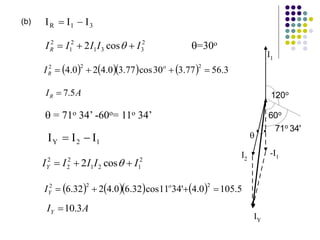
(b) 3
1
R I
I
I 

2
3
3
1
2
1
2
cos
2 I
I
I
I
IR 

 
       3
.
56
77
.
3
30
cos
77
.
3
0
.
4
2
0
.
4
2
2
2



 o
R
I
A
IR 5
.
7

1
2
Y I
I
I 

2
1
2
1
2
2
2
cos
2 I
I
I
I
IY 

 
       5
.
105
0
.
4
'
34
11
cos
32
.
6
0
.
4
2
32
.
6
2
2
2



 o
Y
I
A
IY 3
.
10

I1
-I1
I2
IY
120o
71o
34'
60o

 = 71o 34’ -60o= 11o 34’
=30o
2
2
2
3
2
3
2
cos
2 I
I
I
I
IB 

 
       5
.
18
77
.
3
'
26
138
cos
32
.
6
77
.
3
2
32
.
6
2
2
2



 o
B
I
A
IB 3
.
4

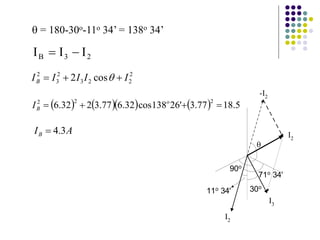
 = 180-30o-11o 34’ = 138o 34’
2
3
B I
I
I 


-I2
I2
I3
I2
71o 34'
90o
30o
11o 34'
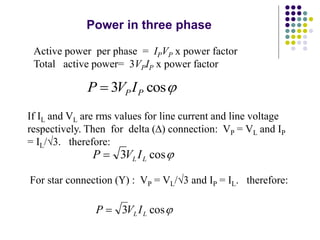
Power in three phase
Active power per phase = IPVP x power factor
Total active power= 3VPIP x power factor

cos
3 P
PI
V
P 
If IL and VL are rms values for line current and line voltage
respectively. Then for delta () connection: VP = VL and IP
= IL/3. therefore:

cos
3 L
L I
V
P 
For star connection () : VP = VL/3 and IP = IL. therefore:

cos
3 L
L I
V
P 
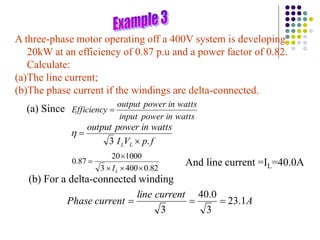
A three-phase motor operating off a 400V system is developing
20kW at an efficiency of 0.87 p.u and a power factor of 0.82.
Calculate:
(a)The line current;
(b)The phase current if the windings are delta-connected.
(a) Since
watts
in
power
input
watts
in
power
output
Efficiency 
f
p
V
I
watts
in
power
output
L
L .
3 


82
.
0
400
3
1000
20
87
.
0





L
I
And line current =IL=40.0A
(b) For a delta-connected winding
A
current
line
current
Phase 1
.
23
3
0
.
40
3



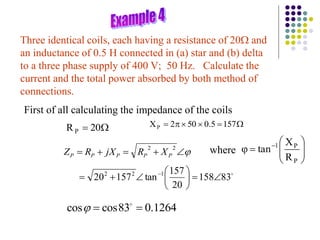
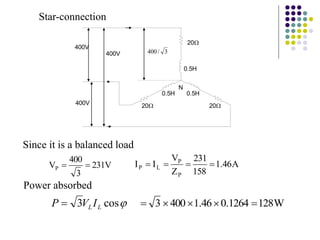
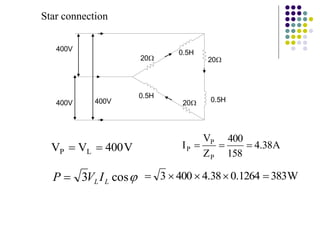
Three identical coils, each having a resistance of 20 and
an inductance of 0.5 H connected in (a) star and (b) delta
to a three phase supply of 400 V; 50 Hz. Calculate the
current and the total power absorbed by both method of
connections.

 20
RP





 157
5
.
0
50
2
XP






2
2
P
P
P
P
P X
R
jX
R
Z

83
158
20
157
tan
157
20 1
2
2










 
First of all calculating the impedance of the coils









 
P
P
1
R
X
tan
where
1264
.
0
83
cos
cos 
 

20
3
/
400
400V
400V
400V
N
0.5H
0.5H 0.5H
20 20
V
231
3
400
VP 

Since it is a balanced load
Star-connection
A
46
.
1
158
231
Z
V
I
I
P
P
L
P 




cos
3 L
L I
V
P  W
128
1264
.
0
46
.
1
400
3 




Power absorbed
20
400V
400V
400V 0.5H
0.5H
0.5H
20
20
Star connection
V
400
V
V L
P 
 A
38
.
4
158
400
Z
V
I
P
P
P 



cos
3 L
L I
V
P  W
383
1264
.
0
38
.
4
400
3 




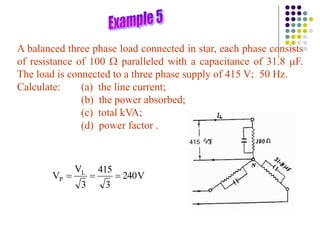
A balanced three phase load connected in star, each phase consists
of resistance of 100  paralleled with a capacitance of 31.8 F.
The load is connected to a three phase supply of 415 V; 50 Hz.
Calculate: (a) the line current;
(b) the power absorbed;
(c) total kVA;
(d) power factor .
415
V
240
3
415
3
V
V L
P 


P
P
P
X
1
R
1
Y 
 C
j
1
XP


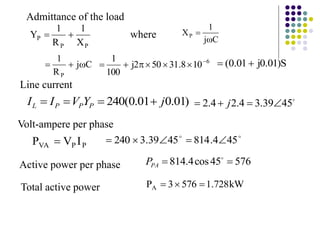
Admittance of the load
where
C
j
R
1
P


 6
10
8
.
31
50
2
j
100
1 





 S
)
01
.
0
j
01
.
0
( 

)
01
.
0
01
.
0
(
240 j
Y
V
I
I P
P
P
L 


 
45
39
.
3
4
.
2
4
.
2 


 j
P
P
VA I
V
P 


45
4
.
814
45
39
.
3
240 




576
45
cos
4
.
814 
 
PA
P
kW
728
.
1
576
3
PA 


Line current
Volt-ampere per phase
Active power per phase
Total active power
kW
728
.
1
j
576
3
j
PR 


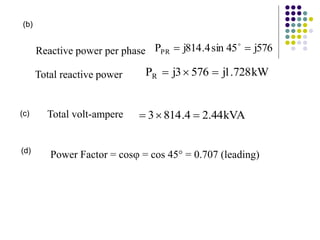
Reactive power per phase 576
j
45
sin
4
.
814
j
PPR 
 
Total reactive power
kVA
44
.
2
4
.
814
3 


Total volt-ampere
(b)
(c)
(d)
Power Factor = cos = cos 45 = 0.707 (leading)
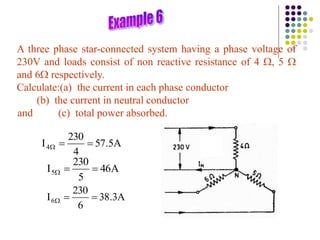
A three phase star-connected system having a phase voltage of
230V and loads consist of non reactive resistance of 4 , 5 
and 6 respectively.
Calculate:(a) the current in each phase conductor
(b) the current in neutral conductor
and (c) total power absorbed.
A
5
.
57
4
230
I4 


A
46
5
230
I5 


A
3
.
38
6
230
I6 


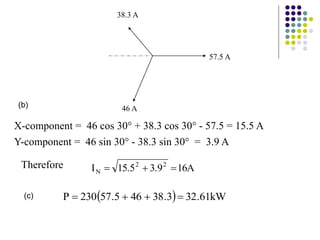
57.5 A
46 A
38.3 A
X-component = 46 cos 30 + 38.3 cos 30 - 57.5 = 15.5 A
Y-component = 46 sin 30 - 38.3 sin 30 = 3.9 A
16A
3.9
15.5
I 2
2
N 


Therefore
(b)
(c)   kW
61
.
32
3
.
38
46
5
.
57
230
P 




10 three phase system.ppt

  • 1.
  • 2.
    Flux density B [T] l d   L A M N Generatorfor single phase Current induces in the coil as the coil moves in the magnetic field Current produced at terminal Note Induction motor cannot start by itself. This problem is solved by introducing three phase system
  • 3.
    Instead of usingone coil only , three coils are used arranged in one axis with orientation of 120o each other. The coils are R-R1 , Y-Y1 and B-B1. The phases are measured in this sequence R-Y-B. I.e Y lags R by 120o , B lags Y by 120o.
  • 4.
    The three windingcan be represented by the above circuit. In this case we have six wires. The emf are represented by eR , eY, eB. t e   sin Em R ) 120 - sin( Em Y  t e   ) 240 - sin( Em B  t e   Load Finish Finish Finish start start start R R1 Y Y1 B B1 L1 L2 L3 eR eY eB
  • 5.
    The circuit canbe simplified as follows, where R1 can be connected to Y and Y1 can be connected to B. In this case the circuit is reduced to 4 wires. B Y R 1 RB e e e e    )] 240 sin( ) 120 sin( [sin Em           t t t   120 sin t cos 120 cos t sin t [sin         m E ] 240 sin t cos 240 cos t sin         ] t 866 . 0 t sin 5 . 0 t cos 866 . 0 t sin 5 0 t [sin      kos . Em      0  Since the total emf is zero, R and B1 can be connected together, thus we arrive with delta connection system. Finish Finish Finish start start start R R1 Y Y1 B B1 eR+eY+eB eR eY eB
  • 6.
    R R1 Y Y1 B B1 eB eR eY Line conductors R R1 Y Y1 B B1 PL PM PN •Since the totalemf is zero, R and B1 can be connected together as in Fig.A , thus we arrive with delta connection system as in Fig. C. •The direction of the emf can be referred to the emf waveform as in Fig. B where PL is +ve (R1- R), PM is –ve (Y-Y1) and PN is –ve (B-B1). Fig.A Fig. B Fig. C
  • 7.
    •R1, Y1 andB1 are connected together. •As the e.m.f generated are assumed in positive direction , therefore the current directions are also considered as flowing in the positive direction. •The current in the common wire (MN) is equal to the sum of the generated currents. i.e iR+iY+iB . •This arrangement is called four –wire star-connected system. The point N refers to star point or neutral point. R R1 Y Y1 B B1 Generator Load N iR iB iY 1 iR+iY+iB M
  • 8.
    t sin i  m R I  ) 120 t sin( i - Im Y   ) 240 t sin( i  - Im B   The instantaneous current in loads L1 , L2 and L3 are B Y R N i i i i    0 )] 240 t sin( ) 120 t sin( t [sin            m I R R 1 Y Y 1 B B1 Line conductors R N iR iB iY iR +iY +iB L3 L1 L2 B Y
  • 9.
    Three-wire star-connected systemwith balanced load For balanced loads, the fourth wire carries no current , so it can be dispensed R R 1 Y Y 1 B B1 N L L L a b c balanced load generator coils 5A 10A 5A 0 8.66A 2.6A 9.7A 7.1A 8.66A
  • 10.
    phase and line current in ampere Instantaneous currents’ waveformfor iR, iY and iB in a balanced three-phase system.
  • 11.
    VR VY VB -VY -VB -VR VRY VYB VBR ) ( Y R Y R RY V V V V V     R Y B N VRY VYB IR IB IY R Y B N V VRY VBR VYB IR IB IY R VY VB ) ( B Y B Y YB V V V V V      ) ( R B R B BR V V V V V      •VRY, VYB and VBR are called line voltage •VR, VY and VB are called phase voltage From Kirchoff voltage law we have In phasor diagram
  • 12.
    VR VY VB -VY -VB -VR VRY VYB VBR For balanced loadVR , VY and VB are equaled but out of phase VR = VP30; VY = VP-90; VB = VP150;   P o R RY V V V 3 30 cos 2   therefore VRY = VL30; VYB = VL-90; VBR = VL150;   P o Y YB V V V 3 30 cos 2     P o B BR V V V 3 30 cos 2  
  • 13.
      P LV V 3  P L I I  then and
  • 14.
    I3 R Y B IB IR IY I2 I1 •IR, IY andIB are called line current •I1, I2 and I3 are called phase current ) ( I I I 3 1 3 1 R I I      ) ( I I I 1 2 1 2 Y I I      ) ( I I I 2 3 2 3 B I I      I2 I1 I3 -I3 -I2 -I1 IR IY IB From Kirchoff current law we have In phasor diagram VL VP
  • 15.
    I2 I1 I3 -I3 -I2 -I1 IR IY IB P R I I I ) 3 ( 30 cos 21    P Y I I I ) 3 ( 30 cos 2 2      P B I I I 3 30 cos 2 3    Since the loads are balanced, the magnitude of currents are equaled but 120o out of phase. i.e I1 =I2=I3 ,=IP Therefore:- Thus IR=IY=IB = IL Where IP is a phase current and IL is a line current I1 = VP30; I2 = VP-90; I3 = VP150; IR = IL30; IY = IL-90; IB = IL150;
  • 16.
    Hence   P LI I 3  P L V V 
  • 17.
    Unbalanced load In athree-phase four-wire system the line voltage is 400V and non-inductive loads of 5 kW, 8 kW and 10 kW are connected between the three conductors and the neutral. Calculate: (a) the current in each phase (b) the current in the neutral conductor.
  • 18.
    V V V L P 230 3 400 3    A V P I P B B7 . 21 230 10 5 3     A V P I P Y Y 8 . 34 230 10 8 3     A V P I P R R 5 . 43 230 104    Voltage to neutral Current in 8kW resistor Current in 10kW resistor Current in 5kW resistor
  • 19.
    IR IY IB IYH IYV IBH IBV   A . I I Io B Y H 3 . 11 7 . 21 8 . 34 866 0 30 cos 30 cos       A I I I I o B Y R V 0 . 13 ) 7 . 21 8 . 34 ( 5 . 0 5 . 43 60 cos 60 cos         INV INH IN A . I I I NV NH N 2 . 17 0 . 13 3 11 2 2 2 2      Resolve the current components into horizontal and vertical components.
  • 20.
    R B Y 400V 400V 400V IR IB IY I3 I2 I1 R1=100 R2=20 C=30F X2=60 A delta –connectedload is arranged as in Figure below. The supply voltage is 400V at 50Hz. Calculate: (a)The phase currents; (b)The line currents. A R V I RY 4 100 400 1 1    I1 is in phase with VRY since there is only resistor in the branch (a)
  • 21.
    2 2 2 2 Y X R Z  2 2 60 20              2 2 1 Y R X tan         20 60 tan 1 C BR 3 X V I   90 ) 10 30 50 2 /( 1 400 6         A 77 . 3  A Z V I Y YB 32 . 6 60 20 400 2 2 2     o 90  In branch between YB , there are two components , R2 and X2 In the branch RB , only capacitor in it , so the XC is -90 out of phase. ' 34 71  VRY IR I3 I2 VYB VBR I1 71o34' 90o 30o -I3 30o
  • 22.
    (b) 3 1 R I I I  2 3 3 1 2 1 2 cos 2 I I I I IR            3 . 56 77 . 3 30 cos 77 . 3 0 . 4 2 0 . 4 2 2 2     o R I A IR 5 . 7  1 2 Y I I I   2 1 2 1 2 2 2 cos 2 I I I I IY            5 . 105 0 . 4 ' 34 11 cos 32 . 6 0 . 4 2 32 . 6 2 2 2     o Y I A IY 3 . 10  I1 -I1 I2 IY 120o 71o 34' 60o   = 71o 34’ -60o= 11o 34’ =30o
  • 23.
    2 2 2 3 2 3 2 cos 2 I I I I IB           5 . 18 77 . 3 ' 26 138 cos 32 . 6 77 . 3 2 32 . 6 2 2 2     o B I A IB 3 . 4   = 180-30o-11o 34’ = 138o 34’ 2 3 B I I I    -I2 I2 I3 I2 71o 34' 90o 30o 11o 34'
  • 24.
    Power in threephase Active power per phase = IPVP x power factor Total active power= 3VPIP x power factor  cos 3 P PI V P  If IL and VL are rms values for line current and line voltage respectively. Then for delta () connection: VP = VL and IP = IL/3. therefore:  cos 3 L L I V P  For star connection () : VP = VL/3 and IP = IL. therefore:  cos 3 L L I V P 
  • 25.
    A three-phase motoroperating off a 400V system is developing 20kW at an efficiency of 0.87 p.u and a power factor of 0.82. Calculate: (a)The line current; (b)The phase current if the windings are delta-connected. (a) Since watts in power input watts in power output Efficiency  f p V I watts in power output L L . 3    82 . 0 400 3 1000 20 87 . 0      L I And line current =IL=40.0A (b) For a delta-connected winding A current line current Phase 1 . 23 3 0 . 40 3   
  • 26.
    Three identical coils,each having a resistance of 20 and an inductance of 0.5 H connected in (a) star and (b) delta to a three phase supply of 400 V; 50 Hz. Calculate the current and the total power absorbed by both method of connections.   20 RP       157 5 . 0 50 2 XP       2 2 P P P P P X R jX R Z  83 158 20 157 tan 157 20 1 2 2             First of all calculating the impedance of the coils            P P 1 R X tan where 1264 . 0 83 cos cos    
  • 27.
    20 3 / 400 400V 400V 400V N 0.5H 0.5H 0.5H 20 20 V 231 3 400 VP  Since it is a balanced load Star-connection A 46 . 1 158 231 Z V I I P P L P      cos 3 L L I V P  W 128 1264 . 0 46 . 1 400 3      Power absorbed
  • 28.
    20 400V 400V 400V 0.5H 0.5H 0.5H 20 20 Star connection V 400 V VL P   A 38 . 4 158 400 Z V I P P P     cos 3 L L I V P  W 383 1264 . 0 38 . 4 400 3     
  • 29.
    A balanced threephase load connected in star, each phase consists of resistance of 100  paralleled with a capacitance of 31.8 F. The load is connected to a three phase supply of 415 V; 50 Hz. Calculate: (a) the line current; (b) the power absorbed; (c) total kVA; (d) power factor . 415 V 240 3 415 3 V V L P   
  • 30.
    P P P X 1 R 1 Y   C j 1 XP   Admittanceof the load where C j R 1 P    6 10 8 . 31 50 2 j 100 1        S ) 01 . 0 j 01 . 0 (   ) 01 . 0 01 . 0 ( 240 j Y V I I P P P L      45 39 . 3 4 . 2 4 . 2     j P P VA I V P    45 4 . 814 45 39 . 3 240      576 45 cos 4 . 814    PA P kW 728 . 1 576 3 PA    Line current Volt-ampere per phase Active power per phase Total active power
  • 31.
    kW 728 . 1 j 576 3 j PR    Reactive powerper phase 576 j 45 sin 4 . 814 j PPR    Total reactive power kVA 44 . 2 4 . 814 3    Total volt-ampere (b) (c) (d) Power Factor = cos = cos 45 = 0.707 (leading)
  • 32.
    A three phasestar-connected system having a phase voltage of 230V and loads consist of non reactive resistance of 4 , 5  and 6 respectively. Calculate:(a) the current in each phase conductor (b) the current in neutral conductor and (c) total power absorbed. A 5 . 57 4 230 I4    A 46 5 230 I5    A 3 . 38 6 230 I6   
  • 33.
    57.5 A 46 A 38.3A X-component = 46 cos 30 + 38.3 cos 30 - 57.5 = 15.5 A Y-component = 46 sin 30 - 38.3 sin 30 = 3.9 A 16A 3.9 15.5 I 2 2 N    Therefore (b) (c)   kW 61 . 32 3 . 38 46 5 . 57 230 P    