PRESENTED BY
GAYATHRI V
MATHEMATICS
MEASURES OF CENTRAL TENDENCY-
MEAN--CONCEPT,METHOD,ANDWHEN
TOUSE
MEASURE OF CENTRAL TENDENCY
The tendency of the observations to cluster
round some central value is known as
measure of central tendency.
 A common word used for measure of
central tendency is ‘average’.
ARITHEMETIC MEAN
Arithmetic mean is the simplest but most useful
measure of central tendency.
It is nothing but the ‘average’, which we compute
in our high school arithmetic and therefore can
be easily defined as the sum of all values of the
item in a series divided by the number of items. It
is represented by the symbol ‘M’.
Arithmetic mean is sometimes referred to as’the
mean’ or ‘the average’.
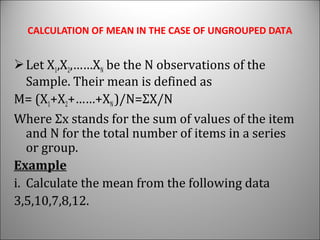
CALCULATION OF MEAN IN THE CASE OF UNGROUPED DATA
Let X1,X2,……XN be the N observations of the
Sample. Their mean is defined as
M= (X1+X2+……+XN)/N=ΣX/N
Where Σx stands for the sum of values of the item
and N for the total number of items in a series
or group.
Example
i. Calculate the mean from the following data
3,5,10,7,8,12.
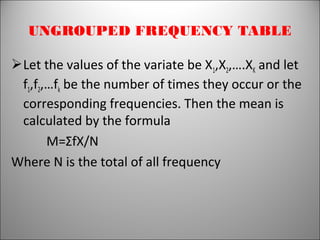
UNGROUPED FREQUENCY TABLE
Let the values of the variate be X1,X2,….XK and let
f1,f2,…fk be the number of times they occur or the
corresponding frequencies. Then the mean is
calculated by the formula
M=ΣfX/N
Where N is the total of all frequency
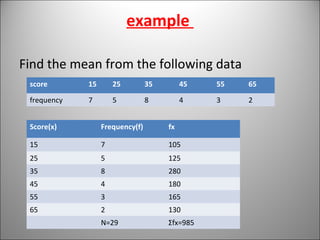
example
Find the mean from the following data
score 15 25 35 45 55 65
frequency 7 5 8 4 3 2
Score(x) Frequency(f) fx
15 7 105
25 5 125
35 8 280
45 4 180
55 3 165
65 2 130
N=29 Σfx=985
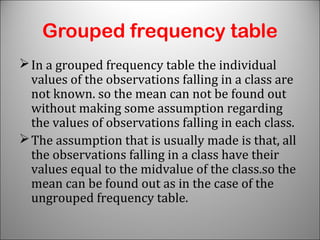
Grouped frequency table
In a grouped frequency table the individual
values of the observations falling in a class are
not known. so the mean can not be found out
without making some assumption regarding
the values of observations falling in each class.
The assumption that is usually made is that, all
the observations falling in a class have their
values equal to the midvalue of the class.so the
mean can be found out as in the case of the
ungrouped frequency table.
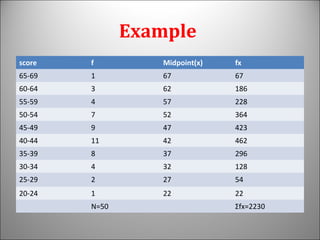
Example
score f Midpoint(x) fx
65-69 1 67 67
60-64 3 62 186
55-59 4 57 228
50-54 7 52 364
45-49 9 47 423
40-44 11 42 462
35-39 8 37 296
30-34 4 32 128
25-29 2 27 54
20-24 1 22 22
N=50 Σfx=2230
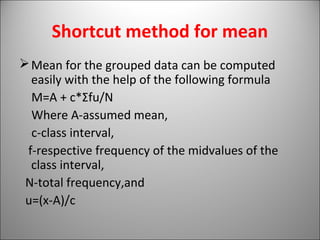
Shortcut method for mean
Mean for the grouped data can be computed
easily with the help of the following formula
M=A + c*Σfu/N
Where A-assumed mean,
c-class interval,
f-respective frequency of the midvalues of the
class interval,
N-total frequency,and
u=(x-A)/c
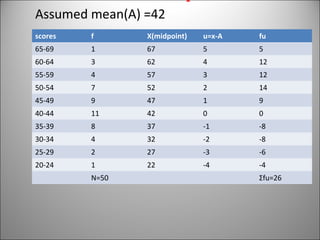
Assumed mean(A) =42
scores f X(midpoint) u=x-A fu
65-69 1 67 5 5
60-64 3 62 4 12
55-59 4 57 3 12
50-54 7 52 2 14
45-49 9 47 1 9
40-44 11 42 0 0
35-39 8 37 -1 -8
30-34 4 32 -2 -8
25-29 2 27 -3 -6
20-24 1 22 -4 -4
N=50 Σfu=26
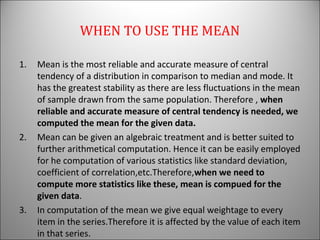
WHEN TO USE THE MEAN
1. Mean is the most reliable and accurate measure of central
tendency of a distribution in comparison to median and mode. It
has the greatest stability as there are less fluctuations in the mean
of sample drawn from the same population. Therefore , when
reliable and accurate measure of central tendency is needed, we
computed the mean for the given data.
2. Mean can be given an algebraic treatment and is better suited to
further arithmetical computation. Hence it can be easily employed
for he computation of various statistics like standard deviation,
coefficient of correlation,etc.Therefore,when we need to
compute more statistics like these, mean is compued for the
given data.
3. In computation of the mean we give equal weightage to every
item in the series.Therefore it is affected by the value of each item
in that series.
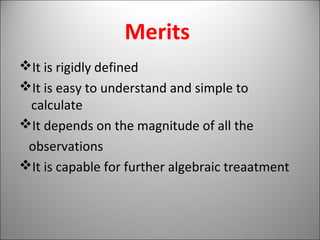
Merits
It is rigidly defined
It is easy to understand and simple to
calculate
It depends on the magnitude of all the
observations
It is capable for further algebraic treaatment
Demerits
The mean can be an impossible value. For
example, the AM of the number of students
per class in a school may turnout to be a
fraction.
If any observation is missing or its exact
magnitude is not known, the AM can not be
calculated even if its relative position is
known.
Thank you

Mean

  • 2.
    PRESENTED BY GAYATHRI V MATHEMATICS MEASURESOF CENTRAL TENDENCY- MEAN--CONCEPT,METHOD,ANDWHEN TOUSE
  • 3.
    MEASURE OF CENTRALTENDENCY The tendency of the observations to cluster round some central value is known as measure of central tendency.  A common word used for measure of central tendency is ‘average’.
  • 4.
    ARITHEMETIC MEAN Arithmetic meanis the simplest but most useful measure of central tendency. It is nothing but the ‘average’, which we compute in our high school arithmetic and therefore can be easily defined as the sum of all values of the item in a series divided by the number of items. It is represented by the symbol ‘M’. Arithmetic mean is sometimes referred to as’the mean’ or ‘the average’.
  • 5.
    CALCULATION OF MEANIN THE CASE OF UNGROUPED DATA Let X1,X2,……XN be the N observations of the Sample. Their mean is defined as M= (X1+X2+……+XN)/N=ΣX/N Where Σx stands for the sum of values of the item and N for the total number of items in a series or group. Example i. Calculate the mean from the following data 3,5,10,7,8,12.
  • 6.
    UNGROUPED FREQUENCY TABLE Letthe values of the variate be X1,X2,….XK and let f1,f2,…fk be the number of times they occur or the corresponding frequencies. Then the mean is calculated by the formula M=ΣfX/N Where N is the total of all frequency
  • 7.
    example Find the meanfrom the following data score 15 25 35 45 55 65 frequency 7 5 8 4 3 2 Score(x) Frequency(f) fx 15 7 105 25 5 125 35 8 280 45 4 180 55 3 165 65 2 130 N=29 Σfx=985
  • 8.
    Grouped frequency table Ina grouped frequency table the individual values of the observations falling in a class are not known. so the mean can not be found out without making some assumption regarding the values of observations falling in each class. The assumption that is usually made is that, all the observations falling in a class have their values equal to the midvalue of the class.so the mean can be found out as in the case of the ungrouped frequency table.
  • 9.
    Example score f Midpoint(x)fx 65-69 1 67 67 60-64 3 62 186 55-59 4 57 228 50-54 7 52 364 45-49 9 47 423 40-44 11 42 462 35-39 8 37 296 30-34 4 32 128 25-29 2 27 54 20-24 1 22 22 N=50 Σfx=2230
  • 10.
    Shortcut method formean Mean for the grouped data can be computed easily with the help of the following formula M=A + c*Σfu/N Where A-assumed mean, c-class interval, f-respective frequency of the midvalues of the class interval, N-total frequency,and u=(x-A)/c
  • 11.
    Assumed mean(A) =42 scoresf X(midpoint) u=x-A fu 65-69 1 67 5 5 60-64 3 62 4 12 55-59 4 57 3 12 50-54 7 52 2 14 45-49 9 47 1 9 40-44 11 42 0 0 35-39 8 37 -1 -8 30-34 4 32 -2 -8 25-29 2 27 -3 -6 20-24 1 22 -4 -4 N=50 Σfu=26
  • 12.
    WHEN TO USETHE MEAN 1. Mean is the most reliable and accurate measure of central tendency of a distribution in comparison to median and mode. It has the greatest stability as there are less fluctuations in the mean of sample drawn from the same population. Therefore , when reliable and accurate measure of central tendency is needed, we computed the mean for the given data. 2. Mean can be given an algebraic treatment and is better suited to further arithmetical computation. Hence it can be easily employed for he computation of various statistics like standard deviation, coefficient of correlation,etc.Therefore,when we need to compute more statistics like these, mean is compued for the given data. 3. In computation of the mean we give equal weightage to every item in the series.Therefore it is affected by the value of each item in that series.
  • 13.
    Merits It is rigidlydefined It is easy to understand and simple to calculate It depends on the magnitude of all the observations It is capable for further algebraic treaatment
  • 14.
    Demerits The mean canbe an impossible value. For example, the AM of the number of students per class in a school may turnout to be a fraction. If any observation is missing or its exact magnitude is not known, the AM can not be calculated even if its relative position is known.
  • 15.