Literary Theory and Criticism
Submitted to:
Maam Irum
Submitted by:
Nagina 381
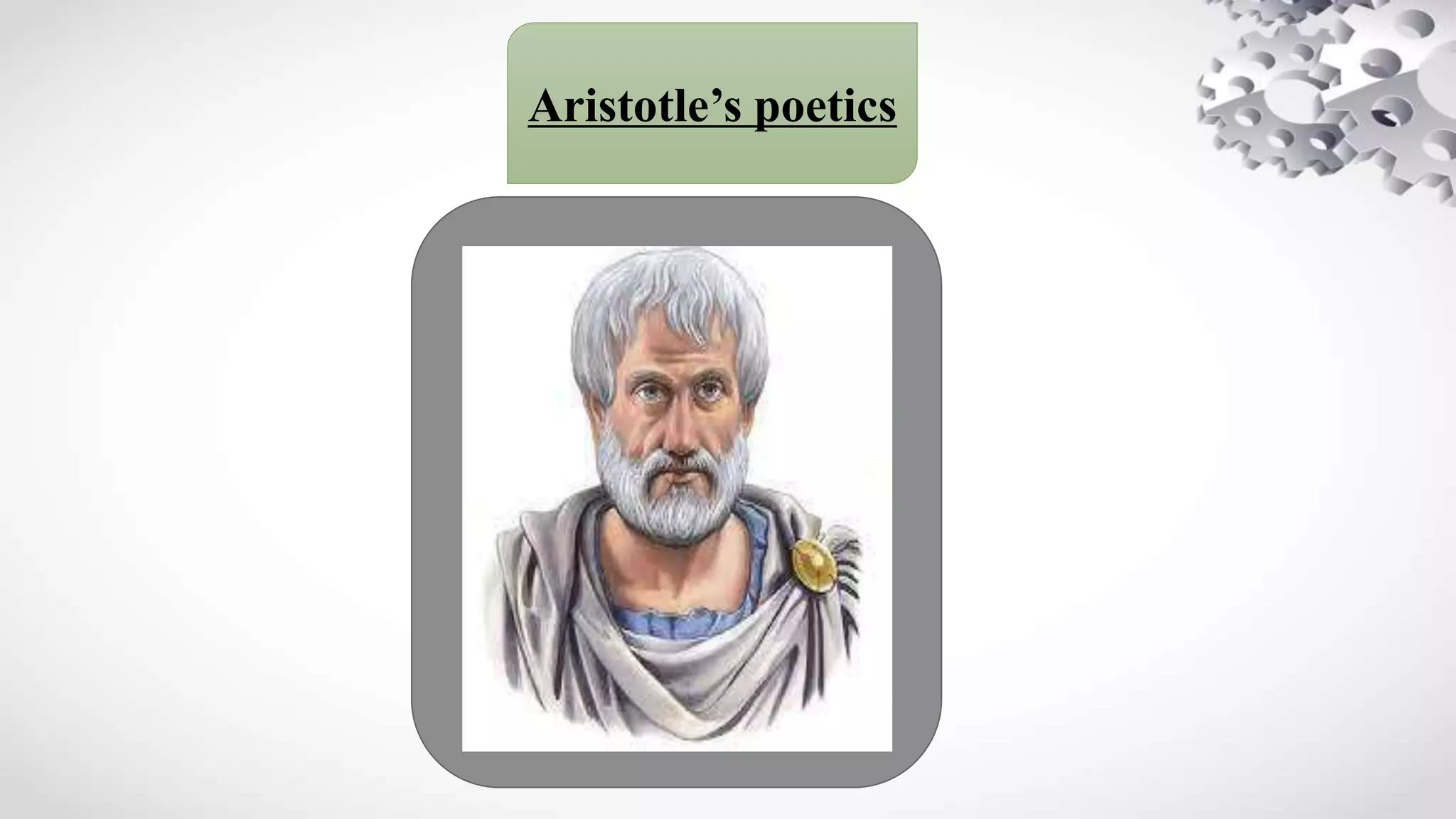
Aristotle’s poetics
Childhood
• Aristotle was born in
384 B.C. in Stagira in
northern Greece.
Both of his parents
were members of
traditional medical
families.
• His parents died
while he was young.
Education
• As a youth, Aristotle
likely had tutors who
taught him about all
sorts of subjects. He
learned to read and
write Greek.
• He also learned about
the Greek gods,
philosophy, and
mathematics.
work
• His most important
treatises include
Physics, Metaphysics,
Nicomachean Ethics,
Politics, On the Soul
and Poetics.
• Aristotle wrote as
many as 200 treatises
and other works
covering all areas of
philosophy and
science.
Aristotle is
student of
plato
Both plato and Aristotle believed in rhese shared principles:
Harmony
organic approach (society functions as an organism)
natural approach, politics and morals,
 they believed that humans are social creatures,
they believed in the functioning of the state and its citizens.
common themes between plato and Aristotle
• “Tragedy,” says Aristotle, “is an imitation of an action that is
serious, complete, and of a certain magnitud through pity and
fear effecting the proper purgation [catharsis] of these
emotions.”
• Ambiguous means may be employed, Aristotle maintains in
contrast to Plato, to a virtuous and purifying end.
Aristotle’s Definition of Tragedy
Aristotle’s 6 poetics
Plot
Character
Diction
Thought
Spectacle (Science Effect)
Song/ Music
importance of Aristotle’s poetics:
It teaches effectively and it teaches the truth.
Convincing and powerful drama describes truth of human nature.
Introduces the concept of “Organic Unity”.
Three Unities
Unity of action Unity of place
Unity of time
Unity of Action
• The Unity of Action
limits the supposed
action to a single set
of incidents which are
related as cause and
effect, "having a
beginning, middle,
and an end." No
scene is to be
included that does not
advance the plot
directly.
• No subplots, no
characters who do not
advance the action.
Unity of Time
• The Unity of Time
limits the supposed
action to the duration,
roughly, of a single
day.
• Aristotle meant that
the length of time
represented in the
play should be ideally
speaking the actual
time passing during its
presentation.
Unity of place
• a tragedy should exist
in a single physical
location.
Aristotle poetics

Aristotle poetics

  • 1.
    Literary Theory andCriticism Submitted to: Maam Irum Submitted by: Nagina 381
  • 2.
  • 3.
    Childhood • Aristotle wasborn in 384 B.C. in Stagira in northern Greece. Both of his parents were members of traditional medical families. • His parents died while he was young. Education • As a youth, Aristotle likely had tutors who taught him about all sorts of subjects. He learned to read and write Greek. • He also learned about the Greek gods, philosophy, and mathematics. work • His most important treatises include Physics, Metaphysics, Nicomachean Ethics, Politics, On the Soul and Poetics. • Aristotle wrote as many as 200 treatises and other works covering all areas of philosophy and science.
  • 4.
  • 5.
    Both plato andAristotle believed in rhese shared principles: Harmony organic approach (society functions as an organism) natural approach, politics and morals,  they believed that humans are social creatures, they believed in the functioning of the state and its citizens. common themes between plato and Aristotle
  • 6.
    • “Tragedy,” saysAristotle, “is an imitation of an action that is serious, complete, and of a certain magnitud through pity and fear effecting the proper purgation [catharsis] of these emotions.” • Ambiguous means may be employed, Aristotle maintains in contrast to Plato, to a virtuous and purifying end. Aristotle’s Definition of Tragedy
  • 8.
  • 10.
    importance of Aristotle’spoetics: It teaches effectively and it teaches the truth. Convincing and powerful drama describes truth of human nature. Introduces the concept of “Organic Unity”.
  • 11.
    Three Unities Unity ofaction Unity of place Unity of time
  • 12.
    Unity of Action •The Unity of Action limits the supposed action to a single set of incidents which are related as cause and effect, "having a beginning, middle, and an end." No scene is to be included that does not advance the plot directly. • No subplots, no characters who do not advance the action. Unity of Time • The Unity of Time limits the supposed action to the duration, roughly, of a single day. • Aristotle meant that the length of time represented in the play should be ideally speaking the actual time passing during its presentation. Unity of place • a tragedy should exist in a single physical location.