ARIADNE is funded by the European Commission's Seventh Framework Programme
Lifecycles
Kate Fernie
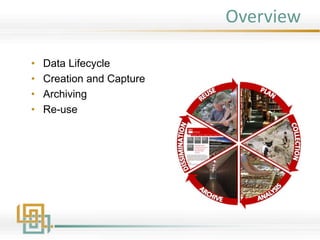
Overview
• Data Lifecycle
• Creation and Capture
• Archiving
• Re-use
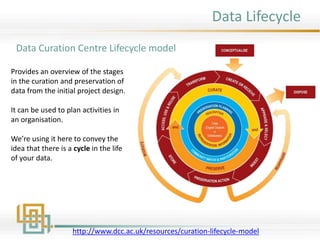
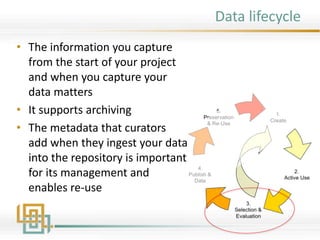
Data Lifecycle
Provides an overview of the stages
in the curation and preservation of
data from the initial project design.
It can be used to plan activities in
an organisation.
We’re using it here to convey the
idea that there is a cycle in the life
of your data.
http://www.dcc.ac.uk/resources/curation-lifecycle-model
Data Curation Centre Lifecycle model
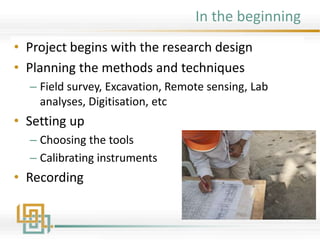
In the beginning
• Project begins with the research design
• Planning the methods and techniques
– Field survey, Excavation, Remote sensing, Lab
analyses, Digitisation, etc
• Setting up
– Choosing the tools
– Calibrating instruments
• Recording
Creation: Born digital
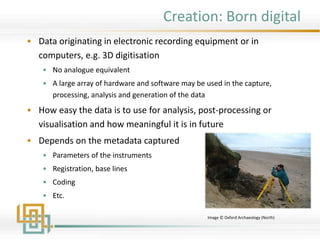
• Data originating in electronic recording equipment or in
computers, e.g. 3D digitisation
• No analogue equivalent
• A large array of hardware and software may be used in the capture,
processing, analysis and generation of the data
• How easy the data is to use for analysis, post-processing or
visualisation and how meaningful it is in future
• Depends on the metadata captured
• Parameters of the instruments
• Registration, base lines
• Coding
• Etc.
Image © Oxford Archaeology (North)
Creation: Digitised
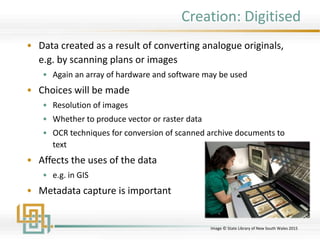
• Data created as a result of converting analogue originals,
e.g. by scanning plans or images
• Again an array of hardware and software may be used
• Choices will be made
• Resolution of images
• Whether to produce vector or raster data
• OCR techniques for conversion of scanned archive documents to
text
• Affects the uses of the data
• e.g. in GIS
• Metadata capture is important
Image © State Library of New South Wales 2015
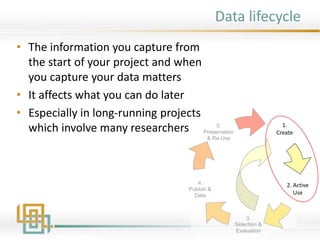
Data lifecycle
1.
Create
• The information you capture from
the start of your project and when
you capture your data matters
• It affects what you can do later
• Especially in long-running projects
which involve many researchers
2. Active
Use
Archiving
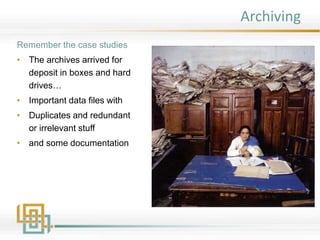
Remember the case studies
• The archives arrived for
deposit in boxes and hard
drives…
• Important data files with
• Duplicates and redundant
or irrelevant stuff
• and some documentation
Archiving
• When data is received a curator will
– Appraise it (work out what the deposit includes)
– Select the data that is useful to keep in the long term
The information that
researchers give describing their
project and documenting their
data is crucial for appraisal.
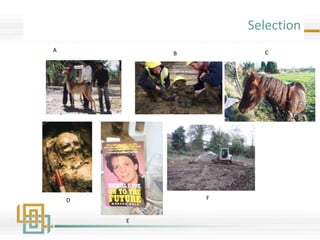
Selection
A
B C
E
D F
Archiving
• When data is received a curator will
– Appraise it
– Select the data that is useful to keep in the long term
– Possibly transform the data into new formats
– Add administrative metadata
– Ingest into the repository
– Make it available for re-use
Data lifecycle
• The information you capture
from the start of your project
and when you capture your
data matters
• It supports archiving
• The metadata that curators
add when they ingest your data
into the repository is important
for its management and
enables re-use
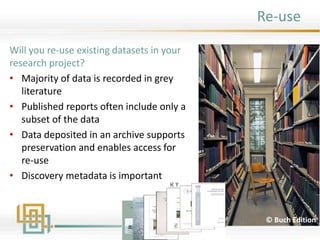
Will you re-use existing datasets in your
research project?
• Majority of data is recorded in grey
literature
• Published reports often include only a
subset of the data
• Data deposited in an archive supports
preservation and enables access for
re-use
• Discovery metadata is important
© Buch Edition
Re-use
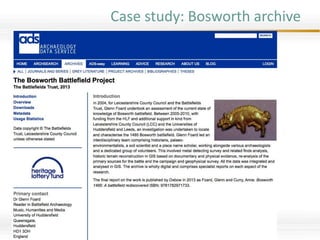
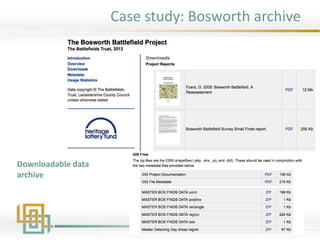
Case study: Bosworth archive
Downloadable data
archive
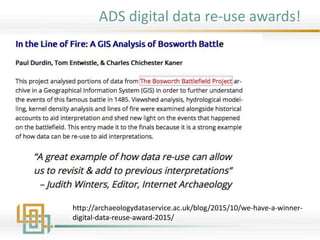
ADS digital data re-use awards!
http://archaeologydataservice.ac.uk/blog/2015/10/we-have-a-winner-
digital-data-reuse-award-2015/
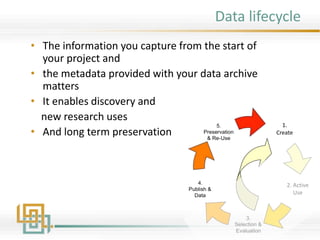
• The information you capture from the start of
your project and
• the metadata provided with your data archive
matters
• It enables discovery and
new research uses
• And long term preservation
Data lifecycle
1.
Create
2. Active
Use
This is not a tyranny
• We don’t mean to over-state the
case
• Or to scare off well-meaning people
with a high-tech approach
• There can be a scaled approach
• Good practices go a long way in
helping to secure your data
Document it
Capture metadata
Make a back up
Deposit in an archive
Make it available for re-use
How will you look after your data?
Acknowledgements
ARIADNE is a project funded by the European Commission under the Community’s Seventh
Framework Programme, contract no. FP7-INFRASTRUCTURES-2012-1-313193.
Dr Katie Green, Archaeology Data Service
Dr. Jeremy Huggett, University of Glasgow
DataTrain Project, Cambridge University Library
Image credits:
DCC Data Lifecycle and image of Checklist for a Data Management Plan courtesy of the Digital
Curation Centre
ACE 'Working in Archaeology' Photographic Exhibition 2011-12

Ariadne: Lifecycles

  • 1.
    ARIADNE is fundedby the European Commission's Seventh Framework Programme Lifecycles Kate Fernie
  • 2.
    Overview • Data Lifecycle •Creation and Capture • Archiving • Re-use
  • 3.
    Data Lifecycle Provides anoverview of the stages in the curation and preservation of data from the initial project design. It can be used to plan activities in an organisation. We’re using it here to convey the idea that there is a cycle in the life of your data. http://www.dcc.ac.uk/resources/curation-lifecycle-model Data Curation Centre Lifecycle model
  • 4.
    In the beginning •Project begins with the research design • Planning the methods and techniques – Field survey, Excavation, Remote sensing, Lab analyses, Digitisation, etc • Setting up – Choosing the tools – Calibrating instruments • Recording
  • 5.
    Creation: Born digital •Data originating in electronic recording equipment or in computers, e.g. 3D digitisation • No analogue equivalent • A large array of hardware and software may be used in the capture, processing, analysis and generation of the data • How easy the data is to use for analysis, post-processing or visualisation and how meaningful it is in future • Depends on the metadata captured • Parameters of the instruments • Registration, base lines • Coding • Etc. Image © Oxford Archaeology (North)
  • 6.
    Creation: Digitised • Datacreated as a result of converting analogue originals, e.g. by scanning plans or images • Again an array of hardware and software may be used • Choices will be made • Resolution of images • Whether to produce vector or raster data • OCR techniques for conversion of scanned archive documents to text • Affects the uses of the data • e.g. in GIS • Metadata capture is important Image © State Library of New South Wales 2015
  • 8.
    Data lifecycle 1. Create • Theinformation you capture from the start of your project and when you capture your data matters • It affects what you can do later • Especially in long-running projects which involve many researchers 2. Active Use
  • 9.
    Archiving Remember the casestudies • The archives arrived for deposit in boxes and hard drives… • Important data files with • Duplicates and redundant or irrelevant stuff • and some documentation
  • 10.
    Archiving • When datais received a curator will – Appraise it (work out what the deposit includes) – Select the data that is useful to keep in the long term The information that researchers give describing their project and documenting their data is crucial for appraisal.
  • 11.
  • 12.
    Archiving • When datais received a curator will – Appraise it – Select the data that is useful to keep in the long term – Possibly transform the data into new formats – Add administrative metadata – Ingest into the repository – Make it available for re-use
  • 13.
    Data lifecycle • Theinformation you capture from the start of your project and when you capture your data matters • It supports archiving • The metadata that curators add when they ingest your data into the repository is important for its management and enables re-use
  • 14.
    Will you re-useexisting datasets in your research project? • Majority of data is recorded in grey literature • Published reports often include only a subset of the data • Data deposited in an archive supports preservation and enables access for re-use • Discovery metadata is important © Buch Edition Re-use
  • 15.
  • 16.
    Case study: Boswortharchive Downloadable data archive
  • 17.
    ADS digital datare-use awards! http://archaeologydataservice.ac.uk/blog/2015/10/we-have-a-winner- digital-data-reuse-award-2015/
  • 18.
    • The informationyou capture from the start of your project and • the metadata provided with your data archive matters • It enables discovery and new research uses • And long term preservation Data lifecycle 1. Create 2. Active Use
  • 19.
    This is nota tyranny • We don’t mean to over-state the case • Or to scare off well-meaning people with a high-tech approach • There can be a scaled approach • Good practices go a long way in helping to secure your data
  • 20.
    Document it Capture metadata Makea back up Deposit in an archive Make it available for re-use How will you look after your data?
  • 21.
    Acknowledgements ARIADNE is aproject funded by the European Commission under the Community’s Seventh Framework Programme, contract no. FP7-INFRASTRUCTURES-2012-1-313193. Dr Katie Green, Archaeology Data Service Dr. Jeremy Huggett, University of Glasgow DataTrain Project, Cambridge University Library Image credits: DCC Data Lifecycle and image of Checklist for a Data Management Plan courtesy of the Digital Curation Centre ACE 'Working in Archaeology' Photographic Exhibition 2011-12

Editor's Notes

  • #4 Data has a life cycle. The UK’s Data Curation Centre lifecycle model provides the overview of the stages in the curation and preservation of data, from the initial project design or receipt of data by an archive. You can use this lifecycle model to plan activities in your project or organisation. We’re using it here to convey the idea that there is a cycle in the life of your data.
  • #6  There are a large range of types – from standard digital files such as text documents, images or sound files, to specialist archaeological datasets such as analyses and survey data, and complex objects such as 3D models (or websites) which combine many individual objects such as shape files and images. Different types of data have different requirements for managment.
  • #7  There are a large range of types – from standard digital files such as text documents, images or sound files, to specialist archaeological datasets such as analyses and survey data, and complex objects such as 3D models (or websites) which combine many individual objects such as shape files and images. Different types of data have different requirements for managment.
  • #10 Too often, archives are seen as the final resting place for archaeological information, rather than as one stage in a cycle of information-gathering and reuse
  • #11 When an archivist receives a deposit
  • #12 A – camelids and textile manufacture in the Andes B –an image collections of 41 images, 26 of which are of backfilling and general site shots (63%) C - ! D - spitalfields E – !!! F- heathrow t5 and photos of the party ect BUT Massive collection of 20,000+ images, so a small sample
  • #15 Much of the information produced by archaeological research over the past century is recorded in on paper in grey literature (unpublished reports) scattered in various academic, commercial and private archives or museums. These records are not easily searchable. A significant proportion of research remains unpublished and access to data, even those which are published, are often difficult or inconvenient to find and those publications that are accessible often include only a subset of the data collected. Deposit of the data in an archive aids preservation and allows access for re-use.   Access is not the only reason that existing archaeological archives are under-utilised..
  • #16 Between 2004 and 2010, Glenn Foard undertook an assessment of the current state of knowledge of Bosworth battlefield. An investigation was undertaken to locate and characterise the 1485 Bosworth battlefield. Glenn Foard led an interdisciplinary team comprising historians, palaeo-environmentalists, a soil scientist and a place name scholar, working alongside various archaeologists and a dedicated group of volunteers. This included metal detecting survey and related finds analysis, historic terrain reconstruction in GIS based on documentary and physical evidence, re-analysis of the primary sources for the battle and the campaign and geophysical survey. All the data was integrated and analysed in GIS. The archive is wholly digital and comprises specialist reports on each aspect of the research.
  • #17 The digital archive comprises of reports and GIS files
  • #21 Its important to think about how you will look after your data at an early stage in the project. Think about how you will name your files, this sounds obvious but if you will be producing a large number of data files it is important to get right. What software will you be using?