ARIADNE is funded by the European Commission's Seventh Framework Programme
Open Data Publication
Requirements, Good Practices, and Benefits
Open Data Publication
Requirements, Good Practices, and Benefits
EAA 2014 - Istanbul
Session: Barriers and Opportunities: Open Access
and Open Data in Archaeology
13 September 2014
Guntram Geser
Salzburg Research
EAA 2014 - Istanbul
Session: Barriers and Opportunities: Open Access
and Open Data in Archaeology
13 September 2014
Guntram Geser
Salzburg Research
ARIADNE
• Advanced Research Infrastructure for
archaeological Dataset Networking in Europe
– EU FP7-Infrastructures project, type „Integrating Activity“
– Runs 4 years, 02/2013-01/2017
– Focus on archaeological datasets – help overcome data
fragmentation and foster a culture of sharing and re-using
– 23 partners of 18 European countries
– Open to other participants, e.g.
• Transnational Access Programme
• Special Interest Groups
• Website: www.ariadne-infrastructure.eu
• Advanced Research Infrastructure for
archaeological Dataset Networking in Europe
– EU FP7-Infrastructures project, type „Integrating Activity“
– Runs 4 years, 02/2013-01/2017
– Focus on archaeological datasets – help overcome data
fragmentation and foster a culture of sharing and re-using
– 23 partners of 18 European countries
– Open to other participants, e.g.
• Transnational Access Programme
• Special Interest Groups
• Website: www.ariadne-infrastructure.eu
Main topics of this presentation
• Open Data – expectations, criteria, drivers
• Current data (non-)sharing behaviour
• Reasons for lack of open data sharing
• ARIADNE survey results on data publication
• How to benefit from open data publication
• Issue of actual data re-use
• Takeaway points
• Open Data – expectations, criteria, drivers
• Current data (non-)sharing behaviour
• Reasons for lack of open data sharing
• ARIADNE survey results on data publication
• How to benefit from open data publication
• Issue of actual data re-use
• Takeaway points
Open Data – expectations
• The scientific method: provide evidence for
knowledge claims („show us your data“)
• Output of publicly funded research should be openly
available, and properly preserved
• More open data sharing => better analysis => better
decision-making / solutions for critical issues
• Better return-on-investment, e.g.
– no duplication of data collection
– better exploitation of available data – therefore emphasis
on re-use
• Innovation through „data-intensive“, „data-driven“,
„big data“ (incl. archaeology?)
• The scientific method: provide evidence for
knowledge claims („show us your data“)
• Output of publicly funded research should be openly
available, and properly preserved
• More open data sharing => better analysis => better
decision-making / solutions for critical issues
• Better return-on-investment, e.g.
– no duplication of data collection
– better exploitation of available data – therefore emphasis
on re-use
• Innovation through „data-intensive“, „data-driven“,
„big data“ (incl. archaeology?)
Open Data – criteria
• Accessible online
– not necessarily without registration
• Reusable
– not summarized data (i.e. figures, charts,
etc.) canned in publications
– state: raw, cleaned, normalized,… (accord.
to practice)
– open format (e.g. not PDF documents)
• Openly licensed (e.g. CC-BY, if other no
NonDerivative!)
• For free – yes, but somebody has to pay
to ensure sustainability
• Accessible online
– not necessarily without registration
• Reusable
– not summarized data (i.e. figures, charts,
etc.) canned in publications
– state: raw, cleaned, normalized,… (accord.
to practice)
– open format (e.g. not PDF documents)
• Openly licensed (e.g. CC-BY, if other no
NonDerivative!)
• For free – yes, but somebody has to pay
to ensure sustainability
“Publishing data in a
reusable form to
support findings
must be mandatory”
– one of six key
areas for action
highlighted in the
The Royal Society’s
report Science as an
Open Enterprise
(2012)
Open Data – drivers /1
• High-level policies & initiatives
– OECD Declaration on Access to Research
Data from Public Funding (2004; Principles
and Guidelines, 2007)
– EC Communications, Open data (2011),
Towards better access to scientific
information (2012)
– Many others, e.g. Research Data Alliance –
international initiative (launched in March
2013), various working & interest groups
(archaeology not represented yet)
• High-level policies & initiatives
– OECD Declaration on Access to Research
Data from Public Funding (2004; Principles
and Guidelines, 2007)
– EC Communications, Open data (2011),
Towards better access to scientific
information (2012)
– Many others, e.g. Research Data Alliance –
international initiative (launched in March
2013), various working & interest groups
(archaeology not represented yet)
Neelie Kroes, EC
Vice-President, 2012:
“Taxpayers should
not have to pay twice
for scientific research
and they need seam-
less access to raw
data. We want to
bring dissemination
and exploitation of
scientific research
results to the next
level.”
Open Data – drivers /2
• Research funding agencies
– Open Access mandates extended to data
– Mandatory data management plans, i.e. data sharing must
be considered already at application stage
• Data archiving & access infrastructures put in place
– Data centres / repositories
• General : zenodo (related to OpenAIRE), Figshare, …
• Archaeology: e.g. ADS (UK), eDNA (NL), IANUS (Germany, in
preparation), MAPPA (IT), OpenContext and tDAR (USA)
– Data registries / catalogues
– Data citation standard, e.g. DataCite
• Research funding agencies
– Open Access mandates extended to data
– Mandatory data management plans, i.e. data sharing must
be considered already at application stage
• Data archiving & access infrastructures put in place
– Data centres / repositories
• General : zenodo (related to OpenAIRE), Figshare, …
• Archaeology: e.g. ADS (UK), eDNA (NL), IANUS (Germany, in
preparation), MAPPA (IT), OpenContext and tDAR (USA)
– Data registries / catalogues
– Data citation standard, e.g. DataCite
Open Data – drivers /3
• New publication format of „data papers“
– Describe a dataset/database, kind of extensive metadata
record or documentation, also including examples of use /
usefulness for research
– Examples of data journals in archaeology
• Journal of Open Archaeology Data, started 2012
• Internet Archaeology, started a series of data papers in 2013
• New publication format of „data papers“
– Describe a dataset/database, kind of extensive metadata
record or documentation, also including examples of use /
usefulness for research
– Examples of data journals in archaeology
• Journal of Open Archaeology Data, started 2012
• Internet Archaeology, started a series of data papers in 2013
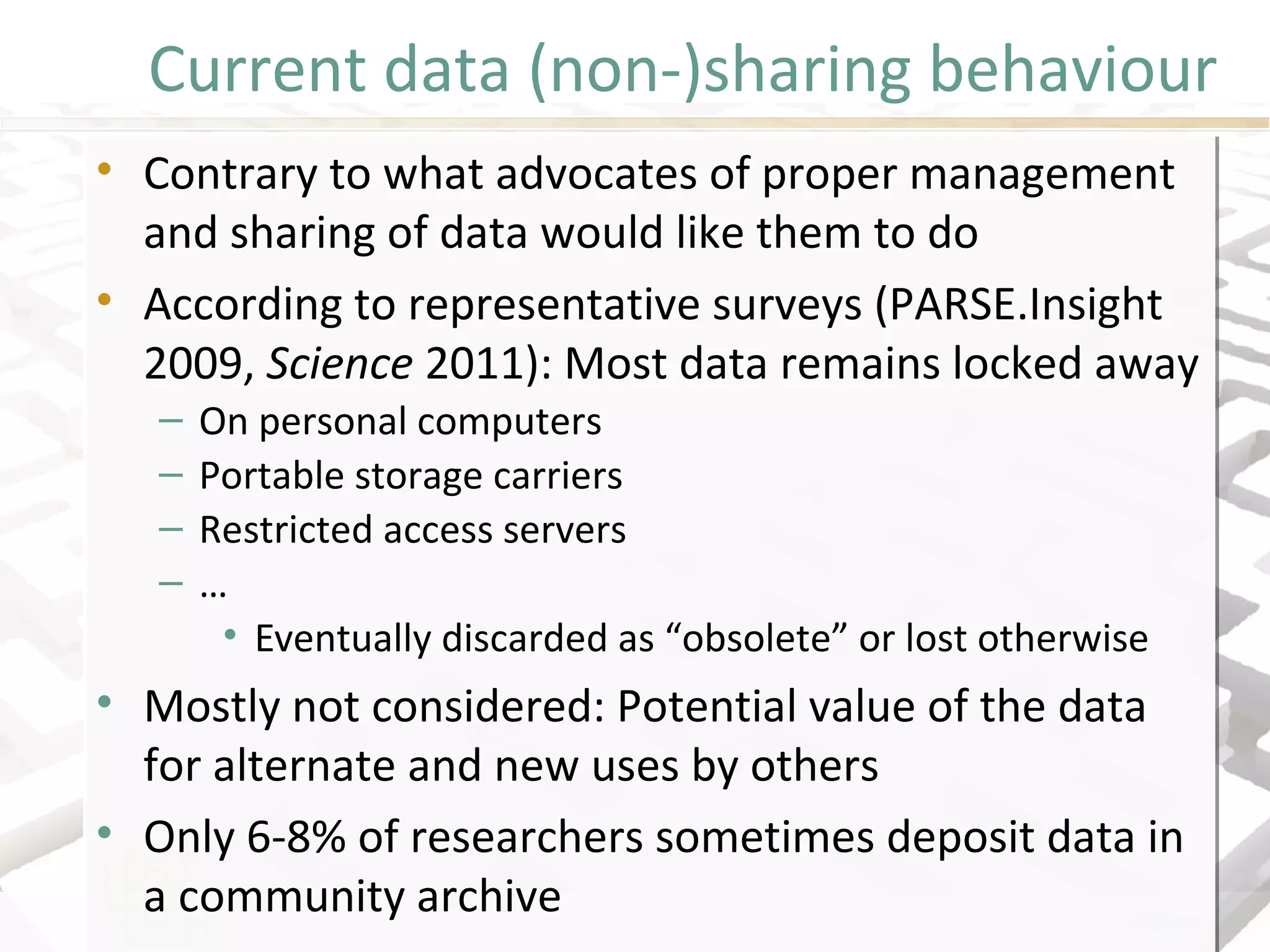
Barriers to open data sharing
• Many obstacles to providing open access to reusable
data
– Priority of published papers
– Little academic reward for development and sharing of
datasets/DB
– Required effort to share re-usable data (incl. formatting,
metadata creation, licensing etc.)
– Existing copyrights, confidential and sensitive data
– Concerns that data could be scooped, misused or
misinterpreted
– Potential reputational risk (e.g. data quality, errors,…)
• Overall a bad ratio of additional effort & risks to
potential benefits
• Many obstacles to providing open access to reusable
data
– Priority of published papers
– Little academic reward for development and sharing of
datasets/DB
– Required effort to share re-usable data (incl. formatting,
metadata creation, licensing etc.)
– Existing copyrights, confidential and sensitive data
– Concerns that data could be scooped, misused or
misinterpreted
– Potential reputational risk (e.g. data quality, errors,…)
• Overall a bad ratio of additional effort & risks to
potential benefits
Current data (non-)sharing behaviour
• Contrary to what advocates of proper management
and sharing of data would like them to do
• According to representative surveys (PARSE.Insight
2009, Science 2011): Most data remains locked away
– On personal computers
– Portable storage carriers
– Restricted access servers
– …
• Eventually discarded as “obsolete” or lost otherwise
• Mostly not considered: Potential value of the data
for alternate and new uses by others
• Only 6-8% of researchers sometimes deposit data in
a community archive
• Contrary to what advocates of proper management
and sharing of data would like them to do
• According to representative surveys (PARSE.Insight
2009, Science 2011): Most data remains locked away
– On personal computers
– Portable storage carriers
– Restricted access servers
– …
• Eventually discarded as “obsolete” or lost otherwise
• Mostly not considered: Potential value of the data
for alternate and new uses by others
• Only 6-8% of researchers sometimes deposit data in
a community archive
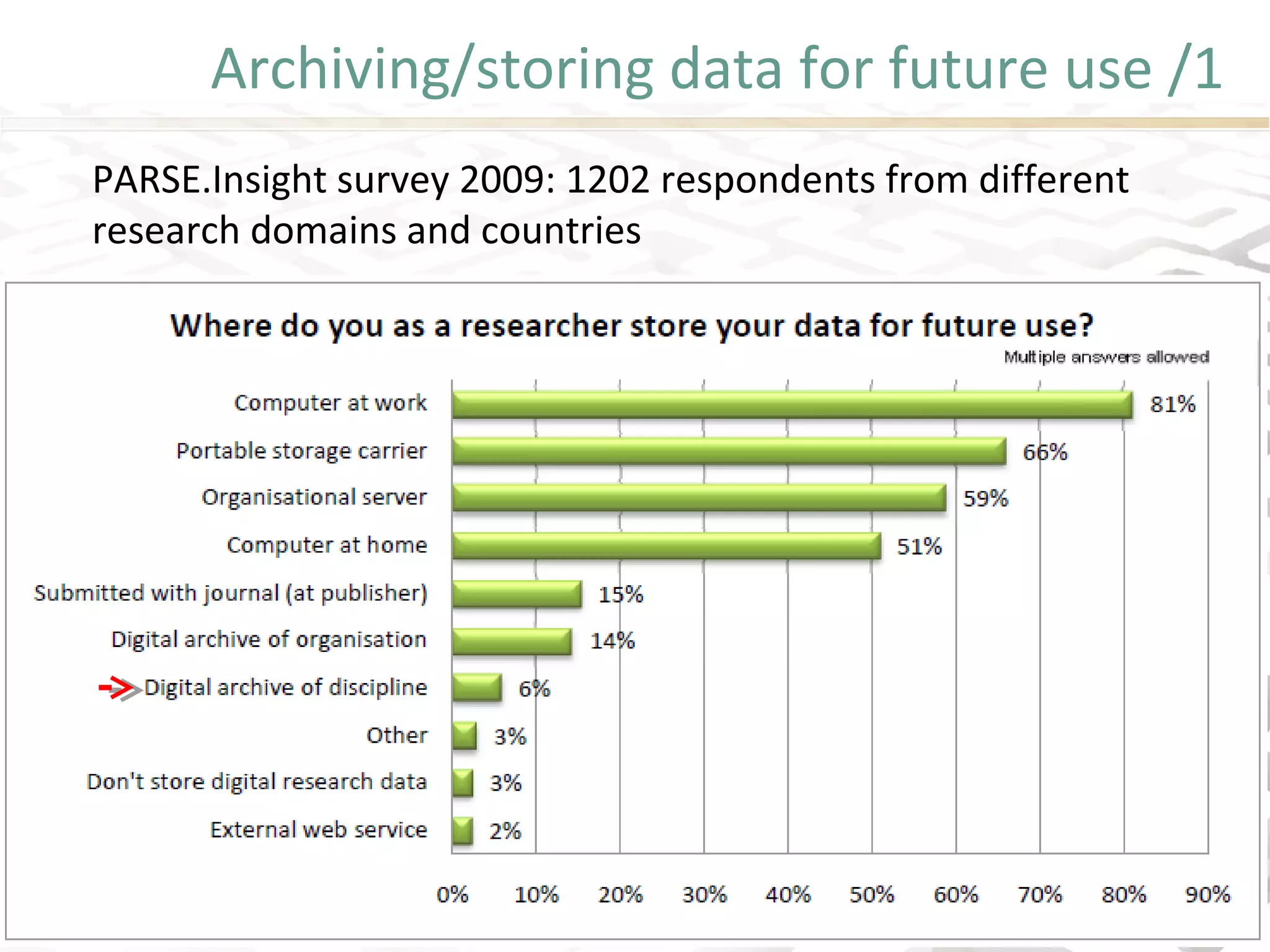
Archiving/storing data for future use /1
PARSE.Insight survey 2009: 1202 respondents from different
research domains and countries
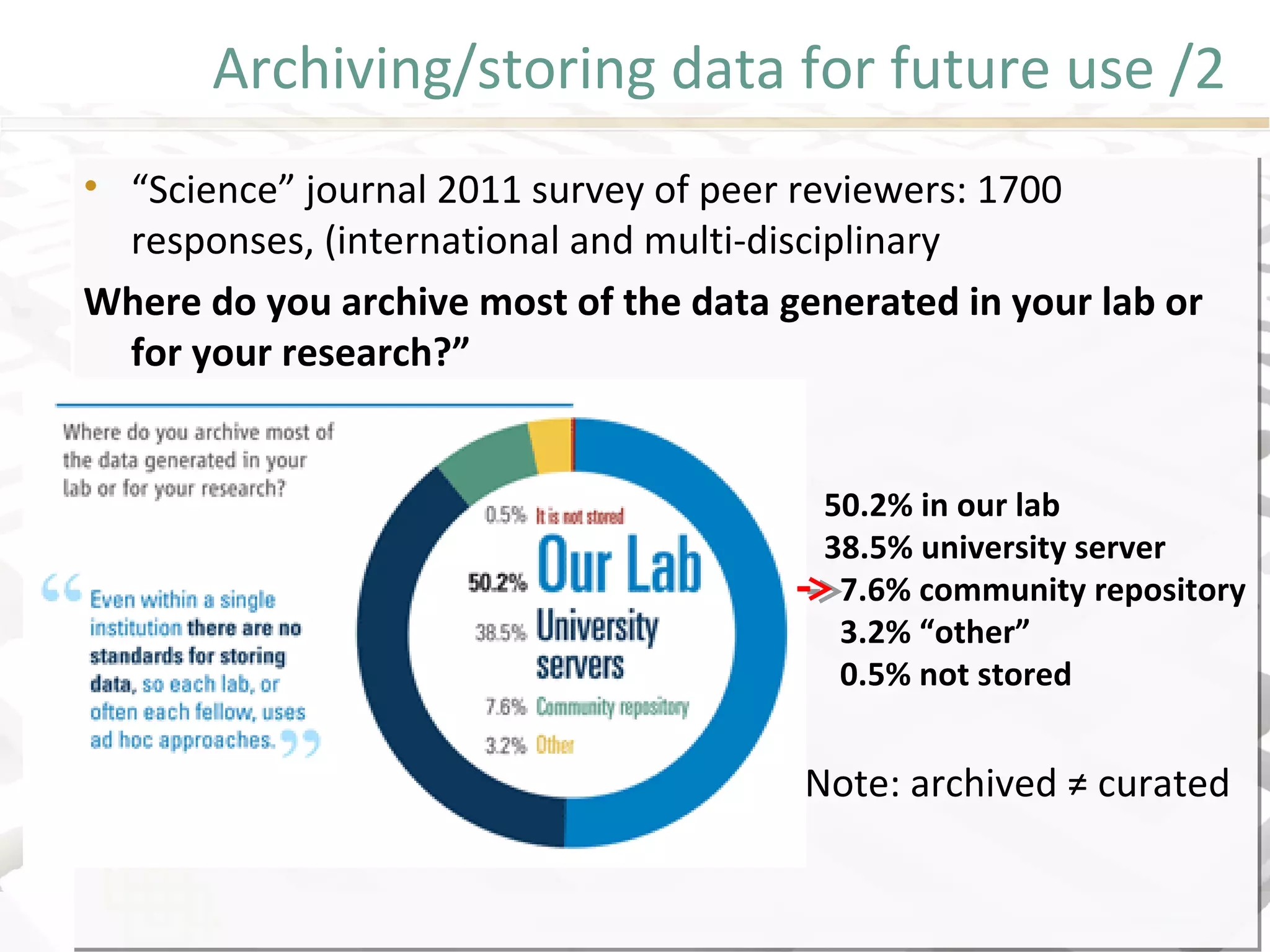
Archiving/storing data for future use /2
• “Science” journal 2011 survey of peer reviewers: 1700
responses, (international and multi-disciplinary
Where do you archive most of the data generated in your lab or
for your research?”
• “Science” journal 2011 survey of peer reviewers: 1700
responses, (international and multi-disciplinary
Where do you archive most of the data generated in your lab or
for your research?”
Note: archived ≠ curated
50.2% in our lab
38.5% university server
7.6% community repository
3.2% “other”
0.5% not stored
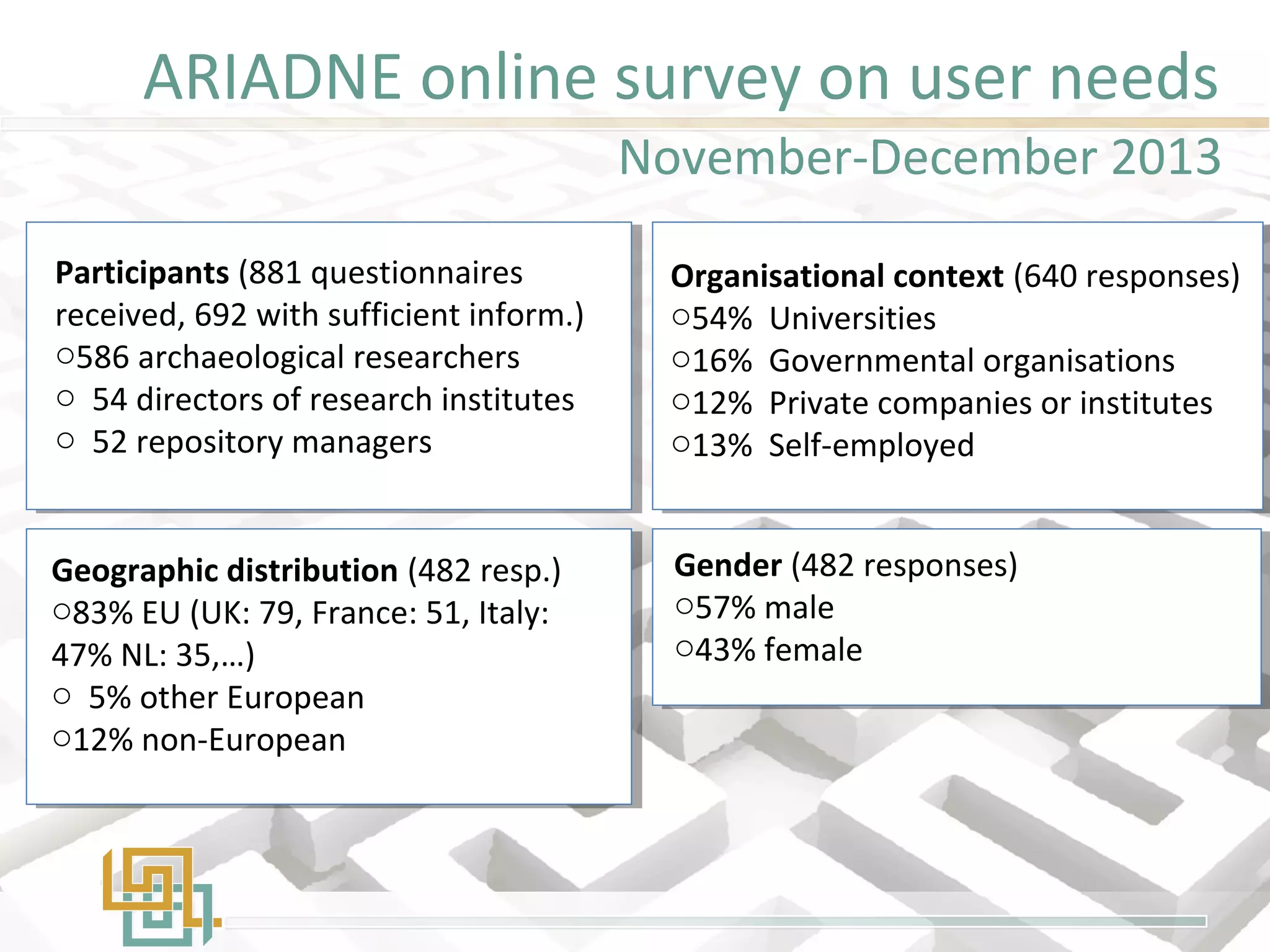
ARIADNE online survey on user needs
Participants (881 questionnaires
received, 692 with sufficient inform.)
o586 archaeological researchers
o 54 directors of research institutes
o 52 repository managers
Organisational context (640 responses)
o54% Universities
o16% Governmental organisations
o12% Private companies or institutes
o13% Self-employed
Gender (482 responses)
o57% male
o43% female
Geographic distribution (482 resp.)
o83% EU (UK: 79, France: 51, Italy:
47% NL: 35,…)
o 5% other European
o12% non-European
November-December 2013
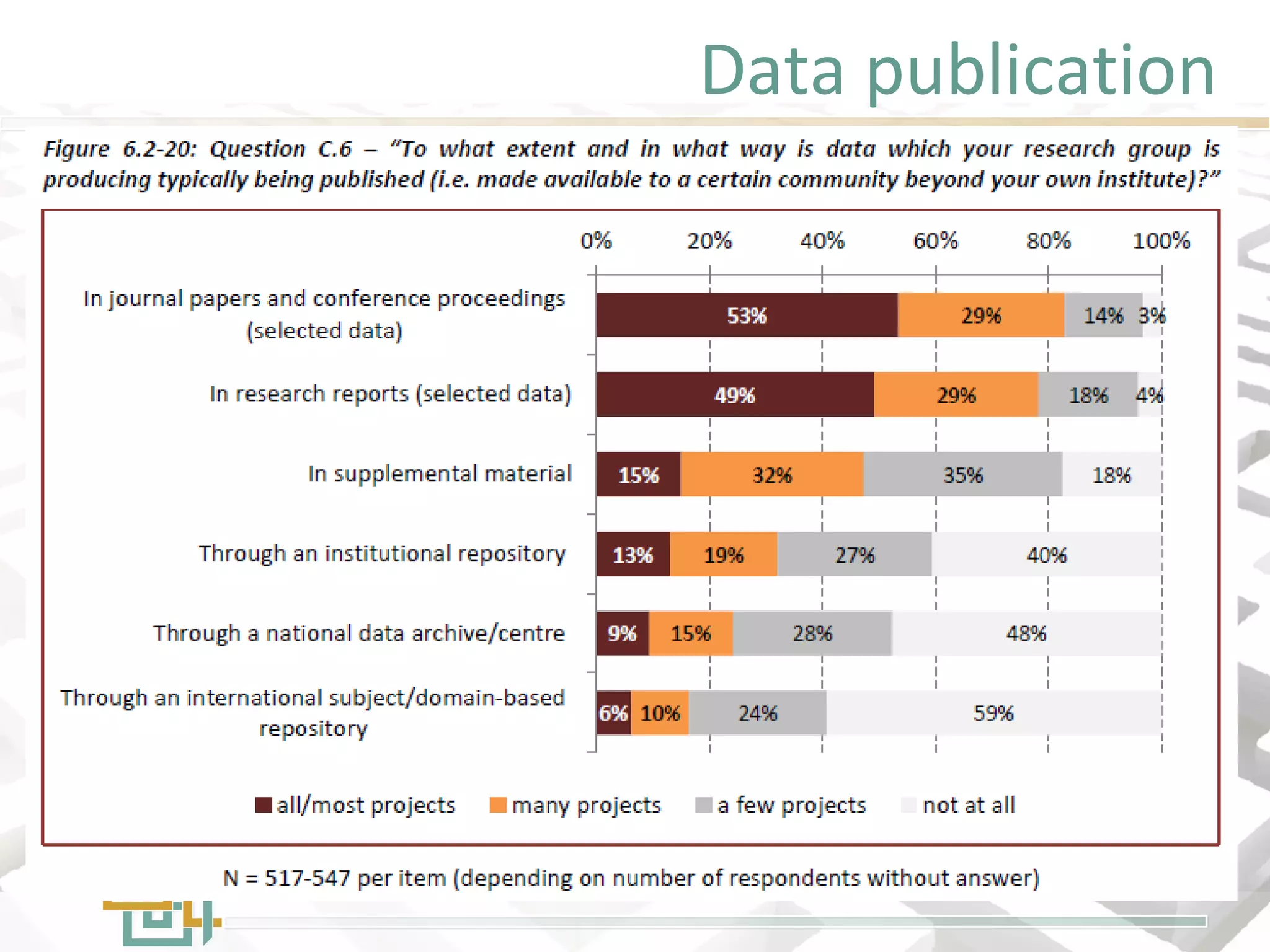
Data publication
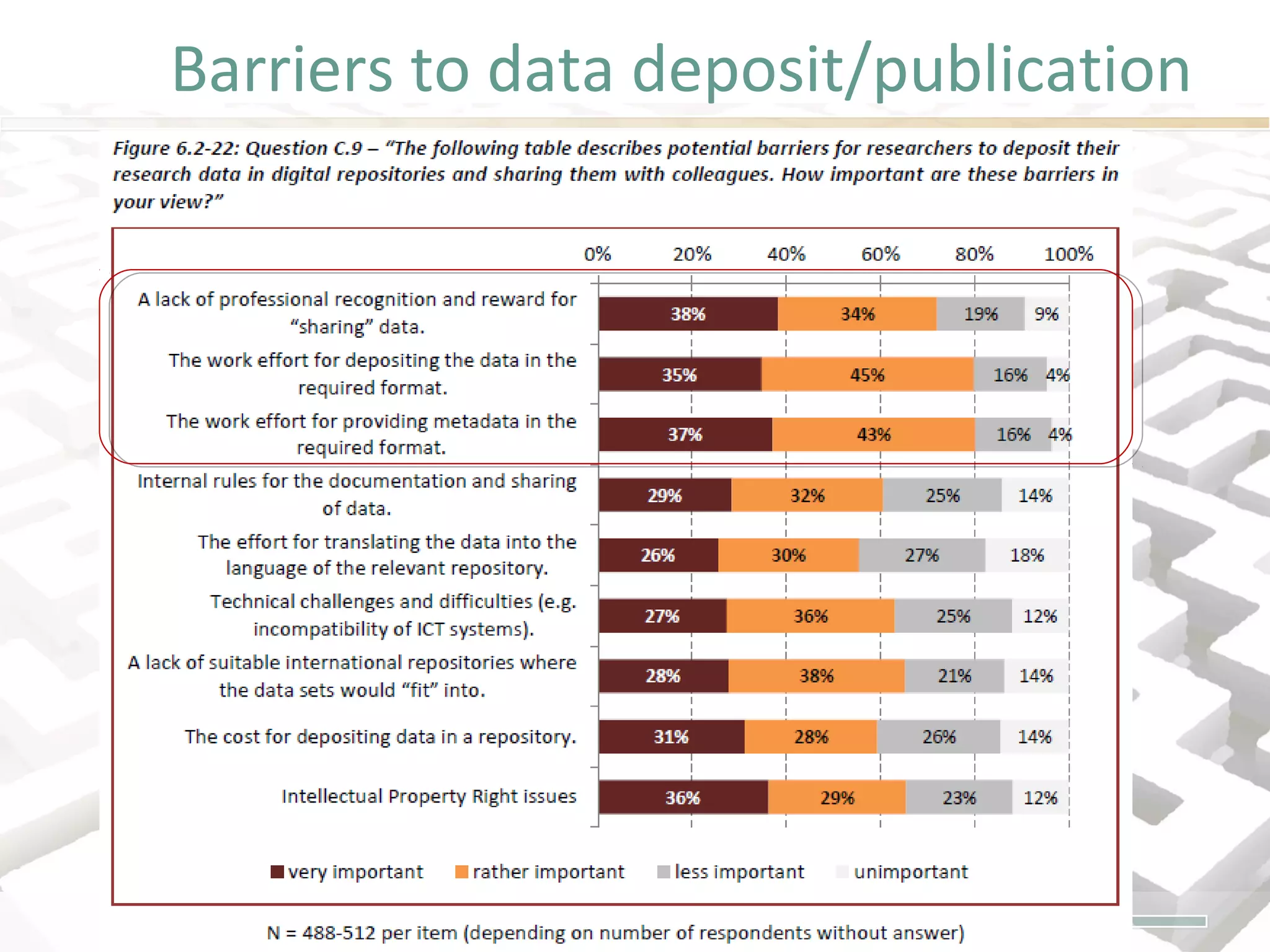
Barriers to data deposit/publication
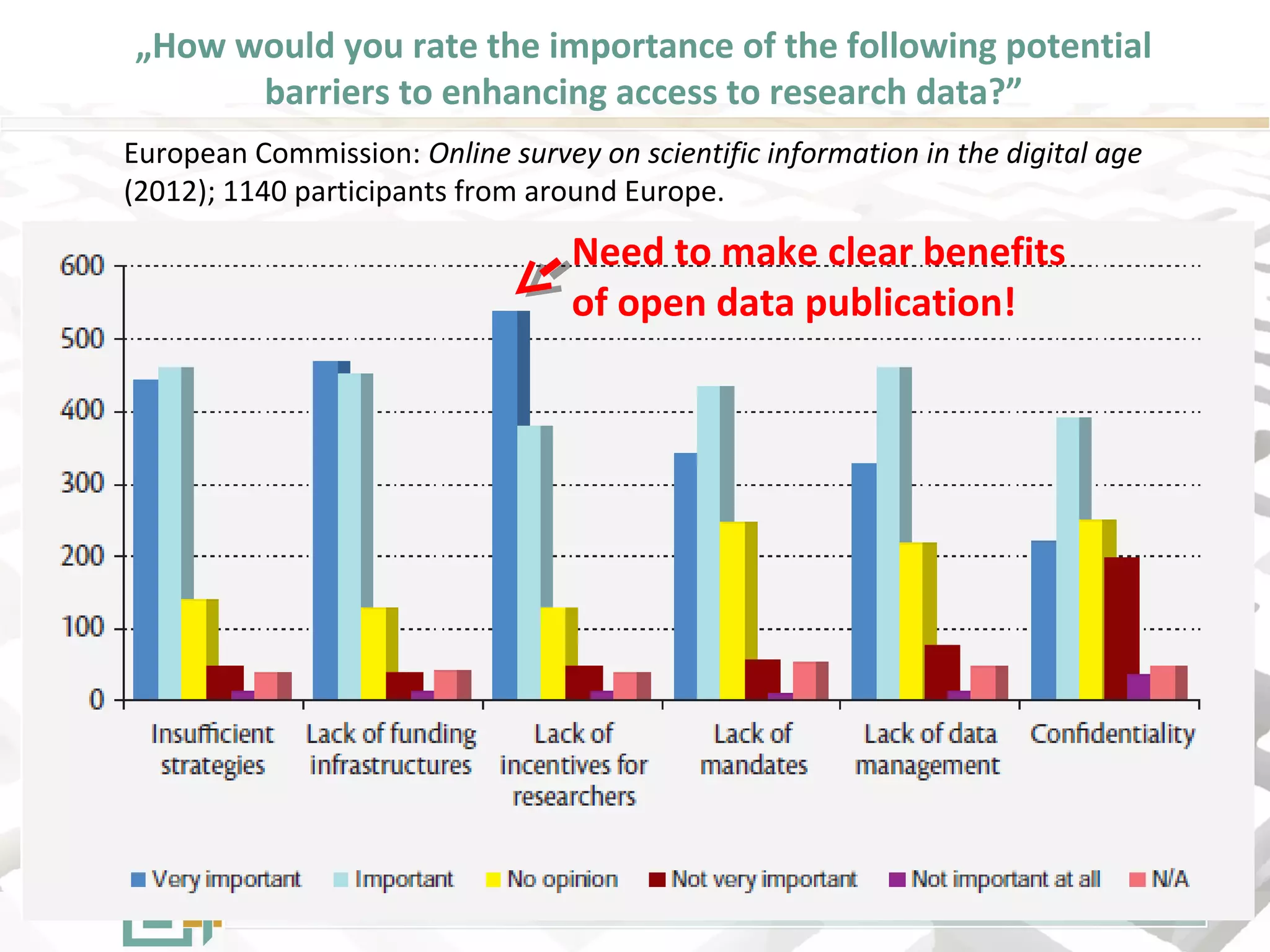
„How would you rate the importance of the following potential
barriers to enhancing access to research data?”
European Commission: Online survey on scientific information in the digital age
(2012); 1140 participants from around Europe.
Need to make clear benefits
of open data publication!
Authors‘ benefits focus
• Goal = recognition and academic reward for data
providers – at least same as for other publications
• Core mechanism = citation of published data/set
– Confirms value of the data contributed
– Indicates providers of good data
– Promotes further use of the data (i.e. more citations)
– Allows the use and impact of the data to be tracked and
measured
• But data citation metrics not implemented yet
• Some indications of higher citation rates of
publications that make underlying data available
• Goal = recognition and academic reward for data
providers – at least same as for other publications
• Core mechanism = citation of published data/set
– Confirms value of the data contributed
– Indicates providers of good data
– Promotes further use of the data (i.e. more citations)
– Allows the use and impact of the data to be tracked and
measured
• But data citation metrics not implemented yet
• Some indications of higher citation rates of
publications that make underlying data available
How to reap the benefits? / 1
• Deposit data that underpins your research results in
a reliable, community recognised repository
– See: Data Seal of Approval; Trusted Repositories Audit &
Certification (TRAC) and other checklists
– Should provide unique persistent identifiers (e.g. DOIs)
– Require following citation standard as part of user
agreement (e.g. DataCite; citation in reference list)
• Provide good metadata – “no pain, no gain”
– Key for data re-use without direct contact with creator
– Costs of preparing data and metadata for publication
should be included in project funding
• Deposit data that underpins your research results in
a reliable, community recognised repository
– See: Data Seal of Approval; Trusted Repositories Audit &
Certification (TRAC) and other checklists
– Should provide unique persistent identifiers (e.g. DOIs)
– Require following citation standard as part of user
agreement (e.g. DataCite; citation in reference list)
• Provide good metadata – “no pain, no gain”
– Key for data re-use without direct contact with creator
– Costs of preparing data and metadata for publication
should be included in project funding
How to reap the benefits? /2
• Apply a license not impeding reuse (e.g. CC-BY, ODC-
BY), i.e. that that should be re-usable
• Demand proper citation by others who use your
published data
• Publish a “data paper” (about your data)
• Promote/cite your data when appropriate
• Seek collaboration and co-authoring of papers with
data re-users
• Apply a license not impeding reuse (e.g. CC-BY, ODC-
BY), i.e. that that should be re-usable
• Demand proper citation by others who use your
published data
• Publish a “data paper” (about your data)
• Promote/cite your data when appropriate
• Seek collaboration and co-authoring of papers with
data re-users
Issue of actual data re-use /1
• No re-use, no citation, no recognition/rewards
• Few studies on re-use outside of science and
engineering disciplines
• DIPIR project included archaeology (Faniel et al.
2013); main results:
– Key importance of contextual information
– Especially research design and data collection procedures
– Other criteria:
• institutional background of data producers (training, reputation)
• good practices of the data repository
• No re-use, no citation, no recognition/rewards
• Few studies on re-use outside of science and
engineering disciplines
• DIPIR project included archaeology (Faniel et al.
2013); main results:
– Key importance of contextual information
– Especially research design and data collection procedures
– Other criteria:
• institutional background of data producers (training, reputation)
• good practices of the data repository
Issue of actual data re-use /2
• Unclear level of actual re-use in the domain
• Will there be more re-use if more data is openly
available?
• Re-use for what – comparative analysis, meta-
analysis,…?
• Main forms of re-use in the domain:
– Re-use of whole datasets as is?
– Build a derivative dataset, incorporating data from others
as well as own data?
– Extract specific „data points“?
• Unclear level of actual re-use in the domain
• Will there be more re-use if more data is openly
available?
• Re-use for what – comparative analysis, meta-
analysis,…?
• Main forms of re-use in the domain:
– Re-use of whole datasets as is?
– Build a derivative dataset, incorporating data from others
as well as own data?
– Extract specific „data points“?
Takeaway points /1
• Researchers as open data publishers and consumers
– Publish open data to reap benefits – individually and as
research community
– Recognise colleagues who share data, cite their datasets
properly
• Research institutions
– Reward researchers who publish data
– Change mind-sets by doing (not teethless mandates)
– Offer skills development and support
• Data archives/repositories
– Important research infrastructure – need sustained
funding, but also demonstrate usage/impact
– Make open data sharing as easy as possible
• Researchers as open data publishers and consumers
– Publish open data to reap benefits – individually and as
research community
– Recognise colleagues who share data, cite their datasets
properly
• Research institutions
– Reward researchers who publish data
– Change mind-sets by doing (not teethless mandates)
– Offer skills development and support
• Data archives/repositories
– Important research infrastructure – need sustained
funding, but also demonstrate usage/impact
– Make open data sharing as easy as possible
Takeaway points /2
• Research funders
– Open Data mandates should come with financial coverage
of extra effort for open data publication
• All: It‘s not about data management (plans) to
comply with policies
• It‘s about …
– making published data part of the scholarly record –
persistent, citable, rewarded
– demonstrating tangible benefits of open data publication
• Research funders
– Open Data mandates should come with financial coverage
of extra effort for open data publication
• All: It‘s not about data management (plans) to
comply with policies
• It‘s about …
– making published data part of the scholarly record –
persistent, citable, rewarded
– demonstrating tangible benefits of open data publication
References and other literature /1
• ADS – Archaeology Data Service, http://archaeologydataservice.ac.uk
• ARIADNE First report on users needs: D2.1, April 2014, http://
www.ariadne-infrastructure.eu/Resources/D2.1-First-report-on-users-needs
• Charles Beagrie Ltd.: Keeping Research Data Safe (KRDS) Benefits Framework,
http://beagrie.com/krds-i2s2.php
• Borgman, C.L: Research Data: Who will share what, with whom, when, and why? Fifth China
– North America Library Conference 2010, Beijing, 8-12 September 2010,
http://works.bepress.com/cgi/viewcontent.cgi?article=1237&context=borgman
• CODATA - ICSTI Task Group on Data Citation Standards and Practices (2013): Out of cite, out
of mind: The current state of practice, policy, and technology for the citation of data. In:
Data Science Journal, vol.12,
https://www.jstage.jst.go.jp/article/dsj/12/0/12_OSOM13-043/_article
• Costas R., Meijer I., Zahedi Z. & Wouters P. (2013): The Value of Research Data. Metrics for
datasets from a cultural and technical point of view. Center for Science and Technology
Studies, Leiden University, http://www.knowledge-exchange.info/Default.aspx?ID=586
• Data Seal of Approval, http://www.datasealofapproval.org
• DataCite, http://www.datacite.org
• DataCite Metadata Schema for the Publication and Citation of Research Data, V3.0, July
2013, http://schema.datacite.org/meta/kernel-3/index.html
• ADS – Archaeology Data Service, http://archaeologydataservice.ac.uk
• ARIADNE First report on users needs: D2.1, April 2014, http://
www.ariadne-infrastructure.eu/Resources/D2.1-First-report-on-users-needs
• Charles Beagrie Ltd.: Keeping Research Data Safe (KRDS) Benefits Framework,
http://beagrie.com/krds-i2s2.php
• Borgman, C.L: Research Data: Who will share what, with whom, when, and why? Fifth China
– North America Library Conference 2010, Beijing, 8-12 September 2010,
http://works.bepress.com/cgi/viewcontent.cgi?article=1237&context=borgman
• CODATA - ICSTI Task Group on Data Citation Standards and Practices (2013): Out of cite, out
of mind: The current state of practice, policy, and technology for the citation of data. In:
Data Science Journal, vol.12,
https://www.jstage.jst.go.jp/article/dsj/12/0/12_OSOM13-043/_article
• Costas R., Meijer I., Zahedi Z. & Wouters P. (2013): The Value of Research Data. Metrics for
datasets from a cultural and technical point of view. Center for Science and Technology
Studies, Leiden University, http://www.knowledge-exchange.info/Default.aspx?ID=586
• Data Seal of Approval, http://www.datasealofapproval.org
• DataCite, http://www.datacite.org
• DataCite Metadata Schema for the Publication and Citation of Research Data, V3.0, July
2013, http://schema.datacite.org/meta/kernel-3/index.html
References and other literature /2
• Data Curation Profiles – Witt M., Carlson J., Brandt D.S & Cragin M.H. (2009): Constructing
Data Curation Profiles. In: International Journal of Digital Curation, Vol. 4, No. 3, 2009,
http://www.ijdc.net/index.php/ijdc/article/view/137
• Data Curation Profiles – website,
http://wiki.lib.purdue.edu/display/dcp/Data+Curation+Profiles
• Digital Object Identifier (DOI), http://www.doi.info
• DIPIR - Dissemination Information Packages for Information Reuse, http://dipir.org
• DRYAD, http://datadryad.org
• EC – European Commission: Online survey on scientific information in the digital age, Brussels,
2012,
http://ec.europa.eu/research/science-society/document_library/pdf_06/survey-on-scientific-infor
• EC Communication: Open data. An engine for innovation, growth and transparent governance
(12.12.2011),
http://ec.europa.eu/information_society/policy/psi/docs/pdfs/opendata2012/open_data_commu
• EC Communication: Towards better access to scientific information: Boosting the benefits of
public investments in research (17.7.2012), http://
ec.europa.eu/research/science-society/document_library/pdf_06/era-communication-towards-be
• EDNA – e-depot Nederlandse archeologie, http://www.edna.nl
• Data Curation Profiles – Witt M., Carlson J., Brandt D.S & Cragin M.H. (2009): Constructing
Data Curation Profiles. In: International Journal of Digital Curation, Vol. 4, No. 3, 2009,
http://www.ijdc.net/index.php/ijdc/article/view/137
• Data Curation Profiles – website,
http://wiki.lib.purdue.edu/display/dcp/Data+Curation+Profiles
• Digital Object Identifier (DOI), http://www.doi.info
• DIPIR - Dissemination Information Packages for Information Reuse, http://dipir.org
• DRYAD, http://datadryad.org
• EC – European Commission: Online survey on scientific information in the digital age, Brussels,
2012,
http://ec.europa.eu/research/science-society/document_library/pdf_06/survey-on-scientific-inform
• EC Communication: Open data. An engine for innovation, growth and transparent governance
(12.12.2011),
http://ec.europa.eu/information_society/policy/psi/docs/pdfs/opendata2012/open_data_commun
• EC Communication: Towards better access to scientific information: Boosting the benefits of
public investments in research (17.7.2012), http://
ec.europa.eu/research/science-society/document_library/pdf_06/era-communication-towards-bet
• EDNA – e-depot Nederlandse archeologie, http://www.edna.nl
References and other literature /3
• European High-level Expert Group on Scientific Data (2010): Riding the wave. How Europe can
gain from the rising tide of scientific data. A submission to the European Commission, October
2010, http://cordis.europa.eu/fp7/ict/e-infrastructure/docs/hlg-sdi-report.pdf
• Faniel I., Kansa E., Whitcher-Kansa S., Barrera-Gomez J. & Yakel E. (2013): The Challenges of
Digging Data: A Study of Context in Archaeological Data Reuse. JCDL 2013 Proceedings of the
13th ACM/IEEE-CS Joint Conference on Digital Libraries, 295-304 (preprint), http://
www.oclc.org/content/dam/research/publications/library/2013/faniel-archae-data.pdf
• Force 11: Joint Declaration of Data Citation Principles, https://www.force11.org/datacitation/
• Gibney E. & Van Noorden R. (2013): Scientists losing data at a rapid rate. Nature, 19.12.2013,
http://www.nature.com/news/scientists-losing-data-at-a-rapid-rate-1.14416
• Goodman A., Pepe A., Blocker A. W. et al. (2014): Ten Simple Rules for the Care and Feeding
of Scientific Data. In: PLoS Computational Biology 10(4): e1003542,
http://dx.doi.org/10.1371/journal.pcbi.1003542
• Harley, Diane et al. (2010b): Assessing the Future Landscape of Scholarly Communication: An
Exploration of Faculty Values and Needs in Seven Disciplines. – Archaeology Case Study.
University of California Berkeley, http://escholarship.org/uc/item/15x7385g#page-37
• Hedstrom M., Niu J., & Marz K. (2008): Incentives for data producers to create “archive/ready”
data: Implications for archives and records management. Proceedings from the Society of
American Archivists Research Forum. San Francisco, CA: SAA, http://
files.archivists.org/conference/2008/researchforum/M-HedstromJ-Niu-SAA-ResearchPaper-2008.p
• European High-level Expert Group on Scientific Data (2010): Riding the wave. How Europe can
gain from the rising tide of scientific data. A submission to the European Commission, October
2010, http://cordis.europa.eu/fp7/ict/e-infrastructure/docs/hlg-sdi-report.pdf
• Faniel I., Kansa E., Whitcher-Kansa S., Barrera-Gomez J. & Yakel E. (2013): The Challenges of
Digging Data: A Study of Context in Archaeological Data Reuse. JCDL 2013 Proceedings of the
13th ACM/IEEE-CS Joint Conference on Digital Libraries, 295-304 (preprint), http://
www.oclc.org/content/dam/research/publications/library/2013/faniel-archae-data.pdf
• Force 11: Joint Declaration of Data Citation Principles, https://www.force11.org/datacitation/
• Gibney E. & Van Noorden R. (2013): Scientists losing data at a rapid rate. Nature, 19.12.2013,
http://www.nature.com/news/scientists-losing-data-at-a-rapid-rate-1.14416
• Goodman A., Pepe A., Blocker A. W. et al. (2014): Ten Simple Rules for the Care and Feeding
of Scientific Data. In: PLoS Computational Biology 10(4): e1003542,
http://dx.doi.org/10.1371/journal.pcbi.1003542
• Harley, Diane et al. (2010b): Assessing the Future Landscape of Scholarly Communication: An
Exploration of Faculty Values and Needs in Seven Disciplines. – Archaeology Case Study.
University of California Berkeley, http://escholarship.org/uc/item/15x7385g#page-37
• Hedstrom M., Niu J., & Marz K. (2008): Incentives for data producers to create “archive/ready”
data: Implications for archives and records management. Proceedings from the Society of
American Archivists Research Forum. San Francisco, CA: SAA, http://
files.archivists.org/conference/2008/researchforum/M-HedstromJ-Niu-SAA-ResearchPaper-2008.p
References and other literature /4
• Heidorn, P.B: Shedding Light on the Dark Data in the Long Tail of Science. Library Trends 57(2),
2008, http://hdl.handle.net/2142/9127
• IANUS - Research Data Centre for Archaeology and Ancient Studies (Germany),
http://www.ianus-fdz.de
• Knowledge Exchange (2013): "Making Data Count: Research data availability and research
assessment", workshop, Berlin, http://www.knowledge-exchange.info/Default.aspx?ID=577
• Internet Archaeology: Data Papers, http://intarch.ac.uk/authors/data-papers.html
• Journal of Open Archaeology Data, http://openarchaeologydata.metajnl.com
• JISC / Curtis G., Hammond M. & Oppenheim C. (2013): Access to Citation Data: Cost-benefit
and Risk Review and Forward Look. JISC, September 2013,
http://repository.jisc.ac.uk/5371/1/Access-to-Citation-data-report-final.pdf
• Key Perspectives (2010): Data Dimensions: Disciplinary Differences in Research Data Sharing,
Reuse and Long Term Viability. Digital Curation Center,
http://www.dcc.ac.uk/sites/default/files/SCARP%20SYNTHESIS_FINAL.pdf
• Kvalheim V. & Kvamme T. (2014): Policies for Sharing Research Data in Social Sciences and
Humanities. A survey about research funders’ data policies. International Federation of Data
Organisations (IFDO), http://
www.ada.edu.au/documents/ifdo-report-on-policies-for-data-sharing
• Lawrence B., Jones C., Matthews B., Pepler S. & Callaghan S. (2011): Citation and peer review
of data: Moving towards formal data publication. International Journal of Digital Curation,
6(2): 4-37, http://www.ijdc.net/index.php/ijdc/article/viewFile/181/265
• Heidorn, P.B: Shedding Light on the Dark Data in the Long Tail of Science. Library Trends 57(2),
2008, http://hdl.handle.net/2142/9127
• IANUS - Research Data Centre for Archaeology and Ancient Studies (Germany),
http://www.ianus-fdz.de
• Knowledge Exchange (2013): "Making Data Count: Research data availability and research
assessment", workshop, Berlin, http://www.knowledge-exchange.info/Default.aspx?ID=577
• Internet Archaeology: Data Papers, http://intarch.ac.uk/authors/data-papers.html
• Journal of Open Archaeology Data, http://openarchaeologydata.metajnl.com
• JISC / Curtis G., Hammond M. & Oppenheim C. (2013): Access to Citation Data: Cost-benefit
and Risk Review and Forward Look. JISC, September 2013,
http://repository.jisc.ac.uk/5371/1/Access-to-Citation-data-report-final.pdf
• Key Perspectives (2010): Data Dimensions: Disciplinary Differences in Research Data Sharing,
Reuse and Long Term Viability. Digital Curation Center,
http://www.dcc.ac.uk/sites/default/files/SCARP%20SYNTHESIS_FINAL.pdf
• Kvalheim V. & Kvamme T. (2014): Policies for Sharing Research Data in Social Sciences and
Humanities. A survey about research funders’ data policies. International Federation of Data
Organisations (IFDO), http://
www.ada.edu.au/documents/ifdo-report-on-policies-for-data-sharing
• Lawrence B., Jones C., Matthews B., Pepler S. & Callaghan S. (2011): Citation and peer review
of data: Moving towards formal data publication. International Journal of Digital Curation,
6(2): 4-37, http://www.ijdc.net/index.php/ijdc/article/viewFile/181/265
References and other literature /5
• MAPPA Open Data (University of Pisa, Italy), http://mappaproject.arch.unipi.it/?lang=en
• OECD: Declaration on Access to Research Data from Public Funding (30.01.2004),
http://acts.oecd.org/Instruments/ShowInstrumentView.aspx?InstrumentID=157&Lang=en&Book=
• OECD: Principles and Guidelines for Access to Research Data from Public Funding (2007),
http://www.oecd.org/science/sci-tech/38500813.pdf
• Open Context (Alexandria Archive Institute, USA), http://opencontext.org
• Opportunities for Data Exchange (ODE) project / Kotarski R. et al. (2012). Report on best
practices for citability of data and on evolving roles in scholarly communication,
http://www.alliancepermanentaccess.org/index.php/community/current-projects/ode/outputs/
• PARSE.Insight: Insight into digital preservation of research output in Europe. Project
deliverable D3.4: Survey Report, 9 December 2009,
http://www.parse-insight.eu/downloads/PARSE-Insight_D3-4_SurveyReport_final_hq.pdf
• Parsons M.A. & Fox P.A. (2013): Is data publication the right metaphor? In: Data Science
Journal, vol.12, February 2013, https://www.jstage.jst.go.jp/article/dsj/12/0/12_WDS-042/_
pdf
• Piwowar H.A. & Vision T.J. (2013): Data reuse and the open data citation advantage. In:
PeerJ, 1:e175 http://dx.doi.org/10.7717/peerj.175
• MAPPA Open Data (University of Pisa, Italy), http://mappaproject.arch.unipi.it/?lang=en
• OECD: Declaration on Access to Research Data from Public Funding (30.01.2004),
http://acts.oecd.org/Instruments/ShowInstrumentView.aspx?InstrumentID=157&Lang=en&Book=F
• OECD: Principles and Guidelines for Access to Research Data from Public Funding (2007),
http://www.oecd.org/science/sci-tech/38500813.pdf
• Open Context (Alexandria Archive Institute, USA), http://opencontext.org
• Opportunities for Data Exchange (ODE) project / Kotarski R. et al. (2012). Report on best
practices for citability of data and on evolving roles in scholarly communication,
http://www.alliancepermanentaccess.org/index.php/community/current-projects/ode/outputs/
• PARSE.Insight: Insight into digital preservation of research output in Europe. Project
deliverable D3.4: Survey Report, 9 December 2009,
http://www.parse-insight.eu/downloads/PARSE-Insight_D3-4_SurveyReport_final_hq.pdf
• Parsons M.A. & Fox P.A. (2013): Is data publication the right metaphor? In: Data Science
Journal, vol.12, February 2013, https://www.jstage.jst.go.jp/article/dsj/12/0/12_WDS-042/_
pdf
• Piwowar H.A. & Vision T.J. (2013): Data reuse and the open data citation advantage. In:
PeerJ, 1:e175 http://dx.doi.org/10.7717/peerj.175
References and other literature /6
• Pryor, Graham (2009): Multi-scale Data Sharing in the Life Sciences: Some Lessons for Policy
Makers. International Journal of Digital Curation, Vol. 4, No 3, http://
ijdc.net/index.php/ijdc/article/view/135/178
• Research Data Alliance, https://www.rd-alliance.org
• RIN - Research Information Network & British Library (2010): Patterns of information use
and exchange: case studies of researchers in the life sciences, http://
www.rin.ac.uk/our-work/using-and-accessing-information-resources/patterns-information-use-an
• RIN - Research Information Network & Key Perspectives (2008): To Share or not to Share:
Publication and Quality Assurance of Research Data Outputs. Main Report and Annex. RIN:
London, http://
www.rin.ac.uk/our-work/data-management-and-curation/share-or-not-share-research-data-outpu
• RIN & NESTA - National Endowment for Science, Technology, and the Arts (2010): Open to
All? Case Studies of Openness in Research. Report prepared by the Digital Curation Centre.
London: RIN, http://
www.rin.ac.uk/our-work/data-management-and-curation/open-science-case-studies
• Science magazine: Science Staff introduction to the Special Issue “Dealing with Data”,
Science, Vol. 331 no. 6018, 11 February 2011, pp. 692-693,
http://www.sciencemag.org/content/331/6018/692.short
• tDAR - The Digital Archaeological Record (Digital Antiquity consortium, USA), http://
www.tdar.org
• Pryor, Graham (2009): Multi-scale Data Sharing in the Life Sciences: Some Lessons for Policy
Makers. International Journal of Digital Curation, Vol. 4, No 3, http://
ijdc.net/index.php/ijdc/article/view/135/178
• Research Data Alliance, https://www.rd-alliance.org
• RIN - Research Information Network & British Library (2010): Patterns of information use
and exchange: case studies of researchers in the life sciences, http://
www.rin.ac.uk/our-work/using-and-accessing-information-resources/patterns-information-use-and
• RIN - Research Information Network & Key Perspectives (2008): To Share or not to Share:
Publication and Quality Assurance of Research Data Outputs. Main Report and Annex. RIN:
London, http://
www.rin.ac.uk/our-work/data-management-and-curation/share-or-not-share-research-data-outpu
• RIN & NESTA - National Endowment for Science, Technology, and the Arts (2010): Open to
All? Case Studies of Openness in Research. Report prepared by the Digital Curation Centre.
London: RIN, http://
www.rin.ac.uk/our-work/data-management-and-curation/open-science-case-studies
• Science magazine: Science Staff introduction to the Special Issue “Dealing with Data”,
Science, Vol. 331 no. 6018, 11 February 2011, pp. 692-693,
http://www.sciencemag.org/content/331/6018/692.short
• tDAR - The Digital Archaeological Record (Digital Antiquity consortium, USA), http://
www.tdar.org
References and other literature /7
• Tenopir C., Allard S., Douglass K. et al. (2011): Data Sharing by Scientists: Practices and
Perceptions. PLoS ONE 6(6): e21101,
http://www.plosone.org/article/info:doi/10.1371/journal.pone.0021101
• The Royal Society, Science as an Open Enterprise, June 2012,
http://royalsociety.org/policy/projects/science-public-enterprise/report/
• Thessen, A.E & Patterson, D.J (2011) Data issues in the life sciences. In: ZooKeys 150: 15–51,
http://www.pensoft.net/journals/zookeys/article/1766/data-issues-in-the-life-sciences
• Uhlir, Paul F. (ed.): For attribution: Developing scientific data attribution and citation
practices and standards: Summary of an international workshop. Washington, D.C.: National
Academies Press, 2012, http://www.nap.edu/catalog.php?record_id=13564
• Vines T.H., Andrew R.L., Bock D.G. et al. (2013): Mandated data archiving greatly improves
access to research data. FASEB Journal, 27(4), http://www.fasebj.org/content/27/4/1304
• Wright S.J., Kozlowski W.A., Dietrich D. et al. (2013): Using Data Curation Profiles to Design
the Datastar Dataset Registry. D-Lib Magazine, Volume 19, Number 7/8, July/August 2013,
http://www.dlib.org/dlib/july13/wright/07wright.html
• zenodo, http://www.zenodo.org (CERN, related to OpenAIRE)
• Tenopir C., Allard S., Douglass K. et al. (2011): Data Sharing by Scientists: Practices and
Perceptions. PLoS ONE 6(6): e21101,
http://www.plosone.org/article/info:doi/10.1371/journal.pone.0021101
• The Royal Society, Science as an Open Enterprise, June 2012,
http://royalsociety.org/policy/projects/science-public-enterprise/report/
• Thessen, A.E & Patterson, D.J (2011) Data issues in the life sciences. In: ZooKeys 150: 15–51,
http://www.pensoft.net/journals/zookeys/article/1766/data-issues-in-the-life-sciences
• Uhlir, Paul F. (ed.): For attribution: Developing scientific data attribution and citation
practices and standards: Summary of an international workshop. Washington, D.C.: National
Academies Press, 2012, http://www.nap.edu/catalog.php?record_id=13564
• Vines T.H., Andrew R.L., Bock D.G. et al. (2013): Mandated data archiving greatly improves
access to research data. FASEB Journal, 27(4), http://www.fasebj.org/content/27/4/1304
• Wright S.J., Kozlowski W.A., Dietrich D. et al. (2013): Using Data Curation Profiles to Design
the Datastar Dataset Registry. D-Lib Magazine, Volume 19, Number 7/8, July/August 2013,
http://www.dlib.org/dlib/july13/wright/07wright.html
• zenodo, http://www.zenodo.org (CERN, related to OpenAIRE)
Disclaimer
ARIADNE is a project funded by the European Commission under the
Community’s Seventh Framework Programme, contract no. FP7-
INFRASTRUCTURES-2012-1-313193.
The views and opinions expressed in this presentation are the sole
responsibility of the authors and do not necessarily reflect the views
of the European Commission.
ARIADNE is a project funded by the European Commission under the
Community’s Seventh Framework Programme, contract no. FP7-
INFRASTRUCTURES-2012-1-313193.
The views and opinions expressed in this presentation are the sole
responsibility of the authors and do not necessarily reflect the views
of the European Commission.

Open Data Publication - Requirements, Good practices, and Benefits

  • 1.
    ARIADNE is fundedby the European Commission's Seventh Framework Programme Open Data Publication Requirements, Good Practices, and Benefits Open Data Publication Requirements, Good Practices, and Benefits EAA 2014 - Istanbul Session: Barriers and Opportunities: Open Access and Open Data in Archaeology 13 September 2014 Guntram Geser Salzburg Research EAA 2014 - Istanbul Session: Barriers and Opportunities: Open Access and Open Data in Archaeology 13 September 2014 Guntram Geser Salzburg Research
  • 2.
    ARIADNE • Advanced ResearchInfrastructure for archaeological Dataset Networking in Europe – EU FP7-Infrastructures project, type „Integrating Activity“ – Runs 4 years, 02/2013-01/2017 – Focus on archaeological datasets – help overcome data fragmentation and foster a culture of sharing and re-using – 23 partners of 18 European countries – Open to other participants, e.g. • Transnational Access Programme • Special Interest Groups • Website: www.ariadne-infrastructure.eu • Advanced Research Infrastructure for archaeological Dataset Networking in Europe – EU FP7-Infrastructures project, type „Integrating Activity“ – Runs 4 years, 02/2013-01/2017 – Focus on archaeological datasets – help overcome data fragmentation and foster a culture of sharing and re-using – 23 partners of 18 European countries – Open to other participants, e.g. • Transnational Access Programme • Special Interest Groups • Website: www.ariadne-infrastructure.eu
  • 3.
    Main topics ofthis presentation • Open Data – expectations, criteria, drivers • Current data (non-)sharing behaviour • Reasons for lack of open data sharing • ARIADNE survey results on data publication • How to benefit from open data publication • Issue of actual data re-use • Takeaway points • Open Data – expectations, criteria, drivers • Current data (non-)sharing behaviour • Reasons for lack of open data sharing • ARIADNE survey results on data publication • How to benefit from open data publication • Issue of actual data re-use • Takeaway points
  • 4.
    Open Data –expectations • The scientific method: provide evidence for knowledge claims („show us your data“) • Output of publicly funded research should be openly available, and properly preserved • More open data sharing => better analysis => better decision-making / solutions for critical issues • Better return-on-investment, e.g. – no duplication of data collection – better exploitation of available data – therefore emphasis on re-use • Innovation through „data-intensive“, „data-driven“, „big data“ (incl. archaeology?) • The scientific method: provide evidence for knowledge claims („show us your data“) • Output of publicly funded research should be openly available, and properly preserved • More open data sharing => better analysis => better decision-making / solutions for critical issues • Better return-on-investment, e.g. – no duplication of data collection – better exploitation of available data – therefore emphasis on re-use • Innovation through „data-intensive“, „data-driven“, „big data“ (incl. archaeology?)
  • 5.
    Open Data –criteria • Accessible online – not necessarily without registration • Reusable – not summarized data (i.e. figures, charts, etc.) canned in publications – state: raw, cleaned, normalized,… (accord. to practice) – open format (e.g. not PDF documents) • Openly licensed (e.g. CC-BY, if other no NonDerivative!) • For free – yes, but somebody has to pay to ensure sustainability • Accessible online – not necessarily without registration • Reusable – not summarized data (i.e. figures, charts, etc.) canned in publications – state: raw, cleaned, normalized,… (accord. to practice) – open format (e.g. not PDF documents) • Openly licensed (e.g. CC-BY, if other no NonDerivative!) • For free – yes, but somebody has to pay to ensure sustainability “Publishing data in a reusable form to support findings must be mandatory” – one of six key areas for action highlighted in the The Royal Society’s report Science as an Open Enterprise (2012)
  • 6.
    Open Data –drivers /1 • High-level policies & initiatives – OECD Declaration on Access to Research Data from Public Funding (2004; Principles and Guidelines, 2007) – EC Communications, Open data (2011), Towards better access to scientific information (2012) – Many others, e.g. Research Data Alliance – international initiative (launched in March 2013), various working & interest groups (archaeology not represented yet) • High-level policies & initiatives – OECD Declaration on Access to Research Data from Public Funding (2004; Principles and Guidelines, 2007) – EC Communications, Open data (2011), Towards better access to scientific information (2012) – Many others, e.g. Research Data Alliance – international initiative (launched in March 2013), various working & interest groups (archaeology not represented yet) Neelie Kroes, EC Vice-President, 2012: “Taxpayers should not have to pay twice for scientific research and they need seam- less access to raw data. We want to bring dissemination and exploitation of scientific research results to the next level.”
  • 7.
    Open Data –drivers /2 • Research funding agencies – Open Access mandates extended to data – Mandatory data management plans, i.e. data sharing must be considered already at application stage • Data archiving & access infrastructures put in place – Data centres / repositories • General : zenodo (related to OpenAIRE), Figshare, … • Archaeology: e.g. ADS (UK), eDNA (NL), IANUS (Germany, in preparation), MAPPA (IT), OpenContext and tDAR (USA) – Data registries / catalogues – Data citation standard, e.g. DataCite • Research funding agencies – Open Access mandates extended to data – Mandatory data management plans, i.e. data sharing must be considered already at application stage • Data archiving & access infrastructures put in place – Data centres / repositories • General : zenodo (related to OpenAIRE), Figshare, … • Archaeology: e.g. ADS (UK), eDNA (NL), IANUS (Germany, in preparation), MAPPA (IT), OpenContext and tDAR (USA) – Data registries / catalogues – Data citation standard, e.g. DataCite
  • 8.
    Open Data –drivers /3 • New publication format of „data papers“ – Describe a dataset/database, kind of extensive metadata record or documentation, also including examples of use / usefulness for research – Examples of data journals in archaeology • Journal of Open Archaeology Data, started 2012 • Internet Archaeology, started a series of data papers in 2013 • New publication format of „data papers“ – Describe a dataset/database, kind of extensive metadata record or documentation, also including examples of use / usefulness for research – Examples of data journals in archaeology • Journal of Open Archaeology Data, started 2012 • Internet Archaeology, started a series of data papers in 2013
  • 9.
    Barriers to opendata sharing • Many obstacles to providing open access to reusable data – Priority of published papers – Little academic reward for development and sharing of datasets/DB – Required effort to share re-usable data (incl. formatting, metadata creation, licensing etc.) – Existing copyrights, confidential and sensitive data – Concerns that data could be scooped, misused or misinterpreted – Potential reputational risk (e.g. data quality, errors,…) • Overall a bad ratio of additional effort & risks to potential benefits • Many obstacles to providing open access to reusable data – Priority of published papers – Little academic reward for development and sharing of datasets/DB – Required effort to share re-usable data (incl. formatting, metadata creation, licensing etc.) – Existing copyrights, confidential and sensitive data – Concerns that data could be scooped, misused or misinterpreted – Potential reputational risk (e.g. data quality, errors,…) • Overall a bad ratio of additional effort & risks to potential benefits
  • 10.
    Current data (non-)sharingbehaviour • Contrary to what advocates of proper management and sharing of data would like them to do • According to representative surveys (PARSE.Insight 2009, Science 2011): Most data remains locked away – On personal computers – Portable storage carriers – Restricted access servers – … • Eventually discarded as “obsolete” or lost otherwise • Mostly not considered: Potential value of the data for alternate and new uses by others • Only 6-8% of researchers sometimes deposit data in a community archive • Contrary to what advocates of proper management and sharing of data would like them to do • According to representative surveys (PARSE.Insight 2009, Science 2011): Most data remains locked away – On personal computers – Portable storage carriers – Restricted access servers – … • Eventually discarded as “obsolete” or lost otherwise • Mostly not considered: Potential value of the data for alternate and new uses by others • Only 6-8% of researchers sometimes deposit data in a community archive
  • 11.
    Archiving/storing data forfuture use /1 PARSE.Insight survey 2009: 1202 respondents from different research domains and countries
  • 12.
    Archiving/storing data forfuture use /2 • “Science” journal 2011 survey of peer reviewers: 1700 responses, (international and multi-disciplinary Where do you archive most of the data generated in your lab or for your research?” • “Science” journal 2011 survey of peer reviewers: 1700 responses, (international and multi-disciplinary Where do you archive most of the data generated in your lab or for your research?” Note: archived ≠ curated 50.2% in our lab 38.5% university server 7.6% community repository 3.2% “other” 0.5% not stored
  • 13.
    ARIADNE online surveyon user needs Participants (881 questionnaires received, 692 with sufficient inform.) o586 archaeological researchers o 54 directors of research institutes o 52 repository managers Organisational context (640 responses) o54% Universities o16% Governmental organisations o12% Private companies or institutes o13% Self-employed Gender (482 responses) o57% male o43% female Geographic distribution (482 resp.) o83% EU (UK: 79, France: 51, Italy: 47% NL: 35,…) o 5% other European o12% non-European November-December 2013
  • 14.
  • 15.
    Barriers to datadeposit/publication
  • 16.
    „How would yourate the importance of the following potential barriers to enhancing access to research data?” European Commission: Online survey on scientific information in the digital age (2012); 1140 participants from around Europe. Need to make clear benefits of open data publication!
  • 17.
    Authors‘ benefits focus •Goal = recognition and academic reward for data providers – at least same as for other publications • Core mechanism = citation of published data/set – Confirms value of the data contributed – Indicates providers of good data – Promotes further use of the data (i.e. more citations) – Allows the use and impact of the data to be tracked and measured • But data citation metrics not implemented yet • Some indications of higher citation rates of publications that make underlying data available • Goal = recognition and academic reward for data providers – at least same as for other publications • Core mechanism = citation of published data/set – Confirms value of the data contributed – Indicates providers of good data – Promotes further use of the data (i.e. more citations) – Allows the use and impact of the data to be tracked and measured • But data citation metrics not implemented yet • Some indications of higher citation rates of publications that make underlying data available
  • 18.
    How to reapthe benefits? / 1 • Deposit data that underpins your research results in a reliable, community recognised repository – See: Data Seal of Approval; Trusted Repositories Audit & Certification (TRAC) and other checklists – Should provide unique persistent identifiers (e.g. DOIs) – Require following citation standard as part of user agreement (e.g. DataCite; citation in reference list) • Provide good metadata – “no pain, no gain” – Key for data re-use without direct contact with creator – Costs of preparing data and metadata for publication should be included in project funding • Deposit data that underpins your research results in a reliable, community recognised repository – See: Data Seal of Approval; Trusted Repositories Audit & Certification (TRAC) and other checklists – Should provide unique persistent identifiers (e.g. DOIs) – Require following citation standard as part of user agreement (e.g. DataCite; citation in reference list) • Provide good metadata – “no pain, no gain” – Key for data re-use without direct contact with creator – Costs of preparing data and metadata for publication should be included in project funding
  • 19.
    How to reapthe benefits? /2 • Apply a license not impeding reuse (e.g. CC-BY, ODC- BY), i.e. that that should be re-usable • Demand proper citation by others who use your published data • Publish a “data paper” (about your data) • Promote/cite your data when appropriate • Seek collaboration and co-authoring of papers with data re-users • Apply a license not impeding reuse (e.g. CC-BY, ODC- BY), i.e. that that should be re-usable • Demand proper citation by others who use your published data • Publish a “data paper” (about your data) • Promote/cite your data when appropriate • Seek collaboration and co-authoring of papers with data re-users
  • 20.
    Issue of actualdata re-use /1 • No re-use, no citation, no recognition/rewards • Few studies on re-use outside of science and engineering disciplines • DIPIR project included archaeology (Faniel et al. 2013); main results: – Key importance of contextual information – Especially research design and data collection procedures – Other criteria: • institutional background of data producers (training, reputation) • good practices of the data repository • No re-use, no citation, no recognition/rewards • Few studies on re-use outside of science and engineering disciplines • DIPIR project included archaeology (Faniel et al. 2013); main results: – Key importance of contextual information – Especially research design and data collection procedures – Other criteria: • institutional background of data producers (training, reputation) • good practices of the data repository
  • 21.
    Issue of actualdata re-use /2 • Unclear level of actual re-use in the domain • Will there be more re-use if more data is openly available? • Re-use for what – comparative analysis, meta- analysis,…? • Main forms of re-use in the domain: – Re-use of whole datasets as is? – Build a derivative dataset, incorporating data from others as well as own data? – Extract specific „data points“? • Unclear level of actual re-use in the domain • Will there be more re-use if more data is openly available? • Re-use for what – comparative analysis, meta- analysis,…? • Main forms of re-use in the domain: – Re-use of whole datasets as is? – Build a derivative dataset, incorporating data from others as well as own data? – Extract specific „data points“?
  • 22.
    Takeaway points /1 •Researchers as open data publishers and consumers – Publish open data to reap benefits – individually and as research community – Recognise colleagues who share data, cite their datasets properly • Research institutions – Reward researchers who publish data – Change mind-sets by doing (not teethless mandates) – Offer skills development and support • Data archives/repositories – Important research infrastructure – need sustained funding, but also demonstrate usage/impact – Make open data sharing as easy as possible • Researchers as open data publishers and consumers – Publish open data to reap benefits – individually and as research community – Recognise colleagues who share data, cite their datasets properly • Research institutions – Reward researchers who publish data – Change mind-sets by doing (not teethless mandates) – Offer skills development and support • Data archives/repositories – Important research infrastructure – need sustained funding, but also demonstrate usage/impact – Make open data sharing as easy as possible
  • 23.
    Takeaway points /2 •Research funders – Open Data mandates should come with financial coverage of extra effort for open data publication • All: It‘s not about data management (plans) to comply with policies • It‘s about … – making published data part of the scholarly record – persistent, citable, rewarded – demonstrating tangible benefits of open data publication • Research funders – Open Data mandates should come with financial coverage of extra effort for open data publication • All: It‘s not about data management (plans) to comply with policies • It‘s about … – making published data part of the scholarly record – persistent, citable, rewarded – demonstrating tangible benefits of open data publication
  • 24.
    References and otherliterature /1 • ADS – Archaeology Data Service, http://archaeologydataservice.ac.uk • ARIADNE First report on users needs: D2.1, April 2014, http:// www.ariadne-infrastructure.eu/Resources/D2.1-First-report-on-users-needs • Charles Beagrie Ltd.: Keeping Research Data Safe (KRDS) Benefits Framework, http://beagrie.com/krds-i2s2.php • Borgman, C.L: Research Data: Who will share what, with whom, when, and why? Fifth China – North America Library Conference 2010, Beijing, 8-12 September 2010, http://works.bepress.com/cgi/viewcontent.cgi?article=1237&context=borgman • CODATA - ICSTI Task Group on Data Citation Standards and Practices (2013): Out of cite, out of mind: The current state of practice, policy, and technology for the citation of data. In: Data Science Journal, vol.12, https://www.jstage.jst.go.jp/article/dsj/12/0/12_OSOM13-043/_article • Costas R., Meijer I., Zahedi Z. & Wouters P. (2013): The Value of Research Data. Metrics for datasets from a cultural and technical point of view. Center for Science and Technology Studies, Leiden University, http://www.knowledge-exchange.info/Default.aspx?ID=586 • Data Seal of Approval, http://www.datasealofapproval.org • DataCite, http://www.datacite.org • DataCite Metadata Schema for the Publication and Citation of Research Data, V3.0, July 2013, http://schema.datacite.org/meta/kernel-3/index.html • ADS – Archaeology Data Service, http://archaeologydataservice.ac.uk • ARIADNE First report on users needs: D2.1, April 2014, http:// www.ariadne-infrastructure.eu/Resources/D2.1-First-report-on-users-needs • Charles Beagrie Ltd.: Keeping Research Data Safe (KRDS) Benefits Framework, http://beagrie.com/krds-i2s2.php • Borgman, C.L: Research Data: Who will share what, with whom, when, and why? Fifth China – North America Library Conference 2010, Beijing, 8-12 September 2010, http://works.bepress.com/cgi/viewcontent.cgi?article=1237&context=borgman • CODATA - ICSTI Task Group on Data Citation Standards and Practices (2013): Out of cite, out of mind: The current state of practice, policy, and technology for the citation of data. In: Data Science Journal, vol.12, https://www.jstage.jst.go.jp/article/dsj/12/0/12_OSOM13-043/_article • Costas R., Meijer I., Zahedi Z. & Wouters P. (2013): The Value of Research Data. Metrics for datasets from a cultural and technical point of view. Center for Science and Technology Studies, Leiden University, http://www.knowledge-exchange.info/Default.aspx?ID=586 • Data Seal of Approval, http://www.datasealofapproval.org • DataCite, http://www.datacite.org • DataCite Metadata Schema for the Publication and Citation of Research Data, V3.0, July 2013, http://schema.datacite.org/meta/kernel-3/index.html
  • 25.
    References and otherliterature /2 • Data Curation Profiles – Witt M., Carlson J., Brandt D.S & Cragin M.H. (2009): Constructing Data Curation Profiles. In: International Journal of Digital Curation, Vol. 4, No. 3, 2009, http://www.ijdc.net/index.php/ijdc/article/view/137 • Data Curation Profiles – website, http://wiki.lib.purdue.edu/display/dcp/Data+Curation+Profiles • Digital Object Identifier (DOI), http://www.doi.info • DIPIR - Dissemination Information Packages for Information Reuse, http://dipir.org • DRYAD, http://datadryad.org • EC – European Commission: Online survey on scientific information in the digital age, Brussels, 2012, http://ec.europa.eu/research/science-society/document_library/pdf_06/survey-on-scientific-infor • EC Communication: Open data. An engine for innovation, growth and transparent governance (12.12.2011), http://ec.europa.eu/information_society/policy/psi/docs/pdfs/opendata2012/open_data_commu • EC Communication: Towards better access to scientific information: Boosting the benefits of public investments in research (17.7.2012), http:// ec.europa.eu/research/science-society/document_library/pdf_06/era-communication-towards-be • EDNA – e-depot Nederlandse archeologie, http://www.edna.nl • Data Curation Profiles – Witt M., Carlson J., Brandt D.S & Cragin M.H. (2009): Constructing Data Curation Profiles. In: International Journal of Digital Curation, Vol. 4, No. 3, 2009, http://www.ijdc.net/index.php/ijdc/article/view/137 • Data Curation Profiles – website, http://wiki.lib.purdue.edu/display/dcp/Data+Curation+Profiles • Digital Object Identifier (DOI), http://www.doi.info • DIPIR - Dissemination Information Packages for Information Reuse, http://dipir.org • DRYAD, http://datadryad.org • EC – European Commission: Online survey on scientific information in the digital age, Brussels, 2012, http://ec.europa.eu/research/science-society/document_library/pdf_06/survey-on-scientific-inform • EC Communication: Open data. An engine for innovation, growth and transparent governance (12.12.2011), http://ec.europa.eu/information_society/policy/psi/docs/pdfs/opendata2012/open_data_commun • EC Communication: Towards better access to scientific information: Boosting the benefits of public investments in research (17.7.2012), http:// ec.europa.eu/research/science-society/document_library/pdf_06/era-communication-towards-bet • EDNA – e-depot Nederlandse archeologie, http://www.edna.nl
  • 26.
    References and otherliterature /3 • European High-level Expert Group on Scientific Data (2010): Riding the wave. How Europe can gain from the rising tide of scientific data. A submission to the European Commission, October 2010, http://cordis.europa.eu/fp7/ict/e-infrastructure/docs/hlg-sdi-report.pdf • Faniel I., Kansa E., Whitcher-Kansa S., Barrera-Gomez J. & Yakel E. (2013): The Challenges of Digging Data: A Study of Context in Archaeological Data Reuse. JCDL 2013 Proceedings of the 13th ACM/IEEE-CS Joint Conference on Digital Libraries, 295-304 (preprint), http:// www.oclc.org/content/dam/research/publications/library/2013/faniel-archae-data.pdf • Force 11: Joint Declaration of Data Citation Principles, https://www.force11.org/datacitation/ • Gibney E. & Van Noorden R. (2013): Scientists losing data at a rapid rate. Nature, 19.12.2013, http://www.nature.com/news/scientists-losing-data-at-a-rapid-rate-1.14416 • Goodman A., Pepe A., Blocker A. W. et al. (2014): Ten Simple Rules for the Care and Feeding of Scientific Data. In: PLoS Computational Biology 10(4): e1003542, http://dx.doi.org/10.1371/journal.pcbi.1003542 • Harley, Diane et al. (2010b): Assessing the Future Landscape of Scholarly Communication: An Exploration of Faculty Values and Needs in Seven Disciplines. – Archaeology Case Study. University of California Berkeley, http://escholarship.org/uc/item/15x7385g#page-37 • Hedstrom M., Niu J., & Marz K. (2008): Incentives for data producers to create “archive/ready” data: Implications for archives and records management. Proceedings from the Society of American Archivists Research Forum. San Francisco, CA: SAA, http:// files.archivists.org/conference/2008/researchforum/M-HedstromJ-Niu-SAA-ResearchPaper-2008.p • European High-level Expert Group on Scientific Data (2010): Riding the wave. How Europe can gain from the rising tide of scientific data. A submission to the European Commission, October 2010, http://cordis.europa.eu/fp7/ict/e-infrastructure/docs/hlg-sdi-report.pdf • Faniel I., Kansa E., Whitcher-Kansa S., Barrera-Gomez J. & Yakel E. (2013): The Challenges of Digging Data: A Study of Context in Archaeological Data Reuse. JCDL 2013 Proceedings of the 13th ACM/IEEE-CS Joint Conference on Digital Libraries, 295-304 (preprint), http:// www.oclc.org/content/dam/research/publications/library/2013/faniel-archae-data.pdf • Force 11: Joint Declaration of Data Citation Principles, https://www.force11.org/datacitation/ • Gibney E. & Van Noorden R. (2013): Scientists losing data at a rapid rate. Nature, 19.12.2013, http://www.nature.com/news/scientists-losing-data-at-a-rapid-rate-1.14416 • Goodman A., Pepe A., Blocker A. W. et al. (2014): Ten Simple Rules for the Care and Feeding of Scientific Data. In: PLoS Computational Biology 10(4): e1003542, http://dx.doi.org/10.1371/journal.pcbi.1003542 • Harley, Diane et al. (2010b): Assessing the Future Landscape of Scholarly Communication: An Exploration of Faculty Values and Needs in Seven Disciplines. – Archaeology Case Study. University of California Berkeley, http://escholarship.org/uc/item/15x7385g#page-37 • Hedstrom M., Niu J., & Marz K. (2008): Incentives for data producers to create “archive/ready” data: Implications for archives and records management. Proceedings from the Society of American Archivists Research Forum. San Francisco, CA: SAA, http:// files.archivists.org/conference/2008/researchforum/M-HedstromJ-Niu-SAA-ResearchPaper-2008.p
  • 27.
    References and otherliterature /4 • Heidorn, P.B: Shedding Light on the Dark Data in the Long Tail of Science. Library Trends 57(2), 2008, http://hdl.handle.net/2142/9127 • IANUS - Research Data Centre for Archaeology and Ancient Studies (Germany), http://www.ianus-fdz.de • Knowledge Exchange (2013): "Making Data Count: Research data availability and research assessment", workshop, Berlin, http://www.knowledge-exchange.info/Default.aspx?ID=577 • Internet Archaeology: Data Papers, http://intarch.ac.uk/authors/data-papers.html • Journal of Open Archaeology Data, http://openarchaeologydata.metajnl.com • JISC / Curtis G., Hammond M. & Oppenheim C. (2013): Access to Citation Data: Cost-benefit and Risk Review and Forward Look. JISC, September 2013, http://repository.jisc.ac.uk/5371/1/Access-to-Citation-data-report-final.pdf • Key Perspectives (2010): Data Dimensions: Disciplinary Differences in Research Data Sharing, Reuse and Long Term Viability. Digital Curation Center, http://www.dcc.ac.uk/sites/default/files/SCARP%20SYNTHESIS_FINAL.pdf • Kvalheim V. & Kvamme T. (2014): Policies for Sharing Research Data in Social Sciences and Humanities. A survey about research funders’ data policies. International Federation of Data Organisations (IFDO), http:// www.ada.edu.au/documents/ifdo-report-on-policies-for-data-sharing • Lawrence B., Jones C., Matthews B., Pepler S. & Callaghan S. (2011): Citation and peer review of data: Moving towards formal data publication. International Journal of Digital Curation, 6(2): 4-37, http://www.ijdc.net/index.php/ijdc/article/viewFile/181/265 • Heidorn, P.B: Shedding Light on the Dark Data in the Long Tail of Science. Library Trends 57(2), 2008, http://hdl.handle.net/2142/9127 • IANUS - Research Data Centre for Archaeology and Ancient Studies (Germany), http://www.ianus-fdz.de • Knowledge Exchange (2013): "Making Data Count: Research data availability and research assessment", workshop, Berlin, http://www.knowledge-exchange.info/Default.aspx?ID=577 • Internet Archaeology: Data Papers, http://intarch.ac.uk/authors/data-papers.html • Journal of Open Archaeology Data, http://openarchaeologydata.metajnl.com • JISC / Curtis G., Hammond M. & Oppenheim C. (2013): Access to Citation Data: Cost-benefit and Risk Review and Forward Look. JISC, September 2013, http://repository.jisc.ac.uk/5371/1/Access-to-Citation-data-report-final.pdf • Key Perspectives (2010): Data Dimensions: Disciplinary Differences in Research Data Sharing, Reuse and Long Term Viability. Digital Curation Center, http://www.dcc.ac.uk/sites/default/files/SCARP%20SYNTHESIS_FINAL.pdf • Kvalheim V. & Kvamme T. (2014): Policies for Sharing Research Data in Social Sciences and Humanities. A survey about research funders’ data policies. International Federation of Data Organisations (IFDO), http:// www.ada.edu.au/documents/ifdo-report-on-policies-for-data-sharing • Lawrence B., Jones C., Matthews B., Pepler S. & Callaghan S. (2011): Citation and peer review of data: Moving towards formal data publication. International Journal of Digital Curation, 6(2): 4-37, http://www.ijdc.net/index.php/ijdc/article/viewFile/181/265
  • 28.
    References and otherliterature /5 • MAPPA Open Data (University of Pisa, Italy), http://mappaproject.arch.unipi.it/?lang=en • OECD: Declaration on Access to Research Data from Public Funding (30.01.2004), http://acts.oecd.org/Instruments/ShowInstrumentView.aspx?InstrumentID=157&Lang=en&Book= • OECD: Principles and Guidelines for Access to Research Data from Public Funding (2007), http://www.oecd.org/science/sci-tech/38500813.pdf • Open Context (Alexandria Archive Institute, USA), http://opencontext.org • Opportunities for Data Exchange (ODE) project / Kotarski R. et al. (2012). Report on best practices for citability of data and on evolving roles in scholarly communication, http://www.alliancepermanentaccess.org/index.php/community/current-projects/ode/outputs/ • PARSE.Insight: Insight into digital preservation of research output in Europe. Project deliverable D3.4: Survey Report, 9 December 2009, http://www.parse-insight.eu/downloads/PARSE-Insight_D3-4_SurveyReport_final_hq.pdf • Parsons M.A. & Fox P.A. (2013): Is data publication the right metaphor? In: Data Science Journal, vol.12, February 2013, https://www.jstage.jst.go.jp/article/dsj/12/0/12_WDS-042/_ pdf • Piwowar H.A. & Vision T.J. (2013): Data reuse and the open data citation advantage. In: PeerJ, 1:e175 http://dx.doi.org/10.7717/peerj.175 • MAPPA Open Data (University of Pisa, Italy), http://mappaproject.arch.unipi.it/?lang=en • OECD: Declaration on Access to Research Data from Public Funding (30.01.2004), http://acts.oecd.org/Instruments/ShowInstrumentView.aspx?InstrumentID=157&Lang=en&Book=F • OECD: Principles and Guidelines for Access to Research Data from Public Funding (2007), http://www.oecd.org/science/sci-tech/38500813.pdf • Open Context (Alexandria Archive Institute, USA), http://opencontext.org • Opportunities for Data Exchange (ODE) project / Kotarski R. et al. (2012). Report on best practices for citability of data and on evolving roles in scholarly communication, http://www.alliancepermanentaccess.org/index.php/community/current-projects/ode/outputs/ • PARSE.Insight: Insight into digital preservation of research output in Europe. Project deliverable D3.4: Survey Report, 9 December 2009, http://www.parse-insight.eu/downloads/PARSE-Insight_D3-4_SurveyReport_final_hq.pdf • Parsons M.A. & Fox P.A. (2013): Is data publication the right metaphor? In: Data Science Journal, vol.12, February 2013, https://www.jstage.jst.go.jp/article/dsj/12/0/12_WDS-042/_ pdf • Piwowar H.A. & Vision T.J. (2013): Data reuse and the open data citation advantage. In: PeerJ, 1:e175 http://dx.doi.org/10.7717/peerj.175
  • 29.
    References and otherliterature /6 • Pryor, Graham (2009): Multi-scale Data Sharing in the Life Sciences: Some Lessons for Policy Makers. International Journal of Digital Curation, Vol. 4, No 3, http:// ijdc.net/index.php/ijdc/article/view/135/178 • Research Data Alliance, https://www.rd-alliance.org • RIN - Research Information Network & British Library (2010): Patterns of information use and exchange: case studies of researchers in the life sciences, http:// www.rin.ac.uk/our-work/using-and-accessing-information-resources/patterns-information-use-an • RIN - Research Information Network & Key Perspectives (2008): To Share or not to Share: Publication and Quality Assurance of Research Data Outputs. Main Report and Annex. RIN: London, http:// www.rin.ac.uk/our-work/data-management-and-curation/share-or-not-share-research-data-outpu • RIN & NESTA - National Endowment for Science, Technology, and the Arts (2010): Open to All? Case Studies of Openness in Research. Report prepared by the Digital Curation Centre. London: RIN, http:// www.rin.ac.uk/our-work/data-management-and-curation/open-science-case-studies • Science magazine: Science Staff introduction to the Special Issue “Dealing with Data”, Science, Vol. 331 no. 6018, 11 February 2011, pp. 692-693, http://www.sciencemag.org/content/331/6018/692.short • tDAR - The Digital Archaeological Record (Digital Antiquity consortium, USA), http:// www.tdar.org • Pryor, Graham (2009): Multi-scale Data Sharing in the Life Sciences: Some Lessons for Policy Makers. International Journal of Digital Curation, Vol. 4, No 3, http:// ijdc.net/index.php/ijdc/article/view/135/178 • Research Data Alliance, https://www.rd-alliance.org • RIN - Research Information Network & British Library (2010): Patterns of information use and exchange: case studies of researchers in the life sciences, http:// www.rin.ac.uk/our-work/using-and-accessing-information-resources/patterns-information-use-and • RIN - Research Information Network & Key Perspectives (2008): To Share or not to Share: Publication and Quality Assurance of Research Data Outputs. Main Report and Annex. RIN: London, http:// www.rin.ac.uk/our-work/data-management-and-curation/share-or-not-share-research-data-outpu • RIN & NESTA - National Endowment for Science, Technology, and the Arts (2010): Open to All? Case Studies of Openness in Research. Report prepared by the Digital Curation Centre. London: RIN, http:// www.rin.ac.uk/our-work/data-management-and-curation/open-science-case-studies • Science magazine: Science Staff introduction to the Special Issue “Dealing with Data”, Science, Vol. 331 no. 6018, 11 February 2011, pp. 692-693, http://www.sciencemag.org/content/331/6018/692.short • tDAR - The Digital Archaeological Record (Digital Antiquity consortium, USA), http:// www.tdar.org
  • 30.
    References and otherliterature /7 • Tenopir C., Allard S., Douglass K. et al. (2011): Data Sharing by Scientists: Practices and Perceptions. PLoS ONE 6(6): e21101, http://www.plosone.org/article/info:doi/10.1371/journal.pone.0021101 • The Royal Society, Science as an Open Enterprise, June 2012, http://royalsociety.org/policy/projects/science-public-enterprise/report/ • Thessen, A.E & Patterson, D.J (2011) Data issues in the life sciences. In: ZooKeys 150: 15–51, http://www.pensoft.net/journals/zookeys/article/1766/data-issues-in-the-life-sciences • Uhlir, Paul F. (ed.): For attribution: Developing scientific data attribution and citation practices and standards: Summary of an international workshop. Washington, D.C.: National Academies Press, 2012, http://www.nap.edu/catalog.php?record_id=13564 • Vines T.H., Andrew R.L., Bock D.G. et al. (2013): Mandated data archiving greatly improves access to research data. FASEB Journal, 27(4), http://www.fasebj.org/content/27/4/1304 • Wright S.J., Kozlowski W.A., Dietrich D. et al. (2013): Using Data Curation Profiles to Design the Datastar Dataset Registry. D-Lib Magazine, Volume 19, Number 7/8, July/August 2013, http://www.dlib.org/dlib/july13/wright/07wright.html • zenodo, http://www.zenodo.org (CERN, related to OpenAIRE) • Tenopir C., Allard S., Douglass K. et al. (2011): Data Sharing by Scientists: Practices and Perceptions. PLoS ONE 6(6): e21101, http://www.plosone.org/article/info:doi/10.1371/journal.pone.0021101 • The Royal Society, Science as an Open Enterprise, June 2012, http://royalsociety.org/policy/projects/science-public-enterprise/report/ • Thessen, A.E & Patterson, D.J (2011) Data issues in the life sciences. In: ZooKeys 150: 15–51, http://www.pensoft.net/journals/zookeys/article/1766/data-issues-in-the-life-sciences • Uhlir, Paul F. (ed.): For attribution: Developing scientific data attribution and citation practices and standards: Summary of an international workshop. Washington, D.C.: National Academies Press, 2012, http://www.nap.edu/catalog.php?record_id=13564 • Vines T.H., Andrew R.L., Bock D.G. et al. (2013): Mandated data archiving greatly improves access to research data. FASEB Journal, 27(4), http://www.fasebj.org/content/27/4/1304 • Wright S.J., Kozlowski W.A., Dietrich D. et al. (2013): Using Data Curation Profiles to Design the Datastar Dataset Registry. D-Lib Magazine, Volume 19, Number 7/8, July/August 2013, http://www.dlib.org/dlib/july13/wright/07wright.html • zenodo, http://www.zenodo.org (CERN, related to OpenAIRE)
  • 31.
    Disclaimer ARIADNE is aproject funded by the European Commission under the Community’s Seventh Framework Programme, contract no. FP7- INFRASTRUCTURES-2012-1-313193. The views and opinions expressed in this presentation are the sole responsibility of the authors and do not necessarily reflect the views of the European Commission. ARIADNE is a project funded by the European Commission under the Community’s Seventh Framework Programme, contract no. FP7- INFRASTRUCTURES-2012-1-313193. The views and opinions expressed in this presentation are the sole responsibility of the authors and do not necessarily reflect the views of the European Commission.