+ 
Identity criteria and 
fundamental concepts 
in archaeology 
The case of the 
“archaeological site” 
Sorin Hermon 
STARC 
The Cyprus Institute 
Franco Niccolucci 
PIN 
University of Florence 
Martin Doerr 
ICS 
FORTH 
Gerald Hiebel 
ICS 
FORTH 
ARIADNE 
is 
funded 
by 
the 
European 
Commission's 
Seventh 
Framework 
Programme
+ 
Aim of research 
n Formally represent the “reasoning process” in archaeology 
n Information - the pattern of organization of physical or digital objects, 
conceptual structures, and semantic relationships. 
n Source 
n Organization 
n Representation and interaction 
n Identification of fundamental concepts in archaeology 
n Definition of their identity criteria 
n Representation of the relation between such concepts 
n Impact of informatics on the archaeological discipline (enablers and 
constraints). 
n Intellectual need for transparency of research (e.g. data 
provenance/quality and formal knowledge representation).
+ 
Aim of research 
n There are more than one useful senses of the term “site” 
n Different definitions have different “fitness for purpose” 
n Are there few “core” senses ? 
n Can we describe their identity criteria, such that a particular sense 
can be used in an information system unambiguously? 
n What is the purpose of each sense, and how do we formally 
represent this?
+ 
Fundamental concepts in 
Archaeology 
n Archaeological site 
n Archaeological research – excavations 
n Regional research – surveys 
n Management – administrative (not addressed in this paper) 
n Basic research unit 
n Most common term of discussion among archaeologists and beyond 
n Any discussion in archaeology eventually involves the term
+ 
Archaeological site 
common definitions 
n …the smallest unit of space dealt with by the archaeologist… it be 
fairly continuously covered by the remains of former occupation, 
and the general idea is that these pertain to a single unit of 
settlement… the basic unit for stratigraphic studies… It is in effect 
the minimum operational unit of geographic spaces. 
n Willey,G.R. and Phillips,P. 1958. Method and theory in American 
Archaeology. Chicago: University of Chicago Press. 
n A site is any place, large or small, where there are to be found 
traces of ancient occupation or activity. 
n Hole,F. and Heizer,R.F. 1973. An introduction to prehistoric archaeology. 
New York: Holt, Rinehart and Winston.
+ 
Archaeological site 
common definitions 
n …a spatial cluster of cultural features or items, or both… The formal 
characteristics of a site are defined by its formal content and the spatial 
and associational structure of the population’s cultural items and 
features present. 
n Binford ,L. R. 1964. A Consideration of Archaeological Research Design. 
American Antiquity, 29.4 :425-441. 
n …provides the framework for recording artifact provenience and 
usually serves as a sampling frame at some level in most fieldwork and, 
by default serves as the unit of artifact association. Site is usually 
depicted as a basic unit of archaeology. 
n Dunnell,R.C. 1992. The Notion Site. In Rossignol,J. and Wandsnider,L. editors, 
Space, Time and Archaeological Landscapes, p.21-41.New York: Plenum Press. 
n A distinct spatial clustering of artifacts, features, structures, and 
organic and environmental remains—the residue of human activity. 
n Renfrew, C.,, P. G. Bahn. Archaeology: Theories, methods, and practice. Thames 
and Hudson, 1991.
+ 
Archaeological site 
common definitions 
n …any place where object, features, or ecofacts manufactures or 
modified by human beings are found… Any material remains of 
the past which offer potential for archaeological investigation and 
analysis as a means of contributing to the understanding of past 
human communities. 
n Darvil, T. 2008.The Concise Oxford Dictionary of Archaeology Online. 
Oxford New York: Oxford University Press. 
n …activity areas and rubbish. That is where people have done 
things in the past and left some residue of having done something… 
n Drewett, P.L. 2011. Field Archaeology. An Introduction. Oxon: Routledge. 
n An archaeological site is a place … in which evidence of past 
activity is preserved … and which has been, or may be, 
investigated using the discipline of archaeology and represents 
a part of the archaeological record. 
n http://en.wikipedia.org
+ 
Archaeological sites 
n basic necessary characteristics: 
n defined following an archaeological investigation (survey or excavation) 
n must have some remains (features, e.g. a fountain, or artifacts, e.g. 
arrowheads). 
n remains have to be "clustered” following an anthropogenic activity. 
n deliberate human activity at the site, which left the identified remains. 
n Ambiguities 
n spatial boundaries delineation - along identified formal cluster of finds 
n temporal boundaries limitations – none 
n definition does not deal with variations of the above, such as: same human 
activity (of one cultural group) repeated over several episodes, different 
human activities (of a single cultural group) in a single time period, different 
cultural groups doing the same activity in the same time, or in different time 
periods. 
n does the "archaeological site" represent "a single unit of settlement", or "the 
minimum geographic unit"?
+ 
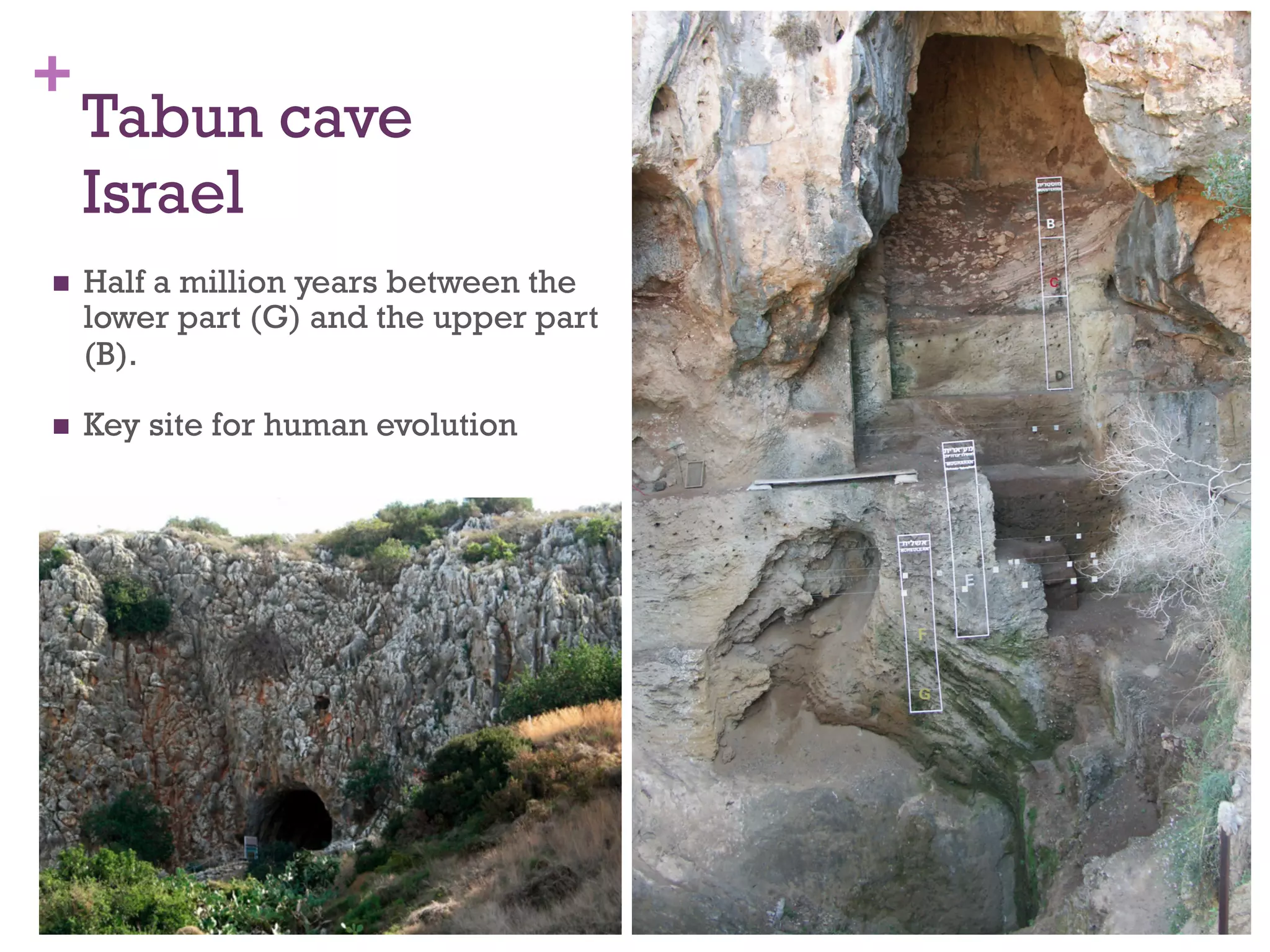
Tabun cave 
Israel 
n Half a million years between the 
lower part (G) and the upper part 
(B). 
n Key site for human evolution
+ 
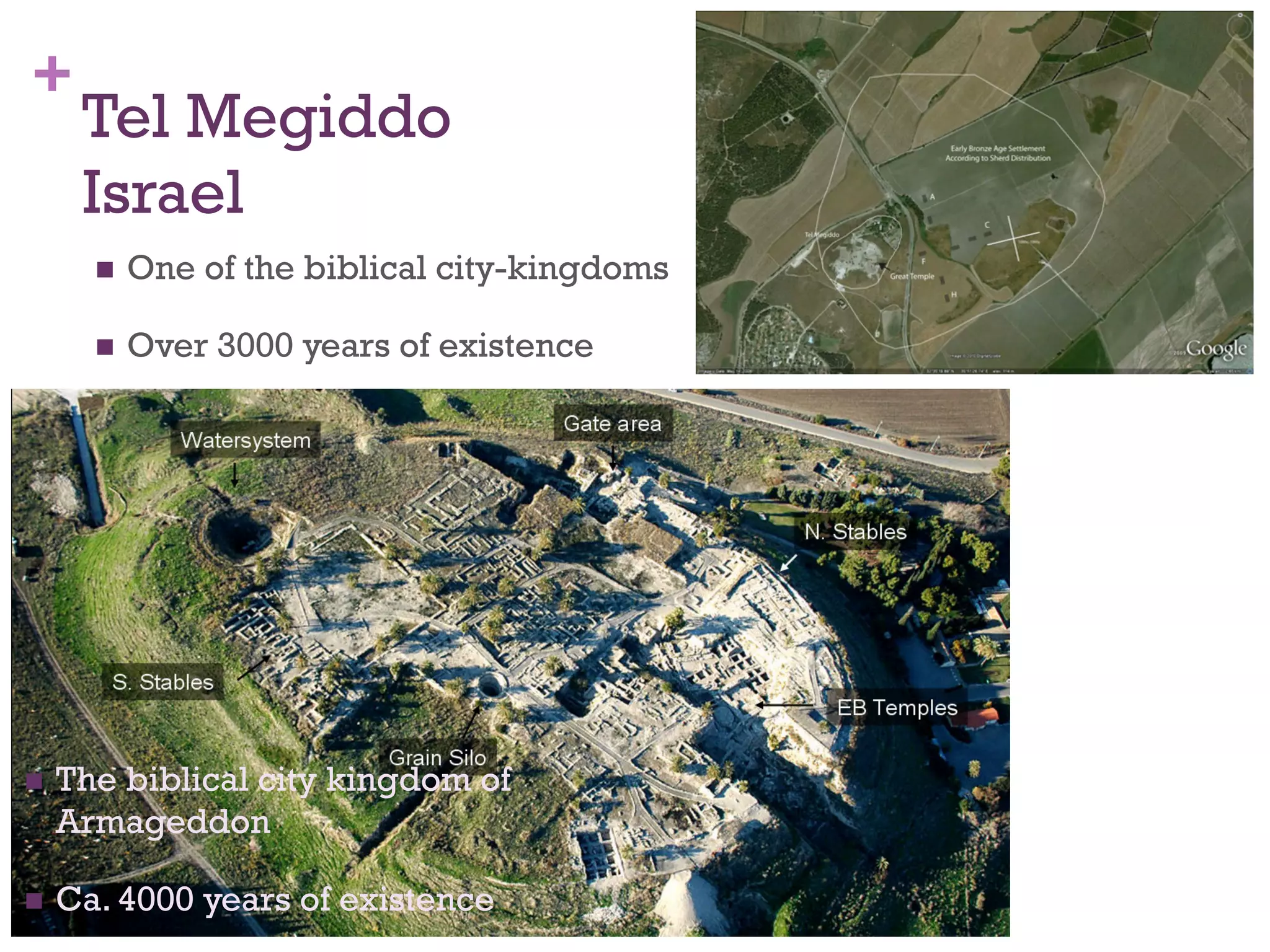
Tel Megiddo 
Israel 
n One of the biblical city-kingdoms 
n Over 3000 years of existence 
n The biblical city kingdom of 
Armageddon 
n Ca. 4000 years of existence
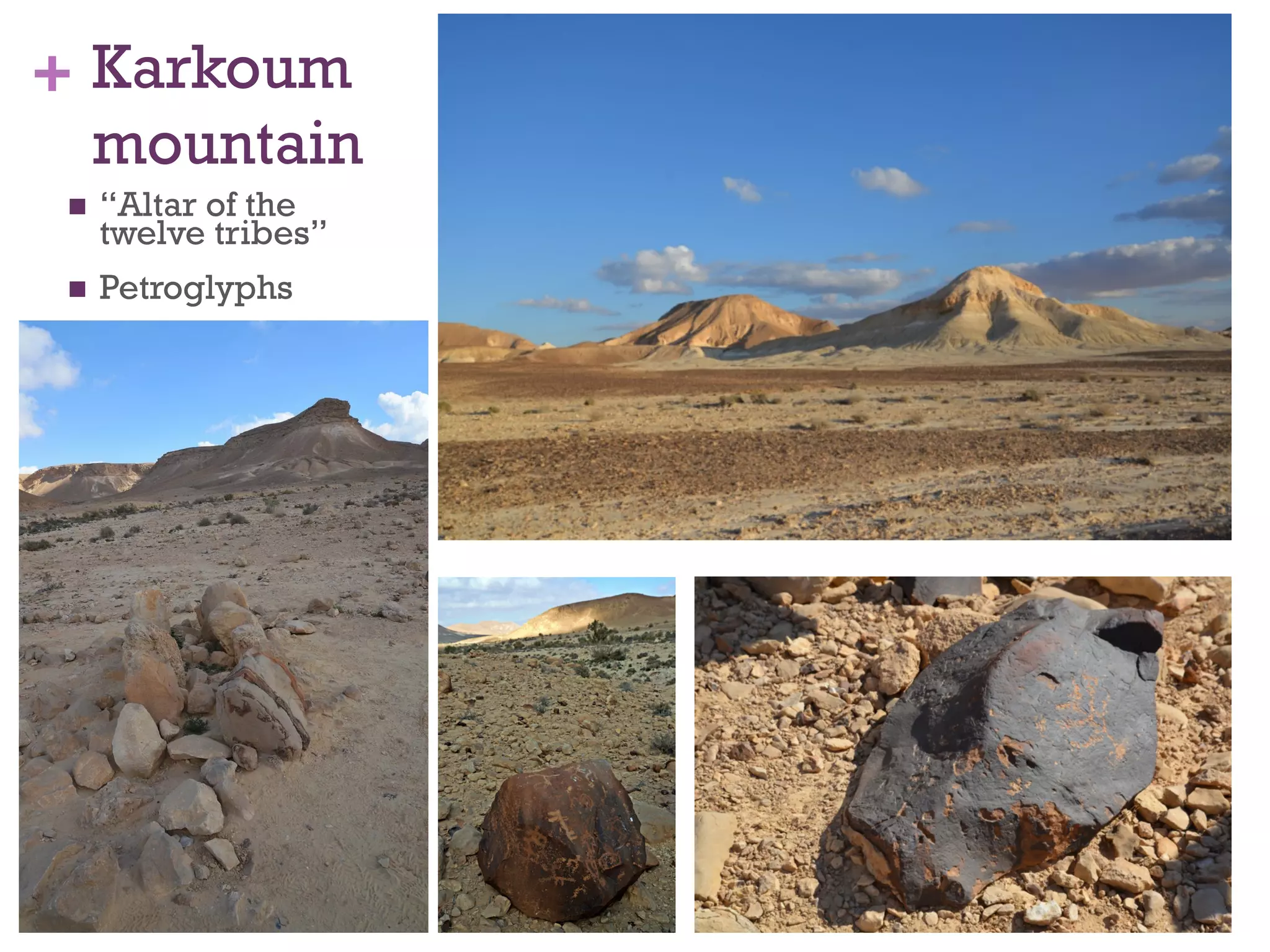
+ Karkoum 
mountain 
n “Altar of the 
twelve tribes” 
n Petroglyphs
+ 
Identity conditions 
n Defined by the nature (causality) of the relations: 
n Objects – context (observation) 
n Objects – objects (observation) 
n Human activity – objects (inference) 
n Association of activities (inference) 
n Delineation of spatial borders 
n declarative(end of resources for excavation, permission limitations, etc.) 
n external constraints (e.g. a road, a building…) 
n phenomenological/observable (distribution of remains) 
n guesstimated – input from other disciplines 
n Delineation of temporal borders 
n Crisp end – event (excavation), blur beginnings 
n Reference to other disciplines (e.g. history, physics / chemistry)
+ 
4 alternatives of substance 
n Place 
n Defined by declaration /observation /past activity 
n As diachronically existing 
n Matter 
n Concentration of a class of remains 
n As being stable/at rest for “a longer time” 
n Spatially bound activity of the past 
n An Information Object of scientific explanation
+ 
Identity criteria – archaeological 
sites 
n What 
n Physical space 
n Social space 
n When 
n Subject to identification by archaeologist (?) 
n Comes into existence once an archaeological activity starts (survey, 
excavation) 
n Temporal boundaries (usually a blur beginning – terminated by the modern 
process of archaeological excavation). 
n Who 
n Exclusiveness 
n One / multiple manifestations of human activities 
n Mixture of anthropogenic / natural events 
n E.g. stratigraphy: tower built, abandoned, natural decay, build a cemetery.
+ 
Working definition 
Archaeological site 
n The goodness-of-fit between one or a series of (un)related 
past activities and the subsequent material culture produced 
and their manifestation in the present, as recorded during an 
archaeological investigation (e.g. excavation). 
On-going work: 
n Who are the actors involved (in the past and in the present) 
n Where is it manifested? 
n What knowledge is it based on?
+ 
Example – defining archaeological 
sites following an excavation 
n Decision of excavation spatial boundary 
n Following an observation (e.g. change in sediment, anthropogenic 
feature, etc.) 
n Following an hypothesis (e.g. looking for the wall’s foundation) 
n Following an interpretation (e.g. this is the floor of a room)
+ 
Information integration 
n Structure of information 
n Inner representations 
n Conceptualization 
n Identity and unity criteria (archaeological site) 
n Formal ontologies – CIDOC-CRM 
n Explicit representation 
n Decoding information 
n Understand epistemology of archaeology 
n Representation of experts’ judgment
+ 
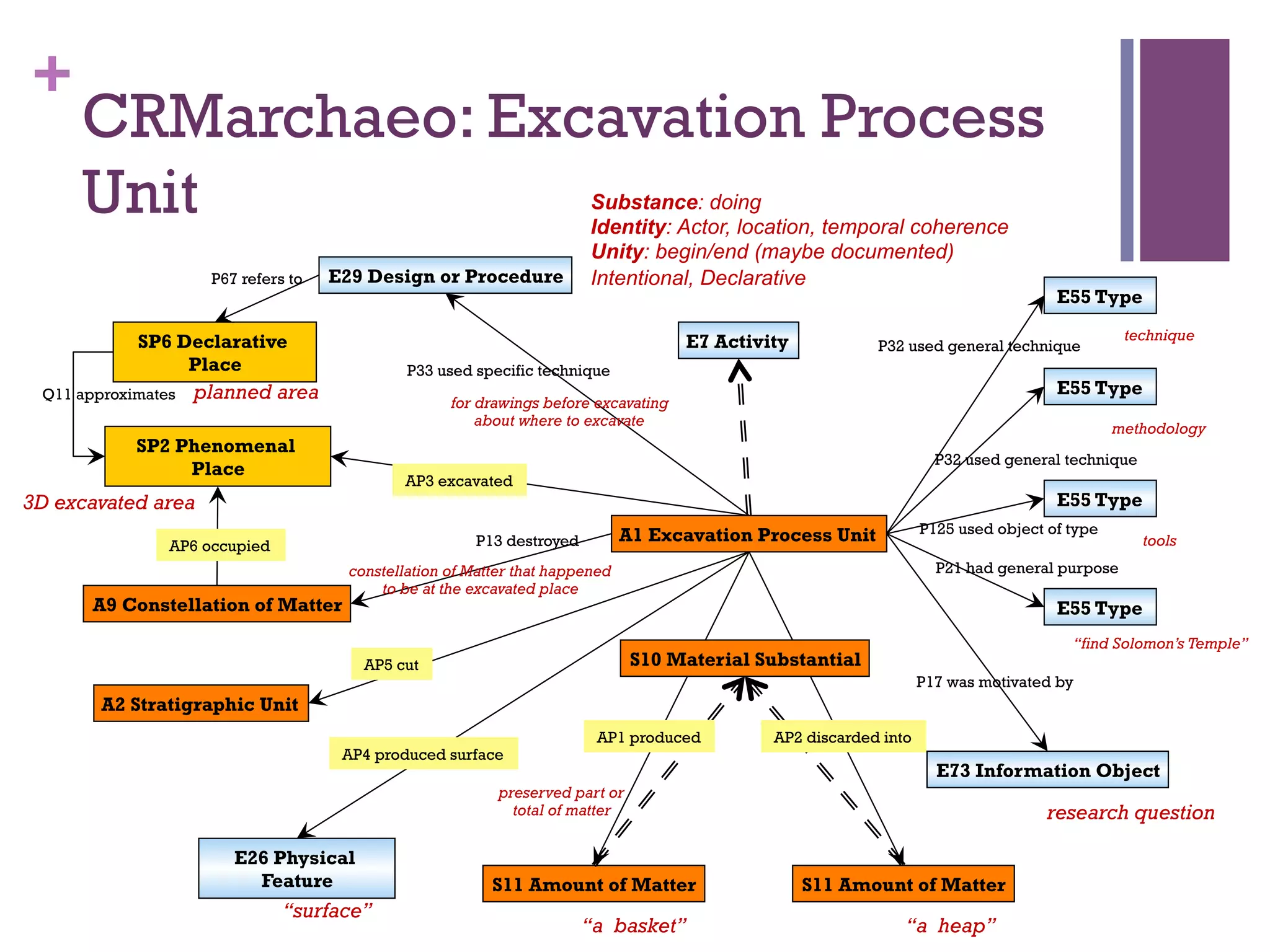
CRMarchaeo: Excavation Process 
Unit 
E7 Activity 
planned area for drawings before excavating 
A1 Excavation Process Unit 
E29 Design or Procedure 
P33 used specific technique 
AP1 produced AP2 discarded into 
preserved part or 
total of matter 
S11 Amount of Matter 
P32 used general technique 
technique 
E55 Type 
methodology 
P32 used general technique 
E55 Type 
P125 used object of type 
P21 had general purpose 
P17 was motivated by 
E73 Information Object 
P13 destroyed 
E26 Physical 
Feature 
AP4 produced surface 
Substance: doing 
Identity: Actor, location, temporal coherence 
Unity: begin/end (maybe documented) 
Intentional, Declarative 
E55 Type 
SP2 Phenomenal 
Place 
AP3 excavated 
SP6 Declarative 
Place 
S11 Amount of Matter 
“find Solomon’s Temple” 
“a basket” “a heap” 
Q11 approximates 
P67 refers to 
A9 Constellation of Matter 
A2 Stratigraphic Unit 
AP5 cut 
tools 
research question 
S10 Material Substantial 
“surface” 
3D excavated area 
about where to excavate 
constellation of Matter that happened 
to be at the excavated place 
AP6 occupied 
E55 Type
WP 
14 
Addressing 
Complexity 
CRMarchaeo: 
Modelling 
Context, 
StraHgraphic 
Unit, 
Excavated 
MaKer 
Mar$n 
Doerr, 
Sorin 
Hermon, 
Gerald 
Hiebel 
, 
Athina 
Kritsotaki, 
Anja 
Masur, 
Keith 
May, 
Wolfgang 
Smidle, 
Maria 
Theodoridou, 
Despoina 
Tsiafaki 
Plakias, 
19-­‐22 
August 
2013 
ARIADNE 
is 
funded 
by 
the 
European 
Commission's 
Seventh 
Framework 
Programme

Identity criteria and fundamental concepts in archaeology: the case of the archaeological "site"

  • 1.
    + Identity criteriaand fundamental concepts in archaeology The case of the “archaeological site” Sorin Hermon STARC The Cyprus Institute Franco Niccolucci PIN University of Florence Martin Doerr ICS FORTH Gerald Hiebel ICS FORTH ARIADNE is funded by the European Commission's Seventh Framework Programme
  • 2.
    + Aim ofresearch n Formally represent the “reasoning process” in archaeology n Information - the pattern of organization of physical or digital objects, conceptual structures, and semantic relationships. n Source n Organization n Representation and interaction n Identification of fundamental concepts in archaeology n Definition of their identity criteria n Representation of the relation between such concepts n Impact of informatics on the archaeological discipline (enablers and constraints). n Intellectual need for transparency of research (e.g. data provenance/quality and formal knowledge representation).
  • 3.
    + Aim ofresearch n There are more than one useful senses of the term “site” n Different definitions have different “fitness for purpose” n Are there few “core” senses ? n Can we describe their identity criteria, such that a particular sense can be used in an information system unambiguously? n What is the purpose of each sense, and how do we formally represent this?
  • 4.
    + Fundamental conceptsin Archaeology n Archaeological site n Archaeological research – excavations n Regional research – surveys n Management – administrative (not addressed in this paper) n Basic research unit n Most common term of discussion among archaeologists and beyond n Any discussion in archaeology eventually involves the term
  • 5.
    + Archaeological site common definitions n …the smallest unit of space dealt with by the archaeologist… it be fairly continuously covered by the remains of former occupation, and the general idea is that these pertain to a single unit of settlement… the basic unit for stratigraphic studies… It is in effect the minimum operational unit of geographic spaces. n Willey,G.R. and Phillips,P. 1958. Method and theory in American Archaeology. Chicago: University of Chicago Press. n A site is any place, large or small, where there are to be found traces of ancient occupation or activity. n Hole,F. and Heizer,R.F. 1973. An introduction to prehistoric archaeology. New York: Holt, Rinehart and Winston.
  • 6.
    + Archaeological site common definitions n …a spatial cluster of cultural features or items, or both… The formal characteristics of a site are defined by its formal content and the spatial and associational structure of the population’s cultural items and features present. n Binford ,L. R. 1964. A Consideration of Archaeological Research Design. American Antiquity, 29.4 :425-441. n …provides the framework for recording artifact provenience and usually serves as a sampling frame at some level in most fieldwork and, by default serves as the unit of artifact association. Site is usually depicted as a basic unit of archaeology. n Dunnell,R.C. 1992. The Notion Site. In Rossignol,J. and Wandsnider,L. editors, Space, Time and Archaeological Landscapes, p.21-41.New York: Plenum Press. n A distinct spatial clustering of artifacts, features, structures, and organic and environmental remains—the residue of human activity. n Renfrew, C.,, P. G. Bahn. Archaeology: Theories, methods, and practice. Thames and Hudson, 1991.
  • 7.
    + Archaeological site common definitions n …any place where object, features, or ecofacts manufactures or modified by human beings are found… Any material remains of the past which offer potential for archaeological investigation and analysis as a means of contributing to the understanding of past human communities. n Darvil, T. 2008.The Concise Oxford Dictionary of Archaeology Online. Oxford New York: Oxford University Press. n …activity areas and rubbish. That is where people have done things in the past and left some residue of having done something… n Drewett, P.L. 2011. Field Archaeology. An Introduction. Oxon: Routledge. n An archaeological site is a place … in which evidence of past activity is preserved … and which has been, or may be, investigated using the discipline of archaeology and represents a part of the archaeological record. n http://en.wikipedia.org
  • 8.
    + Archaeological sites n basic necessary characteristics: n defined following an archaeological investigation (survey or excavation) n must have some remains (features, e.g. a fountain, or artifacts, e.g. arrowheads). n remains have to be "clustered” following an anthropogenic activity. n deliberate human activity at the site, which left the identified remains. n Ambiguities n spatial boundaries delineation - along identified formal cluster of finds n temporal boundaries limitations – none n definition does not deal with variations of the above, such as: same human activity (of one cultural group) repeated over several episodes, different human activities (of a single cultural group) in a single time period, different cultural groups doing the same activity in the same time, or in different time periods. n does the "archaeological site" represent "a single unit of settlement", or "the minimum geographic unit"?
  • 9.
    + Tabun cave Israel n Half a million years between the lower part (G) and the upper part (B). n Key site for human evolution
  • 10.
    + Tel Megiddo Israel n One of the biblical city-kingdoms n Over 3000 years of existence n The biblical city kingdom of Armageddon n Ca. 4000 years of existence
  • 11.
    + Karkoum mountain n “Altar of the twelve tribes” n Petroglyphs
  • 12.
    + Identity conditions n Defined by the nature (causality) of the relations: n Objects – context (observation) n Objects – objects (observation) n Human activity – objects (inference) n Association of activities (inference) n Delineation of spatial borders n declarative(end of resources for excavation, permission limitations, etc.) n external constraints (e.g. a road, a building…) n phenomenological/observable (distribution of remains) n guesstimated – input from other disciplines n Delineation of temporal borders n Crisp end – event (excavation), blur beginnings n Reference to other disciplines (e.g. history, physics / chemistry)
  • 13.
    + 4 alternativesof substance n Place n Defined by declaration /observation /past activity n As diachronically existing n Matter n Concentration of a class of remains n As being stable/at rest for “a longer time” n Spatially bound activity of the past n An Information Object of scientific explanation
  • 14.
    + Identity criteria– archaeological sites n What n Physical space n Social space n When n Subject to identification by archaeologist (?) n Comes into existence once an archaeological activity starts (survey, excavation) n Temporal boundaries (usually a blur beginning – terminated by the modern process of archaeological excavation). n Who n Exclusiveness n One / multiple manifestations of human activities n Mixture of anthropogenic / natural events n E.g. stratigraphy: tower built, abandoned, natural decay, build a cemetery.
  • 15.
    + Working definition Archaeological site n The goodness-of-fit between one or a series of (un)related past activities and the subsequent material culture produced and their manifestation in the present, as recorded during an archaeological investigation (e.g. excavation). On-going work: n Who are the actors involved (in the past and in the present) n Where is it manifested? n What knowledge is it based on?
  • 16.
    + Example –defining archaeological sites following an excavation n Decision of excavation spatial boundary n Following an observation (e.g. change in sediment, anthropogenic feature, etc.) n Following an hypothesis (e.g. looking for the wall’s foundation) n Following an interpretation (e.g. this is the floor of a room)
  • 17.
    + Information integration n Structure of information n Inner representations n Conceptualization n Identity and unity criteria (archaeological site) n Formal ontologies – CIDOC-CRM n Explicit representation n Decoding information n Understand epistemology of archaeology n Representation of experts’ judgment
  • 18.
    + CRMarchaeo: ExcavationProcess Unit E7 Activity planned area for drawings before excavating A1 Excavation Process Unit E29 Design or Procedure P33 used specific technique AP1 produced AP2 discarded into preserved part or total of matter S11 Amount of Matter P32 used general technique technique E55 Type methodology P32 used general technique E55 Type P125 used object of type P21 had general purpose P17 was motivated by E73 Information Object P13 destroyed E26 Physical Feature AP4 produced surface Substance: doing Identity: Actor, location, temporal coherence Unity: begin/end (maybe documented) Intentional, Declarative E55 Type SP2 Phenomenal Place AP3 excavated SP6 Declarative Place S11 Amount of Matter “find Solomon’s Temple” “a basket” “a heap” Q11 approximates P67 refers to A9 Constellation of Matter A2 Stratigraphic Unit AP5 cut tools research question S10 Material Substantial “surface” 3D excavated area about where to excavate constellation of Matter that happened to be at the excavated place AP6 occupied E55 Type
  • 19.
    WP 14 Addressing Complexity CRMarchaeo: Modelling Context, StraHgraphic Unit, Excavated MaKer Mar$n Doerr, Sorin Hermon, Gerald Hiebel , Athina Kritsotaki, Anja Masur, Keith May, Wolfgang Smidle, Maria Theodoridou, Despoina Tsiafaki Plakias, 19-­‐22 August 2013 ARIADNE is funded by the European Commission's Seventh Framework Programme